What Is AI Search Visibility? The Complete Explainer for Business Owners
When someone asks ChatGPT which accounting firm to hire, which CRM to use, or which contractor to call, your website either appears in that answer or it doesn’t. That’s AI search visibility. It has nothing to do with where you rank in Google. It’s a different mechanism entirely, with different signals, different optimization strategies, and a different competitive landscape.
Most businesses have spent years building Google rankings and have done almost nothing for AI visibility. That gap is closing, but not evenly. The sites being cited in AI answers right now are the ones that understood this shift early and built the right infrastructure. This post explains what AI search visibility is, how it works, and what actually determines whether your brand shows up.
What AI Search Visibility Means
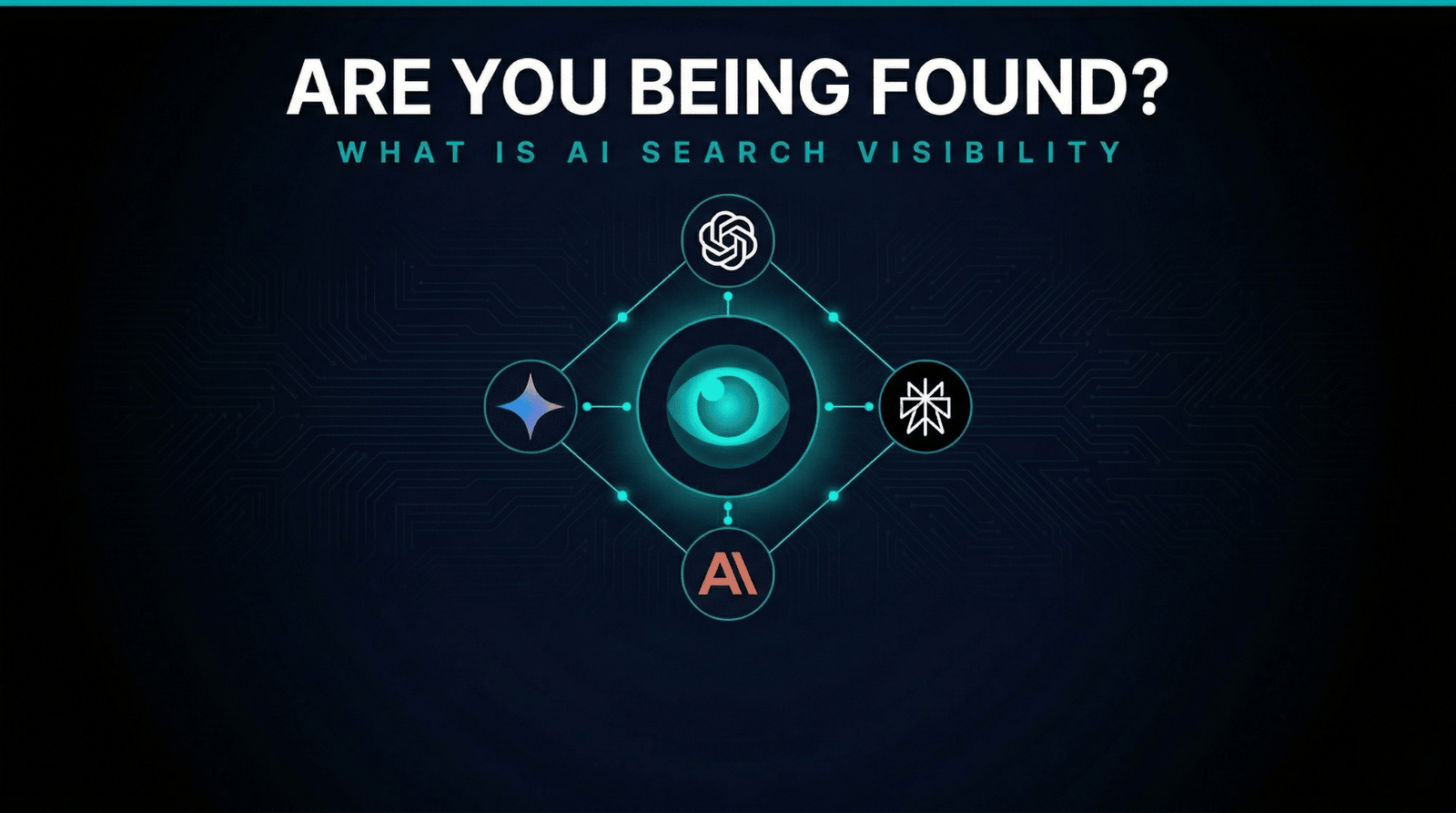
AI search visibility is the degree to which your brand, website, and content appear in answers generated by AI systems, specifically ChatGPT, Google Gemini, Perplexity, Microsoft Copilot, and Claude. When a user asks one of these systems a question relevant to your business, AI visibility determines whether you’re cited as a source, recommended as a solution, or invisible entirely.
The key distinction from traditional search visibility: AI systems don’t return a ranked list of links for the user to click through. They generate a synthesized answer, often without the user ever visiting a website. Your content either feeds that synthesis or it doesn’t contribute to it. This is why standard SEO alone is no longer sufficient.
How AI Search Works (And Why It’s Different from Google)
Traditional search engines like Google use a crawl-index-rank system. They find pages, add them to an index, and rank them against each other based on hundreds of signals: keyword relevance, backlinks, domain authority, page experience. The user sees a list. They click. They arrive.
AI search systems work differently. They don’t rank pages against each other. They synthesize answers from sources they’ve already evaluated as credible and relevant. ChatGPT, Gemini, and Perplexity each do this slightly differently, but the underlying logic is similar: they pull from content that is clearly structured, demonstrably authoritative, and easy to extract key facts from.
The practical consequence is that two websites covering the same topic with roughly equal Google rankings can have completely different AI visibility. The one with clear heading hierarchy, FAQ content, schema markup, strong authorship signals, and verified presence in Bing’s index gets cited. The one without doesn’t, regardless of how long it’s been around or how many backlinks it has.
The Five AI Platforms That Matter Most
ChatGPT (OpenAI)
The largest AI assistant by usage, with roughly 900 million weekly active users as of early 2026. ChatGPT uses Bing’s index as its primary real-time retrieval layer, supplemented by OpenAI’s own crawler, which means Bing Webmaster Tools verification is the single most direct prerequisite for ChatGPT visibility. Sites not indexed in Bing can’t reliably appear in ChatGPT answers, regardless of Google ranking.
Google Gemini and AI Overviews
Google’s AI layer is increasingly visible at the top of search results. AI Overviews synthesize answers from indexed content and display them before traditional blue links. Google’s systems evaluate structured data, E-E-A-T signals (Experience, Expertise, Authoritativeness, Trustworthiness), and content clarity. Sites already well-optimized for Google have a structural advantage here, but schema markup and content organization remain critical differentiators.
Perplexity
A search-native AI system that pulls sources directly and displays them as citations alongside answers. Perplexity is heavily used by researchers, analysts, and professionals, making it particularly valuable for B2B businesses. It indexes the open web and tends to favor sources with clear topical authority, well-structured content, and explicit citations or factual density.
Microsoft Copilot
Powered by Bing and OpenAI, Copilot is deeply integrated into Microsoft’s product suite: Windows, Office, Edge, and enterprise tools. It draws from Bing’s index, making the same Bing optimization that helps ChatGPT visibility directly applicable here. For B2B companies whose customers use Microsoft products, Copilot visibility is often underestimated in importance.
Claude (Anthropic)
Increasingly used for research and professional tasks, Claude runs its own web search powered by Brave Search. Like the other systems, it evaluates source credibility, content structure, and topical relevance. Claude’s user base skews toward technical and professional audiences, another reason B2B brands benefit disproportionately from broader AI visibility.
What Actually Determines AI Search Visibility
The signals AI systems evaluate are different from traditional SEO signals, though some overlap. Here’s what matters most:
| Signal | What It Means | Why It Matters for AI |
|---|---|---|
| Content Structure | Clear H1/H2/H3 hierarchy, short paragraphs, lists, tables | AI systems extract from structure, not keywords. Well-organized content is easier to parse and cite. |
| Schema Markup | FAQ, Article, Service, Organization, and other structured data types | Schema tells AI systems what your content is, not just what it says. FAQ schema maps directly to how AI systems present answers. |
| Bing Index Presence | Verification in Bing Webmaster Tools, sitemap submitted, pages indexed | ChatGPT and Copilot use Bing’s index. If you’re not there, you can’t appear in real-time queries regardless of Google ranking. |
| Authorship Signals | Visible author bios, credentials, linked profiles, consistent authorship across posts | AI systems evaluate who created content and whether that person has real, verifiable expertise on the topic. |
| Entity Clarity | Clear, consistent description of who you are, what you do, where you operate | AI systems are entity-based. They need to understand the relationships between your business, your services, your location, and your authority, not just find keywords. |
| llms.txt | A file that guides AI systems toward your most important pages | Similar to robots.txt but designed for language models. Early adoption is a low-competition signal most sites haven’t added yet. |
| Site Performance | Page load speed, Core Web Vitals, mobile optimization | Fast sites are crawled more frequently, meaning new content reaches AI indexes sooner. Speed is also a proxy for source quality. |
| Off-Site Authority | Mentions, citations, and links from other credible sources | Brand mentions across the web reinforce that your business is a real, recognized entity. AI systems weight this as a trust signal. |
AI Search Visibility vs Traditional SEO: The Key Differences
Traditional SEO and AI search visibility share some signals (site speed, structured content, credibility), but the objectives and measurement are fundamentally different.
| Dimension | Traditional SEO | AI Search Visibility |
|---|---|---|
| Goal | Rank in position 1-10 | Be cited in synthesized answers |
| Primary signal | Keywords and backlinks | Content structure and entity clarity |
| User behavior | Click from a list of results | Receive an AI-generated answer (often without clicking) |
| Domain authority value | High, older domains with many links outrank newer ones | Lower, structure and clarity can outperform domain age |
| Schema markup | Helpful for rich results | Critical for citation probability |
| Measurement | Rankings, clicks, organic traffic | AI citations, mention tracking, AI-driven traffic |
| Competitive window | Compressed, well-established players dominate | Open, most businesses haven’t started yet |
Why the Window Is Open Right Now
Traditional SEO is a mature competitive landscape. Most industries have entrenched players who have been building domain authority, acquiring backlinks, and publishing content for years. Breaking into the top positions for competitive keywords takes significant time and resources.
AI search visibility is different. The current citation landscape reflects early movers, businesses that happened to have well-structured content when AI systems began indexing at scale, not necessarily businesses with the largest budgets or longest histories. A B2B company with a two-year-old website can build AI visibility faster than it can build Google rankings, because AI citation is driven by structure and clarity rather than by accumulated domain authority.
That window won’t stay open indefinitely. As more businesses understand AI visibility and begin optimizing for it, the bar will rise. The sites investing in this now are building the kind of compounding structural advantage that becomes harder to displace over time.
What Industry You’re In Determines How Urgent This Is
Not all industries have the same AI search exposure. The sectors where AI visibility matters most right now:
- B2B services: buyers increasingly ask AI systems which agencies, consultants, or vendors to hire. If your competitors are being cited and you aren’t, deals are going elsewhere.
- Professional services: legal, financial, accounting, and healthcare practices are all seeing AI systems field the questions they used to receive directly. Citation in those answers is direct pipeline.
- Software and SaaS: “What’s the best tool for X?” is among the most common AI query types. Product pages and comparison content with proper structure are being cited constantly.
- E-commerce: Shopify’s Agentic Storefronts went live in March 2026, putting product discovery directly inside AI interfaces. The stores being recommended are the ones with structured product data.
- Local services: AI systems increasingly recommend local contractors, specialists, and service providers. Structured local business schema and Bing/Google Maps presence are the key signals.
The Terms You’ll Encounter
The field is young and terminology is still standardizing. Here are the terms in common use and what they mean:
- GEO (Generative Engine Optimization): the practice of optimizing content and site structure so AI systems are more likely to cite your content in generated answers. The AI-search equivalent of SEO.
- AEO (Answer Engine Optimization): a closely related term focused specifically on appearing in AI-generated answers, sometimes used interchangeably with GEO.
- AI Visibility: broader term covering how consistently and accurately your brand, website, and content appear across AI platforms.
- AI Search: queries conducted through AI-powered interfaces (ChatGPT, Gemini, Perplexity, Copilot) rather than traditional search engines.
- Entity optimization: the process of making your business clearly identifiable as a specific, real entity, with a name, location, services, and context that AI systems can accurately represent.
- AI citation: a specific instance of an AI system referencing or recommending your site in a generated answer.
Where to Start
The three highest-impact starting points for most businesses:
- Verify in Bing Webmaster Tools. This is the fastest, highest-impact move available. ChatGPT and Copilot both use Bing’s index for real-time queries. If your site isn’t verified there, it has a direct gap in AI visibility that Google Search Console doesn’t fix. It takes about 5 minutes if you already have Google Search Console set up.
- Add FAQ schema to your most important pages. FAQ content maps precisely to how AI systems structure answers: question-and-answer pairs are among the most extractable content formats available. Every homepage, service page, and key blog post should have an FAQ section with schema markup.
- Run an AI Visibility Report. Before optimizing, understand where you currently stand. The Rivetline AI Visibility Report shows how ChatGPT, Gemini, and Perplexity currently see your brand and identifies your specific gaps.
Platform-specific guidance, for WordPress, Shopify, and Wix, is available through Rivetline’s AI Visibility service pages. The underlying principles are the same across all platforms; the implementation differs by CMS.
Frequently Asked Questions
What is AI search visibility?
AI search visibility is how often and how accurately your brand appears in answers generated by AI systems like ChatGPT, Google Gemini, Perplexity, and Microsoft Copilot. It’s determined by content structure, schema markup, entity clarity, authorship signals, and site performance, not keyword density or backlink counts. A business with high AI search visibility gets cited and recommended by AI systems when users ask relevant questions.
Is AI search visibility the same as SEO?
No. They share some signals (site speed, structured content, authorship), but the objectives and primary signals are different. Traditional SEO optimizes for search engine rankings. AI visibility optimizes for citation in generated answers. A page with perfect keyword density and strong backlinks may still have poor AI visibility if it lacks schema markup, clear structure, and entity definition. GEO (Generative Engine Optimization) is the emerging term for the AI-focused discipline.
How do I know if my business appears in ChatGPT answers?
The most direct method is to ask ChatGPT questions your ideal customer would ask and see whether your business appears in the answer. For systematic tracking, tools like Otterly run AI queries across your target topics and report which sources are cited, including whether your site appears and how it’s described. Bing Webmaster Tools also provides an AI Performance report showing Copilot citation data. Run the Rivetline AI Visibility Report for a structured snapshot of your current AI citation coverage.
Does Google still matter if AI search is growing?
Yes. Google still drives the majority of web traffic for most businesses and that won’t change overnight. The important framing is that AI search and traditional SEO aren’t competing priorities. Many of the signals that improve AI visibility (structured content, schema, fast load times) also improve Google rankings. Building for AI visibility tends to make sites better across every channel. The risk isn’t abandoning SEO for AI. It’s optimizing only for Google while a growing share of discovery happens in AI interfaces.
How long does it take to see results from AI visibility optimization?
Some improvements, like Bing Webmaster Tools verification, can have an impact within weeks as your content gets re-crawled. Schema markup and content restructuring typically show citation impact within 60 to 90 days. Building the full foundation (entity clarity, off-site authority signals, comprehensive schema coverage) is a 6-month process. AI citation landscapes also shift over time as AI systems update their evaluation criteria, which is why ongoing monitoring and optimization matter beyond the initial setup.
Is AI visibility relevant for small businesses or just large ones?
It’s particularly relevant for small and mid-sized businesses because the competitive dynamic is more favorable. In traditional SEO, larger brands have a structural advantage through domain authority and backlink volume that’s hard to overcome. In AI search, structure and content clarity matter more than domain age or budget, meaning a smaller business with well-organized, credible content can appear alongside (or ahead of) larger competitors for specific citation opportunities. The early-mover advantage is more accessible than it is in traditional search.
What is GEO and how does it relate to AI visibility?
GEO (Generative Engine Optimization) is the emerging discipline of optimizing content and website infrastructure specifically for AI-generated answers. It’s to AI search what SEO is to traditional search. AEO (Answer Engine Optimization) is a related term used interchangeably by some practitioners. All three terms (AI visibility, GEO, and AEO) refer to roughly the same set of practices: structuring content so AI systems can extract, understand, and cite it accurately.
What does an AI Visibility System engagement involve?
Rivetline’s AI Visibility System is a 6-month structured engagement covering entity mapping, schema implementation, content architecture, Bing and AI index setup, authorship and credibility signals, off-site authority building, and monthly measurement. It’s platform-specific, built differently for WordPress, Shopify, and Wix, and includes an AI Visibility Playbook delivered at Month 6 with a prioritized set of ongoing optimization actions. Details are on the AI Visibility System page.
The Bottom Line
AI search visibility is not a future consideration. ChatGPT has roughly 900 million weekly users. Perplexity is fielding billions of queries. Google’s AI Overviews appear at the top of results for a growing share of searches. Businesses are already being recommended (or passed over) in AI answers every day. The question isn’t whether this matters. It’s whether your brand is showing up or your competitors are.
The infrastructure required to show up isn’t complicated. It requires structured content, schema markup, clear authorship, and presence in the right indexes. Most businesses have done none of it. That gap is both the risk and the opportunity.
Rivetline builds AI Visibility Systems for WordPress, Shopify, and Wix. This is the Foundation tier of our model, the layer that makes your brand legible to AI search and citable in AI answers. Run the free AI Visibility Report to see how ChatGPT, Gemini, and Perplexity currently see your brand, or book a discovery call to talk through your specific situation.

Chris Breikss is the founder of Rivetline and a WordPress and AI search optimization specialist with over 27 years of experience in SEO and digital strategy. He helps businesses improve visibility in platforms like ChatGPT and Perplexity by structuring websites for clarity, authority, and performance, while also building systems for speed-to-lead optimization, CRM integration, and AI-powered SDR automation.