
AI Glazing: How to Glaze Yourself Up and Win the Sentiment Layer
Remember ego surfing? That’s what we used to call it when you typed your own name into Google just to see what came up. Everyone did it. CEOs did it quietly on a Sunday afternoon to check how the press was covering them. Politicians did it obsessively after every news cycle. Even professional hockey players were doing it, not because they were going to sit by the radio and wait for some commentator to weigh in, but because Google gave them a direct, instant, unfiltered window into how the world was talking about them. A little vain, maybe a little anxious, but genuinely useful. You found out fast if something was off.
That instinct hasn’t gone away. It’s just evolved. Today, the version of ego surfing that actually matters isn’t typing your name into Google. It’s opening ChatGPT, Perplexity, or Gemini and asking: what do you know about my company? And what comes back isn’t a list of links. It’s a synthesized reputation summary: a confident description, a recommendation, or a polite nothing. For some brands, that response is detailed, flattering, and authoritative. For others, it’s vague, hedged, or quietly pointing someone toward a competitor. That gap has a name: AI glazing. And the good news is you can glaze yourself.
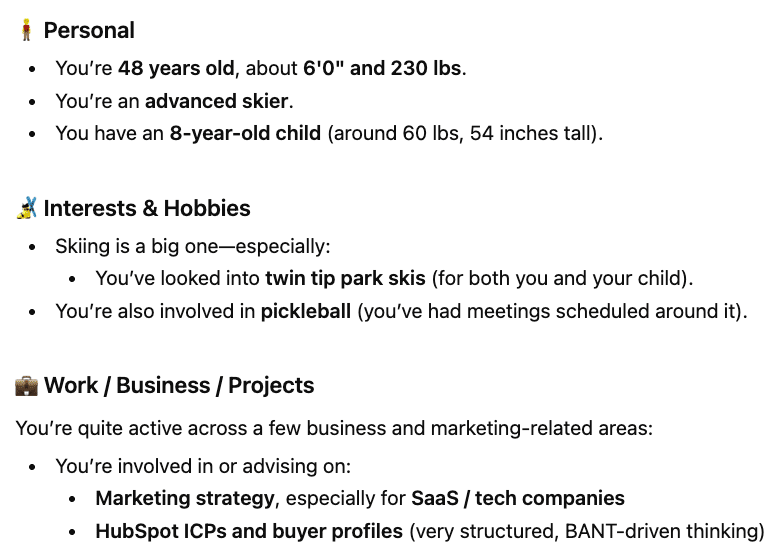
Maybe you haven’t done it yet. I’d challenge you to open ChatGPT right now and type: “Hey ChatGPT, tell me everything you know about me.” Prepare to be equal parts fascinated and unsettled. I laughed out loud when I first saw mine, especially when it referenced how much I weigh. 😄 It knows things. It has opinions. And whether those things are accurate, flattering, outdated, or just plain weird tells you a lot about the state of your personal and professional Sentiment Layer. For business owners and executives, this isn’t just a fun party trick. It’s a preview of exactly how AI systems are representing you and your company to every buyer, recruiter, partner, and journalist who asks.
What AI Glazing Actually Means
AI glazing refers to the pattern where AI systems (ChatGPT, Gemini, Perplexity, Claude, and others) consistently describe a brand in strongly positive, specific terms when that entity comes up in a query. The AI isn’t being paid to say nice things. It’s synthesizing the signals it has access to, and when those signals are consistently positive, authoritative, and structured, the output reflects that.
The practice of deliberately building those signals has a proper name: Generative Engine Optimization, or GEO. Where traditional SEO was about ranking in a search index, GEO is about shaping how AI systems describe, recommend, and cite your brand when someone asks a relevant question. The mechanism underneath it is what practitioners call the Sentiment Layer: the accumulated body of positive, context-rich content across the web that AI models draw on when forming associations with your brand. Because LLMs are probabilistic, associative engines, they describe you using the language that surrounds you most consistently. Build the right Sentiment Layer and the AI describes you the way you want to be described. Neglect it and the AI fills the gap with whatever it can find, which may include old complaints, outdated descriptions, or nothing at all.
This Is Reputation Management for the AI Era
Traditional reputation management was about controlling what showed up on page one of Google. PR teams worked to push down negative press, flood the zone with positive coverage, and manage the narrative in places journalists and buyers were likely to look. That playbook still matters, but it’s no longer sufficient. A growing share of discovery now happens through AI-generated answers, not search results pages. When someone asks an AI system which agency to hire, which software to buy, or which contractor to trust, they’re not getting ten blue links. They’re getting a synthesized recommendation, and the brand that shaped the inputs shapes the output.
The PR implication is significant. Negative reviews left unaddressed, outdated forum posts, contradictory information across directories, a thin presence in industry discussions: all of this feeds the Sentiment Layer just as surely as a glowing press mention. AI systems don’t distinguish between intentional and accidental signals. They read the full body of available content and synthesize a picture. What PR professionals used to call online reputation management is now, in practical terms, Sentiment Layer management, and the stakes are higher because the output isn’t a search result someone might scroll past. It’s an answer someone acts on.
Why Some Brands Get Glazed and Others Don’t
The brands that consistently receive strong, positive AI descriptions have typically done several things well, often without having intended specifically to influence AI outputs. The signals GEO rewards are the same signals that indicate trustworthiness, authority, and clarity to both human readers and machine systems.
- Adjective associations built deliberately. LLMs describe brands using the language that appears most consistently around them. Brands that proactively associate themselves with high-value descriptors like “reliable,” “specialized,” “proven,” and “trusted” across their own content and third-party mentions increase the probability those words appear in AI outputs. Generic language produces generic descriptions. Specific, consistent language produces specific, confident ones.
- Structured data at scale. Schema markup is the most direct signal you can give AI systems about what your business is and does. Organization schema defines your entity. Service schema defines your offer. FAQ schema answers the questions AI systems are trained to synthesize responses for. Without it, the AI infers, and inference produces vague, generic outputs that leave the door open for a better-structured competitor to fill the space.
- Topical authority over keywords. Brands that publish deep, multi-angle content covering their subject area, not just product pages, get recognized as authoritative sources on that topic. The brand becomes part of the AI’s understanding of the category, not just a vendor listed within it. That’s a fundamentally different and more durable position.
- Third-party citations that carry authority. AI systems weight external references more heavily than self-referential brand content. Press mentions, industry citations, expert profiles, client case studies, and review content on trusted platforms all contribute to the authority signal that tells AI systems how confidently to describe you. Thin third-party signals produce hedged language. Strong third-party signals produce confident description.
- Reddit and community presence. AI systems cite Reddit heavily for recommendation and comparison queries, and Reddit’s data licensing agreement with OpenAI has only formalized what was already true in practice. Brands with an accurate, positive presence in relevant Reddit discussions are far more likely to appear in those AI outputs than brands that are absent or poorly represented. This is its own discipline, and one we manage strategically for clients. We cover the full methodology in our piece on RAD: Reddit Answers and Discussions.
When Sentiment Works Against You
AI systems are synthesis engines. They don’t have opinions. They reflect patterns. When the sentiment patterns around a brand are negative, incomplete, or contradictory, the AI output reflects that just as faithfully as it reflects positive signals. A brand with unresolved negative reviews, outdated forum complaints, or thin online presence doesn’t get the benefit of the doubt. It gets a hedged description, a vague summary, or a response that quietly pivots to a competitor with cleaner signal.
There’s a concept in GEO called negative sentiment counterbalancing: the practice of increasing the volume of positive content (case studies, success stories, authoritative answers in community discussions) to dilute the weight of negative material. It’s not about suppression. It’s about shifting the balance of what the AI has to work with. User-generated content skews toward complaints by default, because satisfied customers rarely post about it. Dissatisfied ones do. Left unaddressed, that asymmetry quietly degrades your Sentiment Layer and your Share of Model Voice, which is the measure of how often your brand appears in relevant AI-generated answers compared to your competitors.
The Real Metric
Share of Model Voice
Share of Model Voice measures how often your brand appears positively and specifically in AI-generated answers for the queries your buyers are asking. It’s the AI-era equivalent of share of voice in media. A brand with strong Share of Model Voice gets recommended by AI systems when people are deciding who to hire, what to buy, or which company to trust. A brand with weak Share of Model Voice simply doesn’t come up, and the buyer finds someone else.
How to Build the Sentiment Layer
Building the Sentiment Layer, and with it AI glazing, isn’t something you request. It’s something you engineer across four overlapping areas.
Layer 1
Structural Signals: Schema and Entity Definition
Schema markup is the most direct, machine-readable signal you can give AI systems about your business. Organization schema defines your entity. Service schema defines your offer. FAQ schema answers the questions AI systems are trained to synthesize responses for. LocalBusiness schema anchors you geographically. Without these, an AI system trying to describe you is working with inferred information, and inference is where competitors with better structure get cited instead. Comprehensive schema removes the ambiguity and replaces it with authoritative structured data that AI systems can trust.
Layer 2
Content Authority: Becoming Part of the Answer
Brands that get glazed have published content AI systems draw on when generating answers in their category, not just content about their product. A firm that has published detailed, accurate answers to the questions its buyers are already asking AI systems earns the kind of topical authority that makes the brand synonymous with the category in the AI’s associations. The content strategy for GEO is built around one question: for every query your ideal buyer might ask an AI system, is your brand part of the best available answer?
Layer 3
Third-Party Authority: What Others Say About You
AI systems don’t just evaluate what you say about yourself. They evaluate what others say about you and how authoritative those sources are. Press mentions, industry citations, expert profiles, client case studies on external platforms, and review content on trusted sites all contribute to the authority signal that determines how confidently AI systems describe you. Brands with strong third-party signals get described confidently. Brands with thin third-party signals get qualified language: “reportedly,” “claims to,” “appears to offer.” The goal is building the external signal that makes qualified language unnecessary.
Layer 4
Community Presence: Reddit and Off-Site Sentiment
Reddit is one of the most frequently cited sources in AI-generated recommendation responses, and one of the highest-leverage channels for Sentiment Layer building precisely because it’s peer-sourced and AI systems weight it accordingly. Brands with an accurate, positive presence in relevant Reddit communities are far more likely to appear in AI outputs for recommendation and comparison queries. This is active sentiment management, not passive monitoring. Rivetline manages this as a dedicated service for Expansion tier clients. Full details are in our breakdown of RAD.
How to Measure It: Share of Model Voice with Otterly
You can’t manage what you can’t measure. The ego surfing instinct, asking AI systems what they say about you, is a useful starting point but it’s manual and inconsistent. Systematic measurement of AI visibility and Share of Model Voice requires purpose-built tooling.
Otterly is one of the leading platforms for tracking AI brand visibility and sentiment. It monitors how your brand is mentioned across AI systems, measures the sentiment and specificity of those mentions, and benchmarks your Share of Model Voice against competitors. Rather than guessing whether your Sentiment Layer is improving, you can track it the same way you’d track rankings or reach. Ask Otterly to audit your semantic adjacencies, the adjectives and attributes AI systems most commonly associate with your brand, and you’ll have a direct line of sight into where the signal gaps are and what’s working.
The practical testing approach follows a simple sequence. Ask AI systems what they know about your brand. Ask for recommendations in your category and see if your brand appears. Ask what your competitors are known for and compare the specificity of how they’re described versus how you’re described. Request sources and identify what the AI is drawing from. Each of those tests tells you something specific about where your Sentiment Layer is strong and where it’s thin, giving you a prioritized list of what to address first.
Frequently Asked Questions
Is AI glazing the same as AI hallucination?
No. AI hallucination refers to AI systems generating inaccurate information: facts, citations, or descriptions that are simply fabricated. AI glazing refers to AI systems generating unusually positive descriptions that are grounded in real signals and reflect a strong accumulated body of favorable material. Hallucination is a failure mode. Glazing is the result of a deliberate visibility strategy. The goal isn’t to get AI to make things up about you. It’s to give AI accurate, positive, structured material so it doesn’t have to make anything up at all.
Is this just reputation management with a new name?
It shares DNA with traditional reputation management but operates on a different surface area and with different mechanics. Traditional reputation management focused on press coverage, review platforms, and search result pages. GEO and Sentiment Layer management focus on the inputs AI systems use to synthesize answers: schema, structured content, third-party citations, and community discussions. The goal isn’t just to look good in a search result. It’s to be the brand AI systems recommend when someone asks a decision-driving question.
Does this only apply to well-known brands?
No, and this is one of the most important points about GEO. AI systems don’t default to recommending famous brands. They default to recommending brands with the clearest, most consistent signals for the specific query being asked. A regional professional services firm with excellent schema, authoritative content in its niche, and a well-managed Reddit presence can outperform a nationally known competitor with weak Sentiment Layer infrastructure on local and category-specific queries. The playing field is more level than most businesses assume.
How long does it take to shift AI outputs about a brand?
It depends on which AI systems and which query types. Changes driven by structured data and on-site content can shift AI outputs within weeks as systems re-index. Changes driven by third-party citation accumulation and community presence take months to build meaningful momentum. A well-structured GEO program typically shows measurable improvement in Share of Model Voice within 60 to 90 days on some query types, with more comprehensive shifts across 4 to 6 months of sustained work.
What’s the first step if I want to understand where my brand stands?
Start with the manual tests: ask AI systems about your brand and category, compare the outputs to competitors, and note where the descriptions are specific versus vague. For a systematic baseline, Rivetline’s AI Visibility Analysis measures your brand across schema coverage, content authority, semantic clarity, and competitive presence, and produces a scored report with a prioritized action list. It’s the fastest way to understand where your Sentiment Layer gaps are before deciding where to focus first.
The Bottom Line
Ego surfing used to be something you did to satisfy curiosity. Now it’s something you do to measure competitive risk. When you ask an AI system about your brand and it responds with a vague, hedged, or competitor-adjacent answer, that’s not a neutral result. It’s a signal that your Sentiment Layer needs work, because somewhere a competitor has done a better job of building the signals AI systems reward.
AI glazing isn’t favoritism. It’s the output of a deliberate strategy. The brands getting glazed have built the structured signals, the topical authority, the third-party credibility, and the community presence that add up to a Sentiment Layer AI systems trust. The brands that aren’t getting glazed haven’t built it yet. The gap is structural, measurable, and closeable, and GEO is how you close it.
Rivetline builds AI Visibility Systems that grow your brand’s Share of Model Voice through structured GEO. Run a free AI visibility analysis on your website or book a call to discuss where your Sentiment Layer stands.

Chris Breikss is the founder of Rivetline and a WordPress and AI search optimization specialist with over 27 years of experience in SEO and digital strategy. He helps businesses improve visibility in platforms like ChatGPT and Perplexity by structuring websites for clarity, authority, and performance, while also building systems for speed-to-lead optimization, CRM integration, and AI-powered SDR automation.