The Shopify AI Optimization Stack: How to Get Your Store Recommended, Not Just Indexed
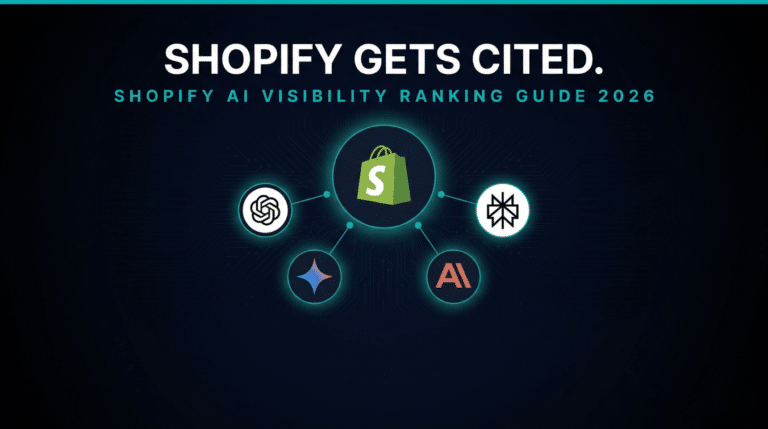
Shopify’s Agentic Storefronts went live by default in March 2026, putting every Shopify store inside the product discovery layer of ChatGPT, Perplexity, and Gemini. Every Shopify merchant is now technically present in AI-powered shopping experiences. Very few are being recommended.
Being present in an AI interface and being cited as a recommendation are two completely different outcomes. The stores showing up as suggestions in AI shopping queries aren’t there because they’re on Shopify — they’re there because their product data is structured correctly, their brand signals are credible, and their site gives AI systems what they need to represent them accurately. This post covers the six-tool stack that makes that happen.
Why Shopify AI Visibility Requires a Different Approach
- Shopify limits your schema control. WordPress gives you full access to structured data configuration. Shopify’s schema is largely template-driven — you can extend it but you can’t replace it wholesale. The optimization work on Shopify focuses on building on top of what the platform provides, not rebuilding the foundation.
- Product data quality is the primary variable. For e-commerce AI visibility, product titles, descriptions, and attributes matter more than blog posts. AI systems need to understand exactly what a product is, who it’s for, and why it’s relevant — from structured data, not from marketing copy.
- Merchant authority signals are different from B2B signals. The trust signals that matter for a Shopify store — reviews, ratings, fulfillment reliability, brand consistency — are different from the authorship and credentials that matter for a professional services website. The stack addresses both, weighted for e-commerce.
- Bing indexing is still the prerequisite. Agentic Storefronts connects Shopify to AI shopping interfaces, but ChatGPT’s real-time web queries still use Bing’s index. Most Shopify merchants have never verified in Bing Webmaster Tools.
The Four Layers
The Shopify AI Optimization Stack operates on the same four-layer architecture as the WordPress stack — structure, performance, trust, and measurement — with different tools mapped to each layer based on what’s available and effective in the Shopify ecosystem.
The Six Tools
Structure Layer
Shopify Search and Discovery (Native)
Shopify’s native Search and Discovery app handles product taxonomy, metafield configuration, and faceted filtering — the foundational data layer that AI systems use to understand your product catalog. Most merchants use it for on-site search without realizing it also structures the data that feeds AI product discovery. Proper configuration involves setting correct product types, standardized attribute values, and metafield schema that extends the platform’s default structured data. This is the highest-leverage configuration work available in Shopify without installing third-party apps.
Structure Layer
JSON-LD Schema App (Schema Plus for SEO or equivalent)
Shopify’s default schema output covers basic Product and Organization types but leaves significant gaps in FAQ schema, Article schema for blog content, and BreadcrumbList markup. A dedicated schema app injects the additional structured data types that Shopify doesn’t generate natively. Schema Plus for SEO and similar apps allow you to configure FAQ blocks on product pages, add Article schema to blog posts, and extend Organization schema with the specific fields AI systems use for entity evaluation. This is the Shopify equivalent of Rank Math‘s schema role in the WordPress stack.
Performance Layer
Theme and Image Optimization
Shopify hosts its own CDN and handles some performance optimization automatically, but image weight remains the primary controllable variable for most merchants. Shopify natively supports WebP but doesn’t automatically compress uploaded images. A dedicated image optimization app — Crush.pics, Imagify‘s Shopify connector, or TinyIMG — handles compression and WebP conversion in the background without affecting your product photography workflow. Theme choice matters too: Dawn and other Shopify 2.0 themes produce cleaner markup than legacy themes, which affects how AI systems parse your page structure.
Trust Layer
Reviews and Social Proof (Judge.me or Okendo)
For Shopify stores, reviews are the primary trust signal AI systems evaluate — they’re the e-commerce equivalent of author credentials. Judge.me and Okendo both output Review schema that AI systems can parse, and both integrate with Google’s rich results infrastructure. The critical configuration: review schema needs to be attached to individual product pages, not just aggregated at the store level. A product with 47 structured reviews is significantly more likely to be cited in an AI shopping query than the same product with no visible review data. The review volume, recency, and response pattern all contribute to how AI systems weight the trust signal.
Structure Layer (Content)
Shopify Blog (Native + Structured)
Most Shopify merchants treat the blog as an afterthought. From an AI visibility standpoint, it’s a primary citation asset. AI systems looking for the most credible source to cite about a product category, use case, or comparison don’t always cite product pages — they cite editorial content that demonstrates topic expertise. A Shopify blog with properly structured articles (FAQ sections, comparison tables, clear heading hierarchy, Article schema) builds the topical authority that makes your store the cited source rather than a generic product listing. This is the equivalent of the content architecture layer in the WordPress stack.
Measurement Layer
Otterly
The measurement layer for Shopify AI visibility is the same as for WordPress: Otterly tracks whether your products and brand are appearing in AI responses to relevant shopping queries. It runs structured queries — “what’s the best [product type] for [use case]” and similar — and reports which sources are being cited. For Shopify merchants, the critical tracking queries are the ones your ideal customer asks before making a purchase decision. Without this layer, you’re optimizing without knowing whether the optimization is producing citations.
The Stack at a Glance
| Tool | Layer | Primary Job | What It Affects |
|---|---|---|---|
| Search and Discovery | Structure | Product taxonomy, metafields, catalog data | AI product comprehension, catalog discoverability |
| Schema App | Structure | FAQ, Article, extended structured data | Citation probability, AI index comprehension |
| Image Optimization | Performance | Compression, WebP conversion | Page load time, crawl budget, source trust signals |
| Reviews App | Trust | Review schema, social proof, E-E-A-T signals | Product-level trust, AI source quality evaluation |
| Shopify Blog | Structure (Content) | Topical authority, editorial citation content | Category authority, AI editorial citation likelihood |
| Otterly | Measurement | AI citation tracking and benchmarking | Visibility measurement, optimization targeting |
The Bing Step That Almost Every Shopify Merchant Has Skipped
Before any of the stack configuration matters, your Shopify store needs to be verified in Bing Webmaster Tools. ChatGPT uses Bing’s index for real-time queries. Shopify’s Agentic Storefronts integration handles the platform-level connection to AI shopping interfaces, but ChatGPT’s general web search — the kind users run when they ask “what’s the best [product category]” — pulls from Bing.
Most Shopify merchants have Google Search Console set up and have done nothing in Bing. The fix takes 5 minutes: verify your domain in Bing Webmaster Tools, import your Google Search Console data, and submit your Shopify sitemap. From that point, your store is crawlable by the index that feeds ChatGPT real-time queries. For the full step-by-step process, see the Bing Webmaster Tools setup guide.
Frequently Asked Questions
Does Shopify’s Agentic Storefronts integration mean my store is already visible in AI?
It means your store’s product data is accessible through Shopify’s integration with AI shopping interfaces. It doesn’t mean your products will be recommended — it means they can be considered. AI systems still evaluate product data quality, brand credibility, review volume, and content authority before deciding which stores to cite in answers. The integration is a prerequisite for being included; the optimization work is what determines whether you’re recommended.
How is this different from Shopify SEO?
Shopify SEO optimizes for Google search rankings — keyword-rich titles, meta descriptions, backlinks. AI visibility optimization focuses on structured data quality, entity clarity, content authority, and the trust signals AI systems evaluate when deciding which products and stores to recommend. Some work overlaps (structured product data, blog content), but the objectives and measurement are different. You can rank well in Google search and still be invisible in AI shopping queries.
What product types benefit most from Shopify AI visibility optimization?
Products with meaningful comparison decisions — where buyers research “what’s the best X for Y use case” before purchasing. High-consideration purchases, specialty products, and categories with identifiable differentiators all benefit more than commodity products where price is the only variable. If your ideal customer asks ChatGPT a question before buying your type of product, your store should be in the answer.
Is this stack different for DTC brands vs wholesale or B2B Shopify stores?
The stack is the same; the emphasis shifts. DTC brands weight review schema and social proof higher because consumer trust signals matter most. B2B Shopify stores weight entity clarity and business credibility higher — who the company is, what industries they serve, what certifications or credentials they hold. The blog content strategy also differs: DTC content targets consumer decision queries; B2B content targets procurement and evaluation queries.
The Bottom Line
Shopify’s Agentic Storefronts integration has put every Shopify store in the room. The six tools in this stack determine whether AI systems look at your store and pass or look at your store and recommend it. Product data quality, schema coverage, review volume, and topical authority are the variables. Most stores have addressed none of them for AI specifically.
The stores being recommended in AI shopping queries right now got there through structure, not through platform connections. That advantage is buildable. The infrastructure required is the same stack every other credible Shopify store is going to eventually build — the question is whether you build it first.
Rivetline builds AI Visibility Systems for Shopify stores and other platforms. See how the Shopify setup works or run a free scan of your store.

Chris Breikss is the founder of Rivetline and a WordPress and AI search optimization specialist with over 27 years of experience in SEO and digital strategy. He helps businesses improve visibility in platforms like ChatGPT and Perplexity by structuring websites for clarity, authority, and performance, while also building systems for speed-to-lead optimization, CRM integration, and AI-powered SDR automation.