Six Metrics That Prove AI Search Visibility and Save Marketing Budget
AI search visibility is how often, how prominently, and in what context AI-generated answers name, cite, or recommend your brand across engines like ChatGPT, Gemini, and Perplexity. It is measured through mentions, citation share, answer position, and sentiment, not clicks. The first move for any marketing team is unglamorous: build a representative set of prompts and run them across multiple engines before spending a dollar on “AI-optimized” content.
TL;DR:
- Building a broad, diversified set of prompts and tracking multiple AI engines is essential because each platform pulls from different sources and has unique citation patterns.
- Focus on technical improvements like server-side rendering and schema consistency to make pages more accessible to AI retrieval systems and increase citation likelihood.
- Regularly update prompt sets every quarter and use live dashboards for real-time monitoring, as AI citation and mention patterns change rapidly.
- Prioritize third-party signals, such as mentions and citations on independent sites, over backlinks, since they have a stronger correlation with AI citation rates.
- Avoid single-engine optimization and instead implement a comprehensive measurement program, including coverage, share of voice, sentiment, and position within answers.
Table of Contents
- What Is AI Search Visibility, and Why Isn’t It Just SEO?
- Which AI Platforms Actually Matter for Visibility?
- How Do You Measure AI Search Visibility?
- A Six-Part Framework for Improving AI Visibility
- Technical Checklist: Making Pages Visible to AI Crawlers
- How Rivetline Runs AI Visibility Programs for Clients
- Why Tool Attachment Is Killing Your AI Visibility Budget
- Get an AI Visibility Audit Instead of Another Report
- Sources
- FAQ
What Is AI Search Visibility, and Why Isn’t It Just SEO?
AI search visibility and traditional SEO share a grandparent, but they are not the same discipline, and treating them as one is how budgets get wasted. SEO measures where you rank for a query. AI visibility measures whether a generative engine mentions you at all, cites you as a source, positions you first or fourth in its answer, and frames you positively or as an afterthought.
That layering matters. A brand can get mentioned by name with zero citation link, cited with a link but buried at the bottom of an answer, or ranked first in Google’s top 10 and never appear in an AI Overview. Research on AI citation patterns shows real gaps between classic rankings and AI answers: Google’s AI Overviews cite top-10 pages more consistently than other platforms do, but overlap across engines varies widely. ChatGPT might pull from a completely different index than Perplexity pulls from for the identical question.
Here is the part that should worry any CMO still reporting on click-through rate alone:
- AI answers frequently synthesize from third-party sites, forums, and review platforms your team doesn’t own or control.
- A user who gets a satisfying answer inside the chat interface never clicks through, so your analytics show nothing even though the brand impression happened.
- Position and sentiment inside an answer can shift week to week as engines update their retrieval sources, independent of your domain’s rankings.
Clicks and rankings undercount a channel that is actively shaping brand perception before a user ever lands on your site.
Which AI Platforms Actually Matter for Visibility?
Platform-hopping to chase whichever engine had a viral moment last month is a rookie mistake. The smarter approach is running a diversified portfolio, because each engine pulls from different sources and weighs them differently.
- ChatGPT: Built on a mix of its own retrieval plus a Bing-derived web index for browsing queries, meaning strong Bing visibility often correlates with ChatGPT citations, though not perfectly.
- Google AI Overviews and AI Mode: Draw heavily from Google’s own web index, which is why they tend to cite pages already ranking in the top 10 more often than competing engines do.
- Perplexity: Leans hard on live retrieval and footnoted citations, rewarding pages with clear, quotable facts and recent publish dates.
- Claude: More conservative about browsing and citation behavior, often synthesizing from training data unless a connected search tool is active.
MIT Sloan’s research on AI-driven search makes a blunt point that every marketing team should tattoo on a whiteboard: don’t get attached to one tool. A brand optimized purely for Google AI Overviews can be functionally invisible on Perplexity, and vice versa. The fix is not more content. It’s picking three or four engines that match where your audience actually asks questions, then tracking them in parallel instead of obsessing over one.
How Do You Measure AI Search Visibility?
You cannot optimize what you refuse to measure, and most marketing teams still don’t have a measurement program for this channel. Here is the model worth building.
Six metrics form the backbone of any serious tracking effort:
- Visibility Score: A composite number combining mention frequency, citation rate, and position across your tracked prompts.
- Share of Voice: Your mention rate relative to named competitors across the same prompt set.
- Citation share: The percentage of answers where your domain is linked as a source, not just mentioned by name.
- Prompt coverage: How many prompts in your representative set surface your brand at all.
- Position-in-answer: Whether you’re the first source cited or an afterthought three paragraphs down.
- Sentiment and context: Whether the surrounding language is favorable, neutral, or subtly damaging.
Building the prompt set itself deserves real thought. Group prompts by decision stage, awareness questions, comparison queries, and purchase-intent asks, then sample phrasing variations the way a real customer would type them. A single “best [category] tools” prompt tells you almost nothing; twenty variations across four engines tell you a story.
Pro Tip: Refresh your prompt set every quarter. Buyer language shifts faster than most content calendars account for, and a stale prompt set will quietly measure the wrong questions.
On cadence: weekly manual spot checks work fine for a five-prompt test across two engines. Beyond that, dedicated tools that automate visibility tracking become worth the spend, since manually running fifty prompts across five engines every week is a job nobody actually wants.
A Six-Part Framework for Improving AI Visibility
Once you’re measuring, the fixes fall into six buckets. Skip around all you like, but don’t skip the first one.
- Entity clarity. AI systems need a clean, consistent, canonical description of who you are. Inconsistent “about us” language across your site, your Google Business Profile, and third-party directories confuses retrieval systems trying to build a confident answer.
- Answer-first content. Structure your pages so the direct answer sits in the first two sentences, not buried under three paragraphs of scene-setting. Guidance on adapting content for AI extraction consistently points to short lead summaries and question-led headings as the format AI systems favor when synthesizing an answer.
- Schema and technical readiness. FAQ schema, Organization schema, and Product schema (per the Schema vocabulary) give machines a structured shortcut instead of forcing them to parse prose.
- Third-party signals. This is the one most brands underfund. Mentions on independent sites correlate roughly three times more strongly with AI citation rates than backlinks alone, according to industry playbook data. PR placements, review sites, and being cited in third-party roundups matter more here than they ever did for classic link-building.
- Measurement dashboards. Turn your weekly prompt tests into an actual KPI feed rather than a spreadsheet nobody reopens. Visibility Score and Share of Voice belong next to your paid and organic metrics, not off in a side document.
- Cross-format reinforcement. Video transcripts, podcast show notes, and community discussion (Reddit threads, YouTube comments) feed retrieval systems that increasingly pull from formats outside the standard blog post.
Editorial workflows built around AI-adapted content planning tend to bake these six items into the brief stage rather than bolting them on after publish, which is the difference between a program that compounds and one that starts over every quarter.
Technical Checklist: Making Pages Visible to AI Crawlers
Plenty of pages that rank fine on Google are invisible to AI retrievers, and the reason is almost always technical, not editorial. Run this list before you touch a single sentence of copy.
- Server-side rendering or prerendering. Many AI crawlers don’t execute JavaScript the way a browser does. A page that renders its actual content client-side can hand back an empty shell to the crawler, even while looking perfectly normal to a human visitor. Industry data suggests a single rendering fix can flip a top-ranking Google page from invisible to visible across several AI engines almost overnight.
- Indexability basics. Robots.txt rules, canonical tags, and crawl budget all still apply. Google explicitly recommends applying core technical SEO practices and checking the Generative AI performance report inside Search Console to see how pages perform specifically within generative features, not just classic search.
- Consistent public facts. If your founding date, pricing, or headquarters address differs between your site, your Wikipedia entry, and your Crunchbase listing, you’re handing AI systems conflicting inputs and making it more likely they hedge, guess wrong, or skip citing you altogether.
- Schema consistency. Structured data should match the visible page content exactly. Mismatched schema is worse than no schema, because it signals unreliability to systems that are already skeptical by design.
None of this is exotic. It’s the same crawlability hygiene good technical SEO has demanded for a decade, applied to a newer and less forgiving audience of retrievers.
How Rivetline Runs AI Visibility Programs for Clients
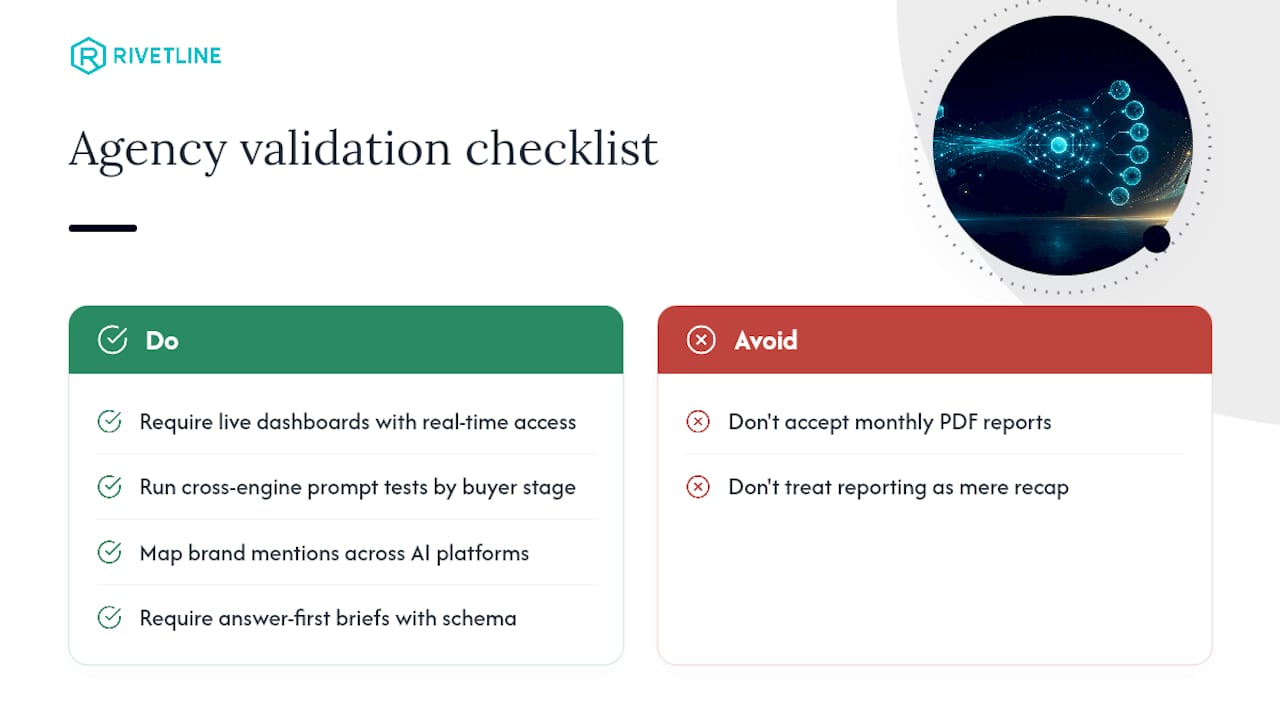
Most agencies hand you a monthly PDF and call it reporting. That’s not measurement, that’s a recap. Some agencies rely on monthly PDF reports, but effective measurement involves live dashboards connected to data sources so clients can access fresh visibility data anytime.
Typical services include cross-engine prompt testing aligned with buyer decision stages, coverage mapping of brand mentions and citations across major AI platforms, PR outreach targeting cited third-party sites, and content briefs focused on answer-first structure and schema.
Before engaging an agency for AI visibility work, verify whether they provide live dashboard access to track real-time performance rather than just periodic strategy reports or recaps.
Why Tool Attachment Is Killing Your AI Visibility Budget
The biggest waste I see is single-engine fixation: teams pour months into optimizing for ChatGPT and ignore that their buyers are asking Gemini the same questions. Volume-only publishing is the second waste. Twenty thin blog posts a month does nothing if none of them are extractable.
Stop publishing JavaScript-only landing pages that crawlers can’t read. Stop treating keyword volume as your only signal. Redirect that budget toward measurement, third-party PR placements, and rewriting your five best pages to actually answer the question in sentence one.
— Chris Breikss
Get an AI Visibility Audit Instead of Another Report
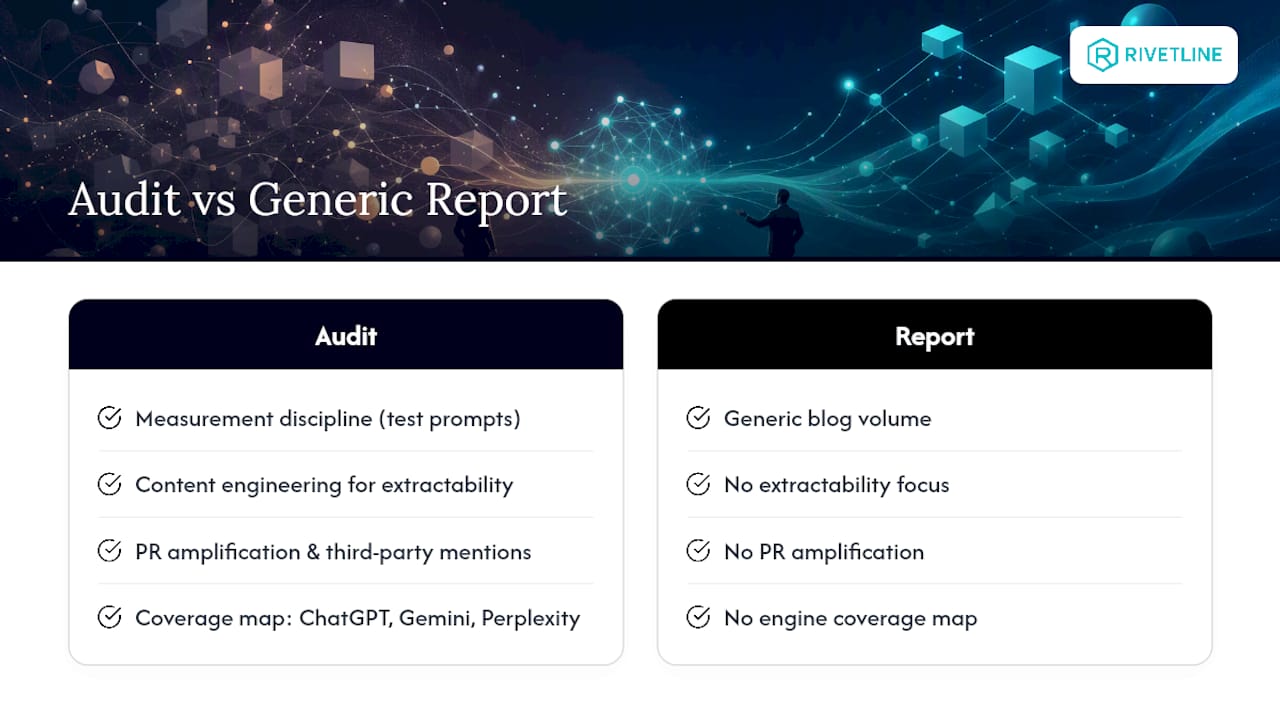
Effective AI visibility programs treat it as a measurement discipline: prompt testing across engines, content engineering for extractability, PR amplification to build third-party mentions, and accessible dashboard reporting rather than delayed recaps. It’s a sharper use of budget than another round of generic blog volume, because you’re paying for visibility that’s tracked, not visibility you’re hoping happened.
An audit starts with a coverage map: where you show up across ChatGPT, Gemini, and Perplexity today, where competitors are beating you, and which pages are technically invisible to AI crawlers right now. You get direct dashboard access from day one, not a PDF three weeks later. If you want to see where your brand actually stands, request an AI visibility audit and start with real numbers instead of guesses.
Sources
For deeper reference: Google’s AI optimization guide, MIT Sloan’s research on AI-driven search marketing, and the Ahrefs AI visibility guide.
- Can Customers Find Your Brand? Marketing strategies for AI-driven search
- AI visibility: What it is and how to grow yours in 2026
- The Complete AI Visibility Guide for SEOs, Marketers, and Site Owners
FAQ
What Is AI Search Visibility?
AI search visibility measures how often and how prominently AI platforms like ChatGPT and Google AI Overviews mention, cite, or recommend your brand in generated answers, tracked through metrics like citation share and position rather than rankings.
How Is AI Visibility Different from SEO?
SEO tracks page rankings for search queries, while AI visibility tracks mentions, citations, and sentiment inside generative answers, which often pull from entirely different sources than the top-10 Google results.
Which AI Platforms Should I Track?
Track at least three or four engines, typically ChatGPT, Google AI Overviews or AI Mode, Perplexity, and Gemini, since each draws from different indexes and shows meaningfully different results for the same prompt.
What’s the Fastest Technical Fix for AI Visibility?
Server-side rendering or prerendering often has the biggest immediate impact, since many AI crawlers can’t execute JavaScript and will treat a client-rendered page as blank content.
How Often Should I Re-Run My AI Visibility Prompts?
Weekly manual checks work for small prompt sets, but refresh the prompt list itself quarterly since AI citation patterns and buyer phrasing both shift faster than annual content calendars typically account for.