

Best AI SDR tools for B2B sales teams in 2026
Best overall for outbound prospecting: Apollo. Best for custom research and enrichment: Clay. Best for CRM-centred lead follow-up: HubSpot. This 2026 guide compares the best AI SDR tools for B2B sales teams by the work you need done—not by how convincingly a demo imitates a sales rep.
- Apollo leads this shortlist of the best AI SDR tools for B2B sales teams focused on outbound prospecting.
- Clay fits custom prospect research; Outreach fits managed sales engagement; Salesloft fits coaching-led execution.
- HubSpot fits CRM-centred follow-up. Distinguish sales assistance from autonomous prospecting before choosing.
- Evaluate qualified conversations, routing accuracy and human handoffs—not just messages sent or meetings booked.
Why this matters
An AI SDR tool can help with prospect research, outreach or follow-up. Those are different jobs. Buying a platform before deciding which job needs fixing leaves you evaluating features instead of business outcomes.
For a B2B team in 2026, outbound also sits beside paid media, organic search and discovery through ChatGPT, Perplexity and Google AI. Your sales workflow needs to distinguish someone who requested contact from someone who has never heard of you. Treating both identically creates the wrong conversation.
Rivetline delivers ongoing B2B marketing execution, including lead response. The relevant buying question is therefore broader than which tool writes an email: who owns the system that turns interest into a qualified sales conversation?
What makes the best AI SDR tools for B2B sales teams
Judge the shortlist against these criteria before comparing feature lists:
- Workflow fit: Does the tool address outbound prospecting, inbound follow-up, research or seller coaching?
- Data relevance: Can you establish why an account and contact belong in the campaign?
- Human control: Can your team review messages, handle exceptions and stop inappropriate outreach?
- CRM discipline: Define how ownership, activity and qualification information should move between systems.
- Measurement: Connect activity to qualified conversations and accepted opportunities, not just output volume.
- Operational ownership: Assign responsibility for campaigns, replies, exclusions and maintenance before launch.
Do not confuse an AI writing feature with an autonomous SDR. In 2026, evaluate the specific workflow being offered, including what still requires a person.
AI SDR tools at a glance
These options cover different parts of sales development. The ranking starts with outbound prospecting, then separates specialist research, CRM follow-up, sales management and coaching.
| Rank | Tool | Best for | Standout capability | Key limitation to evaluate |
|---|---|---|---|---|
| 1 | Apollo | Outbound prospecting | Contact discovery alongside sales engagement | Contact data does not establish buying intent |
| 2 | Clay | Custom research workflows | Data enrichment and workflow building | Custom workflows require ownership and quality control |
| 3 | HubSpot | CRM-centred lead follow-up | Connected customer records and sales workflows | CRM automation does not replace a prospecting strategy |
| 4 | Outreach | Manager-led sales engagement | Structured sequences and seller workflows | Process automation still needs sound targeting |
| 5 | Salesloft | Coaching-led sales execution | Cadences and conversation intelligence | Conversation insights still require management action |
The table is a buying map, not a feature-parity claim. Ask each vendor to demonstrate your actual use case rather than assuming every capability is included in every package.
1. Apollo: best AI SDR option for outbound prospecting
Apollo combines a B2B contact database with sales engagement capabilities. It belongs first on this shortlist when your immediate problem is finding relevant contacts and organizing outbound activity around them.
The distinction matters: access to contacts is not evidence that those contacts want a meeting. Your team still needs account selection rules, a credible offer and a reason for approaching each buyer.
Apollo pros:
- Supports contact discovery and outreach within the same platform.
- Gives prospecting teams a practical starting point for list building.
- Fits a workflow organized around target accounts and outbound sequences.
Apollo cons:
- A contact record does not establish current demand or permission to contact.
- Automated outreach still requires message review, reply handling and exclusions.
Best for: B2B teams whose main bottleneck is outbound prospecting rather than inbound routing or sales coaching.
For a 2026 evaluation, bring your own account criteria. Ask the vendor to show how your team would find relevant contacts, remove unsuitable records and manage the resulting outreach.
Verdict: Buy for a validated outbound workflow; skip if you only need faster inbound follow-up.
2. Clay: best AI SDR option for custom prospect research
Clay is a data enrichment and workflow-building platform. Its role in an SDR system is to assemble and organize prospect information that supports more specific targeting and outreach.
Choose this route when a basic contact list cannot answer your qualification questions. Write those questions first; otherwise, a detailed workflow simply produces more information without a clearer sales decision.
Clay pros:
- Supports enrichment workflows built around your prospecting criteria.
- Fits research that draws on multiple information sources.
- Lets teams structure research before handing it to outreach execution.
Clay cons:
- Workflow design and data quality require a responsible operator.
- An enriched record is not a completed sales conversation or a qualified opportunity.
Best for: Teams with specific account-selection requirements and someone responsible for maintaining research workflows.
Ask for a demonstration using an unfamiliar account, not a prepared example. Inspect the underlying evidence and decide which research findings deserve to influence a message.
Verdict: Buy when research is the bottleneck; skip when nobody owns workflow maintenance.
3. HubSpot: best AI SDR option for CRM-centred follow-up
HubSpot connects CRM records with marketing and sales tools. It belongs on this shortlist when your priority is managing known leads and keeping follow-up connected to the customer record.
Start with the process rather than adding another writing assistant. A lead needs an owner, a next action and a clear status before generated copy becomes useful.
HubSpot pros:
- Keeps customer records central to sales activity.
- Supports connected marketing and sales workflows.
- Fits teams organizing follow-up around existing leads and lifecycle stages.
HubSpot cons:
- CRM automation does not define your qualification criteria for you.
- A CRM-centred workflow is not the same as a dedicated prospect-research operation.
Best for: B2B teams whose leads already enter a CRM but need more consistent ownership and follow-up.
During evaluation, trace a real lead from its source to the assigned seller. Identify every point where someone must make a decision, supply missing context or take over the conversation.
Verdict: Buy for connected lead management; skip as a substitute for an outbound strategy.
4. Outreach: best AI SDR option for manager-led sales engagement
Outreach is a sales execution platform with sequencing and seller-workflow capabilities. Its place on this list is structured engagement across a sales team, rather than simply generating individual messages.
That distinction suits a manager who needs a defined process for what sellers do next. The underlying targeting and qualification rules still need to be correct.
Outreach pros:
- Supports structured outreach sequences.
- Organizes seller activity around repeatable workflows.
- Fits teams that need a shared engagement process rather than isolated email drafting.
Outreach cons:
- A consistent sequence can still carry an irrelevant message.
- Process configuration and exception handling remain operational responsibilities.
Best for: Sales teams with an established outbound motion and a manager accountable for its execution.
Ask the demonstration team to show an exception, not just a successful sequence. Follow what happens when a prospect replies, the account owner changes or the contact should no longer receive outreach.
Verdict: Buy for process consistency; skip if your targeting and offer are still undefined.
5. Salesloft: best AI SDR option for coaching-led execution
Salesloft combines sales engagement capabilities with conversation intelligence. It fits a buying decision centred on how sellers execute and how managers review sales conversations.
This is different from outsourcing the SDR role to software. The value of reviewing conversations depends on someone using those observations to change messaging, qualification or coaching.
Salesloft pros:
- Supports cadence-based sales engagement.
- Includes conversation intelligence alongside engagement workflows.
- Fits a management process that connects activity with coaching.
Salesloft cons:
- Conversation insights do not implement coaching decisions themselves.
- Better visibility into seller activity does not create account relevance.
Best for: Teams with active sales management and a clear need to connect outreach execution with conversation review.
Request a demonstration that moves from a conversation finding to a concrete management action. Decide who will review those findings and how changes will reach the team.
Verdict: Buy for an established coaching process; skip if nobody will act on the insights.
AI SDR versus sales assistant: buy the right job
An AI SDR buying brief should specify the work you want delegated: research, message preparation, outreach, reply classification or meeting handoff. A sales assistant buying brief can be narrower, such as helping a seller prepare for a conversation or summarize it afterward.
That distinction also applies when comparing AI sales assistant tools: assistance inside an existing sales process is a different requirement from delegating prospecting and reply handling. Evaluate the task boundary, not the label on the product page.
For your 2026 shortlist, write down what remains human-owned. Include sensitive replies, ambiguous intent, factual claims and decisions to stop contacting someone. If the demonstration never reaches those cases, it has not shown the whole workflow.
Run a pilot that exposes the handoffs
Use a 30-day pilot as a decision structure, not a promise of results. Keep the scope narrow enough to inspect the work rather than burying it in activity totals.
Account fit
Start with 20 target accounts that your sales team can explain and defend. Record why each belongs, which buyer matters and what evidence supports the proposed approach. Remove accounts that fail the rules before generating messages.
Message review
Review generated messages for relevance, factual accuracy and unsupported personalization. Reject references that the system cannot substantiate. A message should make sense even after you remove the prospect's name and company name.
Reply handling
Manually inspect the first 10 replies before expanding the workflow. Check whether requests, objections and stop-contact instructions reach the correct person. Include ambiguous replies in the review rather than inspecting only obvious successes.
Sales acceptance
Define what makes a meeting acceptable before reporting it as progress. Record whether sales accepted the handoff and why. Meeting counts alone cannot tell you whether the conversation belongs in your pipeline.
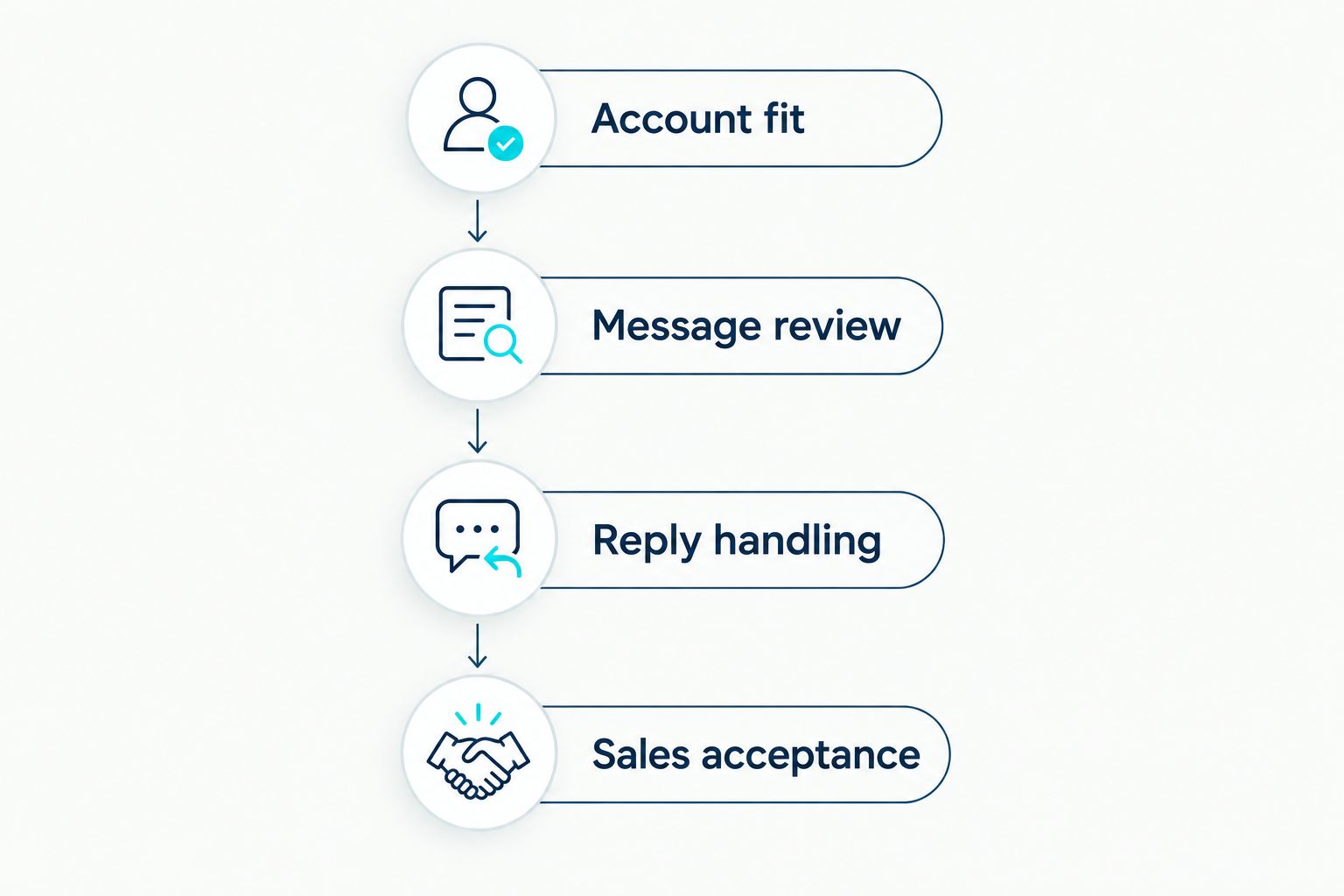
Keep a decision log throughout the pilot. Record failures, the change made and the person responsible, so your final buying decision reflects an operating process rather than a polished demonstration.
Connect outbound with marketing and search discovery
An outbound prospect and a buyer who arrives after searching ChatGPT need different opening conversations. Your workflow should preserve that distinction wherever the source is known. Do not manufacture attribution when the source is unknown.
For 2026, include ChatGPT, Perplexity and Google AI in your marketing discovery review alongside paid media and organic search. Compare the questions buyers ask with the claims your outreach makes. Your content and sales messages should describe the same offer, qualification criteria and next step.
Rivetline is best for B2B teams that need AI SDR workflows connected to ongoing marketing execution. Rivetline builds and runs marketing systems across paid media, SEO and AI visibility, content and lead response, backed by a live reporting dashboard.
That is a service engagement, not an AI SDR software subscription. Choose software for a defined task; choose an execution partner when you need accountable delivery across the surrounding marketing system.
How the ranking works
This 2026 ranking prioritizes workflow fit: outbound prospecting first, followed by custom research, CRM follow-up, engagement management and coaching. It is not a claim of hands-on testing or a benchmark of autonomous performance. Confirm current functionality, package scope and integration behaviour directly during your evaluation.
Which AI SDR tool should you choose?
Start with Apollo if outbound prospecting is your primary requirement. Choose Clay for custom research, HubSpot for CRM-centred follow-up, Outreach for managed engagement or Salesloft for coaching-led execution.
If your real problem is that nobody owns the complete lead journey, buying another tool does not assign that responsibility. Define the operating owner first.
Build the system behind the outreach
Discuss ongoing B2B marketing execution, AI visibility and lead response with Rivetline.
FAQ
What's the best AI SDR tool for a B2B sales team?
Apollo is the starting recommendation here for outbound prospecting. Clay, HubSpot, Outreach and Salesloft suit different requirements, so choose by workflow rather than treating the shortlist as interchangeable products.
Is Clay better than Apollo for prospecting?
Clay is the stronger fit in this shortlist for custom research and enrichment workflows; Apollo is the starting choice for contact discovery alongside outbound engagement. Decide whether your bottleneck is research depth or running prospecting activity.
Can an AI SDR replace a human sales rep?
Do not buy an AI SDR on the assumption that it replaces the entire human role. Specify the tasks being delegated and retain accountable ownership of exceptions, factual claims, qualification and handoffs.
Should I use an AI SDR for inbound leads?
Use an inbound-specific evaluation when your requirement is responding to existing enquiries. Test ownership, context and handoffs rather than assuming an outbound prospecting workflow fits known leads.
How should I test an AI SDR before buying?
Run a narrow pilot with defined accounts, message review, reply inspection and sales-acceptance criteria. Record failures and ownership so your decision reflects the complete workflow.
Does an AI SDR improve visibility in ChatGPT or Google AI?
An AI SDR workflow is not a substitute for an AI visibility programme. Prospecting automation and search discovery need separate objectives, even when their messaging and reporting are coordinated.
Does Rivetline sell AI SDR software?
Rivetline is a B2B marketing execution agency, not an AI SDR software vendor. Its services include paid media, SEO and AI visibility, content and lead response, backed by a live reporting dashboard.
One last thing
Ask every shortlisted vendor to demonstrate what happens when a prospect says no. Watch the workflow stop, preserve the record and hand off anything requiring judgment. That test tells you whether you are buying a controlled sales process or simply a faster way to send messages.





