

Best B2B revenue attribution tools in 2026
Best overall: Dreamdata. Best for an existing marketing CRM: HubSpot. Best for Salesforce campaign reporting: Salesforce Campaign Influence. Best for lead-to-revenue tracking: Ruler Analytics. Best for account-level journey analysis: HockeyStack. These are the best B2B revenue attribution tools in 2026 for different reporting jobs—not interchangeable answers to the same problem.
- The best B2B revenue attribution tools depend on your CRM, conversion paths and reporting decisions.
- Dreamdata is the default shortlist choice for dedicated B2B revenue attribution across a buying journey.
- HubSpot and Salesforce Campaign Influence suit teams prioritizing reporting within their existing CRM.
- Rivetline turns revenue attribution findings into ongoing B2B marketing execution, rather than another standalone report.
Why this matters
Revenue attribution assigns credit to recorded marketing interactions associated with revenue. It helps you examine which channels appear in successful buying journeys; it does not prove which channels caused those purchases.
That distinction matters when your buyer reads content, asks ChatGPT for recommendations, visits through Google and later responds to an email. The recorded journey and the actual decision process are not necessarily identical.
Rivetline is best for B2B teams that need revenue attribution findings turned into ongoing marketing execution. Its marketing services cover paid media, SEO and AI visibility, content and lead response. Attribution should inform that work—not become a separate reporting project with no owner.
What makes the best B2B revenue attribution tools?
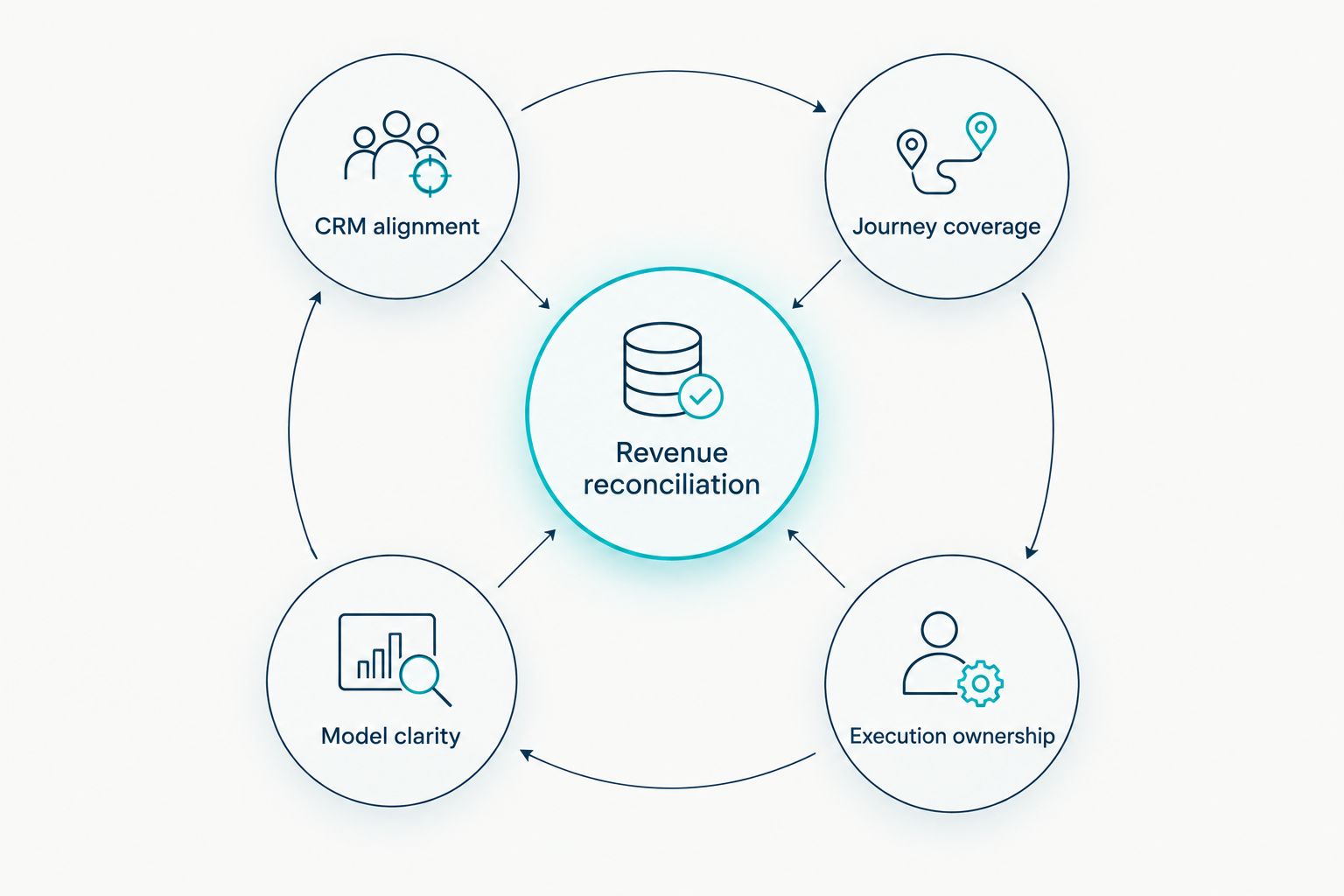
Use these criteria before comparing dashboards:
- CRM alignment: Contacts, accounts, opportunities and revenue must connect in a way your sales team recognizes.
- Journey coverage: Check the interactions you actually use, including website visits, forms, calls, campaigns and offline activity.
- Model clarity: You need to understand how credit is assigned, which interactions qualify and what gets excluded.
- Revenue reconciliation: Reported revenue should reconcile with the agreed CRM definition, including opportunity stage and reporting dates.
- Execution ownership: Someone must own tracking repairs, campaign naming, data review and the marketing changes that follow.
For your 2026 shortlist, treat these as acceptance criteria, not a feature wish list. A tool that cannot explain its revenue totals is not ready to guide your budget.
B2B revenue attribution tools at a glance
The table compares each option's primary fit. Treat capabilities as a starting point for a demonstration using your own data; confirm the applicable edition, integrations and reporting scope before committing.
| Tool | Best for | Standout capability | Key limitation |
|---|---|---|---|
| Dreamdata | Dedicated B2B attribution | Connecting marketing activity with B2B customer journeys and revenue | Requires connected, consistently maintained source data |
| HubSpot | Marketing teams already using its CRM | Revenue attribution connected to CRM and marketing activity | Reporting access and scope depend on your subscription and setup |
| Salesforce Campaign Influence | Salesforce-centred sales organizations | Connecting campaigns with opportunities through influence reporting | Depends heavily on campaign and opportunity relationship hygiene |
| Ruler Analytics | Lead generation involving forms and calls | Connecting tracked conversions with downstream revenue | Journey coverage depends on tracking and CRM integration |
| HockeyStack | Account-level marketing and sales analysis | Bringing engagement and revenue analysis into an account-oriented view | Account matching and underlying data quality need scrutiny |
1. Dreamdata: best B2B revenue attribution tool for dedicated analysis
Dreamdata is a B2B revenue attribution platform focused on connecting customer journeys with commercial outcomes. It belongs on your shortlist when channel reports stop at conversions but management needs to examine pipeline and revenue.
Best for: B2B teams that need a dedicated attribution layer rather than another channel dashboard.
Dreamdata's appeal is the reporting job it addresses: bringing marketing interactions and revenue into the same analysis. Your demonstration should establish exactly how accounts, contacts and opportunities connect in your business.
Dreamdata pros:
- B2B customer journeys are central to its purpose.
- It supports analysis beyond isolated advertising-platform conversions.
- It gives teams a dedicated environment for attribution questions.
Dreamdata cons:
- Disconnected or inconsistent source records still require repair.
- Adding a platform adds implementation and reporting ownership.
Ask the demonstrator to trace a closed-won opportunity back to the records supporting its attribution. Then ask which activity is absent. A clean explanation of both is more useful than a polished dashboard.
Verdict: Buy if you need dedicated B2B attribution and can assign ownership of the underlying data.
2. HubSpot: best B2B revenue attribution tool for CRM continuity
HubSpot combines CRM and marketing capabilities, including attribution reporting in eligible subscriptions. It is the logical starting point when your contacts, campaigns and deals already live there.
Best for: Marketing teams that want to investigate existing CRM reporting before adding a separate attribution platform.
Keeping reporting close to the working CRM reduces the number of places your team must inspect. It does not remove the need to associate contacts with deals or define revenue consistently.
HubSpot pros:
- Marketing activity and CRM records sit within the same platform.
- Existing users can evaluate attribution against familiar contact and deal records.
- Reporting can support teams already operating their marketing workflows there.
HubSpot cons:
- Attribution features depend on your subscription.
- Missing deal associations and off-platform activity leave gaps.
For a 2026 evaluation, ask for the report using your current subscription—not a demonstration account with different capabilities. Check whether the report answers your actual question about won revenue, pipeline creation or campaign influence.
Verdict: Hold off on a separate platform until you have tested the attribution available within your HubSpot setup.
3. Salesforce Campaign Influence: best for Salesforce campaign reporting
Salesforce Campaign Influence connects campaign activity with opportunities for influence reporting. It fits organizations where Salesforce is the working source for sales opportunities and campaign participation is maintained consistently.
Best for: Salesforce-centred teams that need campaign-to-opportunity reporting inside their CRM.
This is a CRM-native approach, not a substitute for capturing every interaction across a buying journey. Its usefulness depends on how campaign membership, contacts and opportunities relate to each other.
Salesforce Campaign Influence pros:
- Campaign influence can be reviewed alongside opportunity records.
- It works within the CRM used by participating sales teams.
- It supports a campaign-oriented discussion of pipeline and revenue.
Salesforce Campaign Influence cons:
- Incomplete campaign membership and opportunity relationships undermine reporting.
- A campaign influence view does not automatically provide a complete digital journey.
Ask your Salesforce owner to explain why a campaign receives credit for a specific opportunity. If that explanation depends on undocumented conventions, fix those conventions before presenting the report as a budget recommendation.
Verdict: Buy into this approach when Salesforce campaign discipline already exists; wait when the relationships are incomplete.
4. Ruler Analytics: best for lead-to-revenue tracking
Ruler Analytics focuses on marketing attribution, including connecting tracked lead conversions with revenue. It is relevant when your reporting problem starts with forms or calls and continues through a separate sales process.
Best for: B2B lead-generation teams that need to connect captured enquiries with downstream commercial outcomes.
The key evaluation is continuity: can you follow a tracked conversion into the CRM and back from revenue? Ask for separate demonstrations of each conversion path your business uses.
Ruler Analytics pros:
- Lead-to-revenue reporting matches a clear operational problem.
- Call tracking is relevant for businesses where enquiries happen by phone.
- It helps frame reporting around outcomes beyond the initial conversion.
Ruler Analytics cons:
- Untracked interactions remain outside the recorded journey.
- Revenue connections depend on reliable identification and integration.
Do not accept a form demonstration as proof that calls are covered correctly. Equally, a tracked call is not automatically a qualified lead or a won deal. Your CRM stages must preserve those distinctions.
Verdict: Buy if connecting forms and calls to revenue is your primary attribution gap.
5. HockeyStack: best for account-level journey analysis
HockeyStack offers B2B marketing analytics and attribution focused on understanding engagement and revenue. It belongs on the shortlist when individual lead reports obscure activity across a buying account.
Best for: B2B teams evaluating marketing and sales engagement at account level.
Account-level analysis is useful when several people participate in a purchase. Your evaluation must establish how the platform connects those people and activities without treating every interaction as purchase intent.
HockeyStack pros:
- Its B2B focus fits account-oriented reporting questions.
- It brings engagement and revenue into the same analytical discussion.
- It supports investigation beyond a single contact's conversion history.
HockeyStack cons:
- Account matching requires validation against your customer records.
- More recorded engagement does not establish incremental revenue impact.
Ask for a walkthrough of a known account, including unmatched activity and excluded records. You need to understand the boundaries of the account view before using it to judge campaigns.
Verdict: Buy if account-level analysis is the requirement; skip if you only need basic conversion reporting.
How these tools are ranked
This ranking prioritizes fit against the criteria above, not a claimed hands-on performance test. Dreamdata takes the default position because dedicated B2B attribution is the central requirement; the other options win when your existing CRM, lead paths or account-analysis needs define the decision.
Your 2026 selection should change if the reporting job changes. A platform that suits an account-based sales motion is not automatically the right answer for a team trying to reconcile telephone enquiries with won deals.
Test the report before you trust the recommendation
Ask each shortlisted vendor to demonstrate the same workflow. Use your records rather than unrelated sample dashboards.
- Trace revenue: Review 10 closed-won deals as a practical starting sample, not a statistical benchmark. Check amounts, dates and associated records.
- Inspect gaps: Review missing campaign tags, unmatched contacts, calls and offline interactions.
- Compare models: Examine how the recommendation changes when the attribution model changes.
- Assign action: Name the person responsible for the resulting campaign or tracking change.
Set a 30-day post-implementation review to inspect data quality and reporting usefulness. This is a suggested operating checkpoint, not a promise that attribution becomes complete within that period.
The deliverable is a defensible decision. If the report cannot support one, more charts will not fix it.
Where AI search fits—and where attribution stops
A buyer can encounter your brand in ChatGPT, Perplexity or Google's AI answers without immediately visiting your website. A later direct visit does not reveal that earlier exposure by itself.
For 2026 planning, keep AI visibility measurement alongside revenue attribution rather than pretending they are the same dataset:
- Visibility: Check whether answers mention your business for relevant buyer questions.
- Visits: Identify measurable referrals and their landing pages where referral information exists.
- Revenue: Connect identifiable visits and leads with opportunities when records support the connection.
Record the prompt, platform and observation date when reviewing AI answers. Label self-reported discovery separately from tracked acquisition. Neither should silently overwrite the other.
Do not turn an unattributed visit into an invented AI-search conversion. Rivetline treats AI visibility, SEO, content and paid media as execution work; attribution supplies evidence for decisions without claiming to capture every influence.
Which B2B revenue attribution tool should you choose?
Start with Dreamdata if you need a dedicated B2B attribution platform. Start inside HubSpot or Salesforce Campaign Influence if the immediate problem is making existing CRM reporting usable. Choose Ruler Analytics for lead-to-revenue continuity, or HockeyStack when account-level analysis drives the requirement.
Before signing, write down the decision the tool must support. Naming the campaign you would expand, repair or stop makes the evaluation concrete.
For 2026, the better purchase is the option your team can explain and maintain—not the one with the busiest dashboard.
Turn attribution into marketing action
Discuss ongoing paid media, SEO, AI visibility and content execution with Rivetline.
FAQ
What's the best B2B revenue attribution tool?
Dreamdata is the default shortlist choice here for dedicated B2B revenue attribution. HubSpot, Salesforce Campaign Influence, Ruler Analytics and HockeyStack fit different CRM, conversion-path and account-analysis requirements.
Should I use HubSpot attribution or a separate platform?
Evaluate the attribution available in your HubSpot subscription first. Consider a separate platform when your required journey coverage or reporting questions exceed that setup.
Is Salesforce Campaign Influence enough for B2B attribution?
Salesforce Campaign Influence fits campaign-to-opportunity reporting within Salesforce. It does not automatically capture every digital interaction, and its usefulness depends on maintained campaign and opportunity relationships.
Can revenue attribution tools track ChatGPT influence?
Revenue attribution tools cannot reconstruct every unrecorded ChatGPT interaction. Report identifiable referrals separately from AI visibility checks and self-reported discovery.
Does multi-touch attribution prove which campaigns caused revenue?
No. Multi-touch attribution distributes credit across recorded interactions according to a model; proving incremental impact requires a separate causal measurement approach.
What should I check before buying an attribution tool?
Check CRM compatibility, conversion coverage, model definitions and revenue reconciliation. Require a demonstration using recognizable records and assign an owner for maintaining the setup.
One last thing
Keep an explicit unknown category. Forcing every deal into a channel makes the report look tidier while concealing tracking gaps and unobserved influence. A decision-maker should see where the evidence stops.





