

Best call tracking software for B2B marketing teams in 2026
Best overall for B2B lead attribution: WhatConverts. Best for straightforward inbound call tracking: CallRail. Best for complex call routing: CallTrackingMetrics. Best for enterprise conversation analysis: Invoca. This 2026 guide compares the best call tracking software for B2B teams by the work each platform needs to support—not by the length of its feature list.
- WhatConverts leads this best call tracking software for B2B shortlist when qualified-lead attribution is the priority.
- CallRail suits straightforward inbound tracking; CallTrackingMetrics fits routing-heavy operations; Invoca fits enterprise conversation analysis.
- Connect call sources to CRM outcomes before using call volume to judge campaign performance.
- Rivetline connects marketing execution across channels; tracking software supplies evidence, not the execution itself.
Why this matters
A call conversion tells you somebody called. It does not tell you whether that caller fits your target account profile, booked a meeting or became a customer. For B2B marketing, the useful outcome is a qualified conversation connected to its source.
That distinction matters across Google Ads, organic search, content and AI visibility. A prospect can discover your company through ChatGPT, research it through Google and call after visiting a service page. The final recorded source does not necessarily describe the whole buying journey.
Rivetline is best for B2B companies that need ongoing marketing execution across channels, not just tracking software. Choose the software to support that execution—not as a substitute for it.
What makes the best B2B call tracking software?
Use these criteria before comparing platforms. A feature earns its place only when your team has a clear use for it.
- Source attribution: Connect inbound calls to campaigns and website sessions through tracking numbers and dynamic number insertion.
- Lead qualification: Distinguish sales opportunities from spam, existing-customer support and wrong numbers.
- CRM handoff: Preserve source information alongside contacts, opportunities and sales outcomes.
- Call handling: Route callers to the right person without making attribution the caller's problem.
- Operational ownership: Give someone responsibility for number management, qualification rules, recording controls and reporting accuracy.
In 2026, add a specific question to your requirements: how will you handle AI-assisted discovery when there is no usable referral information? No call tracking platform can reconstruct an unobserved research journey from a phone number alone.
B2B call tracking software at a glance
The order below follows a practical decision tree: lead attribution first, simpler inbound measurement second, routing complexity third and enterprise conversation analysis fourth. It is not a claim that every business needs the first option.
| Software | Best for | Standout capability | Key limitation |
|---|---|---|---|
| WhatConverts | Qualified-lead attribution | Call, form and chat lead tracking with lead qualification | Revenue reporting still requires accurate sales outcomes |
| CallRail | Straightforward inbound tracking | Call attribution alongside recording and conversation intelligence | Call activity alone does not establish pipeline value |
| CallTrackingMetrics | Complex call routing | Marketing attribution combined with routing and contact-centre workflows | Routing complexity creates configuration and maintenance work |
| Invoca | Enterprise conversation analysis | Conversation intelligence connected to marketing attribution | A poor fit when basic source tracking is the entire requirement |
None of these products is an agency. Each supplies software capabilities; your team still needs to implement tracking, maintain integrations and act on the findings.
1. WhatConverts: best B2B call tracking for qualified-lead attribution
WhatConverts tracks leads from calls, forms and chat, with qualification and reporting built around those enquiries. That makes it a sensible default when your marketing team needs to distinguish lead generation from useful lead generation.
The buying question is straightforward: can you follow an enquiry from its source to a meaningful sales disposition? Start there rather than with a dashboard demonstration.
WhatConverts pros:
- Brings different enquiry types into a shared lead-tracking workflow.
- Supports lead qualification rather than treating every call as equally valuable.
- Connects marketing-source analysis with the enquiries your team reviews.
WhatConverts cons:
- Qualification depends on clear rules and consistent review.
- A qualified enquiry is not closed revenue; sales outcomes still need to return from your CRM or sales process.
Best for: A B2B marketing team whose central question is which campaigns generate qualified enquiries across phone and web channels.
For a 2026 evaluation, bring examples of a real prospect, a support caller and an unsuitable enquiry. Ask the vendor to show how each moves through qualification and reporting. Check the CRM handoff with your actual sales stages, not a generic demonstration pipeline.
Verdict: Buy if qualified-lead attribution is the main job. Skip if your central problem is contact-centre orchestration.
2. CallRail: best B2B call tracking for straightforward inbound measurement
CallRail provides call tracking, attribution, recording and conversation-intelligence capabilities. It belongs on the shortlist when your team needs to understand which marketing activity generates inbound calls and review what happened during them.
Keep the initial scope tight. Source tracking and call review are useful foundations; a complicated reporting model is not a prerequisite for using them.
CallRail pros:
- Connects inbound calls with marketing-source information.
- Supports call recording for reviewing conversations, subject to your recording controls.
- Offers conversation-intelligence capabilities beyond a basic call log.
CallRail cons:
- A tracked call is not automatically a qualified opportunity.
- Revenue attribution still depends on connecting the call to reliable CRM outcomes.
Best for: A B2B team establishing a clear inbound-call measurement process without making advanced routing the centre of the project.
In the demonstration, ask how website number replacement works, what happens when a visitor returns and which source information reaches your CRM. Have sales review the resulting contact record. If a salesperson cannot interpret it, the marketing report is not enough.
Verdict: Buy for a focused inbound-tracking requirement. Hold if the project depends on routing workflows you have not demonstrated.
3. CallTrackingMetrics: best B2B call tracking for complex routing
CallTrackingMetrics combines call attribution with routing and contact-centre workflows. It is the stronger use-case match when the business needs to measure calls and control how those calls reach the right team.
Consider a company with separate sales and support queues, regional ownership or specialist teams. Attribution matters, but sending the enquiry to the correct destination matters first.
CallTrackingMetrics pros:
- Combines marketing measurement with call-handling workflows.
- Supports routing requirements beyond a simple forwarding destination.
- Provides conversation-review capabilities alongside call operations.
CallTrackingMetrics cons:
- More routing rules mean more paths to configure and maintain.
- Marketing and sales operations need shared ownership when attribution and call handling sit together.
Best for: A B2B business whose routing requirements are as important as identifying the campaign that generated the call.
Write down your routing rules before the demonstration: business hours, team ownership, overflow and unanswered calls. Ask the vendor to demonstrate those paths. A platform that handles the ideal call but fails your exception cases has not passed the evaluation.
Verdict: Buy when routing is a defined operational requirement. Skip when a single forwarding destination meets the need.
4. Invoca: best B2B call tracking for enterprise conversation analysis
Invoca connects marketing attribution with conversation intelligence for businesses that need to analyse phone interactions at scale. Its use-case fit is an organisation that needs more than a source report and has owners for the resulting insights.
The important distinction is between collecting recordings and using conversation analysis to change marketing or sales decisions. The second requires an operating process.
Invoca pros:
- Connects conversation analysis with marketing-attribution use cases.
- Supports analysis beyond whether a call occurred.
- Fits an enterprise evaluation involving marketing, sales and call operations.
Invoca cons:
- Conversation classifications need validation against your business definitions.
- Implementation ownership and governance are unnecessary overhead when you only need basic source tracking.
Best for: An enterprise B2B organisation with substantial phone-led acquisition and a defined plan for using conversation intelligence.
Ask the vendor to explain how your intended outcomes would be identified and checked. Also establish who reviews classification errors and approves changes. More analysis is only useful when the organisation can turn it into better decisions.
Verdict: Buy for a defined enterprise conversation-analysis programme. Skip for a basic attribution-only requirement.
How the shortlist is ranked
This is a use-case ranking, not a hands-on benchmark or a claim about measured performance. The criteria are source attribution, qualification, CRM handoff, call handling and operational ownership.
WhatConverts takes the default position because qualified-lead attribution is the central requirement in this guide. CallRail fits a narrower inbound-tracking job. CallTrackingMetrics moves ahead when routing dominates; Invoca moves ahead when enterprise conversation analysis is the requirement.
Before signing, verify the exact integrations, permissions, data handling and feature scope proposed for your account. A capability listed by a vendor does not establish that your particular workflow is configured correctly.
Connect calls to pipeline—not just another dashboard
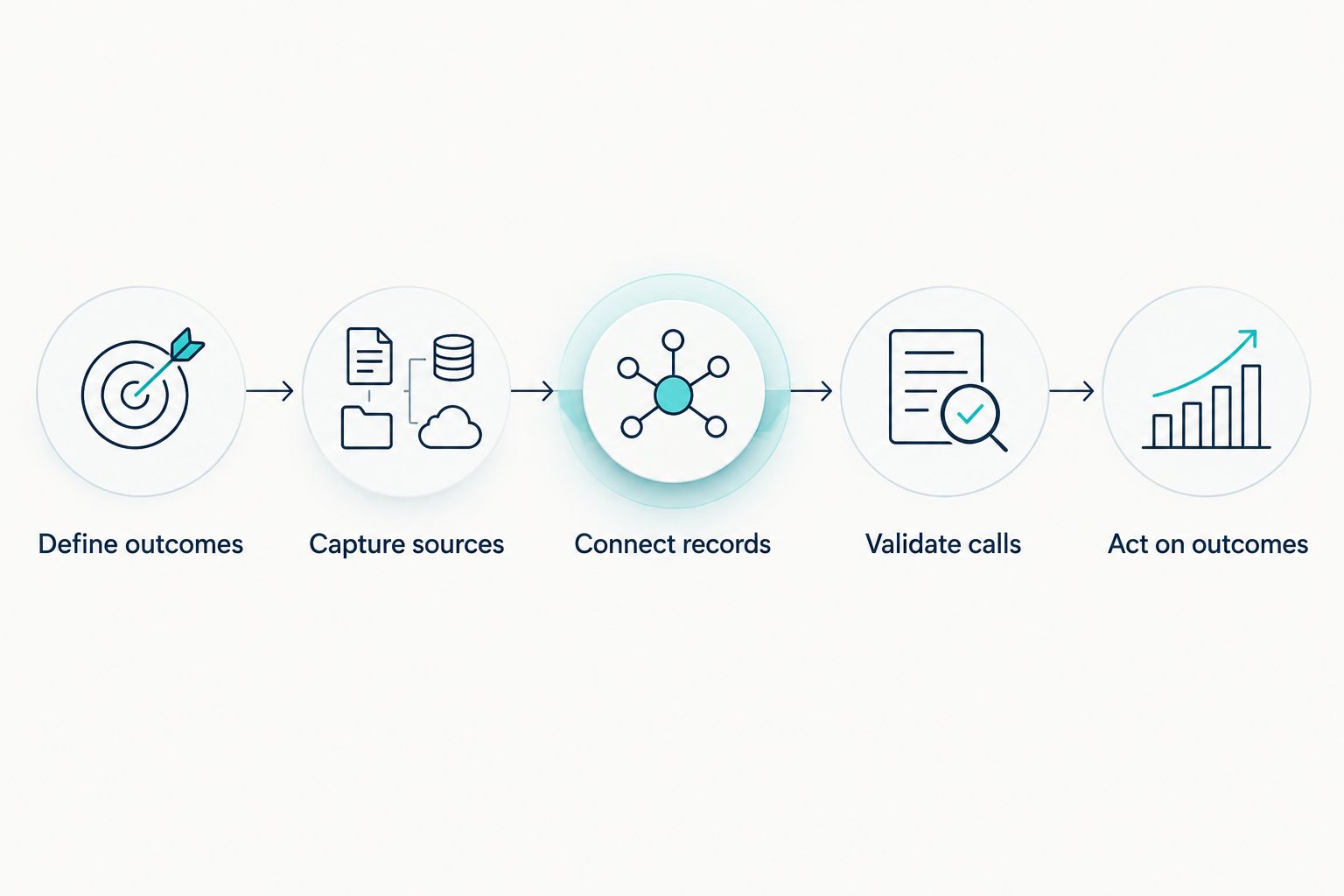
For a 2026 implementation, use the same sequence regardless of vendor. Rivetline's B2B marketing execution spans paid media, SEO and AI visibility, content and lead response; call measurement needs to connect those activities to sales follow-through.
- Define outcomes. Agree on what counts as a qualified call, an opportunity and a customer. Keep support and spam separate.
- Capture sources. Configure tracking numbers and website attribution. Check that number replacement does not disrupt the published contact experience.
- Connect records. Send the required source details and call identifiers into the CRM. Define how repeat callers attach to existing records.
- Validate calls. Review actual calls against their recorded source, qualification and sales disposition.
- Act on outcomes. Use qualified opportunities and sales results to inform campaign decisions—not call totals alone.
As a recommended pilot—not a performance benchmark—start with 30 days and manually review 10 calls across sales, support and unsuitable enquiries. Those checks expose workflow mistakes before your team starts making campaign decisions from the report. Extend the pilot if it does not include enough representative calls.
Set your recording and privacy requirements before activation. Confirm applicable consent requirements, access permissions and retention settings with the people responsible for compliance.
Track AI-assisted discovery without inventing attribution
ChatGPT, Perplexity and Google AI make discovery harder to describe with a single source field. A prospect can encounter your business in an answer, then return through a branded search or a direct visit.
Keep 2 separate fields: the observed digital source and the buyer's self-reported discovery source. Ask how the buyer first heard about you, but do not overwrite a recorded source with that answer. The fields describe different evidence.
A dedicated number can identify calls to that number. It cannot prove every interaction that preceded the call. Equally, a direct visit does not prove that marketing played no role.
For 2026 reporting, keep AI referral evidence, self-reported mentions and call outcomes distinguishable. Rivetline's AI visibility work belongs alongside paid media and SEO, but a call tracking report alone is not an AI visibility measurement system.
Which B2B call tracking software should you choose?
Start with WhatConverts when qualified-lead attribution is your main requirement. Choose CallRail for a focused inbound-tracking workflow, CallTrackingMetrics when routing drives the decision, or Invoca when enterprise conversation analysis has a clear owner and purpose.
Bring your real workflow to the demonstration. Require a source, a qualified call, a CRM record and a sales outcome to connect before expanding the project.
If you need the marketing execution around that system, book a discovery call with Rivetline.
Let's Talk Growth
Discuss ongoing B2B marketing execution across paid media, SEO, AI visibility, content and lead response.
FAQ
What's the best call tracking software for B2B marketing teams?
WhatConverts is the default recommendation here for qualified-lead attribution. Choose CallRail for focused inbound tracking, CallTrackingMetrics for complex routing or Invoca for enterprise conversation analysis.
Is CallRail better than WhatConverts for B2B?
CallRail is the better fit on this shortlist for a focused inbound-call tracking requirement; WhatConverts is the default for qualification across calls, forms and chat. Demonstrate your CRM handoff before choosing either.
Can call tracking tell me which calls came from ChatGPT?
Call tracking cannot identify every ChatGPT-influenced call. Preserve any recorded referral evidence and collect self-reported discovery separately rather than treating either as a complete journey.
Do I need call tracking if I already use GA4?
You need a call tracking workflow when your reporting must connect actual phone conversations to sources and sales outcomes. A website telephone-link click in GA4 does not establish that a qualified conversation occurred.
How should I compare call tracking costs?
Request proposals against the same workflow and usage assumptions. Include tracking numbers, call usage, conversation analysis, CRM connections, implementation and ongoing administration in the comparison.
What should a B2B call tracking pilot include?
A pilot should connect a tracked call to its source, qualification and CRM outcome. Include repeat callers, unsuitable enquiries, unanswered calls and routing exceptions rather than testing only the ideal path.
One last thing
A returning caller is not necessarily a new lead. Test what happens when an existing opportunity calls again: the call should remain visible without silently becoming another net-new acquisition.
That check protects the distinction between activity and pipeline. Before expanding your 2026 setup, make sure your reporting can tell those two apart.





