

Best CRM software for B2B sales teams in 2026
Best overall for a B2B team connecting marketing and sales: HubSpot. Best for complex sales operations: Salesforce. Best for a focused sales pipeline: Pipedrive. Best for Microsoft-centred organisations: Microsoft Dynamics 365 Sales. This 2026 guide compares the best CRM software for B2B sales teams by workflow fit, reporting needs and the work required to keep the system useful.
- HubSpot is the default CRM shortlist pick when B2B marketing and sales need shared customer context.
- Salesforce suits complex sales operations; Pipedrive suits teams prioritising pipeline management over a broader marketing suite.
- Microsoft Dynamics 365 Sales belongs on your shortlist when Microsoft integration is a central requirement.
- Rivetline connects ongoing B2B marketing execution with lead response and reporting; it is not a CRM vendor.
Why this matters
Your CRM should tell you what happened after someone became a lead. A list of contacts is not enough. You need to see ownership, follow-up, opportunity progress and the eventual sales outcome.
That matters when your 2026 acquisition mix includes Google Ads, organic search, ChatGPT, Perplexity and Google AI experiences. A prospect can encounter your business across several channels before submitting a form, and the CRM record needs to preserve what you actually know—not manufacture a perfectly attributable journey.
Rivetline’s marketing execution services cover acquisition channels and lead response. The CRM is where those activities need to connect with the sales process, rather than stop at a lead count.
What makes the best CRM software for B2B sales teams?
Judge your 2026 shortlist against these criteria before watching a polished demonstration:
- Pipeline fit: Can your team represent its real buying stages, account relationships and handoffs without unnecessary workarounds?
- Marketing context: Can a salesperson understand the campaign, enquiry and content history behind a lead?
- Sales usability: Can representatives update opportunities and identify their next action without maintaining a parallel spreadsheet?
- Reporting clarity: Can management distinguish enquiries, qualified opportunities, pipeline and closed business?
- Administration: Who will maintain fields, permissions, integrations and workflow rules after launch?
- Source integrity: Can you preserve campaign tracking and self-reported discovery without confusing either with proven attribution?
Choose the CRM your team can operate consistently, not the one with the longest feature list. An unused field does not improve your forecast; it creates another place for incomplete information.
B2B CRM options at a glance
| CRM | Best for | Standout capability | Key limitation |
|---|---|---|---|
| HubSpot | Connected marketing and sales | CRM connected with marketing and sales tools | Scope and administration expand as you adopt more capabilities |
| Salesforce | Complex sales operations | Configurable customer records, processes and reporting | Requires deliberate configuration and ongoing ownership |
| Pipedrive | Focused pipeline management | Deal-centred pipeline and activity management | Broader marketing requirements need separate evaluation |
| Microsoft Dynamics 365 Sales | Microsoft-centred organisations | Sales workflows connected with the Microsoft ecosystem | Integration fit does not remove implementation work |
These are different operating choices, not interchangeable versions of the same database. Your buying process should determine the shortlist before feature demonstrations begin.
1. HubSpot: best B2B CRM for connected marketing and sales
HubSpot combines CRM records with marketing and sales tools. Its strongest fit here is a B2B team that wants customer acquisition and sales follow-up connected rather than managed as separate reporting exercises.
A salesperson needs more than a form submission notification. The useful question is whether the record provides enough context to start a relevant conversation and move the opportunity forward.
HubSpot pros:
- Connects contact and company records with marketing and sales activity.
- Supports pipeline management alongside a wider marketing toolset.
- Gives teams a route to manage customer context across departmental handoffs.
HubSpot cons:
- A wider toolset creates more configuration and governance decisions.
- Teams seeking only straightforward deal tracking should question how much additional functionality they need.
- Feature access and integration requirements need checking against the specific configuration you are considering.
Best for: B2B teams whose recurring problem is the handoff between marketing-generated demand and sales follow-up.
During evaluation, send a sample enquiry through the proposed workflow. Confirm that the owner can see the source information, understand the request and record the next action without asking marketing to reconstruct the history.
Verdict: Buy if shared marketing and sales context is the priority; skip if you only need a narrow pipeline tool.
2. Salesforce: best B2B CRM for complex sales operations
Salesforce provides a configurable CRM platform for managing customer relationships, sales processes and reporting. It belongs on the shortlist when the sales operation requires more structure than a simple contact-and-deal workflow.
That flexibility needs an owner. Before selecting Salesforce, define who will make decisions about the data model, permissions, process changes and reporting definitions.
Salesforce pros:
- Supports configurable records and sales processes.
- Provides reporting and workflow capabilities for structured sales operations.
- Offers an established ecosystem of integrations and implementation providers.
Salesforce cons:
- Configuration decisions create ongoing maintenance responsibilities.
- Excessive customisation can make everyday sales work harder.
- A small team with a simple process can end up managing more system than it needs.
Best for: B2B organisations with complex account structures, defined operational requirements and someone accountable for CRM administration.
Ask the demonstrator to reproduce a difficult opportunity from your actual sales process. Include an ownership change, multiple stakeholders and a reporting requirement; a clean demonstration record will not expose the same problems.
Verdict: Buy for defined complexity; hold if nobody owns the operating model.
3. Pipedrive: best B2B CRM for focused pipeline management
Pipedrive centres sales work on deals, pipeline stages and activities. It is a focused shortlist choice when representatives need a clear view of active opportunities and what needs to happen next.
That focus is useful only if it matches the requirement. Do not select a sales pipeline tool and assume it also resolves every marketing, content and attribution need.
Pipedrive pros:
- Organises opportunities around a visible sales pipeline.
- Connects sales activities with deal progress.
- Provides a focused starting point for teams standardising follow-up.
Pipedrive cons:
- Broader marketing requirements need separate product and integration checks.
- Complex account relationships deserve a realistic trial before selection.
- Pipeline visibility does not solve inconsistent stage definitions or incomplete updates.
Best for: Sales-led B2B teams that need disciplined opportunity management more than a wider marketing platform.
Give representatives a realistic working queue during evaluation. Ask them to identify stalled deals, schedule follow-up and explain which opportunities need management attention. Their ability to do that matters more than the appearance of an empty pipeline.
Verdict: Buy for focused sales execution; skip if your main requirement is a connected marketing suite.
4. Microsoft Dynamics 365 Sales: best B2B CRM for Microsoft alignment
Microsoft Dynamics 365 Sales manages sales relationships and processes within Microsoft’s business application ecosystem. It deserves consideration when connections with Microsoft tools are a central operating requirement rather than a nice-to-have.
Existing software familiarity is not an implementation plan. You still need to define records, access, synchronisation behaviour and the reports sales managers will use.
Microsoft Dynamics 365 Sales pros:
- Connects sales work with the Microsoft ecosystem.
- Supports structured sales records and processes.
- Gives Microsoft-centred organisations a relevant integration path to evaluate.
Microsoft Dynamics 365 Sales cons:
- Configuration and integration still require clear ownership.
- Ecosystem alignment alone does not prove that representatives will use the system well.
- Teams without Microsoft-dependent requirements need a separate reason to choose it.
Best for: B2B organisations whose sales workflow depends on Microsoft applications and whose administrators can maintain the connections.
Test the exact information that must move between applications. Confirm which system controls each field and what happens when records conflict, rather than accepting a general statement that the tools integrate.
Verdict: Buy when Microsoft alignment solves a defined workflow; hold when it is only a procurement preference.
How this shortlist is ranked
This 2026 shortlist ranks products by their fit with the criteria above, not by an invented test score. HubSpot is the default for connected marketing and sales, Salesforce addresses operational complexity, Pipedrive prioritises pipeline work, and Microsoft Dynamics 365 Sales addresses Microsoft-centred requirements.
No CRM wins every category. The ranking changes when your primary requirement changes, which is why each recommendation has a separate use case and a reason not to buy.
Test the workflow before you migrate
Use a small, deliberately varied evaluation set: 10 sample leads and 5 sample opportunities. These are suggested test sizes, not performance benchmarks. Include incomplete information, duplicate contacts, different campaign sources and a lead that should not become an opportunity.
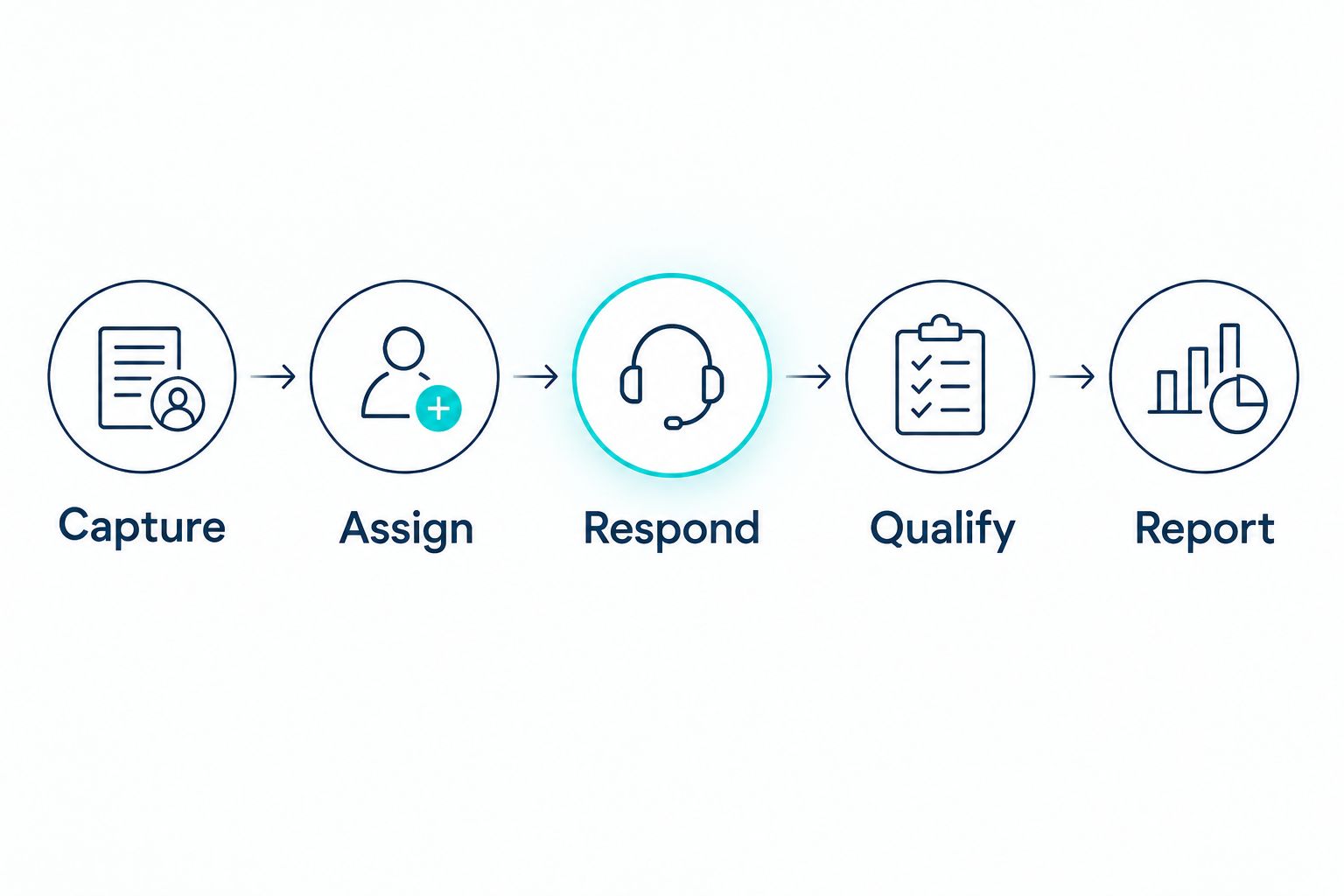
Run the records through these steps:
- Capture: Submit the enquiry with its campaign information and stated need.
- Assign: Send it to the correct owner and expose unassigned records.
- Respond: Record the next action and the information the salesperson needs.
- Qualify: Apply a shared definition of an accepted sales opportunity.
- Report: Show the outcome without manually rebuilding the journey.
Assess time saved through CRM automation against a named task, such as record assignment or follow-up scheduling, rather than treating every automated action as productive work. Record the manual steps first, then check which disappear and which still require judgement.
Follow the pilot with a 30-day review window as an internal checkpoint. Examine missing owners, stale opportunities and failed synchronisations before adding more automation. A workflow that moves bad data faster is still a bad workflow.
Connect AI visibility to sales without inventing attribution
In 2026, your CRM needs room for discovery information that analytics alone does not settle. Someone who mentions ChatGPT on a discovery call has supplied useful evidence, but not a complete record of every influence on the purchase.
Keep distinct fields for distinct types of evidence:
- Recorded source: The campaign or referral information captured with the enquiry.
- Reported discovery: What the buyer says introduced them to your business.
- Sales outcome: Whether the enquiry became an accepted opportunity or customer.
Do not overwrite one with another to produce a cleaner chart. A buyer mentioning Perplexity and arriving through a branded search can have both details recorded without forcing a single explanation.
Rivetline’s B2B marketing execution includes SEO and AI visibility alongside paid media, content and lead response. Connecting that work to sales outcomes is the requirement; claiming that every mention caused revenue is not.
Which B2B CRM should you choose?
Start with HubSpot when your central problem is connecting marketing and sales. Choose Pipedrive when focused opportunity management is the job, Salesforce when operational complexity justifies configuration, and Microsoft Dynamics 365 Sales when Microsoft integration is a defining requirement.
For your 2026 decision, write the workflow first and select the product second. Name the person responsible for administration before migration begins, and require the shortlist to demonstrate your process rather than a generic demo.
Rivetline is best for B2B companies that need ongoing marketing execution connected to lead response, not another report. CRM selection supports that work; it does not replace the acquisition, content and follow-up systems around it.
Connect marketing with sales execution
Discuss paid media, SEO, AI visibility, content and lead response in a discovery call.
FAQ
What's the best CRM software for B2B sales teams?
HubSpot is the default shortlist pick when connecting marketing and sales is the main requirement. Salesforce, Pipedrive and Microsoft Dynamics 365 Sales suit different needs: operational complexity, focused pipeline management and Microsoft alignment.
Is HubSpot better than Salesforce for B2B sales?
HubSpot is the stronger shortlist fit for connected marketing and sales; Salesforce fits defined operational complexity. Choose by demonstrating your actual workflow and identifying who will administer the system.
What's a good CRM for a small B2B sales team?
Pipedrive belongs on the shortlist when a small team primarily needs deal tracking and follow-up discipline. HubSpot also deserves consideration when shared marketing context is central to the sales process.
Should a Microsoft-based business choose Dynamics 365 Sales?
Microsoft Dynamics 365 Sales deserves evaluation when Microsoft integration is a central requirement. Existing Microsoft usage alone does not establish sales usability or remove configuration work.
Can a CRM measure leads from ChatGPT and Perplexity?
A CRM can store captured referral information, buyer-reported discovery and subsequent sales outcomes. Those records do not establish every interaction that influenced the purchase, so keep observed and self-reported information separate.
What should we test before switching CRM systems?
Test capture, assignment, response, qualification and reporting with realistic sample records. Include duplicates, incomplete data and ownership changes so the evaluation exposes exceptions rather than only ideal journeys.
Does Rivetline sell CRM software?
Rivetline is a B2B marketing execution agency, not a CRM software vendor. Its services include paid media, SEO and AI visibility, content, video, social, email, PR and lead response, backed by a live reporting dashboard.
One last thing
Test what happens when a lead arrives without campaign tracking. That record exposes whether your process has a genuine fallback or simply depends on every form and integration working perfectly.
Assign ownership, preserve the unknown source and ask the buyer how they found you. An honest unknown is more useful than a confident attribution label nobody can defend.





