

Best local SEO tools for B2B service businesses in 2026
Best overall: Google Business Profile. Best for geographic rank tracking: BrightLocal. Best for citation research: Whitespark Local Citation Finder. The best local SEO tools for B2B service businesses in 2026 cover different jobs: local discovery, search diagnostics, lead measurement, and visibility beyond Google.
- The best local SEO tools for B2B start with Google Business Profile for eligible businesses.
- Choose BrightLocal for geographic rank tracking and Whitespark Local Citation Finder for citation research.
- Use Google Search Console and Google Analytics 4 to connect search visibility with website enquiries.
- Bing Webmaster Tools adds indexing diagnostics, not proof of mentions in ChatGPT or Perplexity.
Why this matters
A facilities contractor does not need the same reporting priorities as a café. Your buyers need evidence that you serve their location, handle their requirements, and offer a clear way to enquire. A map ranking alone cannot answer whether those buyers become qualified opportunities.
Rivetline is best for B2B businesses that want local SEO and AI visibility executed alongside their other marketing channels. Its marketing execution services cover the work around the tools; Rivetline is an agency, not another software subscription.
For your 2026 shortlist, separate three questions: can buyers find you, does your website answer their questions, and do enquiries reach the right person? Choose tools against those jobs rather than buying overlapping dashboards.
What makes the best local SEO tools for B2B?
Use these criteria before choosing a platform:
- Local accuracy: Can you identify incorrect business details and keep your public information consistent?
- Geographic visibility: Can you distinguish performance near your office from performance across your service area?
- Search diagnostics: Can you investigate discovery, indexing, queries, and landing pages?
- Lead measurement: Can you connect website activity with meaningful enquiries rather than page views alone?
- Execution fit: Does someone own the fixes, content, tracking, and follow-up the tool identifies?
- AI-search discipline: Does reporting distinguish observed assistant mentions from assumptions based on conventional search rankings?
For B2B services, add a qualification check outside the SEO platform. An enquiry from the wrong territory or for a service you do not provide is not a useful outcome simply because analytics records a conversion.
Best local SEO tools for B2B at a glance
The order below starts with your public business presence, then adds specialist research and measurement. It is a buying sequence, not a claim that every business needs every tool.
| Tool | Best for | Standout capability | Key limitation |
|---|---|---|---|
| Google Business Profile | Managing an eligible business’s Google presence | Business information across Google Search and Maps | Does not measure the full sales journey |
| BrightLocal | Comparing local rankings by geography | Local Search Grid | Rankings do not establish lead quality |
| Whitespark Local Citation Finder | Researching citation opportunities | Citation discovery and competitor research | Citation work does not replace useful service pages |
| Google Search Console | Diagnosing Google website search performance | Query, page, and indexing reports | Not a map-grid tracker or CRM |
| Google Analytics 4 | Measuring website enquiry actions | Events and key events | Requires deliberate implementation |
| Bing Webmaster Tools | Investigating Bing discovery and indexing | Search performance and URL inspection | Does not verify assistant recommendations |
1. Google Business Profile: best for your Google business presence
Google Business Profile lets eligible businesses manage how their business information appears in Google Search and Maps. For a B2B service company, that makes it the starting point for your address or service-area details, contact information, hours, and reviews.
Start with accuracy. Choose categories that describe the business you actually operate, and follow Google’s eligibility and address-display rules rather than treating additional locations as ranking shortcuts.
Google Business Profile pros:
- Direct management of your Google business information.
- Customer reviews appear alongside your business presence.
- Useful foundation for location-based discovery.
Google Business Profile cons:
- Eligibility rules exclude some business models and locations.
- Profile interactions do not establish whether an enquiry became a customer.
Best for: An eligible B2B service business establishing or correcting its Google presence.
Verdict: Buy — prioritise adoption before adding specialist reporting.
2. BrightLocal: best for geographic local-rank tracking
BrightLocal provides local SEO reporting and research tools, including Local Search Grid. Use geographic rank tracking when you need to see how local visibility differs across an area rather than relying on a search from your own desk.
For a commercial service business, that distinction matters when your office location and target customer locations differ. Define the services and locations you want to investigate before configuring reports.
BrightLocal pros:
- Geographic reporting makes local ranking differences visible.
- Local SEO audits help organise investigation.
- Useful for reviewing location-based performance over time.
BrightLocal cons:
- A ranking grid does not tell you which enquiries are commercially suitable.
- Reports still require someone to implement and evaluate changes.
Best for: Businesses comparing visibility across their actual service territory.
Verdict: Buy — when geographic reporting will change what you do next.
3. Whitespark Local Citation Finder: best for citation research
Whitespark Local Citation Finder helps you research business citations and discover potential listing opportunities. Use it to investigate where business details appear and which relevant sources deserve attention.
The job is not to collect the longest directory list. Prioritise accurate information and relevant sources; do not confuse a citation opportunity with an endorsement or a guaranteed ranking improvement.
Whitespark Local Citation Finder pros:
- Focused citation discovery rather than an all-purpose dashboard.
- Competitor research helps surface sources to investigate.
- Supports a structured citation research workflow.
Whitespark Local Citation Finder cons:
- Discovery does not remove the work of evaluating or correcting listings.
- Citation research cannot fix weak service content or broken enquiry tracking.
Best for: Businesses investigating inconsistent listings or building a relevant citation shortlist.
Verdict: Hold — adopt when citation research is a defined task, not a vague SEO requirement.
4. Google Search Console: best for website search diagnostics
Google Search Console reports how your website performs in Google Search and provides indexing diagnostics. Use its query and page reports to investigate which searches bring visibility and which service pages attract clicks.
Compare equivalent periods rather than treating a single day as a trend. A 28-day reporting window is a practical starting point; keep the date range consistent when reviewing changes.
Google Search Console pros:
- Query and page reporting helps connect demand with content.
- URL inspection supports indexing investigations.
- Search performance reports distinguish impressions from clicks.
Google Search Console cons:
- It does not show a geographic map-ranking grid.
- Search clicks do not reveal whether visitors became qualified leads.
Best for: B2B teams deciding which website pages need attention.
Verdict: Buy — use it for search diagnosis, not as a substitute for lead reporting.
5. Google Analytics 4: best for measuring website enquiry actions
Google Analytics 4 measures website activity through events and lets you designate important events as key events. Configure it around actions that matter to your business, such as a completed enquiry form, rather than treating every visit as progress.
Keep actions distinct. A telephone-link click is not proof of a completed conversation, and a form submission is not proof of a qualified opportunity.
Google Analytics 4 pros:
- Event-based measurement supports specific website actions.
- Acquisition reporting helps investigate traffic sources.
- Connects landing-page analysis with tracked enquiry actions.
Google Analytics 4 cons:
- Incorrect event setup produces misleading reporting.
- Browser-based measurement does not replace sales records or qualification.
Best for: Teams that need to understand what visitors do after reaching the website.
Verdict: Buy — implement meaningful events before relying on the dashboard.
6. Bing Webmaster Tools: best for Bing indexing diagnostics
Bing Webmaster Tools provides search performance reporting and tools for investigating how Bing discovers and indexes your website. Include it when your search programme needs to cover more than Google.
For AI visibility work in 2026, keep the claim narrow: Bing indexing is something you can investigate here. It does not prove that ChatGPT, Perplexity, or another assistant recommends your company.
Bing Webmaster Tools pros:
- Provides a separate view of Bing search performance.
- URL inspection helps investigate individual pages.
- Sitemap tools support website discovery workflows.
Bing Webmaster Tools cons:
- Bing search reporting does not represent every assistant’s behaviour.
- Indexing diagnostics do not measure qualified enquiries.
Best for: B2B teams adding Bing-specific search diagnostics to their workflow.
Verdict: Buy — use it for Bing evidence, not speculative AI-visibility claims.
How this shortlist is ranked
The ranking follows the criteria above: public information accuracy first, specialist visibility research next, and measurement alongside both. These are established tool capabilities, not results from an invented product test.
Rivetline’s execution model fits around that stack: paid media, SEO and AI visibility, content, and lead response need owners. Adding software without assigning those jobs leaves the underlying work untouched.
Build a workflow, not another reporting pile
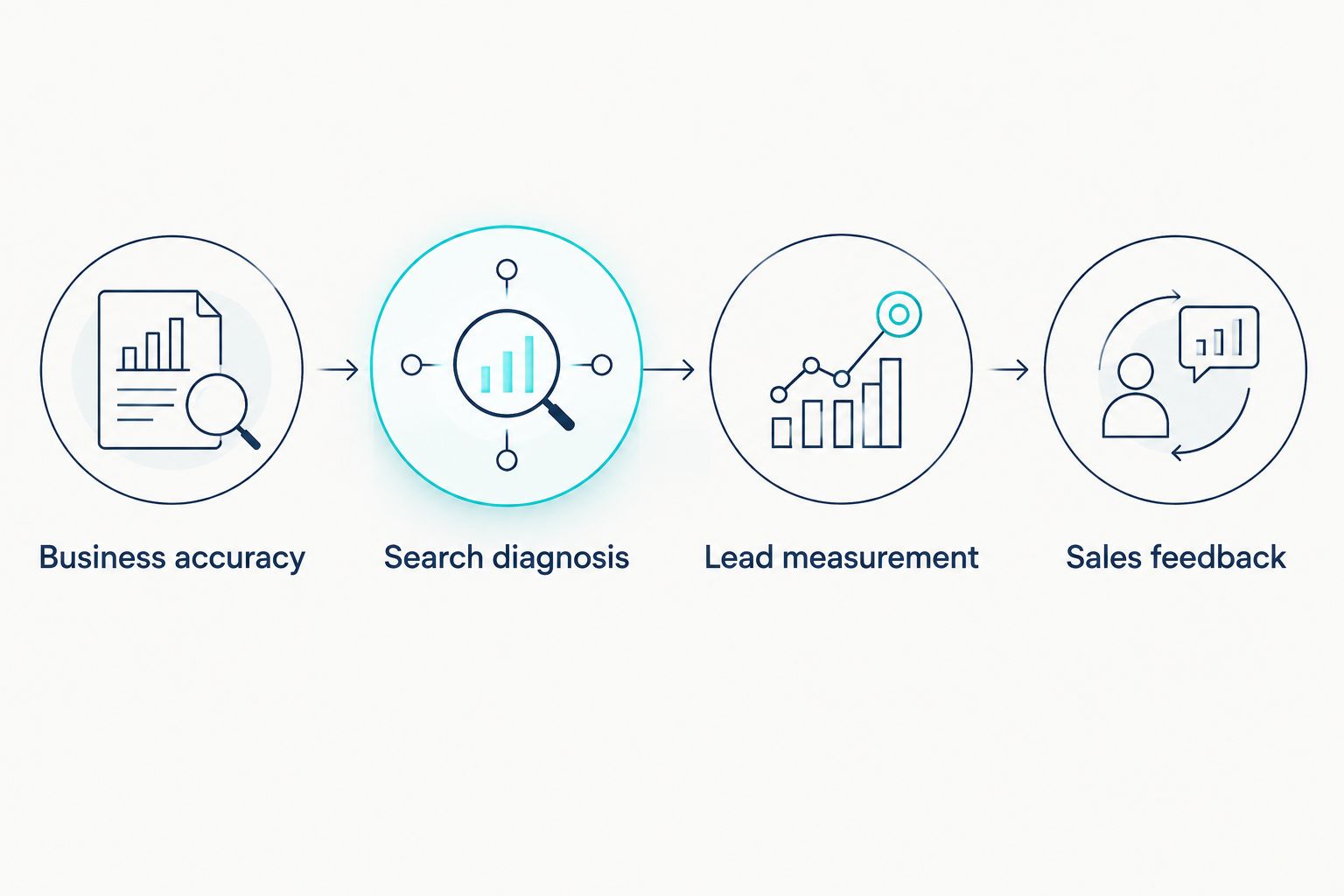
For your 2026 implementation plan, give each stage an owner and a decision. Use a 30-day setup period as a planning framework, not a promised results timeline.
- Business accuracy: Check your public details, eligibility, service areas, categories, and website contact information.
- Search diagnosis: Review indexing and query-to-page relevance. Investigate the service pages that should answer commercial searches.
- Lead measurement: Validate three action types separately: form submissions, telephone-link clicks, and booking completions where applicable.
- Sales feedback: Record whether enquiries match your services and territory. Feed that information into content and campaign decisions.
Do not wait for perfect attribution before correcting an inaccurate profile or a broken form. Fix observable problems, document the change, and compare like-for-like reporting periods.
Add AI visibility without pretending it is local rank tracking
A local ranking report and an assistant answer are different observations. Neither should be presented as proof of the other.
Create a small, repeatable set of buyer questions about your service and location. Record the exact prompt, platform, date, answer, and cited sources when checking ChatGPT, Perplexity, and Google’s AI search experiences. Results describe those observed answers, not every buyer’s experience.
Your 2026 content should make service scope, geography, customer fit, and supporting evidence explicit. Publish only claims you can substantiate. Search access and clear content support discoverability, but neither guarantees an assistant citation.
Which local SEO tools should you choose?
Start with Google Business Profile, Google Search Console, and Google Analytics 4. Together, they cover your eligible Google business presence, website search diagnostics, and tracked website actions.
Add BrightLocal when geography is a reporting question. Add Whitespark Local Citation Finder when citation research has an owner and a purpose. Include Bing Webmaster Tools when investigating Bing discovery and indexing.
Do not make all six subscriptions or accounts the success criterion. Your 2026 stack is useful when it helps someone make and evaluate a specific change.
Book a discovery call
Discuss local SEO, AI visibility, and ongoing marketing execution for your B2B business.
FAQ
What's the best local SEO tool for a B2B service business?
Google Business Profile is the starting point for an eligible business managing its Google Search and Maps presence. Add Google Search Console and Google Analytics 4 for website search diagnostics and enquiry-action measurement.
Is BrightLocal better than Google Search Console?
BrightLocal and Google Search Console solve different problems. BrightLocal supports geographic local-rank reporting, while Search Console reports website search performance and indexing.
Do B2B service businesses need citation software?
Citation software belongs in your stack when you have a defined citation research task. Whitespark Local Citation Finder supports discovery, but someone still needs to evaluate sources and act on findings.
Can local SEO tools show whether ChatGPT recommends my business?
The tools in this shortlist do not establish whether ChatGPT recommends your business. Check and document actual assistant answers separately from map rankings and search indexing reports.
Can an online-only B2B business use Google Business Profile?
An online-only business is not eligible solely because it serves customers in a particular city. Check Google's current eligibility requirements before creating a profile or displaying an address.
What should I measure besides local rankings?
Measure meaningful website enquiry actions and whether those enquiries qualify for your services. Keep telephone-link clicks, submitted forms, and sales outcomes distinct.
Should I hire an agency or buy local SEO software?
Buy software when your team can own implementation and follow-up; hire an execution agency when you need that work delivered. Rivetline provides ongoing B2B marketing execution rather than a standalone reporting product.
One last thing
Your office postcode is not your entire market. Before expanding your reporting stack, write down the locations you genuinely serve and the work you want enquiries about. Then check whether your profiles, service pages, and lead qualification process tell the same story.
Bring those priorities to a discovery call. The useful conversation is about what gets built, maintained, measured, and improved—not how many reports arrive each month.





