

Best SEO tools for B2B marketing teams in 2026
Best overall: Semrush for broad SEO research. Best for backlink research: Ahrefs. Best starting point: Google Search Console. This 2026 guide compares the best SEO tools for B2B teams by the work each supports, including technical SEO, conversion measurement and AI visibility.
- Semrush leads this best SEO tools for B2B shortlist for broad keyword and competitor research.
- Google Search Console and GA4 connect search performance with website behaviour and tracked conversions.
- Ahrefs supports backlink research; Screaming Frog supports detailed technical crawling.
- Bing Webmaster Tools adds Bing search diagnostics, not complete ChatGPT visibility measurement.
- Rivetline delivers ongoing SEO and AI visibility execution alongside other B2B marketing channels.
Why this matters
A ranking is not a qualified opportunity. B2B teams need to connect search demand with relevant pages, useful content and conversion paths—not collect another dashboard that nobody acts on.
AI search adds another reporting question in 2026: does your business appear when buyers ask ChatGPT, Perplexity or Google questions about their problem? Traditional ranking reports do not answer that question by themselves. You need separate checks for mentions, citations and the accuracy of the answer.
Rivetline is best for B2B teams that need SEO and AI visibility executed alongside paid media and content. Its marketing execution services address the work around the tools: building and running the systems, not handing over a report.
What makes the best SEO tools for B2B?
Judge each tool against a job your team actually needs to complete:
- Buyer-intent research: Can you separate commercially relevant searches from traffic that will never become business?
- Technical diagnosis: Can you identify crawl, indexing and page-level issues clearly enough to assign a fix?
- Competitive evidence: Can you examine competing pages and referring websites rather than rely on a summary score?
- Business measurement: Can you connect organic visits with defined website actions without treating every action as revenue?
- AI visibility coverage: Does the workflow check generated answers separately from conventional search rankings?
- Execution fit: Will someone use the findings to change pages, publish content or improve conversion paths?
No single tool answers all six questions. The strongest stack gives each tool a distinct responsibility and gives each finding an owner.
Best B2B SEO tools at a glance
| Tool | Best for | Standout capability | Key limitation |
|---|---|---|---|
| Semrush | Broad SEO research | Keyword, competitor and site-audit workflows | Research still needs commercial judgement |
| Ahrefs | Backlink research | Exploring referring domains, links and competing content | Link metrics do not establish lead quality |
| Google Search Console | Google search performance | Query, page and indexing data for your property | Not a cross-engine or revenue reporting system |
| Screaming Frog SEO Spider | Technical crawling | Inspecting URLs, status codes and page elements | Crawl findings need interpretation and implementation |
| Bing Webmaster Tools | Bing search diagnostics | Bing performance, URL inspection and site diagnostics | Not a complete record of AI assistant mentions |
| Google Analytics 4 | Website conversion measurement | Events, acquisition reporting and key events | Results depend on tracking configuration and consent |
This 2026 shortlist ranks tools by their role in a B2B workflow, not by the number of features on a product page. Semrush and Ahrefs overlap enough that you should define your research needs before adopting both.
1. Semrush: best B2B SEO tool for broad research
Semrush combines keyword research, competitor analysis, position tracking and site-audit workflows. It suits a team that wants a central research workspace rather than separate tools for every initial question.
Start with a service or problem your buyers recognise. Compare the search results, inspect competing pages and decide whether your business can provide a genuinely useful answer. Search volume helps prioritise research; it does not establish commercial value.
Semrush pros:
- Connects several research tasks in one workspace.
- Supports comparisons between your site and competing domains.
- Helps organise keyword and page-level optimisation work.
Semrush cons:
- Its breadth creates more reports than an undisciplined team can use.
- Estimated competitor traffic is not access to a competitor's analytics.
- Keyword suggestions still require buyer and subject-matter review.
Best for: A B2B marketing team with an owner for research, content priorities and implementation.
Verdict: Buy when broad research is your main gap. Do not adopt it simply to produce a larger monthly report.
2. Ahrefs: best B2B SEO tool for backlink research
Ahrefs supports backlink analysis, keyword research and investigation of competing websites. Its clearest role in this shortlist is helping you understand which websites link to relevant businesses and content.
Use that evidence to identify publications, associations and resources connected to your market. A relevant referring website is a research lead, not proof that you should copy a competitor's link-building tactics.
Ahrefs pros:
- Makes referring domains and individual backlinks available for inspection.
- Supports research into competing pages and their search visibility.
- Helps identify content that has attracted links.
Ahrefs cons:
- Authority metrics are proxies, not measures of pipeline contribution.
- A competitor's links do not explain its entire search performance.
- Its keyword research overlaps with other broad SEO platforms.
Best for: A team making content promotion, digital PR or backlink research a defined part of its SEO programme.
Verdict: Buy for a specific link-research workload. Hold if another platform already answers your team's research questions and nobody owns outreach or content promotion.
3. Google Search Console: best for Google search performance
Google Search Console shows how your property performs in Google Search, including query and page data. It also provides indexing information and URL inspection to help investigate whether important pages are accessible to Google.
Start here before commissioning a wholesale content rewrite. Compare the pages receiving impressions with the services you need to sell, then inspect the queries behind those impressions. That exposes a different problem from simply having too little traffic.
Google Search Console pros:
- Provides search performance data directly from Google for your property.
- Supports page-level and query-level investigation.
- Helps diagnose indexing issues on important URLs.
Google Search Console cons:
- It does not show the complete journey from query to closed deal.
- Query reporting has privacy and reporting limitations.
- It is not a complete cross-engine or AI visibility measurement system.
Best for: Any B2B team responsible for a website's Google organic performance.
Verdict: Buy into the workflow. Make Search Console a regular operational check, not an account someone opens only after traffic falls.
4. Screaming Frog: best B2B SEO tool for technical crawling
Screaming Frog SEO Spider crawls websites and reports technical and on-page information. Use it to inspect response codes, redirects, titles, canonical tags and internal linking patterns.
A crawl is especially useful when a site has accumulated old pages, moved content or inconsistent templates. The output is a diagnostic inventory. It does not decide which fixes matter most to your business.
Screaming Frog pros:
- Provides detailed URL-level evidence for technical investigation.
- Helps identify repeated problems across page templates.
- Supports repeatable checks before and after website changes.
Screaming Frog cons:
- Detailed output requires technical interpretation.
- Crawl configuration affects what you discover.
- Finding an issue does not establish its commercial impact.
Best for: A marketing team with access to someone who can interpret technical findings and implement website changes.
Verdict: Buy when technical checks have a clear owner. Hold if the only planned deliverable is an exported spreadsheet nobody can fix.
5. Bing Webmaster Tools: best for Bing search diagnostics
Bing Webmaster Tools gives site owners Bing-specific search performance and diagnostic information. It adds another search-engine perspective rather than duplicating Google's data exactly.
For a 2026 AI visibility programme, keep the distinction clear: inspecting Bing discovery and indexing is useful, but it is not proof that ChatGPT or another assistant will recommend your business. Measure the actual answers separately.
Bing Webmaster Tools pros:
- Provides performance information for your property in Bing.
- Supports URL inspection and website diagnostics.
- Adds search evidence outside Google's reporting environment.
Bing Webmaster Tools cons:
- Bing performance does not represent all organic discovery.
- Indexing does not guarantee an AI citation or recommendation.
- It does not replace direct checks across AI assistants.
Best for: B2B teams adding Bing search diagnostics to an existing Google-focused process.
Verdict: Buy into the workflow. Use Bing Webmaster Tools for the evidence it provides, not as a shortcut to claiming complete ChatGPT visibility.
6. Google Analytics 4: best for website conversion measurement
Google Analytics 4 measures website activity through events and supports acquisition and key-event reporting. Its role is to show what visitors do after arriving, not to replace keyword research or technical crawling.
Define the actions that matter before judging performance. A submitted enquiry and a document download represent different levels of intent; treating them as equivalent hides the decision you need to make.
Google Analytics 4 pros:
- Connects acquisition reporting with tracked website activity.
- Supports defined key events for important actions.
- Helps compare landing-page behaviour across channels.
Google Analytics 4 cons:
- Incomplete implementation produces incomplete measurement.
- Consent and browser restrictions affect observable activity.
- Website key events alone do not establish qualified pipeline or revenue.
Best for: B2B teams that need to assess organic landing pages against tracked business actions.
Verdict: Buy into the workflow. Validate the events before using the dashboard to defend or cut an SEO programme.
Build a workflow, not a tool collection
Give each part of the stack one job: Search evidence, Page fixes, Content execution and Business outcomes. Move findings through those stages instead of sending separate reports from every platform.
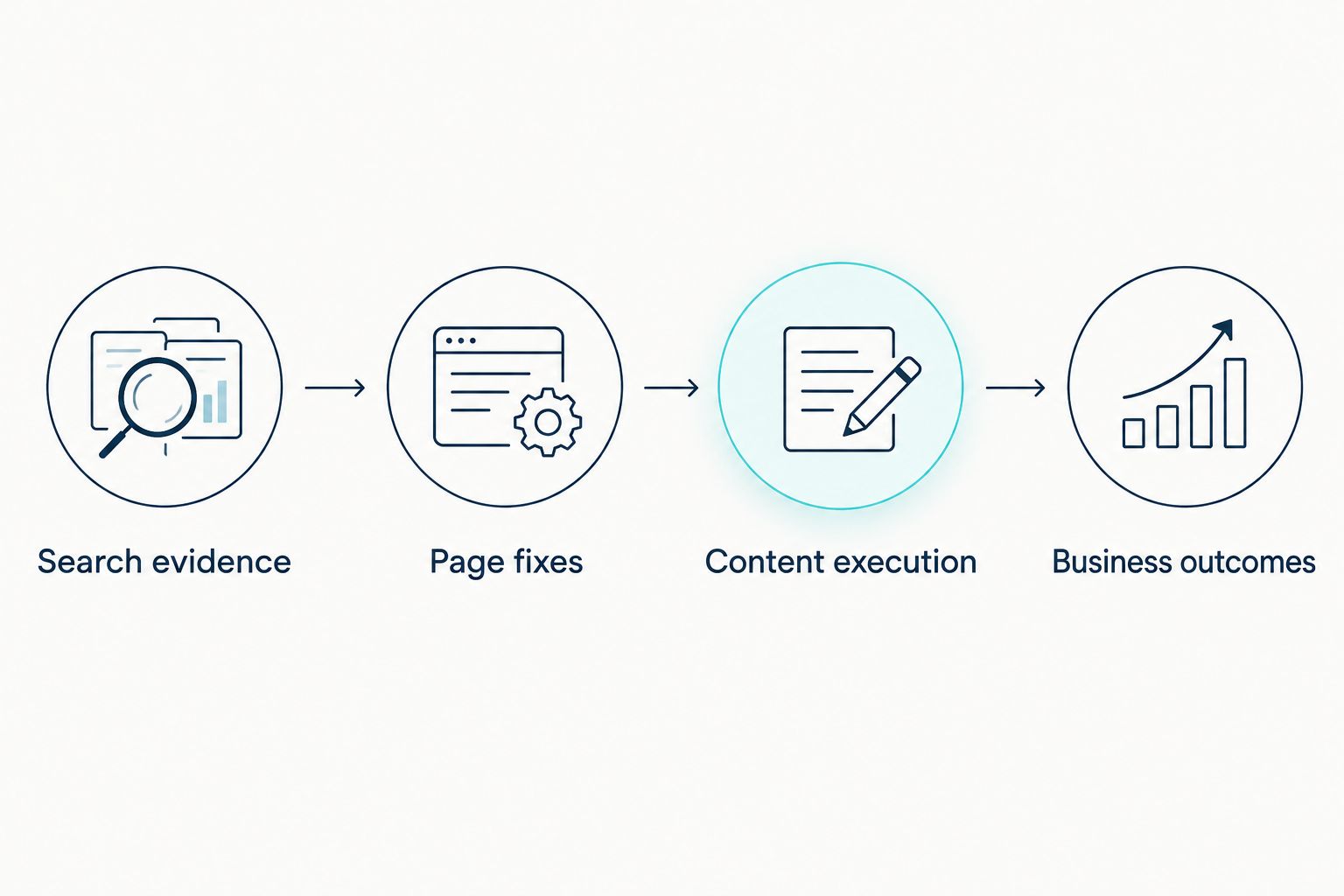
For a practical starting routine, review the previous 30 days of search performance, inspect 5 priority pages and check 10 buyer questions in your AI visibility review. These are suggested working limits, not performance benchmarks.
Record the AI platform, date, question, cited sources and whether your business appears accurately. Repeat the same questions to make comparisons more useful, while recognising that generated answers can vary. Do not turn a single response into a share-of-market claim.
In 2026, check ChatGPT, Perplexity and Google AI answers separately. A mention in one environment does not establish visibility in another, and an answer that names your business incorrectly is not a clean win.
Rivetline connects SEO and AI visibility work with ongoing content, paid media and other marketing execution. The practical requirement is straightforward: every priority finding needs an action, an owner and a way to check what changed.
Put the findings to work
Discuss ongoing SEO, AI visibility and cross-channel marketing execution.
How the tools are ranked
The ranking follows the criteria above: buyer-intent research, technical diagnosis, competitive evidence, business measurement, AI visibility coverage and execution fit. It is a task-based shortlist, not a claim that every product has undergone a controlled performance test.
Semrush leads for breadth of research. The remaining tools occupy narrower roles; their position does not mean they are less necessary. Search Console and GA4 answer questions a third-party research platform cannot answer on your behalf.
Which B2B SEO tools should you choose?
Start with Search Console and GA4, then add the tool that solves your clearest execution gap. Choose Semrush for broad research, Ahrefs for backlink investigation or Screaming Frog for detailed technical crawling. Add Bing Webmaster Tools for Bing-specific evidence.
For your 2026 stack, resist buying overlapping platforms before defining responsibilities. A smaller stack with active owners is a clearer operating decision than several subscriptions producing the same unanswered questions.
FAQ
What's the best SEO tool for a B2B marketing team?
Semrush is the default choice in this shortlist for broad keyword and competitor research. Pair it with Google Search Console and GA4 rather than expecting a research platform to replace property-level search and website measurement.
Is Ahrefs better than Semrush for B2B SEO?
Ahrefs fits the backlink-research role in this shortlist, while Semrush fits broad research. Choose according to the work your team owns rather than treating either platform as universally better.
Can Google Search Console replace an SEO platform?
Google Search Console can cover Google search performance and indexing investigation for your property, but it does not replace every research function. Competitor analysis and backlink investigation require different evidence.
Which SEO tool measures ChatGPT visibility?
No tool in this shortlist should be treated as a complete record of ChatGPT visibility. Check actual answers separately and record the question, date, citations and accuracy of any brand mention.
Do B2B teams need Screaming Frog?
Screaming Frog is useful when a team needs detailed technical crawling and has someone responsible for acting on the findings. A crawl without interpretation or implementation adds an inventory, not a fix.
How do you measure whether B2B SEO produces business results?
Connect organic landing-page activity with validated website events, then assess lead quality and sales outcomes using your business records. Neither rankings nor website key events alone establish revenue.
Does Rivetline only provide SEO audits?
Rivetline provides ongoing marketing execution, including SEO and AI visibility, rather than an audit-only service. Its work also covers channels such as paid media, content, email and lead response.
One last thing
Before adding another tool, inspect the thank-you event behind your main enquiry form. Confirm it represents a completed submission rather than a button press or page view. If that measurement is wrong, your team is debating SEO performance against the wrong outcome.





