30+ Conversions? Broad Match vs Exact Match to Scale Safely
Exact match wins on control, broad match wins on scale, and the only defensible answer is that most accounts should run both at once, deliberately, instead of treating this like a religious debate. If you have at least 30 conversions in 30 days and clean tracking, lean into broad match paired with Smart Bidding and let negative keywords do the steering. If you don’t have that volume yet, start with exact, because you can’t afford to feed a learning algorithm garbage data while it’s still guessing.
TL;DR:
- For accounts with fewer than 30 conversions in 30 days, starting with exact match ensures efficient use of limited data for Smart Bidding.
- Broad match can target close variants and paraphrases, offering expanded reach and improved performance when paired with proper negative keyword management.
- Running broad match in the same campaign as proven exact match keywords dilutes control; separate discovery campaigns help contain costs and measure effectiveness.
- Accurate measurement and negative keyword discipline are crucial; poor data quality and unvetted broad match use lead to wasted spend regardless of match type choice.
- Match types now influence machine learning signals more than targeting precision; ongoing negative management and live reporting are essential for optimal outcomes.
Table of Contents
- Broad Match vs Exact Match: What Google Actually Does With Your Keywords
- The Real Trade-Offs Between Broad and Exact
- Which Match Type Fits Your Account Right Now
- Setting Up Broad Match So It Doesn’t Wreck Your Account
- Where Accounts Actually Go Wrong
- The Governance Shift Nobody’s Pricing In
- Get Your Match Type Strategy Managed, Not Guessed At
- Sources
- FAQ
Broad Match vs Exact Match: What Google Actually Does With Your Keywords
Forget the idea that exact match locks your ad to one exact phrase. Google’s own documentation is blunt about this: every match type, including exact, is eligible to match on close variants, paraphrases, and searches that share the same intent as your keyword. Literal string matching stopped being the default years ago, and a lot of advertisers are still budgeting like it’s 2018.
Here’s what “close variant” covers in practice:
- Plurals, misspellings, and abbreviations (“running shoe” catches “running shoes”)
- Reordered function words (“hotel in Chicago” catches “Chicago hotel”)
- Paraphrases and implied intent (“book a flight” can surface for “cheapest airline tickets”)
- Same-meaning searches with different vocabulary entirely
When multiple keywords across your account are eligible for the same query, Google doesn’t flip a coin. It prefers the more restrictive match type when relevance is equal, then weighs relevance signals, then runs the whole thing through Ad Rank. That hierarchy matters more than most PPC training decks admit, because it means your match type selection is really a reach dial and a signal to the auction, not a string filter you can set and forget.
The Real Trade-Offs Between Broad and Exact
Every argument about broad match vs phrase match vs exact match eventually comes down to the same tension: reach versus control. Neither side is free.
Broad match gives you:
- Discovery you’d never find manually, including query phrasing you’d never think to bid on
- Better performance under Smart Bidding, since the algorithm gets more signal to work with
- Scale that flat-out beats exact in accounts starved for volume
The cost is real: irrelevant queries slip through if your negative keyword hygiene is lazy, and broad match without strong measurement is just an expensive way to find that out.
Exact match gives you cleaner per-keyword data, tighter cost control, and a safer runway for small budgets that can’t absorb wasted spend while they figure out what works. The trade is limited discovery and a slower scale ceiling.
CPC dynamics complicate the “exact is expensive” myth. Search Engine Land’s analysis found phrase match CPCs rose roughly 43% between June 2023 and June 2025, compared to about 29% for broad match over the same stretch. Phrase match, the supposed “safe middle ground,” is quietly becoming the most expensive lane in some accounts because of shrinking traffic share and stiffer auction competition. Exact match sometimes wins on efficiency simply because fewer advertisers are fighting over it.
Which Match Type Fits Your Account Right Now
Match type strategy isn’t a personality trait, it’s a function of your data volume and your goals. Here’s the practical breakdown:
- Under 30 conversions in 30 days: Start with exact match. You don’t have enough signal for Smart Bidding to price broad queries intelligently, and you’ll waste budget finding that out the expensive way.
- Clearing 30+ conversions in 30 days consistently: Add phrase match to widen the net without losing all control, then introduce broad match in a separate campaign once you trust your conversion data.
- Ecommerce accounts: Lean toward broad earlier. Product variety and higher query diversity mean broad match with value-based bidding often finds profitable segments a human strategist would never test.
- Lead gen accounts: Hold the line on exact and phrase longer. Lead quality is harder to measure at the query level, and a bad lead looks identical to a good one in a shallow conversion event. Enhanced Conversions for Leads helps close that gap before you loosen match types.
The 30 conversions per 30 days threshold isn’t arbitrary. It’s the rough floor practitioners and Google’s own Smart Bidding guidance point to as the minimum signal volume the algorithm needs to price traffic without guessing.
Pro Tip: Never let broad match live in the same campaign as your proven exact match performers. Give discovery its own budget and its own reporting line, so a bad week of broad match experimentation doesn’t torch the numbers on keywords you already know convert.
Build your architecture around this reality: a discovery campaign running broad, a core campaign running exact and phrase, a shared negative keyword list applied to both, and hard budget caps on the discovery side until it proves itself.
Setting Up Broad Match So It Doesn’t Wreck Your Account
Running broad match on Manual CPC is like handing someone your credit card and telling them to “figure it out.” Don’t do it. Here’s the actual setup sequence:
- Choose the right Smart Bidding strategy first. Target CPA, Target ROAS, or value-based bidding needs to be live before broad match goes anywhere near your budget. Semrush’s guidance is consistent with what every practitioner learns the hard way: broad without automated bidding is just noise with a spend cap.
- Review search terms weekly, at minimum, during the first month. Add negatives fast. A search term report you check monthly is a search term report you’re paying to ignore.
- Build shared negative keyword lists and apply them across campaigns so one bad query doesn’t have to be caught five separate times.
- Tighten your landing pages and ad copy. Google reads these as relevance signals when deciding how far to stretch a broad match keyword, so a generic landing page invites generic, low-intent traffic.
Pro Tip: Set a dollar cap on your discovery campaign that you’d be comfortable losing entirely in month one. If broad match earns its keep, raise the cap. If it doesn’t, you haven’t damaged your core account.
Where Accounts Actually Go Wrong
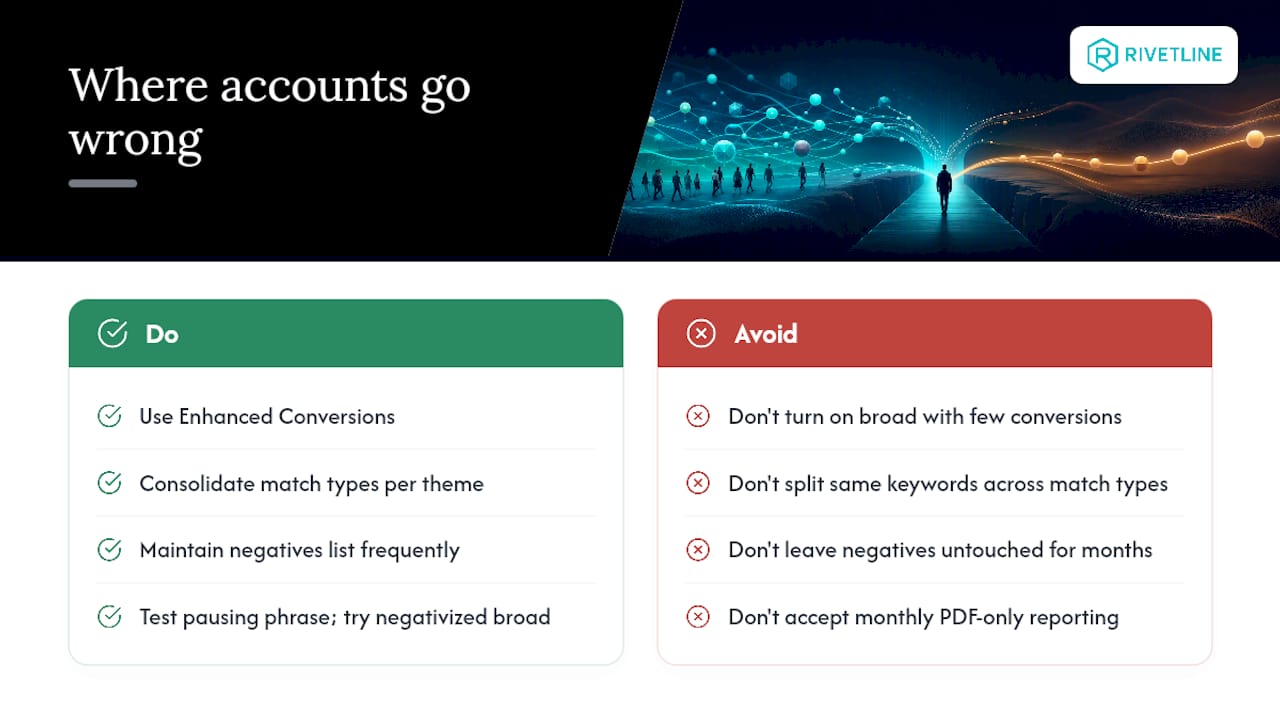
Most broad match disasters aren’t a broad match problem, they’re a measurement problem wearing a broad match costume. The pattern repeats: an advertiser turns on broad match with maybe a dozen conversions a month, no Enhanced Conversions, and a vague “form fill” as the only signal. Smart Bidding has nothing real to learn from, so it chases volume instead of value.
The second common mistake is splitting identical keywords across exact, phrase, and broad in the same ad group, which just makes the auction compete against itself. Fix it by consolidating and letting one clean match type strategy per theme do the work.
Negatives are the only dependable control surface left. Match types open the door, but negatives are what close it. If your negative list hasn’t been touched in a month, you don’t have a broad match strategy, you have an open faucet.
If phrase match CPCs keep climbing in your account the way industry data suggests they have across the board, it’s worth testing whether pausing phrase and reallocating to a tightly negativized broad campaign actually performs better. Some ecommerce accounts have reported ROAS gains after making that exact swap, though results vary by category and competition.
If you outsource this, the questions to ask are simple: Can you see the dashboard right now, or do you wait for a monthly PDF? How fast do negatives get added when a bad query shows up?
The Governance Shift Nobody’s Pricing In
Match types used to be a targeting decision. Now they’re an input into a machine-learning loop, which means your job shifted from picking keywords to managing the quality of what the algorithm learns from. Conversion accuracy, negative keyword discipline, and separate discovery budgets matter more than clever match type theory ever did.
Manual tactics built for the literal-string era are increasingly brittle. If you hire this out, hire someone who shows you live numbers and moves fast on negatives, not someone who mails you a report three weeks after the money’s already spent.
— Chris Breikss
Get Your Match Type Strategy Managed, Not Guessed At
Most agencies treat match type strategy like a “set it and forget it” checkbox, then wonder why broad match spend balloons with nobody watching the search terms report. Some agencies run Google Ads management with Smart Bidding configured from day one, conversion tracking built for accuracy instead of vanity metrics, and negative keyword lists updated quickly to prevent wasteful spending on bad queries.
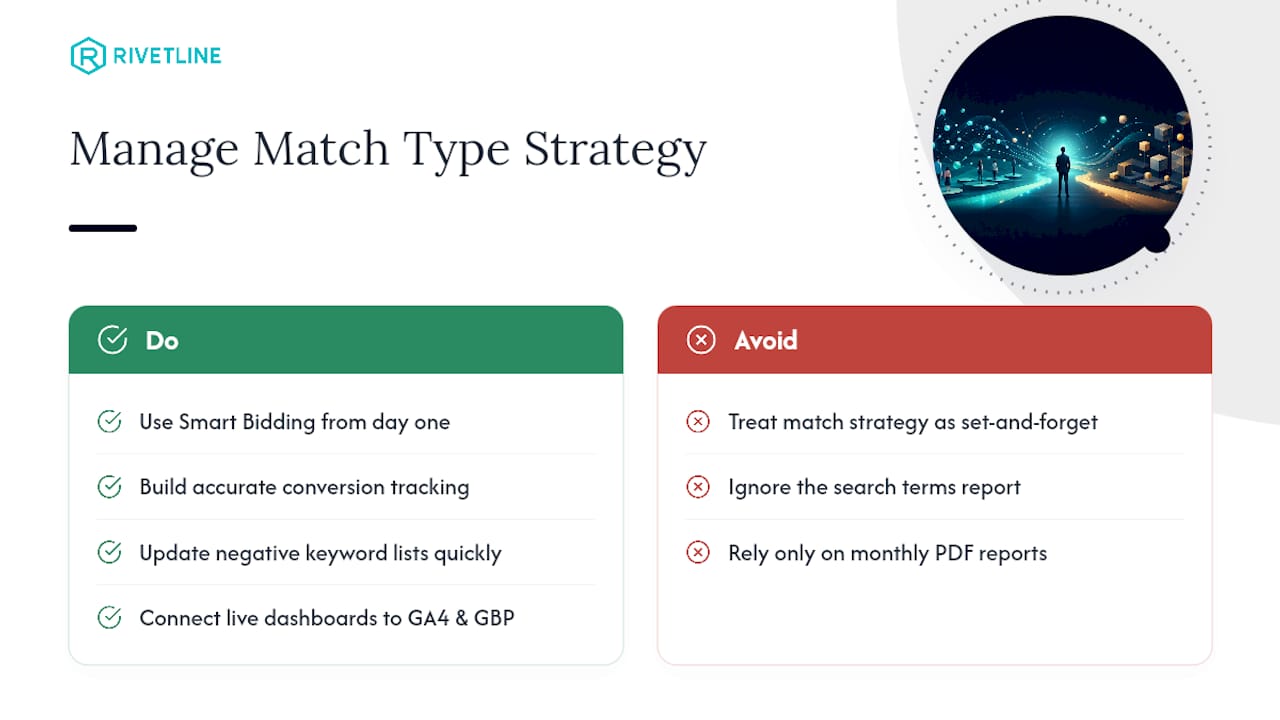
The difference shows up in reporting, too. Instead of a monthly PDF that tells you what already happened, live Looker Studio dashboards can be connected to GA4 and Google Business Profile, so match type performance, query-level profitability, and conversion quality are visible whenever needed, not just when reports arrive. If you’re weighing a broad match experiment and want someone who executes fast and reports honestly, start with a Google Ads audit at Rivetline.
Sources
- Support
- Phrase match losing ground to broad match in Google Ads (Search Engine Land)
- Keyword match types in Google Ads & SEO (Semrush)
FAQ
Should I Use Broad Match or Exact Match?
Use exact match if you’re under 30 conversions in 30 days or running a lead gen account with weak conversion signals. Use broad match paired with Smart Bidding once you consistently clear that 30 conversions per 30 days threshold and have solid tracking in place.
What Is an Example of a Broad Match?
A broad match keyword like “running shoes” can show for “best sneakers for jogging” or “shoes for marathon training” because Google matches on meaning and intent, not literal wording. This is the same close-variant behavior Google documents across all match types now, not just broad.
What’s the Difference Between Exact Match and Phrase Match?
Exact match targets a specific search intent tightly, while phrase match requires your keyword’s core meaning to appear but allows more surrounding words. Both are eligible for close variants, but exact generally gives you narrower, more predictable traffic than phrase.
Is Exact Match More Expensive Than Broad Match?
Not necessarily, and lately the opposite has been true in many accounts. Reported CPC data shows phrase match costs rising roughly 43% between June 2023 and June 2025, versus about 29% for broad, meaning phrase, not exact, has been the pricier middle ground in a lot of campaigns.