Bid Smarter or Prove Revenue: CallRail vs WhatConverts for Agencies
CallRail wins for call-heavy PPC teams that need automated conversation intelligence to feed Google Ads optimization. WhatConverts wins for agencies that need one unified lead profile and revenue reporting across calls, forms, chat, and e-commerce. The differentiator isn’t features on a checklist. It’s whether you’re optimizing bids on call quality or proving dollar-denominated ROI to a client every month.
TL;DR:
- CallRail is more cost-effective for high call volume PPC teams because of its AI-driven conversation intelligence and call-focused features.
- WhatConverts offers better value for agencies managing multiple clients with a unified lead profile, especially when manual lead tagging aligns with team workflows.
- Both platforms’ costs depend heavily on call minutes and lead volume, making custom quotes based on actual usage essential before signing contracts.
- CallRail’s stronger integration with Google Ads offline conversion tracking and GA4 can significantly improve attribution accuracy for PPC campaigns.
- Running comprehensive trials that include CRM and Google Ads offline conversion testing is critical to verify if the chosen platform delivers accurate, actionable data.
Table of Contents
- CallRail vs WhatConverts at a Glance
- How Do CallRail and WhatConverts Actually Differ?
- What Will CallRail or WhatConverts Actually Cost You?
- Which Integrates Better With Google Ads, GA4, HubSpot, and Salesforce?
- What Do Users Say About CallRail and WhatConverts?
- How Do You Choose Between CallRail and WhatConverts?
- An Agency’s Take on Where Teams Waste Money
- Get Reporting That Doesn’t Depend On Which Tool You Pick
- Sources
- FAQ
CallRail vs WhatConverts at a Glance
Both platforms track calls, both handle dynamic number insertion, and both will happily eat a chunk of your monthly tooling budget. The split shows up in what each one is actually built to obsess over.
- CallRail: built for call-heavy PPC and businesses that live or die by phone leads. Entry pricing runs around $45 per month, and minute bundles matter. Its standout feature is Conversation Intelligence, an AI layer that transcribes, scores sentiment, and flags keywords in every call.
- WhatConverts: built for agencies juggling multiple clients who need one number for “what did this campaign actually generate.” Entry pricing sits around $30 per month, with usage tied to lead volume and account profiles rather than call minutes alone.
- Tracking philosophy differs at the root: CallRail leans session based, while WhatConverts leans toward a unified lead profile that follows a contact across visits.
- Qualification differs too. CallRail leans on AI to auto score and transcribe. WhatConverts leans on structured manual tagging and value assignment inside its lead inbox.
- Reporting orientation diverges hardest here: CallRail reports on call quality and campaign performance, WhatConverts reports on revenue per lead across every channel you feed it.
- Integration maturity favors CallRail for Google Ads offline conversion workflows, while WhatConverts holds its own with HubSpot and Salesforce for CRM-side reporting.
How Do CallRail and WhatConverts Actually Differ?
The G2 comparison page lays out feature parity at a glance, but parity on paper hides real behavioral differences once you’re run either tool for a live client. Here’s where they actually diverge.
Tracking model: session data vs. unified lead profile
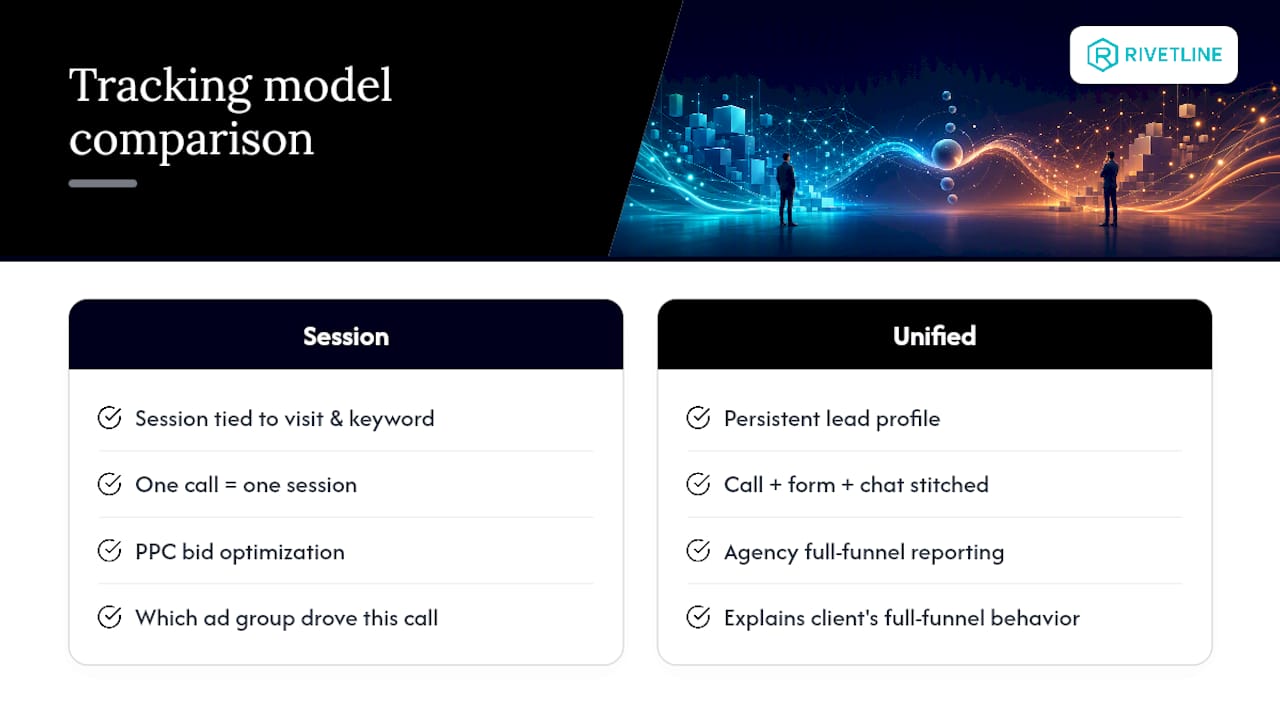
Both platforms support DNI and keyword-level attribution, but they apply that data through different lenses. CallRail treats each call largely as a session tied to a specific visit and keyword, which makes it excellent for answering “which ad group drove this call.” WhatConverts instead builds a persistent lead profile, so a contact who calls once, fills out a form two weeks later, and then chats with your site gets stitched into a single record. For a PPC manager optimizing bids, session-level attribution is the more direct signal. For an agency trying to explain a client’s full-funnel behavior, the unified profile is worth more.
Lead management and qualification
WhatConverts built its entire pitch around in-platform lead sorting: a lead inbox where you tag leads as sales, spam, or existing customer, then assign a dollar value manually. That manual step is either a feature or a chore depending on your team’s discipline. CallRail instead automates a chunk of that qualification through AI, scoring calls and flagging good ones without a human touching a tag menu.
Neither approach is objectively better. A five-person sales team that actually reviews the lead inbox daily gets enormous value from WhatConverts’ manual precision. A lean marketing team with no time for daily QA gets more out of CallRail’s automated scoring, even if it’s less exact.
Conversation intelligence: where CallRail pulls ahead
CallRail’s Conversation Intelligence transcribes calls, tags sentiment, and spots keywords automatically, and multiple comparisons treat it as CallRail’s clearest differentiator. That matters most for PPC managers who need to know, at scale, whether calls from a specific campaign are actually converting into booked jobs or just tire kickers. Instead of a human sampling ten calls a week, the system flags the ones worth listening to.
WhatConverts doesn’t compete on this front the same way, and it doesn’t pretend to. Its value proposition sits elsewhere: making sure a lead that came in as a chat message and a lead that came in as a phone call show up in the same revenue report.
Pro Tip: Don’t buy Conversation Intelligence assuming it will replace your QA process on day one. Run it against 50 to 100 calls first and compare its tags against a human review before you trust the automated scoring for bid decisions.
Channels tracked and what’s treated as “first class”
- CallRail’s core identity is calls first, with forms, chat, and text layered on.
- WhatConverts treats calls, forms, chat, and e-commerce as equally first class from day one, which shows up in how its dashboards are built.
- If your lead mix is 80% phone calls, that difference barely matters.
- If your lead mix is a genuine blend of forms, chat widgets, and calls, WhatConverts’ dashboards will feel less like a call log with extra tabs bolted on.
Data portability and account scale
Both platforms offer API access, but the practical friction shows up at scale. CallRail’s account structure splits between its Call Tracking and Lead Tracking product lines, and buyers frequently mis-select the wrong package at signup, then discover they’re missing a feature they assumed was bundled. WhatConverts’ per-profile model scales more predictably across agency sub-accounts, but it means costs climb in a straighter line as you add clients rather than plateauing.
A PPC manager running Google Ads for a single home services client uses CallRail’s Conversation Intelligence to identify which ad copy generates calls that actually convert, then shifts budget toward those ad groups within days. An agency managing ten SMB clients uses WhatConverts’ lead inbox to assign real dollar values to each lead, then hands the client a single revenue report instead of stitching together three spreadsheets. Same category of software, completely different jobs.
What Will CallRail or WhatConverts Actually Cost You?
Sticker price is the least useful number either vendor gives you. What breaks budgets is the usage layer underneath it.
WhatConverts often lists a lower entry price around $30 per month against CallRail’s roughly $45, but that gap closes or reverses fast depending on volume. CallRail bills more around minutes and Conversation Intelligence tiers; WhatConverts bills more around lead volume and the number of client profiles you’re running.
Three rough scenarios show how this plays out:
- Solo business, ~20 calls a month: either platform’s entry tier likely covers you. The deciding factor becomes whether you need AI transcription (CallRail) or a clean lead inbox for a small sales team (WhatConverts).
- Agency managing 10 client accounts: WhatConverts’ per-profile pricing adds up linearly, but so does running ten separate CallRail sub-accounts with their own minute bundles. Ask both vendors for a quote scoped to your actual client count, not a single-account rate.
- High-volume national campaign, thousands of calls monthly: CallRail’s minute overages and Conversation Intelligence add-ons can climb quickly; WhatConverts’ lead-volume fees do the same. This is the tier where a sample invoice matters more than the rate card.
Before signing anything, ask for a projected invoice built off your last 90 days of call and lead volume, including API export fees and per-minute transcription costs. And confirm which CallRail product line you’re actually buying. Call Tracking and Lead Tracking are not the same package, and vendors won’t always volunteer the distinction.
Which Integrates Better With Google Ads, GA4, HubSpot, and Salesforce?
Integration quality is where trial periods either save you money or waste three weeks of engineering time. Here’s what to actually verify.
- Google Ads offline conversion import. CallRail has a more mature, more automated pipeline for pushing call conversions back into Google Ads for smart-bidding optimization. WhatConverts supports this too, but expect more manual configuration.
- GA4 event pipeline. Both platforms can feed GA4, but confirm whether events arrive as first-party conversions or require a Zapier middle step. That distinction changes how fast your bidding algorithms react.
- CRM sync depth. WhatConverts and CallRail both connect to HubSpot and Salesforce, but native two-way sync varies by plan tier. A one-way webhook dumping leads into your CRM is not the same as a sync that updates lead status back into the tracking platform.
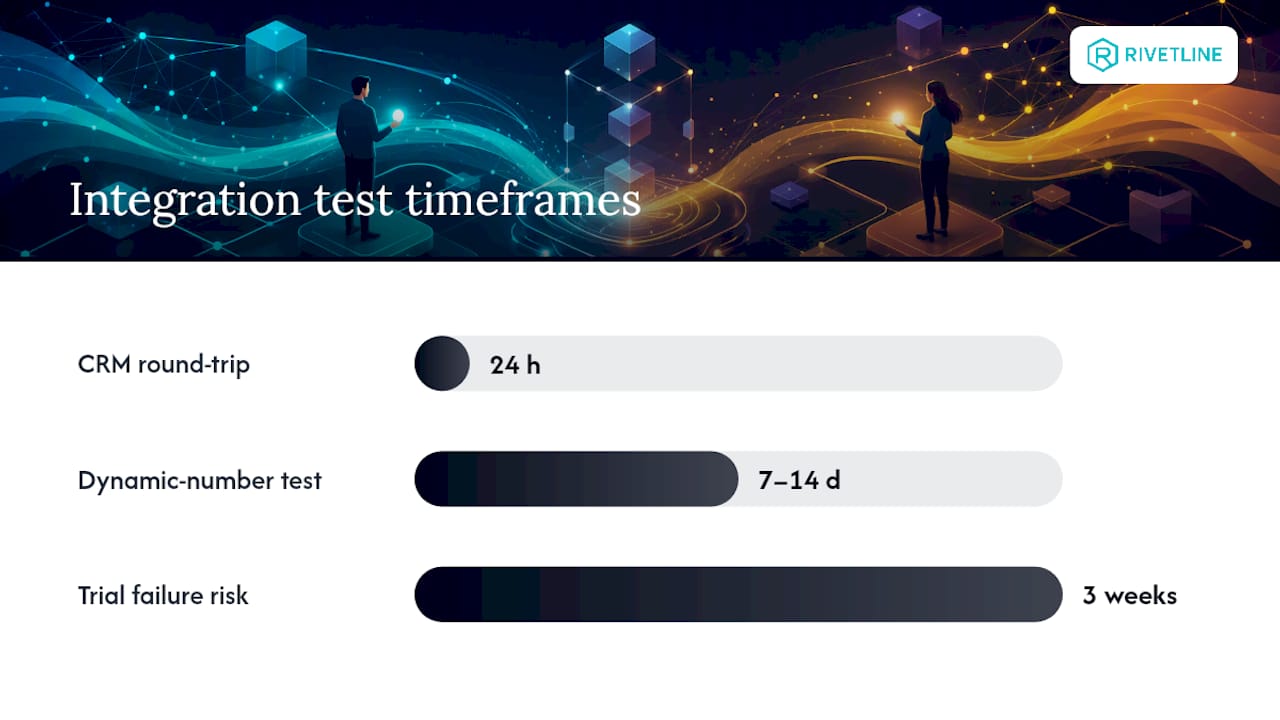
Pro Tip: During any trial, run a full round-trip test: submit a test lead, close it in your CRM, and confirm the closed-won status and dollar value flow back into the tracking platform within 24 hours. If it doesn’t, you’re buying a reporting gap, not a reporting tool.
Run dynamic number insertion for 7 to 14 days on a live campaign, then check offline-conversion timestamps against your CRM’s actual close dates. Mismatched timestamps quietly wreck attribution, and nobody notices until quarterly reporting.
What Do Users Say About CallRail and WhatConverts?
G2’s comparison metrics show both platforms landing in similar territory on ease of setup and overall satisfaction, but the complaints diverge in predictable ways. CallRail reviewers occasionally flag confusion between its Call Tracking and Lead Tracking product lines, the same packaging issue that trips up buyers at signup. WhatConverts reviewers more often mention that accurate client reporting still requires manual lead filtering rather than something fully automatic out of the box.
Treat review scores as a screening tool, not a verdict. A platform can average 4.5 stars on G2 and still be wrong for your specific mix of call volume, client count, and reporting needs. Weight your own trial data, especially the round-trip integration test, above star ratings every time.
How Do You Choose Between CallRail and WhatConverts?
Skip the feature-by-feature spiral and run this instead:
- Count your channels. If calls are 80%+ of your leads, lean CallRail. If leads are genuinely spread across calls, forms, and chat, lean WhatConverts.
- Count your managed accounts. One or two accounts, either works. Ten-plus client accounts needing consolidated reporting, WhatConverts’ model was built for that job.
- Ask whether you need revenue per lead or call quality per campaign. Revenue per lead points to WhatConverts. Call quality feeding bid decisions points to CallRail.
- Trial both against your CRM. Import sample leads, run DNI for a week, and verify offline conversion import into Google Ads actually lands.
- Read the contract for red flags: opaque overage math, no API access on your tier, or no sample client report you can show a stakeholder before signing.
Pro Tip: Ask each vendor for a sample client report before you commit. If they can’t produce one that looks presentable without heavy manual cleanup, budget extra hours every month for report building.
An Agency’s Take on Where Teams Waste Money
Conversation intelligence moves KPIs when a team actually listens to the flagged calls and adjusts bids weekly. It becomes shelfware when nobody owns that workflow. If your job is proving revenue to a client, prioritize reporting breadth over call analytics every time. Some agencies build these evaluations into client analytics setups regularly. Reach out if you want help wiring either platform into a GA4 dashboard that survives a client audit.
— Chris Breikss
Get Reporting That Doesn’t Depend On Which Tool You Pick
There are alternatives to the traditional agency retainer for teams stuck configuring call tracking themselves. Instead of spending weeks wiring CallRail or WhatConverts into your CRM and hoping the offline conversions land correctly, some agencies build the full pipeline. This can mean connecting Google Business Profile to GA4, setting up live Looker Studio dashboards to check anytime instead of waiting for a monthly PDF, and CRM syncs that round trip. Some engagements provide unified reporting across ad platforms and call tracking data within weeks, not a quarter of back and forth with a support ticket queue. If conversation intelligence and transcription tools are on your radar, this breakdown of which AI marketing features are worth automating is worth a read before you commit budget to either platform’s AI tier. Start by checking Rivetline’s analytics and reporting work and get a straight answer on what a live dashboard setup would look like for your account structure.
Sources
- CallRail vs. WhatConverts Comparison 2026 — G2
- CallRail vs. WhatConverts: Four Big Differences — WhatConverts blog
- Callrail vs WhatConverts (2026 Comparison) | The GTM Directory
- WhatConverts vs CallRail: Which Lead Tracking Platform Wins in 2026? — Listicler
FAQ
Is CallRail or WhatConverts better for PPC agencies?
CallRail generally fits PPC-focused agencies better because of its Google Ads offline conversion pipeline and Conversation Intelligence for scoring call quality against ad spend.
Does WhatConverts track calls as well as CallRail?
Yes, WhatConverts supports dynamic number insertion and call tracking, but it treats calls as one of several equally weighted channels rather than the primary focus.
Which platform is cheaper, CallRail or WhatConverts?
WhatConverts often starts around $30 per month versus roughly $45 for CallRail, but usage-based fees at scale can flip that comparison depending on call and lead volume.
Can Rivetline help set up call tracking and reporting dashboards?
Some agencies build GA4 and Looker Studio dashboard integrations tied to Google Business Profile, connecting call tracking platforms into live reporting instead of static monthly reports.
What’s the biggest mistake buyers make with CallRail’s pricing?
Confusing CallRail’s Call Tracking and Lead Tracking product lines at signup, which leads to missing features that buyers assumed were included in their package.