
50 Events to Beat Facebook Learning Limited: A Math First Playbook
Learning Limited means Meta’s delivery system doesn’t think your ad set will generate roughly 50 optimization events within any rolling seven days, so it can’t finish learning who to show your ad to. It isn’t a penalty and it isn’t your creative getting rejected on taste. Before touching a single headline or image, do the arithmetic: divide your weekly budget by your realistic cost per result. If that number sits well below 50, no amount of waiting fixes it.
TL;DR:
- Ensuring your weekly budget divided by your expected CPA exceeds 50 is critical; falling below this number means the ad set cannot generate enough optimization events.
- Refraining from frequent edits, consolidating similar ad sets, and increasing budgets are the most effective ways to promptly exit Learning Limited status.
- Tracking issues like poor pixel firing or incorrect event setup can cause underreported conversions, falsely signaling a volume problem.
- Viewing Learning Limited as a math problem rather than a creative one helps avoid unnecessary testing and preserves ad delivery efficiency.
- Patience and structural fixes are more reliable than creative refreshes, as the key to resolving Learning Limited lies in data volume, not content adjustments.
Table of Contents
- What Does Learning Limited Mean on Facebook Ads?
- How Do You Calculate the 50-Event Threshold?
- What’s the Fastest Way to Fix Learning Limited?
- What Order Should You Diagnose Learning Limited Issues In?
- Why Does Tracking Quality Cause Learning Limited?
- How Do You Scale Without Triggering Learning Limited Again?
- What a Practitioner Checklist Looks Like in Practice
- The Real Lesson Behind Learning Limited
- How Rivetline Fixes Learning Limited Without the Guesswork
- Sources
- FAQ
What Does Learning Limited Mean on Facebook Ads?
Every ad set Meta launches moves through a delivery status, and the three you’ll actually see are worth knowing cold, because marketers routinely confuse them and then panic-edit the wrong lever.
In Learning means the ad set is new, recently edited, or otherwise unproven, and Meta is actively testing audiences, placements, and creative combinations to find a stable delivery pattern. Expect volatile cost per result during this window. That’s normal, not a red flag.
Learning Limited shows up when Meta predicts the ad set won’t rack up enough optimization events to exit that learning window efficiently. The Meta Business Help Center sets that bar at approximately 50 optimization events in a rolling seven day period, not a fixed calendar week that resets on Mondays. Miss that pace and delivery gets less efficient: Meta falls back on broader, less precise targeting because it doesn’t have enough signal to be surgical.
Active is the payoff status, where the algorithm has enough historical data to deliver consistently and your CPA variance settles down.
The practical differences matter for budgeting:
- In Learning ad sets should be left alone and judged over days, not hours.
- Learning Limited ad sets need a structural fix, not patience.
- Active ad sets tolerate small optimizations without resetting.
- Editing any of the three the same way is how advertisers waste budget.
Meta’s own guidance on Learning Limited frames it explicitly as an event-volume problem, and points advertisers toward budget, audience breadth, and bid controls, not creative refreshes. That’s the whole ballgame: this status is math, not marketing.
How Do You Calculate the 50-Event Threshold?
The 50 event benchmark is a rolling window, which means Meta is constantly checking “in the last seven days, starting from right now, did this ad set generate enough events?” It’s not a countdown clock you can outlast by refreshing the dashboard on day eight.
The formula is blunt and it’s the single most useful thing you can do before opening Ads Manager: weekly budget divided by your expected cost per optimization event gives you your projected weekly event count. For example, if your expected CPA and weekly budget yield a number well below the threshold, you won’t meet the event goal. According to practitioner benchmarking work, a common rule of thumb is aiming for a daily budget roughly five times the CPA per ad set to give margin above the weekly minimum.
Three scenarios show how this plays out:
- Clear fail: $50 CPA, $300 weekly budget, resulting in a weekly event count substantially below the threshold. No optimization, no patience, no creative swap fixes this. The budget structurally cannot feed the algorithm enough data, and the only real move is consolidating spend into fewer ad sets or dropping to a cheaper optimization event.
- Marginal: $30 CPA, $1,400 weekly budget, resulting in an event count close to, but slightly under, the threshold. A modest 15 to 20% budget increase, or trimming one competing ad set, often tips this into Active.
- Healthy: $20 CPA, $2,000 weekly budget, resulting in an event count exceeding the threshold, expected to exit learning. The fix here is to leave it alone. Don’t touch it, don’t “optimize” it out of nervousness.
Statistic to remember: the 50 events in 7 days figure isn’t a Meta suggestion, it’s the documented threshold the delivery algorithm uses to judge whether an ad set has enough signal to specialize.
What’s the Fastest Way to Fix Learning Limited?
Fix arithmetic before you fix anything else. Everything below is ranked roughly by leverage, not alphabetically, because the order you attack this in determines whether you solve it in two days or two weeks.
1. Stop editing the ad set. Every meaningful edit (budget swings past 20%, targeting changes, new creative, bid strategy changes) can reset the learning phase. If you’ve been “fixing” a Learning Limited ad set every 12 hours, you’ve been resetting the clock every 12 hours. This alone quietly causes a huge share of chronic Learning Limited cases, because marketers mistake stagnant delivery for a signal to act, when it’s often a signal to freeze.
2. Run the event rate math. Budget divided by CPA. If it clears 50, patience or a tracking fix solves it. If it doesn’t, you need a structural change, not a tweak.
3. Consolidate ad sets. Five ad sets each getting $100 a day is five separate learning phases competing for the same audience and diluting your signal. Two ad sets at $250 a day each often clear the threshold with the same total account spend. This is consistently the highest-leverage move and it costs nothing extra.
4. Reallocate or raise budget. If consolidation alone doesn’t clear the math, redistribute spend from underperforming ad sets or increase the account total.
5. Loosen bid caps. A tight cost cap or bid cap that’s fighting the auction throttles delivery and event volume. Lowest Cost bidding (or Meta’s current default automated bid strategy) usually clears Learning Limited faster because it isn’t rationing your own spend against you.
6. Change the optimization event. Optimizing for Purchase when you get three purchases a week is a losing bet. Dropping to Add to Cart or a mid-funnel event can generate the volume Meta needs, at the cost of resetting learning once. Do this once, deliberately, not as your fifth panicked edit this week.
7. Audit tracking and CAPI. Events that fire inconsistently look like low volume even when real conversions are happening.
8. Improve post-click conversion rate. A faster landing page or a clearer offer generates more optimization events from the same traffic, without spending another dollar.
Pro Tip: Never duplicate an ad set to “test” a fix while the original keeps running. You just split your event volume in half across two ad sets, guaranteeing both stay Learning Limited longer than if you’d left the original alone.
Avoid over-segmenting audiences into five narrow interest groups when one broader audience would clear the event threshold on its own. Narrow targeting is the quiet co-conspirator in most Learning Limited accounts.

What Order Should You Diagnose Learning Limited Issues In?
Random troubleshooting is how advertisers burn a week fixing the wrong thing. Work this in sequence, and don’t skip ahead because a step feels boring.
- Compute expected weekly events. Budget divided by CPA, compared against 50. This single number tells you whether you’re solving a math problem or a technical problem, which changes everything downstream.
- Freeze edits, but only if the math clears. If budget divided by CPA is comfortably above 50, stop touching the ad set and hold for a full seven day rolling window before judging anything.
- Run a tracking audit. Check pixel firing, Conversions API coverage, event deduplication, and match quality. Poor signal quality masks real event volume that Meta simply isn’t crediting.
- Consolidate similar ad sets and reallocate budget into fewer, larger buckets.
- Adjust bid strategy or optimization event if consolidation alone doesn’t clear the threshold.
- Monitor checkpoints and iterate, giving each change a full rolling week before reversing it.
| Step | Success checkpoint | Failure signal |
|---|---|---|
| Event math | Projected events ≥ 50/week | Projected events well under 50, needs structural fix |
| Edit freeze | Delivery stabilizes over 7 days | Status stays Learning Limited despite no edits |
| Tracking audit | Match quality improves, event count rises | Events still underreported after CAPI check |
| Consolidation | Combined ad set clears 50 events | Still under threshold even combined |
| Bid/event change | CPA stabilizes within a week | CPA spikes or volume drops further |
Practitioner audit sequences built on this order, as outlined by Venture Lab, consistently point to the same lesson: advertisers who consolidate and audit tracking before touching bids resolve Learning Limited faster than those who jump straight to budget increases.
Why Does Tracking Quality Cause Learning Limited?
A pixel-only setup routinely under reports real conversions, because ad blockers, iOS privacy settings, and browser restrictions quietly eat a chunk of your events before Meta ever sees them. Your funnel might be converting fine while Meta’s delivery engine sees a fraction of that activity and concludes you’re not generating enough signal to specialize.
Implementing Conversions API sends event data server-side, bypassing a lot of that loss, and it materially improves how many events Meta can actually match and credit. This is frequently the fix advertisers skip because it takes an afternoon of setup instead of five minutes in Ads Manager, and it’s often the highest-leverage change on this entire list.
Common technical failures worth ruling out:
- Events firing on the wrong page (a “Purchase” event on a confirmation page that only 60% of buyers actually load).
- Deduplication errors that cause pixel and CAPI to send Meta two records for one real conversion, or worse, cancel each other out.
- Inconsistent parameter mapping between platforms, where a “lead” in your CRM never matches a “Lead” event in Ads Manager.
Pro Tip: Use Meta’s Events Manager test tool to fire a real test conversion and watch it land in real time. If it doesn’t show up within a minute or two, you’ve found your Learning Limited culprit before touching your budget at all.
Run through this short checklist before assuming your problem is budget: verify events are firing on the correct action, confirm event match quality in Events Manager, check that dedup rules aren’t silently dropping legitimate events, and walk your own purchase or lead funnel start to finish to confirm nothing breaks silently.
How Do You Scale Without Triggering Learning Limited Again?
Prevention is mostly account discipline, and most of it comes down to resisting the urge to build more ad sets every time you have a new idea.
Keep concurrent ad sets per campaign objective limited. Three focused ad sets each hitting the event threshold beat eight fragmented ones splitting the same traffic. Batch your edits into weekly windows instead of daily tinkering, since every stray change risks a fresh learning reset. When you want to test new creative, drop it into an existing, already-stable ad set rather than spinning up a new one for every variant.
- Consolidate similar audiences instead of running near-identical ad sets against slightly different interest stacks.
- Scale budget in steps of roughly 20% rather than doubling overnight, which can trigger a fresh learning phase.
- Split an ad set only when it’s clearly overloaded (too many creatives competing for the same budget); consolidate when several thin ad sets are each individually starved for events.
- Test multiple creatives inside 3 to 5 broader ad sets rather than one ad set per creative, so each ad set still clears the 50 event bar on its own.
That last point solves the tension advertisers feel between “I want to test everything” and “I need each ad set to hit volume.” You don’t have to choose. Group the tests, keep the ad set count sane, and let volume do the work of finding a winner.
What a Practitioner Checklist Looks Like in Practice
A careful first pass on any Learning Limited account runs the same five steps every time: CPA math, event health, edit history, structure consolidation, then a controlled test rollout. It’s boring on purpose. Boring is repeatable.
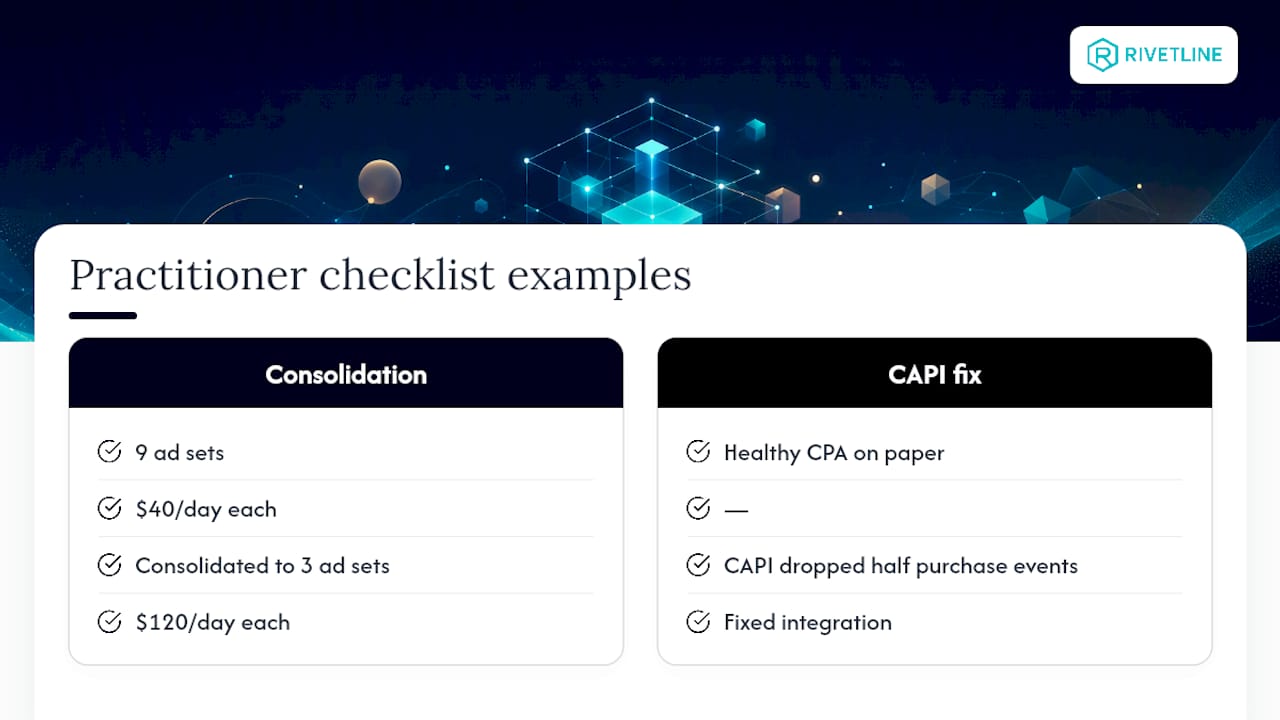
One account came in running nine ad sets at $40 a day each, targeting near-identical lookalikes. Consolidating into three ad sets at $120 a day cleared the 50 event threshold within one rolling week, no budget increase required. Another account had healthy math on paper but was stuck Learning Limited for a month; the culprit was a broken CAPI integration silently dropping half its purchase events. Fixing the integration resolved it in four days.
Marketers who want a managed audit instead of guessing their way through Ads Manager can bring Rivetline in to run this exact sequence against their account.
The Real Lesson Behind Learning Limited
Most advertisers treat Learning Limited as a creative problem because that’s the lever they’re most comfortable pulling. Swap the image, try a new headline, tweak the copy. It feels like action. It’s usually theater, and it usually makes things worse by resetting a learning phase that was already close to clearing.
The conventional advice, “refresh your creative when performance stalls,” is fine general practice, but it’s the wrong first move for this specific status. Learning Limited is a volume and signal problem before it’s ever a creative problem, and the fix lives in a calculator, not a design tool. Budget divided by CPA against 50 tells you more in ten seconds than a week of creative testing will.
Where I’d push back hardest on industry habit: agencies love to bill for constant “optimization,” which in practice means daily micro-edits that keep resetting the learning clock and keep the client paying for activity that looks like progress. Real fixes are quieter. Consolidate, audit tracking, fix the arithmetic, then leave it alone for a full rolling week. If your funnel and budget can support 50 events, patience is the strategy. If they can’t, no amount of patience or creative polish changes that math.
— Chris Breikss
How Rivetline Fixes Learning Limited Without the Guesswork
There are plenty of ways to chase this problem yourself: forum threads, spreadsheet calculators, trial and error inside Ads Manager while your budget quietly burns. Expert providers run the diagnostic instead of the guesswork, doing the CPA math, auditing Conversions API setups, consolidating fragmented ad sets, and rolling out fixes in a controlled sequence instead of five simultaneous changes that make it impossible to know what actually worked.
A typical engagement starts with an audit against the checklist above: event math, tracking health, edit history, structure. From there it continues with prioritized fixes, a monitored rollout over the following weeks, and reporting through live Looker Studio dashboards tied to GA4, not a static report that’s stale by the time you read it. If your account has been stuck in Learning Limited for weeks and you’re tired of editing things that don’t move the needle, talk to Rivetline about a managed Meta Ads audit and get the arithmetic sorted before your next dollar goes out the door.
Sources
FAQ
What Does Learning Limited Mean on Facebook Ads?
It means Meta predicts your ad set won’t reach roughly 50 optimization events within a rolling seven day window, so delivery stays inefficient until that volume problem gets fixed.
How Do You Fix Learning Limited Facebook Ads?
Stop editing the ad set, calculate whether your budget divided by your CPA clears 50 events a week, then consolidate fragmented ad sets, adjust your optimization event, or raise budget based on what the math shows.
How Do You Exit the Learning Phase on Meta Ads?
Give the ad set a stable seven day window without major edits while it accumulates optimization events; if the underlying budget and CPA can’t support 50 events in that window, a structural change like consolidation is required first.
Why Is My Ad Still Stuck in Learning Phase?
Frequent edits reset the learning clock every time they happen, so an ad set that looks stuck is often being repeatedly restarted by well-meaning but constant tweaks rather than genuinely failing to learn.