Stop Chasing Counts: Build Verifiable LLM Citations That Actually Stick
An LLM citation is a per-answer reference that links a specific claim in a model’s output back to a retrievable source, whether that’s a footnote, a source card, or an inline pill. It matters because it’s the closest thing to a trust signal AI search has, and it’s the mechanism that decides whether your brand gets mentioned or gets skipped. The fastest way to earn one: write short, self-contained, quotable passages that name a source and can survive being pulled out of context.
TL;DR:
- Most AI systems produce citations inconsistently, with roughly half of medical claims supported by sources and many responses lacking full verification.
- Post-hoc verification and structured output methods significantly improve citation accuracy but require extra computational steps and careful implementation.
- Building citation infrastructure benefits from deliberate chunking, paired retrievers and rerankers, and explicit citation tagging to enhance source traceability.
- Citation quality metrics like recall, precision, and support are essential to measure, but most teams focus on only one, often overestimating their actual reliability.
- Relying solely on citation counts or brand mentions misleads; continuous, real-time audit of actual source support and verification processes is the best strategy for trustworthy AI outputs.
Table of Contents
- What Are LLM Citations, Exactly?
- How LLMs Decide What to Cite
- Generation-Time, Post-Hoc, or Hybrid: How Citation Systems Actually Work
- How to Build a System That Produces Verifiable Citations
- How Do You Measure Citation Quality?
- How to Earn LLM Citations: The Actual Playbook
- Where Citations Go Wrong: Hallucination and Misattribution
- Rivetline’s Take: Stop Chasing Citation Counts
- Sources
- FAQ
What Are LLM Citations, Exactly?
Forget the backlink comparison for a second, because it’s the wrong mental model. A backlink is permanent, indexed, and crawlable on your own schedule. An LLM citation is a runtime decision. The model generates (or retrieves) an answer, decides a claim needs support, and attaches a reference on the fly. Close the session and the citation is gone. Ask the same question tomorrow and you might get a different source entirely.
Citation formats vary by engine, but you’ll typically see:
- Pills or chips: small numbered markers inline with the text that expand to show the source
- Footnote lists: sources compiled at the bottom of the response, Perplexity’s default style
- Source cards: visual previews with a headline, domain, and snippet
- Grounding metadata: raw structured data (used in tools like Anthropic’s citation features) that ties a span of generated text to an exact source passage
Statistic Callout: Citation behavior isn’t uniform across engines. Some platforms favor forums and video content, with Reddit and YouTube regularly appearing among the most-cited domains across many verticals, while others skip citations altogether depending on the query. If you’re optimizing for “AI visibility” as a single monolithic target, you’re already behind. Each engine has its own appetite.
How LLMs Decide What to Cite
Every citation an LLM produces passes through roughly four stages, and most content fails at the third one without anyone noticing.
- Retrieval: the system pulls candidate documents or passages from an index, often a vector database, sometimes a live web search
- Ranking: candidates get scored on relevance, authority, and freshness, then reordered
- Extraction: the model or a sub-process pulls the specific span of text that supports a claim
- Attribution: that span gets linked back to its source and rendered in the output format
Ranking is where brand authority, content structure, and freshness signals compete. Query fan-out (the model silently generating multiple sub-queries from your one question) means a page can win on one sub-query and lose on another, which is why citation behavior looks inconsistent even for near-identical prompts.
Extraction is the quiet killer. A page can rank well and still get skipped because the model can’t cleanly pull a self-contained answer out of it. Buried claims, answers split across three paragraphs, and vague topic sentences all fail here. This lines up with the finding that roughly 44.2% of AI citations come from the first 30% of an article, because that’s the content most likely to have already delivered a clean, quotable claim before the model has to work for it.
Ranking signals that matter most:
- Structural clarity (clear H2s, one claim per paragraph)
- Freshness (dated content, updated stats)
- Demonstrated authority (named sources, credentials, external validation)
Generation-Time, Post-Hoc, or Hybrid: How Citation Systems Actually Work
There are three architectural approaches to producing citations, and the choice has real consequences for accuracy.
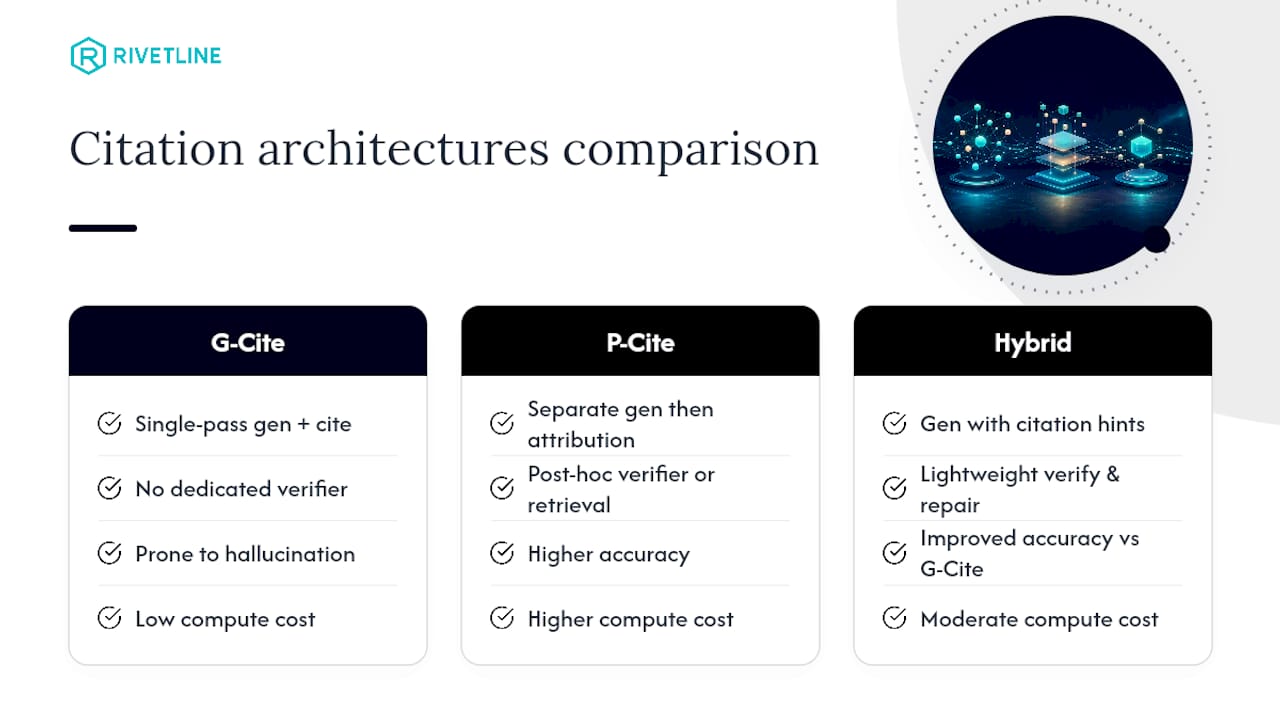
Generation-time citation (G-Cite) has the model attach sources while it writes the answer, in a single pass. It’s fast and cheap to run, but it’s also the approach most prone to hallucinated or mismatched sources, because the model is citing from memory or a loosely constrained context window rather than verifying against retrieved text.
Post-hoc citation (P-Cite) separates generation from attribution. The model writes the answer first, then a second pass (often a retrieval step or a verifier model) goes back and matches claims to sources. This holistic comparison of generation-time versus post-hoc citation found post-hoc consistently improves accuracy at the cost of extra compute and latency.
Hybrid pipelines try to get the best of both: generate with loose citation hints, then verify and repair with a lightweight second pass rather than a full re-retrieval.
Most production RAG systems layer on reranking to push precision higher without a full second generation pass. Toolkits like Citekit, an open-source, modular pipeline with four modules and fourteen swappable components, exist precisely so teams can test retrieval, ranking, and citation components independently instead of guessing which layer is underperforming. Agent-based approaches like CiteGuard take a different angle, using retrieval-augmented validation to check attribution after the fact, and reportedly improve citation attribution accuracy by roughly 10 percentage points over prior baselines.
Pro Tip: If you’re building a citation-aware system and only have budget for one improvement, add a post-hoc verification pass before you touch your retriever. Fixing attribution after generation is cheaper than trying to make generation perfectly grounded from the start.
How to Build a System That Produces Verifiable Citations
Building citation infrastructure isn’t exotic anymore, but most teams still skip steps that cause silent failures later.
- Chunk deliberately. Split source documents into passages of 200 to 500 tokens, and store metadata with every chunk: source URL, document ID, character offsets, author, and publish date. Without offsets, you can’t point back to the exact sentence that supports a claim.
- Pair a retriever with a reranker. Use a vector database for initial candidate retrieval, then rerank the top results for citation precision specifically, not just topical relevance. A tuned reranker can push citation precision from roughly 50% to 80% in experimental setups, without retraining anything.
- Set a rerank threshold. If your top retrieved passage scores below that threshold, retrieve more candidates before generating. Don’t just hand the model a weak match and hope.
- Force structured output. Have the model emit citations as explicit tags (
<cit id="3">) or a JSON schema with claim, source_id, and confidence fields, rather than freeform inline text. Structured output is what makes parsing and validation reliable downstream. - Design the UI deliberately. Inline pills work well for short answers; footnote lists suit long-form responses; grounded spans (highlighting the exact matched text) build the most trust but cost the most engineering effort.
- Choose single-pass or multi-pass based on the stakes. Single-pass generation-time citation is fine for low-risk, high-volume use cases like internal search. Multi-pass verification is worth the latency hit for anything customer-facing, medical, financial, or legal.
The metadata step is the one teams cut first under deadline pressure, and it’s the one that makes every later fix nearly impossible. If you don’t store offsets and document IDs at ingestion, you can’t retrofit attribution later. You’ll be rebuilding your index.
How Do You Measure Citation Quality?
Four metrics matter here, and most teams only track one of them.
Citation recall measures whether every claim that needed a source got one. Citation precision measures whether the sources attached actually support the claims. Response-level support is a stricter, holistic check: does the entire answer hold up, not just individual sentences. Citation granularity measures how precisely a citation points, a full document link is weak granularity, a linked sentence span is strong.
The ALCE benchmark formalized much of this evaluation, scoring systems on fluency, correctness, and citation quality together, and it found that even strong models produce responses without full citation support on roughly half of some test sets.
| Metric | What it checks | Common tool |
|---|---|---|
| Citation recall | Every claim has a source | ALCE-style scoring |
| Citation precision | Sources actually support the claim | NLI entailment models |
| Response-level support | Whole answer holds together | Human or LLM-as-judge review |
| Citation granularity | Precision of the pointer (doc vs. sentence) | Manual audit |
Statistic Callout: A Stanford-led evaluation using an automated framework (SourceCheckup) found response-level support for GPT-4o with RAG enabled landed around 55% on sampled medical queries, hardly a passing grade for anything safety-critical.
Automatic NLI entailment checks catch a lot, but LLM-as-judge scoring has known blind spots on domain-specific claims. Budget for human spot checks on any high-stakes vertical.
How to Earn LLM Citations: The Actual Playbook
Most content teams are still optimizing for the last decade’s search engine. Here’s what actually moves the needle for AI citation instead.
On-page, lead every section with the answer in the first sentence, not the third paragraph. Keep the supporting claim to two or three sentences with a named source and a link, because that’s the shape extraction layers are built to grab. Use one claim per paragraph. Structure H2s and H3s so the first sentence under each one could stand alone if quoted.
Off-page, and this is the part most SEO teams underweight, build genuine third-party presence. Forums, vertical publications, and video all feed engines that pull from a wider net than your own domain. Practitioner data summarized by Eastbound’s LLM SEO research found that adding authoritative inline citations lifted absorption by roughly 115%, and direct quotes added another 43% lift on top of that. Third-party mentions of your brand are consistently the single highest-leverage move, often outperforming on-page tweaks entirely.
- Add named-source quotes and statistics linked to primary research, not just claims stated flat
- Write one extractable, self-contained answer per section
- Track selection rate (how often you’re retrieved) separately from absorption rate (how often you’re actually cited in the final answer)
- Run controlled experiments: publish two versions of a page, one with lead-with-answer structure and one without, and compare citation rates over a few weeks
Pro Tip: Skip the temptation to stuff FAQ schema and JSON-LD everywhere as a shortcut. Schema helps engines parse structure, but it does nothing to make your prose quotable. Extraction layers read sentences, not markup.
Where Citations Go Wrong: Hallucination and Misattribution
The failure rates here are not a rounding error. That same Stanford evaluation found 50% to 90% of LLM responses were not fully supported by their cited sources across the medical queries tested, and ALCE’s benchmarking work found comparable unsupported-citation rates on general knowledge tasks.
Mitigation that actually works in production:
- Add a verification reranker that scores citation precision before the answer ships
- Route flagged low-confidence answers to a human reviewer rather than auto-publishing
- Require human-in-the-loop review for any medical, legal, financial, or safety-related content, no exceptions
For U.S. readers publishing AI-assisted content in regulated categories: citation accuracy doesn’t change your underlying legal exposure for false or misleading claims, so treat an unverified AI citation as a draft, not a source.
Rivetline’s Take: Stop Chasing Citation Counts
Most agencies are selling clients on “citation tracking” dashboards that count mentions and call it strategy. That’s busywork. A citation count with no context on whether the underlying claim was even accurate is a vanity metric wearing a lab coat.
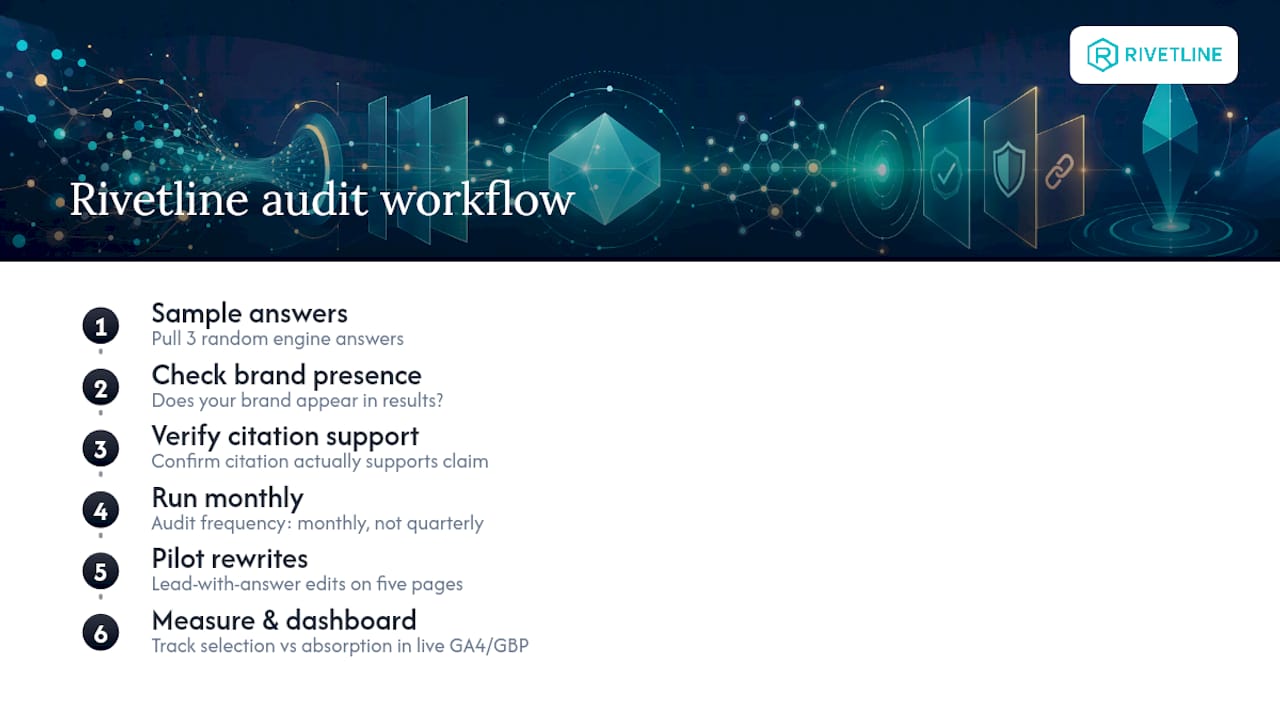
What we test instead: pull three random answers from the engines your audience actually uses, check whether your brand shows up, and if it does, check whether the citation actually supports what you said. Run that audit monthly, not quarterly. Then pilot one structural change, lead-with-answer rewrites on five pages, and measure selection versus absorption separately.
This is exactly the kind of thing that dies in a monthly PDF nobody reads. We build live dashboards tied to GA4 and Google Business Profile so you can watch citation and visibility trends shift in real time instead of waiting for a quarterly recap that’s already stale by the time it lands in your inbox.
— Chris Breikss
Sources
For deeper technical grounding, the ALCE benchmark remains the reference point for citation quality metrics. Citekit offers a working, modular implementation worth cloning if you’re building your own pipeline. CiteGuard documents a retrieval-augmented approach to attribution validation. The Stanford SourceCheckup evaluation is essential reading for anyone shipping medical or safety-adjacent content. For assembling a retrieval and evaluation stack from scratch, Baitless’s practical AI tools guide for researchers covers tooling options worth testing.
- An automated framework for assessing how well LLMs cite relevant medical references (Stanford / SourceCheckup)
- CiteGuard — retrieval-augmented agent for citation attribution (ACL 2026)
FAQ
What counts as a citation in an LLM response?
A citation in an LLM response is any explicit link between a generated claim and a retrievable source, shown as a footnote, inline pill, or source card, depending on the engine.
How do you get an LLM to cite your content?
Write short, self-contained passages that lead with the answer, name a specific source or statistic, and structure each section so its first sentence could stand alone as a quotable claim; build genuine third-party mentions off-site as well.
Does ChatGPT give real citations?
ChatGPT can produce real, working citations when web browsing or retrieval is enabled, but independent evaluation found response-level support for cited claims lands around 55% on some query sets, so verify anything high-stakes rather than trusting the link at face value.
Which tool is best for building or evaluating citations?
For evaluation, the ALCE benchmark is the standard reference. For building your own pipeline, Citekit offers a modular open-source toolkit, and CiteGuard is worth studying for attribution-validation patterns.