Small Businesses: Local SEO Audit That Becomes a 30/60/90 Plan
A local SEO audit gives you a prioritized list of fixes ranked by how much they’ll move your map-pack and organic visibility, not a 40-page PDF nobody reads. The first check, every time, is your Google Business Profile and NAP consistency, because a mismatched phone number or wrong category quietly tanks everything you build after it. Run that check, work the checklist below in order, and re-audit every six to 12 months.
TL;DR:
Prioritize fixing Google Business Profile categories, NAP consistency, and reviews from the start, as these influence both map pack and organic rankings.
Focus on low-effort, high-impact issues like correcting NAP across major directories and updating GBP descriptions with specific, searchable details.
Regularly audit technical site health, schema markup, and local keyword targeting to ensure search engines accurately interpret your business information.
Concentrate on building relevant, recent backlinks from local sources and actively managing reviews to improve visibility and trust.
Use live dashboards to track progress and re-audit every six to 12 months to prevent drifting and maximize local SEO results.
Table of Contents
What a Local SEO Audit Actually Covers
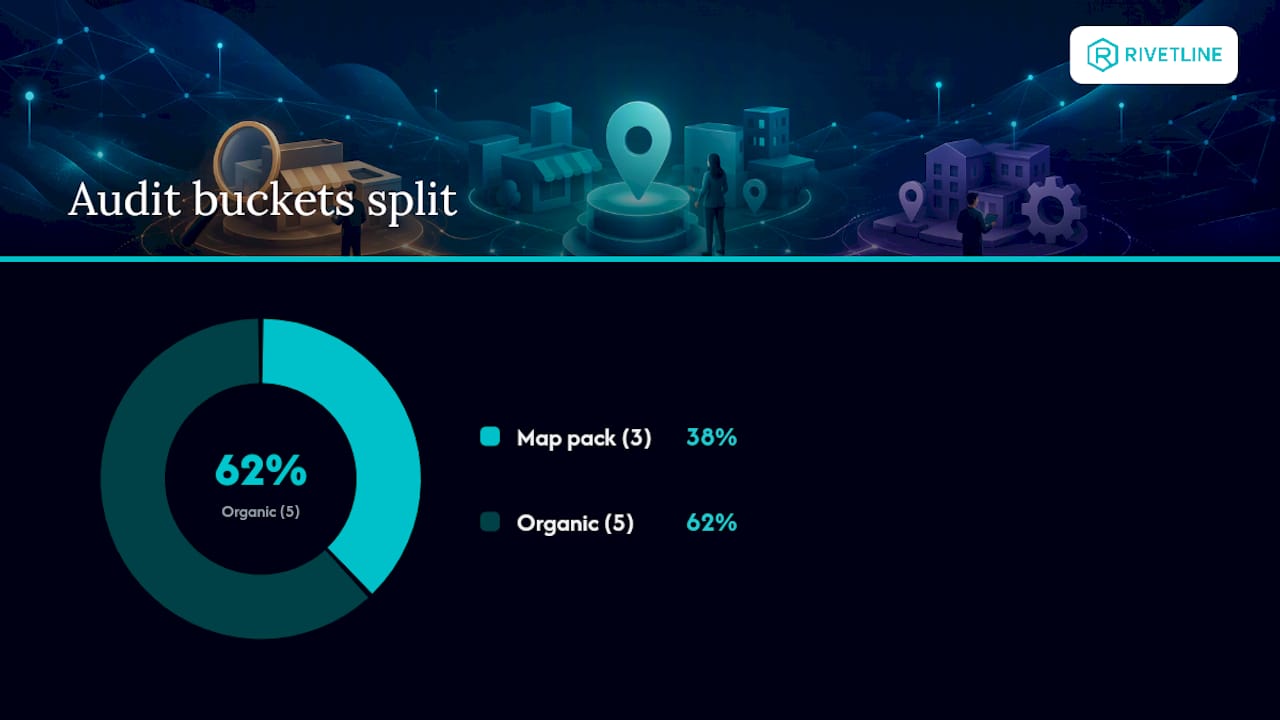
A real audit looks at eight buckets: Google Business Profile, citations and NAP consistency, reviews, technical site health, structured data, local content, backlinks, and analytics. Miss one and you’re optimizing half the puzzle, because local SEO splits into two distinct systems: the map pack (GBP, citations, reviews) and organic blue links (your site’s content and backlink profile). Most business owners audit one and ignore the other, then wonder why rankings stall.
Run this review every six to 12 months, and search engine journal experts recommend that same window as the sweet spot for catching drift before it costs you rank position.
To prioritize what you find:
Score each issue on impact (how many searches or conversions it likely touches) versus effort (hours or dollars to fix).
Fix high-impact, low-effort items first. Always.
Batch medium-impact items into a monthly sprint.
Park low-impact items until you’ve cleared everything above them.
Is Your Google Business Profile Actually Complete?
Most GBP listings are “complete” in the sense that nothing is technically blank. That’s not the same as optimized. Check your primary category first. This is the single field with the most influence over which searches trigger your listing, and half the businesses I look at have picked something vague when a more specific option exists.
Confirm your service-area settings match where you genuinely operate, not where you wish you operated.
Rewrite your business description using the full 750 characters with specific services, neighborhoods, and terminology customers actually search, not marketing fluff.
Verify phone number, website URL, and regular hours, then set special and holiday hours weeks in advance.
Seed your own Q&A section with the questions customers actually ask.
Upload current photos and keep listed services and attributes consistent with what you offer today.
Pro Tip: A specific, factual GBP description beats a polished marketing one almost every time, because both AI Overviews and human searchers are extracting facts, not vibes.
Unattended special hours also trigger automated “temporarily closed” flags around holidays, which can quietly kill your visibility for a week you can’t afford.
How Do You Audit NAP Consistency and Citations?
Start by writing down your canonical Name, Address, and Phone number exactly as it should appear everywhere. Then scan the directories that matter: Google Business Profile, Apple Maps, Yelp, Bing Places, and the data aggregators that feed dozens of smaller sites. Consistent NAP citations are the foundation everything else stands on, and inconsistent listings are one of the most common reasons a business fails to crack the local pack.
Once you’ve collected your citation list, classify each result:
Editable listings you control directly, so fix them yourself immediately.
Uneditable third-party mentions that require outreach or a claim request.
Duplicate listings that need suppression rather than editing.
Old addresses or former phone numbers still floating around from a business move.
Fix GBP, Apple, and Yelp first. Those three carry the most weight and the most traffic, so everything else waits its turn.
What Should a Review Audit Prioritize?
Volume matters less than recency and distribution. A business with 400 reviews from three years ago loses to a competitor with 60 reviews trickling in weekly. Here’s the order to work through:
Pull your review count, average rating, and posting cadence across every platform you’re listed on, not just Google.
Identify unanswered reviews, especially negative ones sitting for more than a few days, and build two response templates: one for legitimate complaints, one for public trolling.
Set a policy for requesting reviews that stays inside platform guidelines. No review-gating, no incentivized reviews.
Decide which platforms deserve active attention based on where your industry’s customers actually browse. A restaurant lives and dies on Google and Yelp; a B2B service might care more about Google and industry-specific directories.
Is Your Website Passing a Technical Audit?
Your Google Business Profile can be flawless and still lose if the website behind it loads slowly or blocks crawlers. Check your robots.txt file, submit and verify your sitemap, and confirm canonical tags aren’t pointing local pages at the wrong URL. Then pull your Google Search Console index coverage report and see what’s actually indexed versus what you think is indexed.
Run a mobile usability test and a page-speed audit, and treat Core Web Vitals (CLS, LCP, TTFB) as non-optional for local landing pages.
Search your own site for thin or near-duplicate location pages that should be merged or expanded with real content.
Review your internal linking to confirm local pages are actually reachable within a few clicks from the homepage.
Local search increasingly happens on a phone in someone’s hand while they’re standing outside your competitor’s storefront, and device-usage data for local search backs up why mobile experience deserves priority over desktop polish in almost every audit.
Does Your Structured Data Pass Validation?
Schema markup is the part of an audit most SMBs skip entirely, which is a mistake now that AI systems lean on structured data to answer questions directly. Confirm you’re running LocalBusiness schema on every location page, then run it through a validator to catch syntax errors and conflicting fields, like two different phone numbers in your schema versus your visible page content.
Verify NAP fields in your schema match your canonical NAP exactly.
Add Service or Product schema alongside LocalBusiness when you sell distinct offerings worth surfacing individually.
Fix conflicting or duplicate schema blocks that confuse crawlers.
Recheck after any site redesign, since schema is often the first casualty of a template swap.
Clean structured data feeds rich results in traditional search and gives AI Overviews cleaner facts to pull from.
Are Your Local Pages Targeting the Right Keywords?
Pull the actual queries triggering your local pages in Search Console before assuming you know what people search. Map each target page to a specific intent, whether that’s “near me” commercial intent or informational research further from a purchase decision.
Audit thin location pages that read like a mail-merge with the city name swapped out, and rebuild them with real local proof: neighborhood references, local case details, staff who work that market.
Rewrite meta titles and H1s to include the specific service and location instead of generic boilerplate.
Strengthen internal links between related local pages and your core service pages.
Consolidate duplicate templated pages that dilute authority instead of building it, since ten weak pages rank worse than three strong ones.
Which Backlinks Are Actually Helping Your Local Rankings?
Run a backlink analysis and separate links into two piles: locally relevant or high-authority, and everything else. A link from your regional chamber of commerce or a local news outlet often outperforms a generic directory link with more raw authority behind it.
Search for unlinked brand mentions and request links from sites that already wrote about you.
Pursue partnerships with local publications, sponsorships, or industry associations that naturally link back.
Prioritize outreach toward sites with a local readership over broad, low-relevance directories.
Flag toxic or spammy links and disavow them only when they’re demonstrably hurting credibility, not as a reflexive cleanup habit.
What Should You Track in Search Console and GA4?
Google Search Console tells you which queries actually trigger your local pages and whether map-pack impressions are climbing or sliding. Check index coverage first, since a page that isn’t indexed can’t rank no matter how well you’ve optimized it.
Set up GA4 events for calls, direction requests, bookings, and contact form submissions, the actions that actually indicate local intent turning into revenue.
Build a simple Looker Studio dashboard pulling GSC and GA4 data into one view instead of checking three separate tabs weekly.
Add rank tracking for your priority local keywords if you need finer-grained movement data than impressions alone provide.
How Do You Turn Audit Findings Into a Real Plan?
Score every finding on impact versus effort, then bucket the results instead of tackling them in the order you found them.
Days 1 to 30: Fix GBP errors, correct NAP mismatches on major platforms, and clear the review-response backlog. These are low-effort, high-impact, and usually free.
Days 31 to 60: Rebuild thin location pages, implement or fix schema, and resolve the technical issues surfaced in Search Console.
Days 61 to 90: Launch backlink outreach and any larger content expansion that needs more lead time.
Assign one owner per bucket, review progress every two weeks, and schedule your next full audit for six months out.
Pro Tip: If you can only do one thing this month, fix your GBP category and NAP consistency. Everything else compounds on top of that foundation, and nothing else compounds if that foundation is wrong.
How Rivetline Turns Audit Findings Into Ranking Wins
An audit that sits in a spreadsheet doesn’t move rankings. Rivetline runs the checklist above, then converts every finding into a scored task list tied directly to KPIs inside GA4 and a live Looker Studio dashboard the client can check anytime, not a monthly PDF summarizing what already happened.
The quick wins are almost always the same three things: a miscategorized GBP listing, a phone number that doesn’t match across five directories, and a location page that hasn’t been touched since 2021. Fix those and map-pack visibility usually moves within the first reporting cycle.
Most engagements see GBP and citation fixes reflected in impressions within weeks, with organic and map-pack ranking movement following as technical and content fixes take effect over a few months.
The Checklist Isn’t the Hard Part, Follow-Through Is
Here’s what the research and the checklist above actually prove: the audit itself isn’t where SMBs fail. Anyone can run a Google Business Profile check or scan a citation tool. Where the conventional advice falls apart is the assumption that finding the problems is the same as fixing them. It isn’t. I’ve seen more “completed audits” gathering dust in a shared drive than I’ve seen audits that actually changed a ranking.

The industry also oversells volume. Chasing 500 reviews or blanketing 40 directories with citations feels productive and moves almost nothing compared to fixing three wrong phone numbers on your highest-traffic platforms. Effort and impact are not the same axis, and most SMBs default to whichever tasks feel busiest rather than whichever tasks actually score highest.
If you take one thing from this, prioritize ruthlessly and re-check your work. An audit without a 30/60/90 triage plan is just a diagnosis with no treatment. And a treatment plan without live reporting, whether that’s a Looker Studio dashboard or your own spreadsheet, means you’ll never know which fix actually worked and which one you wasted a week on.
— Chris Breikss
Get an Audit That Turns Into a Ranking Plan, Not a PDF
Rivetline is the alternative to a traditional agency for local SEO audits: you get a prioritized roadmap in weeks, not a 40-page report that sits unread while your competitor fixes their GBP category first. The process runs audit, prioritized fix list, execution, then live GA4 and Looker Studio dashboards you can check whenever you want, without waiting on a monthly call to find out what happened.
For businesses that want an even sharper read on how AI systems are surfacing (or ignoring) their listings, tools like BabyLoveGrowth’s AI search audit are worth running alongside a traditional local audit. Read more on AI visibility and reporting on the Rivetline blog, then request a free local SEO audit and get your prioritized fix list before your competitor does.
Sources
FAQ
How Often Should I Run a Local SEO Audit?
Every several months, though businesses with multiple locations or frequent listing changes should check GBP and NAP consistency more frequently.
What’s the First Thing to Check in a Local SEO Audit?
Google Business Profile accuracy and NAP consistency across major platforms, since errors there undercut every other fix you make.
Do I Need Schema Markup for Local SEO?
Yes. LocalBusiness schema helps search engines and AI systems extract accurate facts about your business, and it supports eligibility for rich results.
How Long Before a Local SEO Audit Shows Results?
GBP and citation fixes often show impression movement within a month; technical and content fixes typically take 60 to 90 days to fully register.
Should I Run the Audit Myself or Hire an Agency?
You can run the checklist yourself with tools like Google Search Console and a spreadsheet, but an agency like Rivetline turns findings into a scored, executed plan with live reporting instead of a static report.