$30,000+/Month Ecommerce: Mailchimp vs Klaviyo for Revenue
Klaviyo wins for ecommerce brands that live and die by revenue-attributed email, thanks to its native Shopify data and pre-built automation flows. Mailchimp wins for newsletters, service businesses, and anyone whose list doesn’t need to know what a customer just bought. The split gets messy once you cross roughly $30,000 a month in revenue or lean on SMS, so check the feature breakdown below before you commit either budget or migration time.
TL;DR:
- Klaviyo is more cost-effective for large, active ecommerce lists because it charges only for engaged profiles, unlike Mailchimp which bills for all contacts regardless of activity.
- Behavior-based segmentation and pre-built automations in Klaviyo drive revenue directly from store data, often justifying its higher monthly cost within a few billing cycles.
- Migration should prioritize mapping store events and rebuilding key flows, with most projects taking two to four weeks and requiring careful testing of revenue attribution before full switch-over.
- Platforms’ integration depth with Shopify, WooCommerce, and BigCommerce is crucial; Klaviyo’s real-time product and order data boosts automation conversion, especially for Shopify stores.
- For brands relying heavily on SMS marketing, Klaviyo’s integrated channels provide better workflow parity and revenue potential than Mailchimp’s limited SMS offerings.
Table of Contents
- Mailchimp vs Klaviyo at a Glance
- Pricing, Automation, and Integrations: Where the Real Differences Live
- Pros and Cons of Each Platform
- Which Platform Fits Your Business Stage?
- What Migrating From One Platform to the Other Actually Takes
- What Rivetline Sees Working (and Failing) for Ecommerce Clients
- The Honest Take on This Whole Debate
- Get Migration and Attribution Set Up Right the First Time
- Sources
- FAQ
Mailchimp vs Klaviyo at a Glance
Here’s the shortcut version, for readers who don’t want to read 3,000 words to find out they should’ve picked Klaviyo three months ago.
- Ease of use: Mailchimp is faster to learn. Klaviyo has a steeper ramp but rewards the climb with automation most Mailchimp users never touch.
If you’re running a newsletter for a coaching business or a local bakery, Mailchimp’s lower entry cost and friendlier interface make sense. If you’re running a store that lives on repeat purchases and abandoned carts, the calculus flips: Klaviyo costs more per month, but the attributed revenue it surfaces usually justifies the premium within a couple of billing cycles. The tradeoff isn’t complicated. It’s just uncomfortable if you’ve already built three years of campaigns in Mailchimp and don’t want to touch them.
Pricing, Automation, and Integrations: Where the Real Differences Live
Most “Mailchimp vs Klaviyo” comparisons stack feature checklists side by side and call it a day. That’s lazy, because the checklists look similar. The gap only shows up once you follow the money.
How the billing actually works
Mailchimp charges based on total contacts, including people who unsubscribed months ago. Klaviyo charges based on active profiles and excludes suppressed contacts entirely. Pricing mechanics matter more than the sticker price: a store with a messy list can end up paying Mailchimp for contacts it no longer emails, while Klaviyo bills only for active recipients.
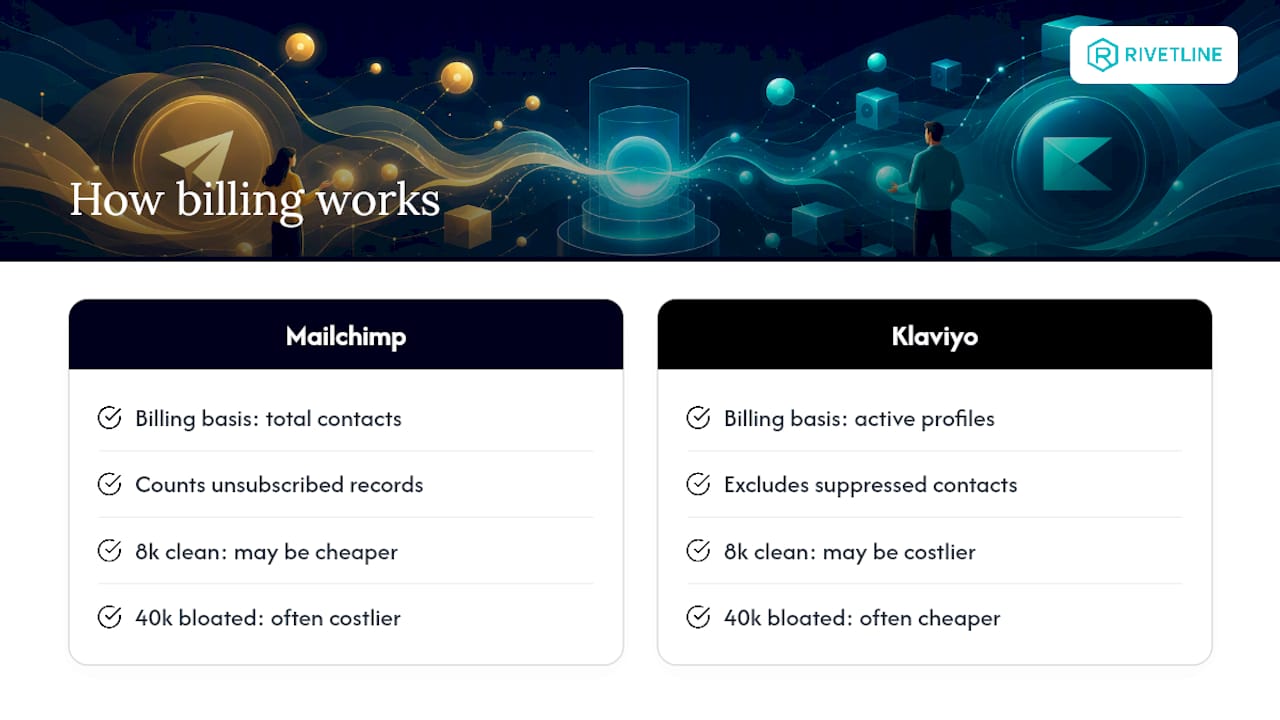
Run the numbers before you assume Mailchimp is cheaper. A six-month-old Shopify store with 8,000 contacts and a clean list might genuinely pay less on Mailchimp. A three-year-old store with 40,000 contacts and a bloated unsubscribe pile often finds Klaviyo cheaper in practice, because it isn’t billing for dead weight.
Segmentation and automation: the gap that actually costs you money
Mailchimp segments on generic attributes: email engagement, tags, custom fields you set up yourself. Klaviyo segments on what your store actually knows: last order date, predicted lifetime value, specific products browsed but not bought, categories abandoned in a cart. That’s not a minor UX difference. It’s the difference between “email everyone who opened a message in the last 90 days” and “email everyone who viewed a $200 jacket twice this week but didn’t buy.”
Klaviyo is engineered for ecommerce, with native Shopify integration pulling transactional data into behavior-based journeys, while Mailchimp is built for simpler, list-based sends. That’s why Klaviyo ships pre-built flows for browse abandonment, post-purchase upsell, and win-back sequences that reference actual SKUs. Mailchimp’s automation exists, but it’s generalist. You can build similar logic manually, but you’ll spend hours recreating what Klaviyo hands you on day one.
There’s a well-documented failure pattern here worth naming directly: teams pick Mailchimp because it’s easy, grow past what “easy” can support, then migrate to Klaviyo anyway, paying twice in setup time and losing months of better-attributed revenue along the way. If you already know your store will scale past casual newsletter sends, that detour costs more than starting on the right platform.
Integrations: Shopify, WooCommerce, BigCommerce
Both platforms connect to the major ecommerce platforms. The depth of that connection is where they diverge.
- Klaviyo: pulls order data, product catalog, and browsing events for dynamic content and predictive segments across Shopify, WooCommerce, and BigCommerce.
- Mailchimp: connects order and customer data too, but the segmentation layered on top stays closer to basic purchase tags than behavioral prediction.
- Both: support abandoned cart triggers, though Klaviyo’s version typically includes richer product imagery and cross-sell logic out of the box.
If your store runs on Shopify specifically, Klaviyo’s native integration is repeatedly cited as the reason its ecommerce value proposition holds up: it’s not that Klaviyo has more features on a spec sheet, it’s that pulling live product and order data into flows is what actually converts feature depth into revenue instead of just looking good in a demo.
Channels and SMS: when text messages decide the platform
Klaviyo includes SMS, push notifications, and WhatsApp as part of its core platform, built with the same segmentation logic as email. Mailchimp sells SMS as a bolt-on with more limited country coverage and less workflow parity with email campaigns. If your brand relies on SMS as a primary revenue channel, rather than an occasional flash-sale blast, that gap alone can decide the platform question before pricing even enters the conversation.
Editor, templates, and reporting
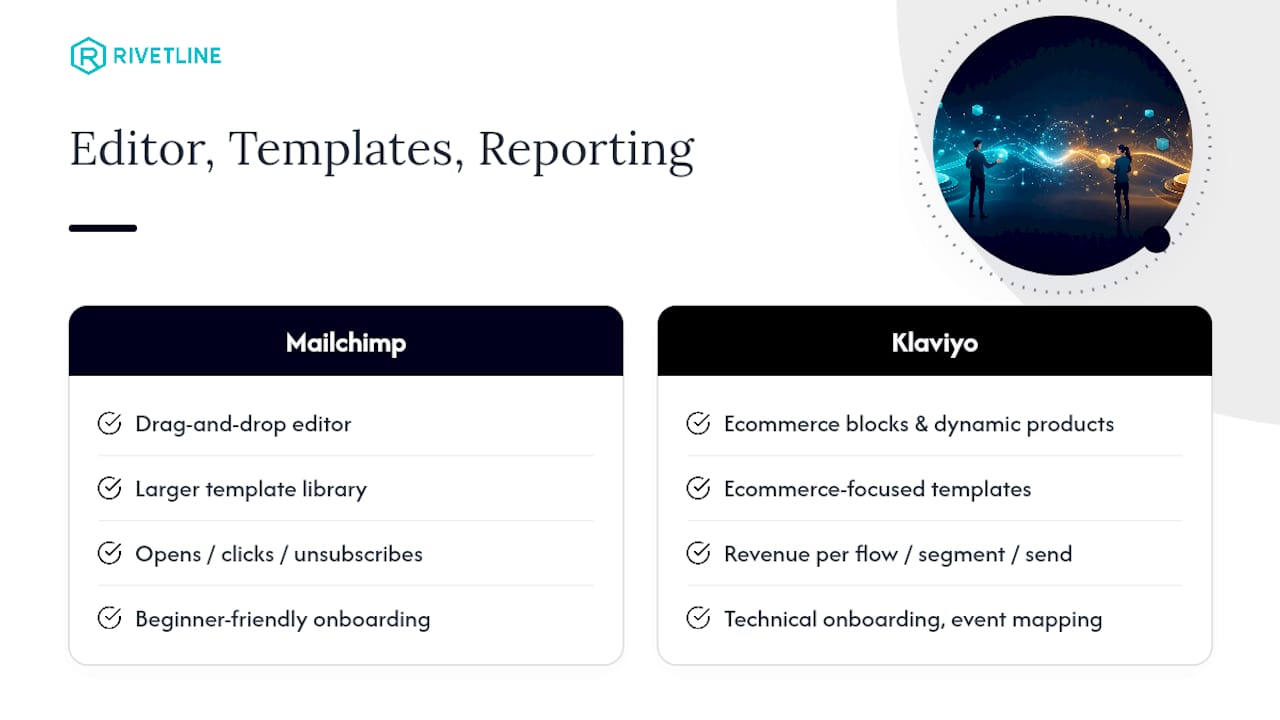
Mailchimp’s drag-and-drop editor and template library remain genuinely strong, particularly for non-ecommerce senders who just want something that looks decent fast. Klaviyo’s editor has closed the gap but leans toward ecommerce-specific blocks, dynamic product recommendations, and content that pulls live catalog data. Mailchimp is friendlier for beginners with a larger template library; Klaviyo is friendlier for anyone who wants a product grid that updates itself.
Reporting is where the philosophical difference is sharpest. Mailchimp tells you opens, clicks, and unsubscribes. Klaviyo tells you dollars: revenue per flow, revenue per segment, revenue per send, tracked against the specific campaign that generated it. That shift changes how you budget. When a flow shows $4,200 in attributed revenue for the month, the conversation with your finance team about renewing the platform gets a lot shorter.
Statistic Callout: For many direct-to-consumer stores, Klaviyo’s native Shopify integration and included automation typically pay for the platform quickly by converting routine store events, an abandoned cart, a browsed product, a completed order, into revenue-driven flows that Mailchimp’s generalist segmentation doesn’t replicate.
Pro Tip: Estimate payback before you migrate anything. Take your projected conversion lift from a single high-value flow, multiply by average order value and repeat purchase rate, then compare that number against the incremental monthly cost of the new platform. Many DTC stores recoup Klaviyo’s premium within 30 to 90 days once flows are configured and tracked correctly, but only if you actually run the math instead of guessing.
On support and onboarding, both platforms offer live chat and documentation at paid tiers. Klaviyo’s onboarding assumes more technical comfort, since you’re mapping events and building segments from day one. Mailchimp’s onboarding is friendlier precisely because it asks less of you, which is exactly the tradeoff that creates the ease-of-use trap discussed above.
Pros and Cons of Each Platform
Stripped of the marketing copy, here’s what each platform is actually good and bad at.
Klaviyo pros:
- Deep native Shopify integration that turns order and browsing data into revenue-generating segments.
- Advanced segmentation built on predictive metrics, not just tags you set manually.
- Built-in revenue attribution per flow and per campaign.
- Native SMS, push, and WhatsApp with workflow parity to email.
Klaviyo cons:
- Higher cost, especially at mid-size list volumes.
- Steeper learning curve for teams without a dedicated email or analytics person.
- Setup requires more upfront mapping of store events and flows.
Mailchimp pros:
- Faster onboarding and a genuinely large, well-designed template library.
- Lower entry price for small lists and simple use cases.
- Simpler interface for teams that just need to send a newsletter.
Mailchimp cons:
- Segmentation and automation are shallow compared to what ecommerce brands actually need.
- Billing counts unsubscribed contacts, which quietly inflates cost on older lists.
- Revenue attribution is limited, making it hard to prove email’s actual contribution to sales.
Which Platform Fits Your Business Stage?
Before picking a side, check four things: your monthly revenue, how much your campaigns depend on store data, whether SMS matters to your channel mix, and whether you have anyone in-house who can actually read an analytics dashboard.
- Newsletter or service business with no product catalog to segment against. Mailchimp. You don’t need behavioral flows for a weekly content digest.
- Small store testing whether email drives real revenue. Either platform works, but the answer depends on how much you need order-level data. If you’re just sending a monthly promo, Mailchimp is fine. If you want to know which product page triggered which sale, start on Klaviyo now instead of migrating later.
- Scaling DTC brand doing $30,000 or more per month. Klaviyo. At this stage, the revenue-attributed automation pays for itself, and the migration cost of waiting only grows.
- Enterprise or multi-store operation. Klaviyo, generally, though this is also the point where bringing in outside help to design the flows correctly pays off faster than a solo build.
- Rule of thumb: if you can’t answer “how much revenue did last month’s email program generate” with a specific number, that’s usually a sign you’ve outgrown Mailchimp’s reporting, regardless of your list size.
Independent comparative reviews keep landing on the same framing: this isn’t really Mailchimp versus Klaviyo as competing products, it’s simple-send versus store-driven revenue automation as two different jobs. Pick based on the job, not the logo.
What Migrating From One Platform to the Other Actually Takes
Migration always sounds simpler in a sales call than it is in practice. Budget for it properly or you’ll blow past your timeline and lose flows in the process.
The checklist:
- Export and clean your contact list before you touch the new platform.
- Map store events and product SKUs to the new platform’s data structure.
- Rebuild your key flows (welcome series, cart abandonment, post-purchase) rather than copy-pasting templates.
- Test revenue attribution on a live flow before killing the old one.
- Update signup forms and privacy notices to reflect the new provider.
Most straightforward migrations take two to four weeks with a developer, an analyst, and a marketer involved. Complex catalogs or multiple storefronts push that timeline longer, particularly if nobody on the team has mapped ecommerce events before.
The pitfalls are predictable and preventable. Businesses accidentally count suppressed or unsubscribed contacts into new billing estimates and get surprised by the invoice. Teams migrate templates without rebuilding dynamic product blocks, so emails go out with broken image placeholders. Worst of all, some skip testing attribution entirely and have no idea whether the new platform is actually performing better, just that it costs more.
Pro Tip: Pilot your highest-value, lowest-complexity flow first, usually cart abandonment, on the new platform while keeping your newsletter running on the old one. Validate revenue attribution on that single flow before migrating anything else. If the pilot doesn’t pay back within a couple of months, you’ve learned that cheaply instead of expensively.
What Rivetline Sees Working (and Failing) for Ecommerce Clients
Most “which platform is better” debates skip the part that actually matters: implementation quality beats platform choice more often than either vendor wants you to admit. A poorly configured Klaviyo account with generic flows performs worse than a tightly segmented Mailchimp list. The platform is a tool, not a strategy.
That said, the tool matters once you’re past a certain size. Rivetline’s email marketing work with ecommerce clients tends to follow a simple rule: if you can’t currently answer how much revenue last month’s flows generated, from any platform, that’s the problem to fix before debating a migration. Reporting infrastructure connected to GA4 and live dashboards, not a monthly PDF someone glances at once, is what turns “we send emails” into “we know exactly what our emails are worth.”
The DIY-versus-hire threshold is usually resourcing, not platform complexity. If nobody on your team has time to map store events, build segments, and QA flows before launch, that work sits half-finished for months while opportunity cost piles up. Bringing in help doesn’t guarantee better creative. It guarantees the setup actually gets done, and gets measured honestly instead of guessed at.
The Honest Take on This Whole Debate
The conventional advice treats this like a feature bake-off, and that’s the wrong frame entirely. Features are table stakes. What separates a good Klaviyo account from a mediocre one, or a smart Mailchimp setup from a wasteful one, is whether anyone bothered to connect the platform to actual revenue reporting and then act on what it shows.
Most stores overrate ease of use and underrate attribution. Easy is nice on day one and expensive by month twelve, once you realize you’ve been guessing at what’s working. The reader’s real priority shouldn’t be “which platform is less annoying to learn.” It should be “which platform will tell me, in dollars, whether my email program is worth the time I’m spending on it.” For most ecommerce brands past the earliest stage, that answer points toward Klaviyo, not because it’s trendier, but because the reporting forces honesty that generalist platforms let you avoid.
— Chris Breikss
Get Migration and Attribution Set Up Right the First Time
Choosing between Mailchimp and Klaviyo is only half the problem. The other half is making sure whichever platform you pick actually gets configured to show you real numbers instead of vanity metrics. Rivetline runs email marketing programs built around live reporting, Google Business Profile tied to GA4, dashboards in Looker Studio you can check any time, rather than a static report that’s already stale by the time you open it. That means migration work, flow architecture, and revenue attribution get handled by people who’ve done it before, with dashboards you can check the day setup finishes instead of waiting on a monthly recap. If your current setup can’t tell you what last month’s emails were actually worth, that’s worth fixing before you spend another dollar on either platform. Book a consultation with Rivetline and get a straight answer on what your email program should be generating.
Sources
- Klaviyo vs. Mailchimp: I Tested Both Email Platforms for 2026
- Klaviyo vs. Mailchimp
- Klaviyo vs Mailchimp (2026) - Semstage
- Mailchimp vs Klaviyo (2026): Pricing and Automation Compared
FAQ
Why Are People Leaving Mailchimp?
Businesses typically leave Mailchimp once they need deeper segmentation or revenue attribution than its generalist tools provide. Teams that chose Mailchimp for its ease of use often hit a ramp wall when they need ecommerce-specific automation, and end up migrating to a platform like Klaviyo anyway.
Who Is Mailchimp’s Biggest Competitor?
Klaviyo is Mailchimp’s most direct competitor in the ecommerce space, built specifically around Shopify data and revenue-attributed automation. HubSpot competes more in the broader marketing and CRM category, appealing to businesses that want email tied into sales pipeline tools rather than store-specific flows.
What Are the Top Email Marketing Tools for Ecommerce?
Klaviyo and Mailchimp dominate most ecommerce comparisons, with Klaviyo favored for revenue attribution and Mailchimp favored for simplicity and cost. A managed program through an agency like Rivetline is often the third option worth considering once your list and flow complexity outgrow what an in-house team can maintain alone.
Is Klaviyo the Best Email Marketing Platform?
Klaviyo is generally the strongest choice specifically for ecommerce brands that need revenue attribution, deep Shopify integration, and native multi-channel flows. It’s not automatically “best” for a newsletter or service business with no product catalog to segment against, where Mailchimp’s simpler setup and lower cost usually make more sense.
Is Klaviyo More Expensive Than Mailchimp?
Klaviyo’s list prices tend to run higher at similar contact volumes, but it bills only on active profiles and excludes suppressed contacts, while Mailchimp counts every contact including unsubscribes. On an older or unclean list, that difference can make Klaviyo cheaper in practice despite the higher sticker price.