Prove Map Pack Ranking With Geo Grid Tests for Local SMBs
Map Pack ranking is Google’s decision about which three local businesses deserve the prime real estate above the organic results, based on relevance, distance, and prominence. You can only really influence two of those three: how complete and well-optimized your Google Business Profile is, and how strong your prominence signals (mainly reviews) look compared to competitors. Distance is mostly out of your hands. Start by auditing your profile completeness and review velocity today, because that’s where the fastest gains sit.
TL;DR:
- Prioritize optimizing your Google Business Profile by completing every field, choosing precise categories, and building a steady flow of recent reviews with natural, location-specific text.
- Focus on rapidly increasing review velocity over accumulated review count, especially maintaining a 4.3 to 4.7-star rating range, and respond to all reviews within 48 hours.
- Regularly track your Map Pack rankings through geo-grid testing to measure progress and adjust strategies based on real, location-based performance data.
- Build local backlinks from reputable community sources and local news to strengthen your prominence signals beyond basic citation efforts.
- Maintain ongoing profile activity with fresh photos, regular Posts, and updated attributes, as well as a fast, mobile-friendly website with schema markup, to reinforce relevance signals.
Table of Contents
- What Is Map Pack Ranking and How Does Google Calculate It?
- Why Do Reviews and Prominence Matter So Much for Ranking?
- Priority Actions: Your GBP Setup and Local Citation Checklist
- How Do You Actually Measure Map Pack Ranking?
- What Should You Actually Rely On Local Practitioners For?
- Do Local Backlinks Still Matter Beyond NAP Consistency?
- How Much Do Clicks, Calls, and Direction Requests Affect Ranking?
- Does Posting Regularly on Google Business Profile Help Rankings?
- Do Site Speed and Mobile Design Affect Map Pack Rankings?
- How Do You Analyze Competitors in the Map Pack?
- How Do You Recover From a Google Business Profile Ranking Drop?
- What the Data Actually Tells You to Do First
- How Rivetline Handles Map Pack Strategy for Clients
- Sources
- FAQ
What Is Map Pack Ranking and How Does Google Calculate It?
The Map Pack, sometimes called the 3-Pack, is the block of three business listings with a map that Google shows above the organic results for local searches. It’s a different beast from the Local Finder (the expanded list you get after clicking “More places”) and from standard organic rankings, and it plays by its own rules. Google has confirmed the three pillars directly: relevance, distance, and prominence.
- Relevance measures how well your profile matches the search, driven by category selection, business description, and services listed.
- Distance measures how close you are to the searcher or the location implied in the query.
- Prominence measures how well known and well reviewed your business is, both on Google and around the web.
Here’s the part most owners don’t want to hear: distance acts as a hard ceiling. A five-star roofing company two miles from the searcher usually loses to a mediocre one three blocks away, no matter how much SEO work gets thrown at it. That’s not a flaw in your strategy. It’s the geometry of local search.
Why Do Reviews and Prominence Matter So Much for Ranking?
Prominence is where most of the controllable ranking power lives, and reviews are the loudest signal inside it. Practitioner testing consistently finds GBP and review signals together driving roughly a third to half of the variance in local pack ranking outcomes, which is a bigger lever than most agencies admit when they’re busy selling you backlink packages instead.
Review velocity beats legacy review count. A business with 40 reviews spread evenly over the last six months typically outranks one sitting on 300 reviews collected five years ago and nothing since. Google reads a dead review profile as a business that might not exist anymore.
Star-rating bands matter too. Profiles under 4.0 stars get filtered out of consideration by a meaningful share of searchers before they even reach the click. The 4.3 to 4.7 range reads as trustworthy without looking suspiciously perfect. A flawless 5.0 with 200 reviews actually raises eyebrows.
Here’s a simple sequence for building a review program that won’t get your profile flagged:
- Ask for the review at the moment of highest satisfaction, right after service delivery, not three weeks later via a generic email blast.
- Never offer discounts or incentives for reviews. It violates Google’s policies and puts your profile at risk.
- Respond to every review, good or bad, within 48 hours. It signals an active, managed business.
- Encourage customers to mention their neighborhood or the service they used naturally in the text.
That last point matters more than people think. Review text that naturally includes location and service terms feeds relevance signals too, effectively giving you free, credible keyword placement you can’t buy through ads.
Pro Tip: Don’t script your review requests word for word across every customer. Google’s systems can flag suspiciously uniform review language, and customers can smell a canned request from a mile away.
Priority Actions: Your GBP Setup and Local Citation Checklist
Most local SEO “strategies” are really just a pile of tasks nobody prioritized. Here’s the order that actually matters, based on what Google itself recommends for improving local ranking.
Get the profile foundation right first.
- Claim and verify your listing if you haven’t already; an unverified profile barely competes.
- Fill in every field: hours, phone number, website, service area or physical address, attributes.
- Choose your primary category with precision. “General Contractor” instead of “Kitchen Remodeler” is leaving relevance points on the table for no reason.
- If you’re service-area only with no walk-in storefront, hide the address and define your service area precisely. Listing a fake or padded address is one of the fastest ways to get suspended.
Fix your citations, but stop treating quantity as the goal.
NAP consistency, meaning your name, address, and phone number matching exactly across the web, still matters as a baseline trust signal. But chasing fifty low-quality directory listings is not a priority for local SEO. Prioritize the handful that carry real weight: your industry-specific directories, your local chamber of commerce, and major data aggregators. A mismatched suite number on some directory nobody’s heard of isn’t costing you the Map Pack.
Build local landing pages that actually support the profile.
If you serve multiple towns or neighborhoods, build a dedicated page for each with unique content, not a template with the city name swapped out. Add LocalBusiness structured data to those pages. It won’t single-handedly win you the pack, but it reinforces the relevance signals Google is already pulling from your profile.
Keep the profile itself active.
- Upload new photos regularly, geotagged where possible.
- Fill out every relevant attribute (wheelchair accessible, free Wi-Fi, appointment-only, whatever applies).
- Answer every question in the Q&A section yourself before a competitor plants a misleading one.
- List your actual products or services as individual entries, not just a paragraph description.
One clarification that saves a lot of wasted ad spend: running Google Local Services Ads or standard local campaigns can absolutely get you into a paid placement above the Map Pack, but it does nothing to move your organic Map Pack position. Different auction, different algorithm, different budget line. Don’t let anyone bill you for “Map Pack SEO” that’s actually just an ads retainer in disguise.
Pro Tip: If you’ve got two locations five miles apart, resist the urge to create a service-area profile for the second one instead of a real listing. Google’s systems are increasingly good at spotting duplicate or “fake” locations, and getting caught means suspension, not just a rankings dip.
How Do You Actually Measure Map Pack Ranking?
Checking your own rank from your own phone tells you almost nothing, because Google shows you results biased by your location and search history. Real measurement requires geo-grid testing: running the same search query from a grid of simulated points around your business location and recording where you rank at each one.
A 3x3 grid works fine for a single-location business checking overall health. An 11x11 grid, or larger, becomes necessary once you’re managing a service area spanning multiple towns or evaluating a location with real competitive pressure, since proximity effects can shift your rank dramatically within a mile or two.
Track these metrics on a recurring basis, not as a one-time snapshot:
| Metric | What it tells you |
|---|---|
| Grid rank percentile | Share of grid points where you land in the top 3 |
| Visibility score | Composite of rank and search volume across the grid |
| Review velocity | New reviews per month relative to competitors |
| GBP insights | Calls, direction requests, and profile views over time |
Run the grid test monthly at minimum, and always before and after any single change so you can attribute movement correctly. A live dashboard pulling GA4 and GBP data into Looker Studio beats a static monthly PDF for this exact reason: you catch a ranking drop the week it happens, not six weeks later when the client finally opens the email.
What Should You Actually Rely On Local Practitioners For?
Some tactics get repeated in local SEO circles because they’re easy to write about, not because they work. Keyword-stuffing your business name field (“Bob’s Plumbing — Best Emergency Plumber Denver CO”) violates Google’s guidelines and risks a suspension, and it rarely moves the needle even when it survives. Chasing every random citation directory you can find, especially the ones that charge a fee, burns budget that would do far more good in a review program.
- Skip business name keyword stuffing. It’s a policy violation, not a hack.
- Skip low-authority citation directories beyond the core handful that matter.
- Skip “set it and forget it” profiles. Stagnant profiles read as inactive businesses.
- Don’t confuse paid local ad visibility with organic Map Pack movement.
DIY works fine for a single location with a patient owner willing to check the grid monthly. Once you’re managing multiple locations, or you’re losing ground to a competitor with a more aggressive review cadence, that’s when hiring help earns its cost. But demand real deliverables, not vague promises.
An agency that can’t show you live rank movement across a geo-grid, tied to actual GA4 and Business Profile data, is asking you to trust a black box. That’s not accountability. That’s a monthly PDF with a different logo on it.
Do Local Backlinks Still Matter Beyond NAP Consistency?
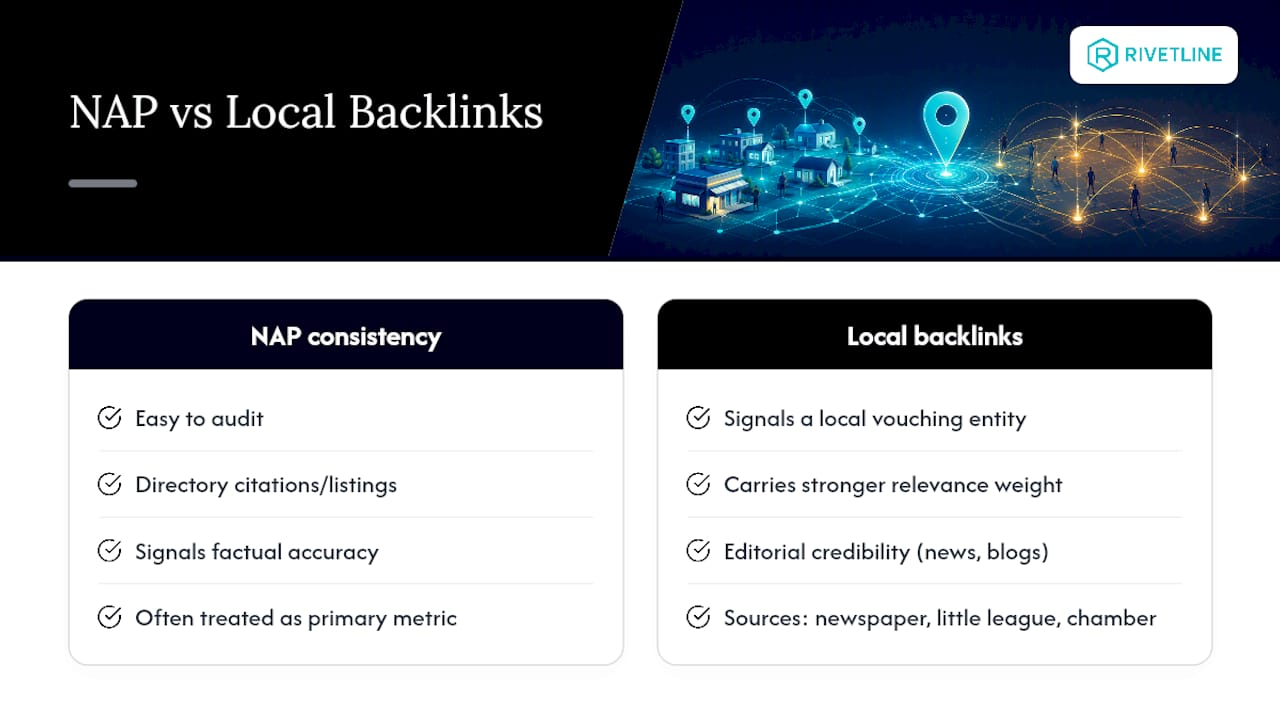
NAP consistency gets all the attention because it’s easy to audit, but local backlinks carry weight that citation cleanup alone can’t replicate. A backlink from your local newspaper, a sponsored little league team’s website, or the chamber of commerce does something a directory listing never will: it signals to Google that a real, geographically relevant entity vouches for your business.
This matters because prominence isn’t only calculated from what’s on your Google Business Profile. Google’s algorithms also weigh your business’s footprint across the broader web, and a link from a .gov city page or a well-trafficked local blog carries more relevance weight than ten generic directory citations combined.
Practical sources worth pursuing: sponsoring a local youth sports team almost always earns a link from the league’s site. Getting quoted in a local news story about a relevant topic in your industry (a contractor commenting on storm damage trends, a bakery featured in a “best of” roundup) earns a link with real editorial credibility attached. Joining your local chamber of commerce or a business improvement district typically comes with a member directory listing that counts as both a citation and a link.
The mistake most businesses make is treating backlinks as an organic-SEO-only concern, disconnected from the Map Pack. They’re not disconnected. A stronger local backlink profile feeds the same prominence signal that reviews feed, just through a different door. If you’re only working the review angle and ignoring local link building, you’re leaving half the prominence equation unaddressed.
How Much Do Clicks, Calls, and Direction Requests Affect Ranking?
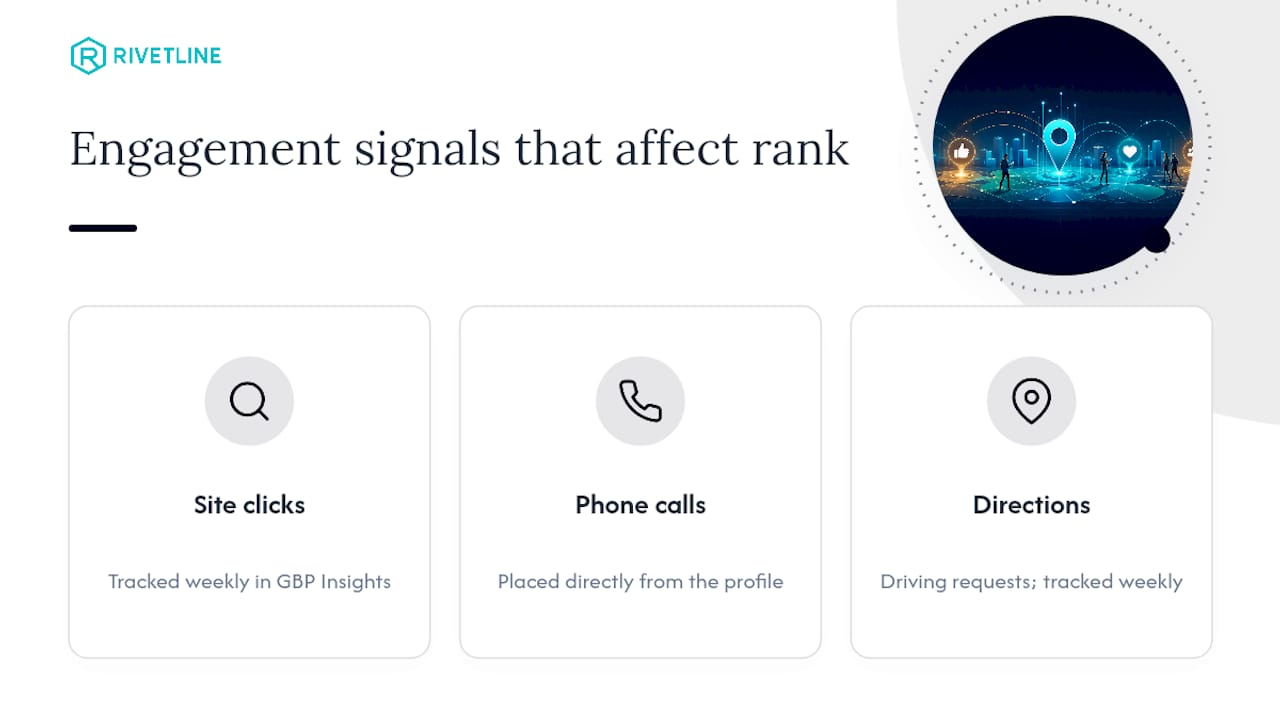
Google tracks how searchers interact with your Map Pack listing, including click-throughs to your website, phone calls placed directly from the profile, and requests for driving directions. These engagement signals function as a real-world vote on relevance and prominence that’s harder to game than a review or a citation.
A listing that gets clicked, called, and navigated to consistently is telling Google’s systems that searchers found what they expected. A listing that shows up but gets ignored, while a competitor three spots down gets all the clicks, sends the opposite signal over time. This is part of why a complete profile with strong photos and an accurate category matters beyond the ranking factors it feeds directly. It also drives the behavioral data that reinforces those same factors in a feedback loop.
You can watch this play out in your GBP Insights dashboard, which breaks out calls, website clicks, and direction requests by week. If those numbers are flat while a competitor is visibly gaining ground in the pack, that’s often a sign your listing looks fine on paper but isn’t compelling enough in the search results to earn the click. A weak primary photo or a vague business description can tank engagement even when every field is technically filled out correctly.
The fix isn’t complicated, but it’s rarely done well: treat your GBP photos and description like ad creative, because that’s functionally what they are. A blurry storefront photo from 2019 loses clicks to a competitor with a crisp, recent shot of their actual team at work. Update your primary photo seasonally if your business has any visual variation worth showing off.
Does Posting Regularly on Google Business Profile Help Rankings?
Google Posts, the short updates you can publish directly to your Business Profile, don’t carry the same direct ranking weight as reviews or category accuracy, but they solve a real problem: signaling that your profile is actively managed rather than abandoned.
An inactive profile with no posts, no new photos, and no review responses for eight months looks the same to Google’s systems as a business that might have closed. Regular activity, even something as simple as a weekly post about a seasonal promotion or a recent project, keeps the freshness signal alive alongside your review velocity.
Posts also occupy visual real estate in the Map Pack expansion and Local Finder view, giving you a chance to highlight a promotion, a new service, or an event before a searcher even clicks through to your website. That’s free advertising space most competitors leave completely blank, which is its own kind of advantage. A profile with recent posts simply looks more legitimate next to one that hasn’t been touched since a previous owner ran it.
The mistake is treating Posts like a one-time task instead of an ongoing habit. A single Post from six months ago provides zero freshness value today. Build it into a monthly calendar, tied loosely to whatever content or promotions you’re already running elsewhere, so it doesn’t become one more forgotten to-do.
Do Site Speed and Mobile Design Affect Map Pack Rankings?
Technical SEO on your website has an indirect but real relationship with Map Pack performance. Google’s local algorithm pulls relevance signals partly from your website content, and a slow, poorly built site undermines that relationship even when your GBP itself is flawless.
A website that loads slowly on mobile, where most local searches happen, hurts you in two ways. It can drag down the organic relevance signals feeding into local pack calculations, and it tanks the engagement metrics discussed earlier: a searcher who clicks through from the Map Pack and waits eight seconds for your page to load is far more likely to bounce back and click a competitor instead.
Structured data matters here too. Adding LocalBusiness or ProfessionalService schema markup to your website makes your name, address, hours, and service area explicit to Google’s crawlers rather than inferred from unstructured text. It won’t move mountains on its own, but paired with a genuinely fast, mobile-friendly site, it removes friction from the relevance signal Google is trying to extract.
None of this replaces GBP optimization. But a business running a fast, mobile-responsive site with clean schema markup is giving Google’s algorithm cleaner data to work with across both the organic and local channels, which compounds over time in a way a single fix never will.
How Do You Analyze Competitors in the Map Pack?
Competitor analysis for the Map Pack is a different exercise than organic keyword research, because you’re not just comparing content quality. You’re comparing three specific inputs: relative distance, relative relevance signals, and relative prominence.
Start by identifying who actually occupies the top three spots for your priority searches, not who you assume your competitors are. The business winning the plumbing Map Pack in your area might be a company you’ve never heard of because they’ve quietly built 300 recent reviews while you were focused on your website redesign.
From there, break down what’s actually different: their category selection, their review count and velocity, their photo volume and recency, and whether they’ve got a physical address advantage you can’t replicate. If a competitor is winning primarily on distance, that’s a signal to stop obsessing over that one query and instead target the searches where your location gives you the edge instead of theirs.
This is where geo-grid testing pulls double duty. Running the same grid test against a competitor’s listing alongside your own shows you exactly where their advantage holds and where it falls apart, which tells you whether you’re fighting a battle you can actually win or wasting budget chasing a query dominated by pure proximity.
How Do You Recover From a Google Business Profile Ranking Drop?
A sudden Map Pack drop usually traces back to one of a handful of causes: a suspension or reinstatement event, a competitor surge in reviews, a Google algorithm update, or an accidental profile edit (sometimes made by someone other than you, since GBP allows suggested edits from the public).
Check your profile status first. If Google flagged and suspended the listing, usually for a policy violation like an inaccurate address or name field, you’ll need to file a reinstatement request through the profile dashboard and correct whatever triggered it before resubmitting.
If the listing is live but rank has simply dropped, pull your GBP Insights history and compare it against your review velocity over the same period. A stall in reviews while competitors kept collecting them is the most common quiet cause of a slow rank slide, not a dramatic algorithm punishment.
Audit for accidental changes next. Public edit suggestions can alter your category, hours, or address without you noticing, and an incorrect category change alone can tank relevance overnight. Google’s own profile history log shows recent edits, which makes this a five-minute check worth doing before assuming the worst.
Once the cause is identified, fix the root issue and give it time. Ranking recovery after a legitimate fix typically shows up within a few weeks, not overnight, especially if the fix involves rebuilding review velocity from a stall.
What the Data Actually Tells You to Do First
Most local SEO advice treats every tactic as equally important, which is exactly backwards. The evidence points to prominence and profile completeness carrying the heaviest controllable weight, while a huge chunk of the industry keeps selling citation packages and directory submissions as if it’s still 2015.
If I had to rank the conventional wisdom’s biggest blind spot, it’s the obsession with one-time fixes over ongoing measurement. Businesses treat GBP optimization like a project with an end date. It isn’t. Review velocity decays the moment you stop asking for reviews, Posts go stale, and competitors don’t stand still while you move on to the next task on the checklist.
The other failure is measurement, or the lack of it. Checking your own rank from your own phone and calling it a day tells you nothing reliable, and plenty of agencies get away with vague monthly summaries because clients never demand the geo-grid data that would prove or disprove their work. If you’re paying someone for Map Pack work, demand to see the grid test, not a screenshot from their office chair.
Prioritize reviews and profile completeness first, measure with a real geo-grid, and treat the whole thing as a maintenance habit instead of a one-time sprint.
— Chris Breikss
How Rivetline Handles Map Pack Strategy for Clients
Rivetline runs Map Pack work the way it should be run everywhere: audit first, prioritize by impact, then prove the movement with data instead of asking you to take our word for it. A typical engagement starts with a full GBP audit against the relevance, distance, and prominence framework, followed by a prioritized roadmap that fixes the highest-impact gaps first.
From there, we build out a review-velocity program designed to run continuously, alongside the content and local page work that supports your profile’s relevance signals. Clients get access to a live Looker Studio dashboard tied directly to GA4 and Google Business Profile data, allowing ongoing checking of grid rank movement, review velocity, and engagement metrics. If you want a clearer look at how that reporting setup works, Rivetline’s blog walks through the approach in more detail. If you’re ready to see where your profile actually stands, request a Map Pack audit and get the prioritized roadmap instead of another generic checklist.
Sources
- Tips to improve your local ranking on Google - Google Business Profile Help
- Google Map Pack: How Local Rankings Work (2026) | Lumina
- Google Maps ranking factors that move the map pin
FAQ
What Is Map Pack Ranking?
Map Pack ranking is your position within the three local business listings Google displays above organic results for a local search, determined by relevance, distance, and prominence.
How Do I Rank Higher in the Google Map Pack?
Complete every field on your Google Business Profile accurately, build a steady flow of recent reviews rather than a one-time push, choose the correct primary category, and keep your listing active with regular photos and Posts.
Is a 75 SEO Score Good?
Most SEO scoring tools indicate solid but incomplete optimization, meaning meaningful gaps likely remain in areas like technical performance, content depth, or backlink profile that are worth auditing before assuming the score reflects strong Map Pack readiness.
How Many Level 10 Google Local Guides Are There?
Google doesn’t publish an exact count of Local Guides at the highest contribution levels, and this program measures individual reviewer contribution status rather than anything tied to business Map Pack ranking.
Does Rivetline Handle Map Pack Optimization?
Yes. Rivetline runs full GBP audits, builds ongoing review-velocity programs, and reports progress through live dashboards connecting GA4 and Google Business Profile data rather than static monthly summaries.