
Responsive Search Ads Best Practices for 2026
Run at least two Responsive Search Ads per ad group, and get at least one to Good or Excellent Ad Strength. Feed each RSA enough unique headlines and descriptions that Google’s system has real material to test, then hand the reins to Smart Bidding paired with broad match keywords. Measure conversions, not clicks. That’s the whole playbook in one sentence, and everything below explains why it works and how to execute it without wrecking your account in the process.
Here’s the checklist to run through this afternoon, before you touch anything else in your account:
Deploy 2+ RSAs per ad group. Google’s own guidance shows advertisers who move from one RSA to two see an average 6.6% lift in conversions at a similar cost per conversion. A third RSA adds another 3.7% on average.
Chase Ad Strength, not perfection. You don’t need every RSA at Excellent. You need at least one per ad group there, because Google reports a 15% average increase in clicks and conversions when Ad Strength moves from Poor to Excellent.
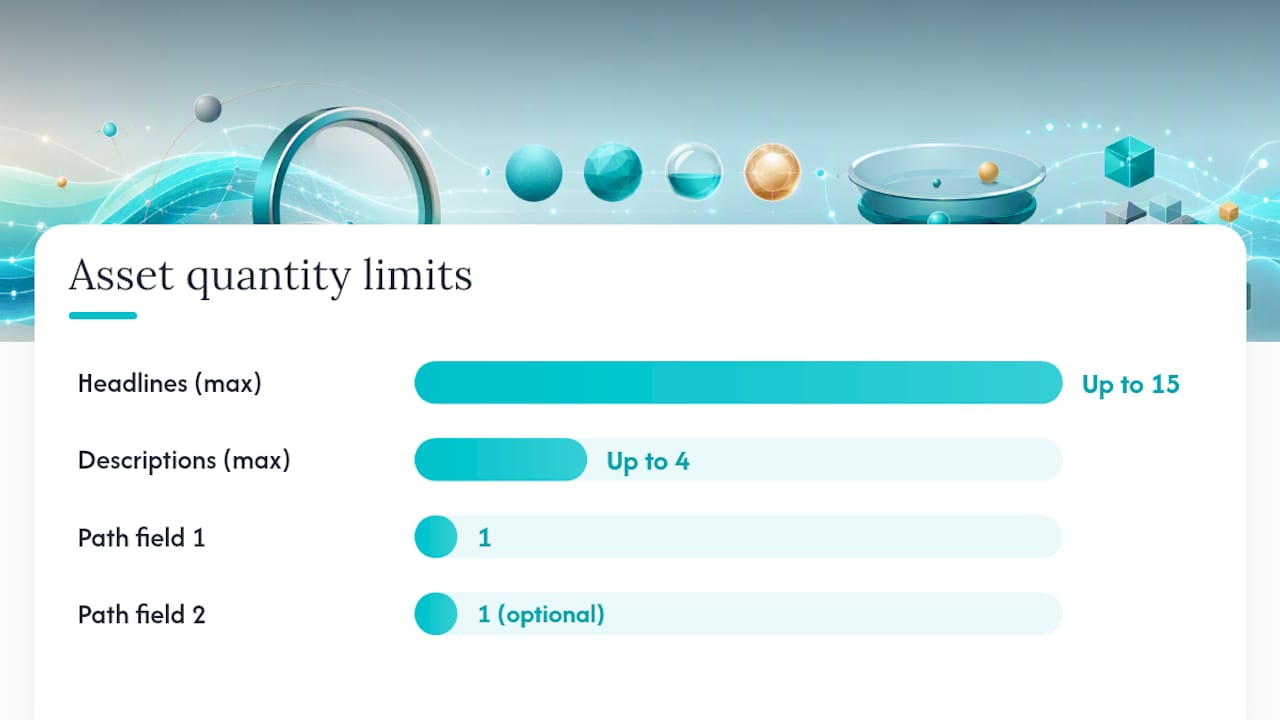
Write diverse assets and respect the limits. Headlines max at 30 characters, descriptions at 90. Cramming in near-duplicate phrasing to hit a headline count defeats the purpose. Google needs genuinely different assets to assemble genuinely different combinations.
Pair RSAs with Smart Bidding and broad match keywords. This is the automation stack Google’s own systems are built around, and it’s how RSAs reach their full potential instead of running on autopilot with one hand tied behind their back.
Pin sparingly. One or two essential assets, maximum. Every pinned slot is a door Google’s algorithm can’t open, and over-pinning is one of the fastest ways to tank an otherwise solid Ad Strength score.
Key Takeaways
Responsive Search Ads perform best when advertisers run at least two per ad group, push at least one to Good or Excellent Ad Strength, and let Smart Bidding paired with broad match handle query-level matching while conversions stay the primary success metric.
PointDetailsRun 2+ RSAs per groupA second RSA adds an average 6.6% conversion lift; a third adds another 3.7% on average.Target Good or Excellent Ad StrengthMoving from Poor to Excellent correlates with 15% more clicks and conversions on average.Pair with automationSmart Bidding and broad match let Google match creative to query intent in real time.Pin only the essentialsLimit pins to 1 to 2 required assets; over-pinning shrinks combinations and can lower Ad Strength.Wait for data before changing assetsGive assets roughly 500+ impressions and ads 2,000+ impressions before judging performance.Work with a tested processRivetline runs a structured audit, asset rebuild, and staged automation rollout for underperforming RSA accounts.
Table of Contents
What Are Responsive Search Ads and How Does the Assembly Work?
Headlines, Descriptions, and Building Assets That Work in Any Order
How Do You Measure RSA Performance Without Chasing the Wrong Signal?
How Do RSAs Perform Best Alongside Smart Bidding and Broad Match?
What RSA Mistakes Are Costing You Clicks and Conversions Right Now?
What Are Responsive Search Ads and How Does the Assembly Work?
A Responsive Search Ad is a single ad unit that holds up to 15 headlines and 4 descriptions, and Google’s system recombines those assets into different ad variations depending on the search query, device, and user signal. You’re not writing one ad. You’re writing a pool of components and letting Google’s machine learning figure out which combination best answers a given search.
This is a fundamentally different mental model than the old Expanded Text Ads format, where you wrote three headlines and two descriptions and that was the ad, full stop. With RSAs, the “ad” the searcher sees might combine your fourth headline with your second description and never touch headlines one through three at all for that particular query.
How does Google decide what goes where? The system scores relevance to the search query, checks for redundancy between assets so it doesn’t stack two headlines that say the same thing, and predicts performance for each candidate combination given the available space in the ad unit. It’s less like a slot machine and more like a very fast editor assembling the best possible sentence from a stack of index cards, constrained by how many characters actually fit.
That’s why the format limits matter more than they might seem to at first glance. Headlines cap at 30 characters. Descriptions cap at 90. Display path fields are capped at 15 characters each. Some languages, including Chinese, Japanese, and Korean, use double-width characters that count differently against these limits, which trips up plenty of advertisers running multilingual accounts. Get comfortable with these numbers early, because every writing decision downstream depends on them.
Why Use Responsive Search Ads Over Static Formats?
RSAs exist to solve a matching problem: the same product or service gets searched a dozen different ways, and a single static ad can’t speak to all of them equally well. By giving Google more raw material, RSAs increase the ad’s eligibility across a wider range of query variations and auctions, which is the entire reason the format has become the default in Google Ads.
The business case is not theoretical. Advertisers who improve their Ad Strength rating from Poor to Excellent see an average 15% increase in clicks and conversions. That’s not a marginal tweak. That’s the difference between an ad group that quietly underperforms and one that pulls its weight in the account.
RSAs earn their keep most clearly in three scenarios. Broad-reach campaigns where you’re trying to capture query variety benefit because the format is built for exactly that kind of coverage. Discovery and scale phases, where you’re still learning what messaging resonates with a new audience, benefit because RSAs let Google’s testing do some of that discovery work for you instead of relying on manual A/B splits. And multi-product or multi-offer campaigns, where a single landing page might serve several distinct customer needs, benefit because flexible headline combinations can speak to different intents without you building a dozen separate ad groups.
Where RSAs matter less: a highly regulated, single-message campaign where legal has approved exact wording and nothing else may run. That’s a pinning conversation, and it’s coming up shortly.
How Do You Create a Responsive Search Ad in Google Ads?
Building an RSA correctly starts before you ever open the ad creation panel. Get the setup right and the ad practically writes itself. Get it wrong and you’ll spend weeks fighting an Ad Strength score that never moves.
Set your foundation first. Confirm your final URL points to a landing page that matches the ad group’s theme, not a generic homepage. Group keywords tightly, ideally around a single product, service, or intent, so the headlines you write can stay relevant to every keyword in that group.
Add headlines in bulk, then prune. Draft more headlines than you need, ideally 10 to 15, covering different angles: a benefit, a feature, a price point, a call to action, a keyword-matched phrase. Google’s own guidance recommends at least 8 to 10 headlines with 5 or more genuinely distinct options, not near-duplicates with a word swapped.
Write at least 2 to 4 unique descriptions. Each should stand on its own and expand on a different reason to click, whether that’s a guarantee, a specific outcome, or a proof point.
Fill in path fields thoughtfully. These 15-character fields appear after your display URL and are a low-effort way to reinforce relevance without eating into headline or description space.
Check the Ad Strength panel before saving. Google surfaces specific suggestions here, add more headlines, include more unique wording, add a keyword, right in the creation flow. Address the highest-impact suggestions before publishing rather than fixing them after the ad has started serving.
Enable automatically created assets if your account has the maturity for it. This lets Google generate additional headline and description variants pulled from your landing page and existing assets. Review what it generates. Turn it off if it produces anything off-brand.
Choose Smart Bidding as your bid strategy where campaign history supports it. Manual bidding on an RSA undercuts the entire point of the format, which is built to let automation react to real-time signals.
Headlines, Descriptions, and Building Assets That Work in Any Order
The single biggest mistake in RSA copywriting is treating headlines like sentence fragments that only make sense next to each other. Google can and will show Headline 3 next to Headline 11 with zero warning, so every headline needs to stand on its own as a complete, sensible thought.
Here’s the field reference to keep pinned to your desk while you write:
Asset TypeCharacter LimitQuantity AllowedNotesHeadline30 charactersUp to 15At least 3 required; 8 to 10 recommended for strong Ad StrengthDescription90 charactersUp to 4At least 2 required; all 4 recommendedPath field 115 characters1Appears after display URLPath field 215 characters1Optional, appended after path field 1
Front-load the important part of every headline and description. Google’s own writing guidance for the format emphasizes putting the key selling point early in each asset, because truncation and combination order mean you can’t guarantee a searcher reads the whole thing in the sequence you intended.
Keyword placement is a balancing act, not a mandate. Put your primary keyword phrase in one or two headlines so relevance signals stay strong, then dedicate the remaining headline slots to benefits, differentiators, social proof, or a direct call to action. A common failure mode is writing ten headlines that all just restate the keyword with minor variation, which technically satisfies “write 10 headlines” while completely missing the point of asset diversity.
A few quick examples of the difference between weak and strong headline construction:
Weak: “Best Running Shoes” / “Running Shoes For Sale” / “Buy Running Shoes Today” — three headlines, one idea, repeated with cosmetic changes.
Strong: “Trail Running Shoes” / “Free Returns, 90 Days” / “Rated 4.8 by 12,000 Runners” / “Ships Same Day” — four headlines, four distinct reasons to click, each one legible in complete isolation.
The description field gives you more room to work with at 90 characters, so use it to answer an objection a headline can’t fully cover: shipping policy, a warranty, a specific use case. Don’t waste both description slots restating the same offer in slightly different words.
When Should You Pin Headlines and Descriptions?
Pin only when something absolutely must appear, and understand what you’re giving up when you do it. Google’s guidance is direct: assets can serve in any order, and pinning restricts the combinations available, which is why it’s not recommended for most advertisers unless there’s a specific requirement forcing it.
The legitimate reasons to pin are narrow. A legal or regulatory disclaimer that must appear in a fixed position. A brand name that absolutely must anchor Headline 1 for trademark or compliance reasons. A required policy phrase mandated by a platform or industry body. Outside of those cases, pinning is usually a symptom of an advertiser who doesn’t trust the algorithm, not a genuine business requirement.
Pro Tip: If you must pin, pin more than one option to that position instead of a single asset. Pinning three different Headline 1 candidates to position one still gives Google room to test which of those three performs best, instead of locking in a single static headline and losing the testing benefit entirely.
A hybrid approach works for most accounts that have a genuine pinning need: pin the one or two assets that are truly non-negotiable, and leave every other slot open. This preserves the bulk of your combination diversity while still satisfying the compliance or branding requirement.
Quick diagnostic checks if you suspect pinning is dragging down a campaign:
Compare Ad Strength before and after pinning. A drop of a full category (Excellent to Good, Good to Average) after adding a pin is a signal to reconsider.
Check the Combinations report for how many distinct ad variations are actually being served. A small number relative to your asset count suggests over-pinning is choking variety.
Look at serving rate across your unpinned assets. If two or three headlines account for nearly all impressions, something is constraining rotation, and pinning is the first place to check.
What Does Ad Strength Measure, and How Do You Improve It?
Ad Strength is Google’s forward-looking scorecard for your RSA, built from a regression analysis of creative features including asset diversity, keyword relevance, and how much unique messaging you’ve actually provided versus how repetitive it is. It’s not a measure of past performance. It’s a prediction of how well-equipped your ad is to perform, which is why you can improve it before you have any conversion data at all.
The score runs Poor, Average, Good, and Excellent. Moving up each tier is a mechanical process, not a mystery:
Current RatingTypical FixWhat It AddressesPoorAdd headlines until you have at least 8 to 10 totalInsufficient raw material for combinationsAverageRemove near-duplicate headlines; add distinct benefit anglesRedundancy scoringGoodAdd keyword-relevant headlines without over-concentrating keywordsRelevance gapsGood to ExcellentFill all 4 description slots with unique copy; unpin non-essential assetsCombination diversity ceiling
The reported payoff for making this climb is real: advertisers moving from Poor to Excellent Ad Strength see 15% more clicks and conversions on average. That’s the single most quoted statistic in RSA optimization for a reason, it’s one of the few places where a specific creative change ties to a specific, measurable outcome.
Work the Ad Strength panel’s own suggestions first before brainstorming from scratch. Google surfaces specific gaps, missing keyword relevance, insufficient headline count, low description diversity, directly in the interface. Automatically created assets and text customization tools can help fill genuine gaps quickly, but review anything auto-generated before it goes live. Automation is a speed tool here, not a replacement for judgment.
How Do You Measure RSA Performance Without Chasing the Wrong Signal?
Conversions and conversion value are your primary KPIs, full stop. Click-through rate and impression volume are context, not verdicts. An RSA with a mediocre CTR but strong down-funnel conversion behavior is doing its job. Google’s own guidance backs conversion-first evaluation over CTR-only judgment, because CTR alone tells you nothing about whether the traffic you’re attracting actually converts.
The biggest measurement mistake is judging assets before they’ve served enough. Here’s a testing sequence that avoids that trap:
Wait for the minimum serving threshold before touching anything. Google’s guidance suggests an asset generally needs more than 500 impressions, and the ad itself more than 2,000 impressions in the “Google Search: Top” segment over a 30-day window, before ratings stabilize. Anything less is still Learning, and reacting to it is reacting to noise.
Use the Combinations report to see what’s actually serving. This report shows real headline and description pairings Google has served, which tells you whether your asset pool is being used broadly or whether a handful of combinations dominate.
Run structured ad variation tests, not gut-feel swaps. Change one variable at a time, a new headline angle, a different CTA, so you can attribute any shift in conversion rate to that specific change.
Check for statistical significance before declaring a winner. A conversion rate difference over a small sample size is often just variance. Give tests enough volume and enough calendar time, generally a few weeks at minimum for most mid-volume accounts, before making a call.
Build your reporting dashboard around asset performance ratings alongside conversion data, not asset ratings in isolation. A “Best” rated headline that isn’t tied to strong downstream conversion behavior deserves a second look, not automatic trust.
How Do RSAs Perform Best Alongside Smart Bidding and Broad Match?
RSAs were built to work inside an automation stack, not as a standalone creative format. Pairing them with Smart Bidding and broad match keywords lets Google evaluate conversion likelihood at the individual query level in real time, then adjust bids and ad combinations accordingly, something no manual bidding strategy or exact-match-only keyword list can replicate at the same speed.
The advertisers who see the strongest results from RSAs are rarely the ones with the cleverest headlines. They’re the ones who stopped fighting the automation and started feeding it clean signals, tight ad groups, real conversion tracking, enough asset diversity, and let Smart Bidding and broad match do the query-level matching work they were built for.
Beyond the core Smart Bidding and broad match pairing, a few adjacent features are worth understanding and configuring deliberately:
Automatically created assets pull headline and description candidates from your landing page and existing ad copy, filling gaps in your asset pool without manual drafting. Useful for speed. Review before trusting.
Final URL expansion lets Google redirect traffic to a more relevant page on your domain than the one you specified, based on the search query. Powerful for large sites, risky if your site structure is inconsistent or your tracking isn’t set up to catch every possible landing destination.
AI Max for Search extends automation further into query matching and creative assembly. Treat it the way you’d treat any new automation layer: enable it in a controlled subset of campaigns first, watch the Search Terms report closely for irrelevant matches, and expand once you trust the signal.
The operational discipline that makes this safe is simple: turn on one automation layer at a time, monitor the Search Terms report weekly for the first month, and confirm your final URLs stay relevant as broad match and expansion start sending traffic to pages you didn’t explicitly target.
What RSA Mistakes Are Costing You Clicks and Conversions Right Now?
Most underperforming RSAs share the same handful of root causes, and every one of them is fixable in under half an hour once you know where to look.
Redundant headlines. Five headlines that all say some version of “Buy Now” waste slots that could hold genuinely distinct value propositions. Fix: audit your headline list, cut anything that duplicates the core idea of another headline, replace with a fresh angle.
Over-pinning. An RSA with four or five pinned assets barely functions as an RSA anymore, it’s an Expanded Text Ad wearing a disguise. Fix: unpin everything except the one or two assets with a genuine legal or brand requirement.
Single-asset RSAs. Running one RSA per ad group means you’re missing the documented 6.6% conversion lift that comes from simply adding a second. Fix: build a second RSA with a different messaging angle in every ad group that only has one.
Mismatched or generic final URLs. Sending traffic to a homepage instead of a themed landing page tanks both Quality Score and conversion rate, no matter how strong the headline copy is. Fix: audit final URLs against ad group themes and correct any mismatches.
Overly broad ad groups. An ad group built around ten loosely related keywords forces your headlines to be vague enough to cover all of them, which drags down relevance scoring. Fix: split broad ad groups into tighter clusters organized by search intent, not just by product category.
Triage in this order: fix over-pinning first, since it’s the single fastest lever on Ad Strength. Add a second RSA next, since that lift is well documented and takes minutes to implement. Then move to final URL and ad group structure fixes, which take longer but compound over time.
Rivetline’s Recommended RSA Setup Checklist
Here’s the setup Rivetline runs when we take over an underperforming Google Ads account, adapted for any paid-search team to implement directly or hand to an agency.
Ad group structure: keep ad groups tightly themed around a single product, service, or search intent, ideally 5 to 15 closely related keywords, not 30 loosely related ones.
RSA count: minimum 2 RSAs per ad group, 3 where the ad group has enough search volume to give a third variant meaningful data.
Ad Strength target: at least one RSA per ad group at Good, with a rolling goal of pushing every RSA to Excellent within the first 60 days of a new campaign.
Landing page requirement: every final URL maps to a page whose content matches the ad group’s specific theme, never a generic category or homepage.
Automation settings: Smart Bidding enabled from day one where conversion tracking history supports it, broad match layered in gradually with weekly Search Terms review for the first month.
Experiment template you can run this quarter:
Hypothesis: Adding a second RSA with a benefit-first messaging angle to underperforming ad groups will increase conversion rate without raising cost per conversion.

KPI: Conversion rate and cost per conversion, measured over a minimum 30-day window.
Control vs. variant: Control ad groups keep their existing single RSA. Variant ad groups add a second RSA built around a distinct angle (price, guarantee, or social proof).
Minimum sample size: Each ad group needs at least 2,000 impressions in the Google Search: Top segment before results are read as reliable, consistent with Google’s own asset rating thresholds.
Reading results: Compare conversion rate and cost per conversion between control and variant groups, and check the Combinations report to confirm the new RSA is actually receiving meaningful serving volume before drawing conclusions.
If you’re handing this off to an agency, expect a reporting cadence built on live dashboards, not a static monthly PDF, so you can check Ad Strength, Combinations data, and conversion trends whenever you want rather than waiting for a recap call.
How Rivetline Actually Runs This for Clients
The sequence rarely changes, even though every account looks different on day one: audit first, asset creation second, automation third, controlled experiments fourth, scale fifth.
The audit almost always finds the same three problems in some combination: ad groups too broad to write relevant headlines for, RSAs pinned into near-static ads, or a single RSA per ad group quietly leaving conversion volume on the table. None of these are exotic. They’re just easy to overlook when a team is managing dozens of ad groups without a systematic review cadence.
Asset creation comes next, and this is where the temptation to rush is strongest. Writing 10 genuinely distinct headlines takes real thought, not a quick pass where you swap one adjective across five near-identical lines. We build headline pools around distinct angles deliberately, price, guarantee, urgency, social proof, feature, so the Ad Strength score reflects real diversity rather than volume for its own sake.
Automation gets layered in gradually rather than flipped on all at once. Smart Bidding first, once conversion tracking has enough history to inform it. Broad match next, with close monitoring of the Search Terms report in the first few weeks. This staged approach catches irrelevant query matches before they burn meaningful budget, instead of discovering the problem in a month-end report.
The reporting cadence clients get access to runs through live Looker Studio dashboards connected to GA4, not a static file that’s stale by the time anyone opens it. Ad Strength, Combinations data, and conversion trends stay visible in real time, which is the difference between reacting to last month’s numbers and adjusting mid-flight.
Ready to Fix Your RSAs? Here’s the Fastest Path
Most in-house teams know their Ad Strength scores are sitting at Average or worse. What they don’t have is the time to rebuild headline pools for forty ad groups while also managing bids, budgets, and everything else on a growth marketer’s plate. That’s the gap Rivetline closes.
Rivetline runs Google Ads management alongside AI visibility work, content production, and reporting infrastructure built on GA4 and live Looker Studio dashboards, so you’re never waiting on a monthly recap to find out whether an experiment worked. For RSAs specifically, that means an account audit that flags over-pinned ads, single-RSA ad groups, and weak Ad Strength scores in one pass, followed by asset rebuilds and a staged rollout of Smart Bidding and broad match with real monitoring behind it.
If your account’s Ad Strength scores have been stuck at Average for months, or you’re not sure whether your current agency is actually testing anything, the fastest next step is a direct look at what’s happening in your account. Visit the Rivetline blog for the RSA audit checklist, or reach out directly to have Rivetline run the audit on your account this week.
Frequently Asked Questions
How many headlines should a responsive search ad have? Aim for 10 to 15 headlines with at least 5 genuinely distinct angles. Google’s guidance sets a technical minimum of 3, but that floor produces weak Ad Strength and limited combination diversity.
Does pinning hurt Ad Strength? Yes, typically. Pinning restricts the number of combinations Google can assemble, and Google’s own guidance advises against it unless a specific requirement, like a legal disclaimer, makes it necessary.
What’s a good Ad Strength score to aim for? Good or Excellent. Advertisers moving from Poor to Excellent see an average 15% increase in clicks and conversions, making that climb one of the highest-leverage changes available in an RSA account.
Should I use broad match with responsive search ads? Pairing broad match with Smart Bidding is a common and effective combination for RSAs, since it lets Google evaluate conversion likelihood at the query level rather than relying solely on exact keyword matching. Monitor the Search Terms report closely when you first enable it.
How long should I wait before judging RSA performance? Wait until assets clear minimum serving thresholds, generally over 500 impressions per asset and over 2,000 impressions for the ad in the Google Search: Top segment over 30 days, before treating performance data as reliable.
Sources
Google’s own documentation remains the most reliable technical reference as the platform’s automation features continue to evolve. Start with Google’s guide to responsive search ads for setup fundamentals, then review the best practices for creating effective RSAs for copywriting specifics, and the writing guide PDF for a deeper look at how Ad Strength scoring actually works.
For ongoing checklists, experiment templates, and audit offers built around this exact framework, the Rivetline blog stays updated as Google’s automation features shift.