Avoid 2 AM Pager Calls: Supermetrics vs Funnel for Agencies
Supermetrics wins for self-serve analysts and small agencies who want fast connector setup and control over their own warehouse. Funnel wins for agencies and enterprises that need centralized governance, managed storage, and consistent data across dozens of client accounts. The split comes down to one architectural decision: Supermetrics pushes data through; Funnel stores and normalizes it first. Everything else, pricing, backfill headaches, and who gets paged at 2 a.m., flows from that.
TL;DR:
- Supermetrics is ideal for small teams and self-serve analysts needing quick setup and direct data transfer without normalization or enterprise features.
- Funnel offers managed storage and normalization, making it better suited for agencies or enterprises requiring consistent governance and reducing backfill issues.
- Connector coverage is similar for major platforms, but backfill handling and transformation capabilities differ, with Funnel smoothing historical data and Supermetrics relying on user-managed backfill.
- Pricing becomes complex at scale, with Supermetrics charging based on connectors and destinations, while Funnel’s volume-based custom pricing favors larger, multi-client setups.
- Monitoring connector health and understanding data retention policies are crucial for avoiding silent failures and data gaps in either architecture.
Table of Contents
- Supermetrics vs. Funnel: How the Full Field Stacks Up
- What the Feature Details Actually Change on the Ground
- What Pricing Actually Looks Like as You Scale
- Where Each Architecture Breaks, and Who Notices First
- The Checklist to Run Before You Sign Anything
- How We Evaluated Supermetrics, Funnel, and the Rest of the Field
- How Strict Are Connector Rate Limits, Really?
- Can You Plug These Into Your Existing BI Stack?
- Who Can See and Touch Your Reporting Data?
- How Far Back Can You Actually Pull Historical Data?
- An Agency Ops Take on Buying vs. Building This Stack
- When It’s Time to Stop Managing Your Own Reporting Stack
- Sources
- FAQ
Supermetrics vs. Funnel: How the Full Field Stacks Up
Before you pick a side in the Supermetrics vs Funnel debate, it helps to see who else showed up to this fight. Thirteen tools claim some version of “we connect your marketing data to somewhere useful,” but they solve genuinely different problems, and treating them as interchangeable is how teams end up paying for features they never use.
Supermetrics is the connector-first extractor. It pulls data from ad platforms, CRMs, and analytics tools and pushes it to Sheets, Looker Studio, BigQuery, or wherever you point it. No mandatory storage layer, no forced normalization. You own the pipes.
Funnel.io is the opposite bet: a managed data hub that ingests, stores, and normalizes everything before it reaches a destination. You’re buying governance, not just plumbing.
Catchr.io is a lightweight collector aimed at SMB teams who find Supermetrics or Funnel overbuilt for their needs. Windsor.ai leans into attribution modeling and AI-assisted reporting rather than raw connector volume. Improvado targets mid-market and enterprise teams that want a managed ETL pipeline with agency-style client reporting baked in.
Adverity goes deep on governance and transformation for enterprises juggling complex, multi-channel data. Domo bundles ETL with a full BI and visualization layer, so you’re buying the pipeline and the dashboard in one contract. Fivetran skips marketing-specific framing entirely and focuses on rock-solid, automated warehouse syncs, popular with data engineering teams who don’t want surprises.
Marketing Cloud Intelligence (formerly Salesforce Datorama) makes sense almost exclusively if you’re already deep in the Salesforce ecosystem and want native integration over best-of-breed tooling. Porter Metrics and Whatagraph both chase the templated, agency-friendly dashboard market, quick to deploy, light on customization. TapClicks adds marketing operations and client billing features on top of its ETL and dashboard layer. Stitch is the developer’s choice: no-frills, predictable pricing, built for engineers who just want data in the warehouse without a marketing-tool interface wrapped around it.
Here’s how the core operational dimensions line up:
| Tool | Connector Coverage | Storage Model | Best For |
|---|---|---|---|
| Supermetrics | Wide, self-serve tiers | Pass-through, optional storage | Self-serve analysts, small agencies |
| Funnel.io | Wide, enterprise-grade | Managed, normalized storage | Agencies and enterprises needing governance |
| Catchr.io | Moderate | Pass-through | SMB teams wanting a lighter alternative |
| Windsor.ai | Moderate, attribution-focused | Pass-through with modeling layer | Teams wanting built-in attribution |
| Improvado | Wide | Managed pipelines | Mid-market and enterprise agencies |
| Adverity | Wide | Managed, transformation-heavy | Complex multi-channel enterprises |
| Domo | Wide | Managed, BI-integrated | Combined ETL + BI buyers |
| Fivetran | Wide, warehouse-focused | Managed, warehouse-native | Data engineering teams |
| Marketing Cloud Intelligence | Moderate | Managed, Salesforce-native | Salesforce-committed enterprises |
| Porter Metrics | Moderate | Pass-through | Agencies wanting templated dashboards |
| TapClicks | Moderate | Managed | Agencies needing client reporting + ops |
| Stitch | Wide, engineering-oriented | Managed, warehouse-native | Engineering teams, simple ingestion |
| Whatagraph | Moderate | Pass-through | Agencies producing packaged client reports |
A few quick notes worth flagging before you request a single demo:
- Supermetrics, Stitch, and Porter Metrics publish self-serve pricing floors you can check without talking to a salesperson.
- Funnel, Improvado, Adverity, Domo, Marketing Cloud Intelligence, and TapClicks generally require a quote or a demo before you see real numbers.
- Fivetran publishes usage-based pricing but the actual bill depends heavily on your row volume, which you won’t know until you’ve run it.
- Windsor.ai and Catchr.io sit in between, with published tiers but limited public detail on enterprise scaling.
What the Feature Details Actually Change on the Ground
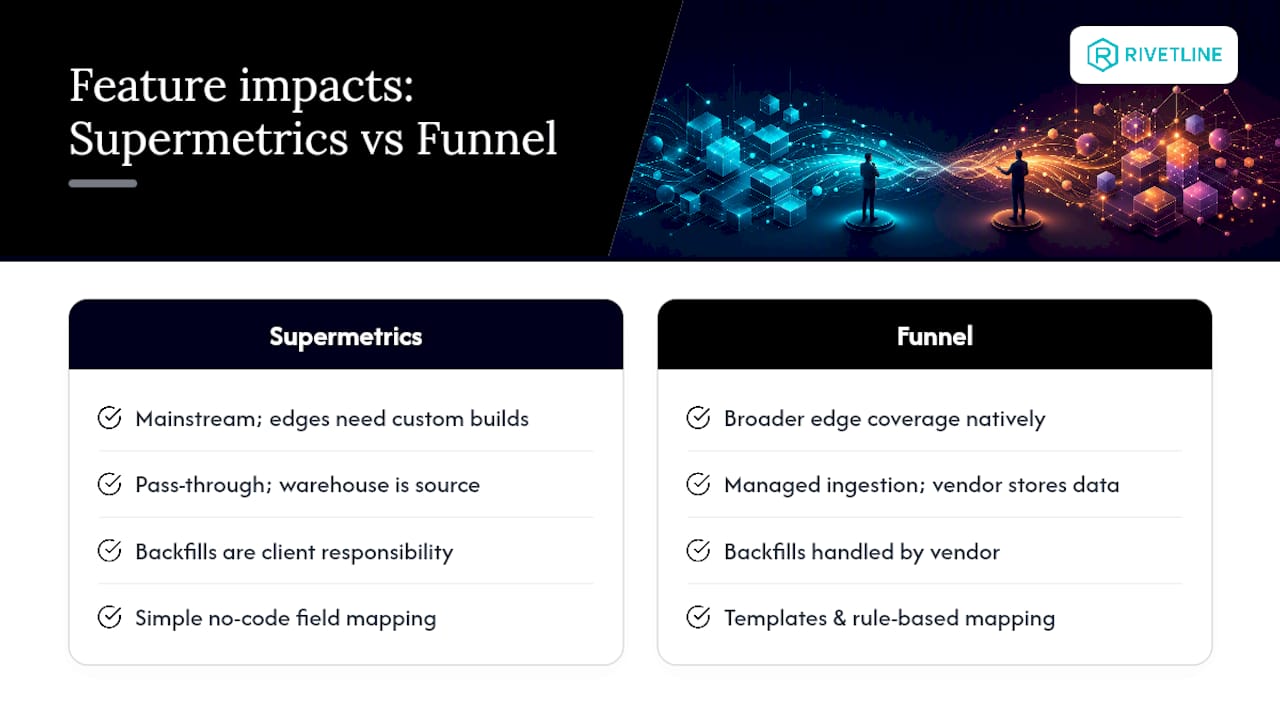
Connector counts get thrown around like a scoreboard, and it’s mostly noise. What matters is whether the specific platforms you use, especially long-tail or regional ad networks, are natively supported or require a custom build. Supermetrics and Funnel both cover the obvious majors (Google Ads, Meta, LinkedIn, TikTok) without issue. The gap shows up at the edges: niche affiliate networks, regional e-commerce platforms, CRM tools outside the Salesforce/HubSpot mainstream.
Storage and backfill behavior is the part nobody explains clearly in a sales deck, and it’s the part that bites you eight months in. Supermetrics typically operates as a pass-through extractor with optional storage, meaning your warehouse or sheet becomes the source of truth, and if you need to backfill six months of historical data after a connector change, that’s on you to manage. Funnel ingests and stores data in its managed layer, which smooths backfills and audits considerably, but that convenience comes wrapped in vendor dependency you can’t easily unwind later.
Transformation tooling splits along a similar line. Supermetrics leans on simpler, no-code field mapping. Funnel offers templating and rule-based transformations designed for non-technical marketers to normalize data without writing SQL. If your team already lives in dbt, neither tool replaces that layer. They feed it.
On security, this one’s a wash: both platforms list SOC 2 and ISO 27001 compliance on their trust pages, so if a vendor’s security posture is your tiebreaker, look elsewhere for the deciding factor because it isn’t here.
Pro Tip: Ask any vendor exactly what happens to your historical data if you cancel. Pass-through tools mean your warehouse keeps everything you already extracted. Managed hubs sometimes hold your normalized history hostage behind an export request, so read that clause before you sign, not after.
User-review data backs this split with real numbers. G2 reviewers consistently rate Funnel higher on custom reporting, dashboarding, and support quality, which tracks with a managed product that has more surface area to support well, and more incentive to.
What Pricing Actually Looks Like as You Scale
Entry price tells you almost nothing about what you’ll pay in month fourteen. Supermetrics scales with connectors and destinations added to your account. Funnel scales with data volume and the number of connected accounts, often quoted as custom pricing once you’re past a starter tier. SelectHub’s comparison notes that Funnel is built for scale while Supermetrics is optimized for smaller, simpler setups, and gets pricier fast once you’re stacking connectors and destinations.
Here’s how that plays out for three real buyer profiles:
- Solo analyst, one brand. Supermetrics on a self-serve tier connecting three ad platforms into Looker Studio. Low, predictable monthly cost, no procurement cycle required.
- Growing agency, 20 to 30 client accounts. This is the inflection zone. Supermetrics costs multiply fast once you’re managing dozens of separate connector setups across clients. Funnel’s workspace model starts paying for itself here, even with a higher licensing floor.
- Multi-market enterprise. Both vendors move to custom quotes at this scale, and the real cost driver isn’t connector count. It’s the number of independent accounts and destinations you’re managing simultaneously.
The procurement experience differs too: Supermetrics lets you sign up and start extracting data today. Funnel, Improvado, and most enterprise-tier tools want a discovery call first, which is annoying if you’re in a hurry and completely reasonable if you’re buying something that touches every client’s data.
Where Each Architecture Breaks, and Who Notices First
Pass-through tools break loudly. When a Supermetrics connector fails, your Looker Studio chart goes blank or throws an error immediately, ugly, but honest. You know something’s wrong the second you look at the dashboard.
Managed hubs break quietly. Funnel’s normalization layer can keep showing a chart with numbers on it even when the underlying feed has gone stale, because the last successful sync is still sitting there looking legitimate. Nobody notices until a client asks why last Tuesday’s spend looks suspiciously flat.
Build monitoring around this distinction, not around vendor marketing:
- Track row-delta counts daily, so a silent stall shows up as a flatline instead of a surprise.
- Watch connector error rates directly, not just destination output.
- Check “last updated” timestamps on every dashboard, not just the pipeline dashboard.
- For agencies, centralize this monitoring per workspace rather than per client, or you’ll drown in dashboards nobody’s actually watching.
Multi-client agencies get a real operational win from Funnel’s workspace and template model: build the transformation logic once, apply it across client accounts, and skip rebuilding pipeline logic every time you onboard a new brand as advised by Stefano Mazzei | Meta Ads & Performance Creative for DTC Ecommerce. That’s the trade you’re making for the higher price floor.
The Checklist to Run Before You Sign Anything
Work through this in order, not all at once:
- List your must-have connectors first. If a platform doesn’t natively support your top three data sources, stop evaluating it.
- Count your accounts, not your connectors. Twenty clients with three connectors each is a different problem than three clients with twenty connectors each.
- Ask about backfill windows explicitly. “Can you backfill 12 months if we add a connector next quarter?” is a yes/no question. Demand a yes/no answer.
- Ask what counts as billable. FlexPoints, row counts, and per-destination fees all hide surprises in the fine print.
- Ask for their SLA on broken connectors. Ad platforms change their APIs constantly. Find out who’s on the hook when that happens.
Pro Tip: If a sales rep can’t explain their pricing model in one sentence without looking it up, that’s not a sign of complexity. It’s a sign you’re going to get a surprise invoice in month four.
Walk away if a vendor won’t commit to a backfill policy in writing, can’t name their essential connector’s exact refresh frequency, or gets vague about what happens to your data on cancellation.
How We Evaluated Supermetrics, Funnel, and the Rest of the Field
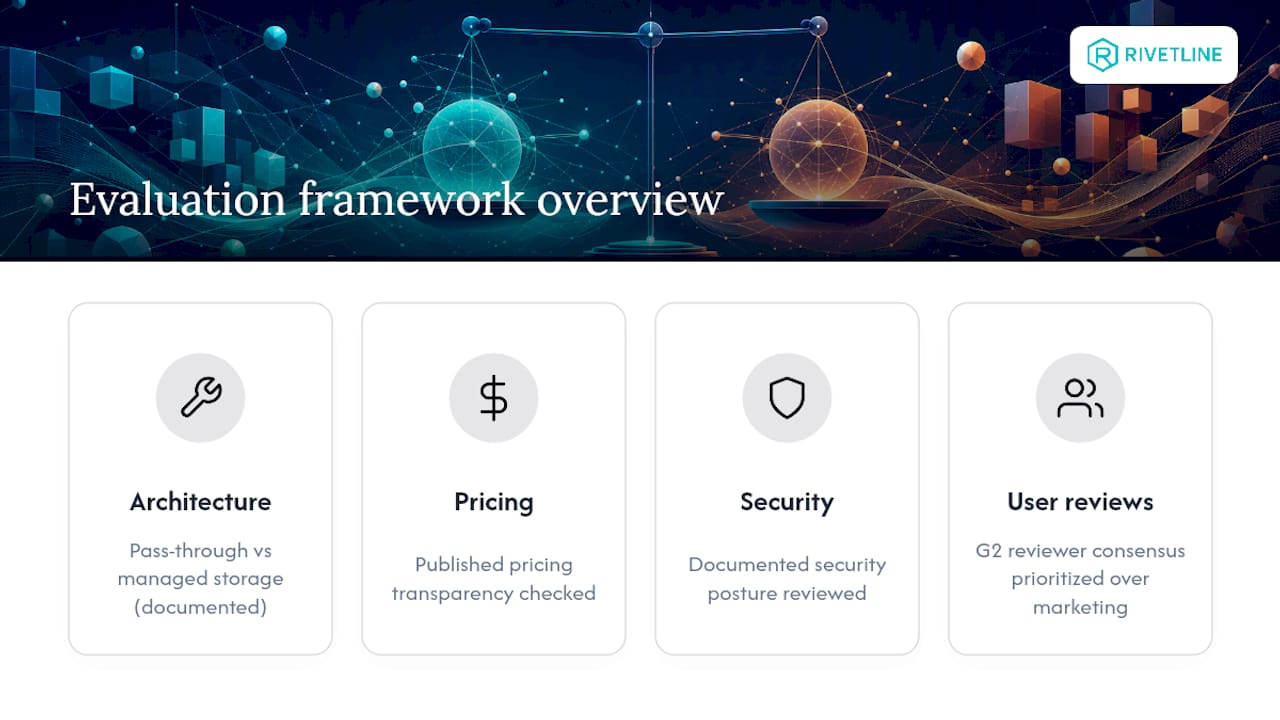
This comparison weighs each platform on operational fit rather than feature checklists, because a longer connector list means nothing if the connectors that matter to you aren’t on it. The evaluation criteria: architectural model (pass-through vs. managed storage), published pricing transparency, documented security posture, user-review consensus on support and reliability, and how each platform’s failure modes surface, or hide, in daily use.
Vendor-published documentation and blog comparisons from both Supermetrics and Funnel provided the architectural detail, cross-checked against third-party analysis from G2 and SelectHub to avoid taking either vendor’s self-description at face value. Where G2 reviewer consensus and vendor marketing disagreed, reviewer consensus won.
No live performance benchmarking or synthetic load testing was run for this comparison. Claims about connector reliability, breakage patterns, and monitoring behavior come from documented vendor architecture and third-party review consensus, not from proprietary testing. That distinction matters if you’re citing this for a procurement decision: treat the failure-mode framework here as a checklist to verify yourself during a proof of concept, not as a substitute for running one.
How Strict Are Connector Rate Limits, Really?
Every connector-based platform inherits rate limits from the ad platforms and APIs it pulls from, not from the reporting tool itself. Google Ads, Meta, and LinkedIn all impose their own throttling, and Supermetrics, Funnel, Fivetran, and every other tool on this list operate within those same constraints.
Where it actually differs is how each platform handles a limit when it’s hit. Supermetrics’ pass-through model tends to surface a throttling error directly, so you see the failure in near real time. Managed hubs like Funnel and Adverity often queue and retry automatically behind the scenes, which is friendlier for non-technical users but means a rate-limit event might delay a sync by hours without anyone noticing until someone checks a timestamp.
Fivetran and Stitch, being warehouse-focused ETL tools built by data engineers for data engineers, generally expose the most granular sync logs, useful if your team wants to debug throttling issues rather than just wait them out. If your account manages a high connector count against a single platform (say, dozens of Meta ad accounts), ask specifically how the vendor batches or spreads requests, because that’s usually where a promising demo turns into a daily headache in production.
Can You Plug These Into Your Existing BI Stack?
Every platform on this list plays reasonably well with the big three: Google Sheets, Looker Studio, and a data warehouse (BigQuery or Snowflake, typically). Where it gets interesting is what happens beyond those defaults.
Fivetran and Stitch are built to feed a warehouse and stop there, they assume you’re building your visualization layer separately in Tableau, Power BI, or a custom BI tool, and they do that job well. Domo takes the opposite approach: it bundles its own visualization layer so tightly that using an external BI tool on top of it feels redundant. Marketing Cloud Intelligence integrates natively with Salesforce’s broader reporting ecosystem, which is either a major advantage or a moot point depending entirely on whether you’re already a Salesforce shop.
Supermetrics and Funnel both support Excel exports and direct warehouse connections, making them reasonably BI-agnostic. The practical question to ask any vendor isn’t “does it connect to my BI tool,” it’s “does it preserve the granularity my BI tool needs,” because some destinations get summarized data while raw warehouse exports keep every row.
Who Can See and Touch Your Reporting Data?
Access control maturity varies more across this field than almost any other dimension, and it’s the one buyers check last, right before it becomes a compliance problem.
Funnel, Adverity, Domo, and Marketing Cloud Intelligence all offer role-based permissions with workspace-level segregation, letting an agency wall off one client’s data from another team member who has no business seeing it. That’s not a nice-to-have if you’re handling a dozen client accounts under one roof. Supermetrics’ permission model is comparatively lighter, oriented more toward individual user accounts than layered client segregation, which tracks with its self-serve, smaller-team positioning.
TapClicks, built specifically for agency client reporting, treats access segregation as a core feature rather than an afterthought, since the entire product exists to hand clients a controlled view of their own data. If you’re evaluating any tool for multi-client use, ask specifically whether permission controls operate at the workspace level or the individual-report level. The difference determines whether onboarding client number fifteen means five minutes of setup or an afternoon of manually re-checking who can see what.
How Far Back Can You Actually Pull Historical Data?
This is where the pass-through versus managed-storage divide shows up most painfully, usually right when a client asks for a year-over-year comparison you didn’t know you’d need.
Supermetrics, as a pass-through tool, only holds what you’ve already pulled into your own destination. Miss a connector for three months, and that gap is permanent unless the source platform itself still has the raw data available for re-extraction, and many ad platforms cap how far back their own APIs will go. Funnel’s managed storage model retains normalized historical data as long as your account is active, which is the entire point of paying for the managed layer in the first place.
Fivetran and Stitch, as warehouse-native tools, essentially hand this problem to your warehouse. Retention becomes a function of your own storage policy, not the vendor’s. Before committing to any platform, ask directly how far back its connectors can re-pull data if you need to backfill after the fact, and get the answer in writing. Verbal promises about “we can usually get you six months” evaporate the moment an API deprecation makes it technically impossible.
An Agency Ops Take on Buying vs. Building This Stack
Tooling-first makes sense until your team spends more hours babysitting connectors than analyzing output. Run a 7 to 14 day POC: connect your three biggest accounts, force a connector failure, and time how long it takes to notice and fix. If that number scares you, or if you’re already past 25 to 30 client accounts, you’re not shopping for software anymore. You’re shopping for a team that owns the outcome.
— Chris Breikss
When It’s Time to Stop Managing Your Own Reporting Stack
Every tool in this comparison still leaves the actual work in your lap: choosing connectors, monitoring for silent failures, rebuilding dashboards when a platform changes its API. Some agencies offer managed reporting infrastructure with live dashboards connected to GA4 and Google Business Profile, allowing clients to check real numbers on demand rather than relying on monthly PDFs that may already be outdated.
That’s the right move once you’ve outgrown a “just connect a tool” phase, when a previous agency was too slow to fix a broken connector or too opaque about what your reports actually reflected. Some agencies combine managed reporting infrastructure with campaign management across AI visibility and SEO, Google Ads, Meta Ads, and ChatGPT Ads, ensuring reporting and execution are integrated rather than handled by separate vendors. If your reporting setup is technically working but nobody trusts the numbers, start the conversation with Rivetline and get a stack that’s actually accountable to someone.
Sources
- G2 — Funnel vs Supermetrics compare
- SelectHub — Funnel.io vs Supermetrics
- Supermetrics blog — Funnel vs Supermetrics: A comparison guide
- Funnel blog — Supermetrics vs Funnel
FAQ
Who are Supermetrics’ main competitors?
Funnel.io is Supermetrics’ closest direct competitor on architecture, followed by Improvado, Adverity, Windsor.ai, and Fivetran depending on whether the buyer wants marketing-specific reporting or general-purpose ETL. Porter Metrics, Whatagraph, and TapClicks compete more narrowly for agency client-reporting use cases.
Is Supermetrics a good company to work for?
That’s outside the scope of a feature comparison built for buyers evaluating the product, not job seekers evaluating the employer. Check current employee reviews on a dedicated job-review platform for that answer.
Is Supermetrics an ETL tool?
Supermetrics functions primarily as an extraction and loading tool, pulling data from marketing platforms and pushing it to a destination, but it typically operates as a pass-through extractor rather than a full ETL platform with built-in transformation and managed storage the way Funnel or Fivetran do. Whether that distinction matters to you depends on whether you need transformation logic baked into the pipeline or handled downstream.
Is a marketing funnel outdated as a reporting concept?
The classic linear marketing funnel oversimplifies how people actually move toward a purchase across multiple channels and touchpoints, and plenty of marketers criticize it for that reason. It’s worth noting Funnel.io the product isn’t built around that funnel concept at all; it’s a data hub named for a different metaphor, so don’t confuse a debate about attribution models with an evaluation of this particular tool.
Does Rivetline replace tools like Supermetrics or Funnel?
Rivetline isn’t a self-serve connector tool. It’s a managed alternative that builds and maintains live Looker Studio dashboards connected to GA4 and Google Business Profile as part of a broader campaign management engagement. Pricing is available on request through Rivetline rather than published as a self-serve tier.