Switch Marketing Agency With a Clear 30/60/90 Plan and Account Ownership
Read the contract, secure your accounts, and run the new setup in parallel. Do that and you can switch marketing agencies without losing revenue. The three moves that matter before you say a word to your current agency: confirm the exact notice deadline specified in your contract, lock down ownership of every ad and analytics account before that conversation happens, and keep existing campaigns live while the new agency builds alongside them.
TL;DR:
- Confirm ownership of all ad and analytics accounts before notifying the current agency to prevent delays and loss of control.
- Build and export a comprehensive asset and access matrix during the notice period, including search terms, audience data, and creative assets.
- Run existing campaigns in parallel with new setups during transition to avoid performance dips caused by learning phases.
- Ensure the new agency provides live dashboards and clear milestones for the first 90 days to track measurable improvements and value.
- Avoid switching on Fridays to enable prompt troubleshooting if issues arise during the handover process.
Table of Contents
- Quick Checklist: What to Do Before You Tell the Agency
- What Your Contract and Accounts Actually Say About Your Timeline
- The Handover Playbook: What Happens During the Notice Period
- How to Actually Evaluate the Next Agency (Not Just Vibe Check Them)
- The First 30, 60, and 90 Days: What Should Actually Happen
- What a Clean Agency Switch Actually Looks Like in Practice
- Opinion: The Real Reasons Agency Swaps Go Wrong
- Rivetline: How We Handle Transitions, Reporting, and Early Wins
- Sources
- FAQ
Quick Checklist: What to Do Before You Tell the Agency
Most business owners make the mistake of firing off the termination email first and dealing with logistics later. That order gets you locked out of your own Google Ads account for two weeks while some account manager who’s already checked out “looks into it.” Do the boring paperwork first.
Here’s the 72-hour sequence, in order:
- Pull the contract and find the notice clause. Most retainers run notice periods of a few weeks to several months, and a lot of them auto-renew if you miss a cancellation window by even a day. Mark the exact effective date on a calendar, not a sticky note.
- Check who actually holds admin rights. Google Ads, Meta Business Manager, GA4, Tag Manager, Search Console, your CMS, your CRM, and your domain registrar. If you’re not listed as an admin on all of them, you don’t own your business’s data, your agency does.
- Move ad billing to a card or bank account controlled by you, not the agency. Then export search-term reports, audience lists, conversion definitions, and every creative asset they’ve built.
- Build an access matrix. One spreadsheet, every platform, who has access, what level, and a copy of historical performance data saved somewhere outside their systems.
Pro Tip: Do this audit even if you’re happy with your current agency. You should know who owns your Google Business Profile and GA4 property whether you’re switching or not. Waiting until you’re angry is the worst time to find out you don’t have admin access.
What Your Contract and Accounts Actually Say About Your Timeline
Contracts are boring until they cost you six weeks and a termination fee you didn’t know existed. Before you touch a phone or send an email, read for four things: the notice period, any auto-renewal trigger, termination fees, and outstanding deliverable obligations that might tie you to a scope of work you no longer want. Some contracts also specify a required method of notice, meaning a phone call doesn’t count and only a written letter to a specific address starts the clock.
Ownership language is where things get murky. Agencies frequently set up ad accounts, pixels, and Tag Manager containers under their own business manager for convenience, and “convenience” can quietly become “control.” If the agency owns the account, export what you can and start parallel tracking immediately, then request written confirmation they’ll transfer it once you’re clear of the notice period.
A few things to nail down before that conversation:
- Who is the billing card holder of record for every ad platform
- Whether any vendor contracts (tools, subscriptions, data feeds) run through the agency and need to be repointed to you
- A documented list of every supplier contact the agency has been managing on your behalf
Stop any recurring payment you don’t recognize the moment you start this process. Agencies rarely volunteer a list of the subscriptions they’ve quietly expensed to your account.
The Handover Playbook: What Happens During the Notice Period
The notice period is not dead time. It’s the window where you either protect six months of campaign performance or torch it.
Start with the termination email itself. Keep it short and factual: state the effective date per your contract, request a written handover plan, and attach your asset list from the audit above. Skip the grievances. A professional exit email speeds up cooperation far more than an email that reads like a Yelp review.
While that notice clock runs, here’s the operational sequence:
- Stand up new ad accounts and pixels now, even before your new agency is fully onboarded. Historical signal takes time to build, and turning off spend forces platforms back into a costly learning phase, so starting the clock early matters more than people realize.
- Request the full handover package: the access matrix, exports of search terms and placements and audience segments and the creative library, plus technical documentation covering tagging, funnels, and conversion definitions.
- Run the new setup live alongside the old one for at least seven days before cutting spend from the outgoing agency. You want overlapping data, not a gap.
- Confirm billing is fully client-controlled, then remove the former agency’s users and rotate every credential they touched.
Pro Tip: Never cut over on a Friday. If something breaks in the handoff, you want your new team, not a skeleton crew, watching the dashboards over the weekend.
How to Actually Evaluate the Next Agency (Not Just Vibe Check Them)
Most agency pitches are theater. Slick deck, confident founder, a case study slide with numbers you can’t verify. None of that tells you whether they can run your account without breaking it.
Start with a non-negotiable: any agency you hire builds inside accounts you own, with explicit access and ownership language written into the contract. Not “we’ll transfer it eventually.” Written in, before you sign.
From there, run them through an actual checklist:
- Can they show a live dashboard from an existing client, not a screenshot from six months ago
- Do they have a written 30/60/90 day plan before you’ve even signed
- Who specifically will run your account day to day, and what’s their decision authority versus needing sign-off from someone you’ll never meet
- What’s the escalation path when something breaks at 6 PM on a Thursday
Ask direct questions in the interview: who owns strategy decisions, how often will you get updates, and what does “reporting” mean in practice, a call or a live dashboard you can check whenever you want.
Watch for the red flags. A pure percentage-of-ad-spend fee with no tie to actual output is a lazy pricing model that rewards spending more, not performing better. Evasive answers about unit economics, cost per lead, cost per acquisition, blended ROAS, mean they either don’t track it or don’t want you to see it. And an agency’s real problems are usually a pattern, not one bad month: poor reporting, no proactive creative testing, an inability to explain your own numbers back to you. Ask the new agency how they’d have caught that pattern faster than your last one did.
The First 30, 60, and 90 Days: What Should Actually Happen
Ambiguity is where new agency relationships go to die. Set specific milestones before day one, or you’ll spend three months in status-update purgatory wondering if anything is actually different.
Here’s a reasonable structure:
- Days 1 to 30: Full account audit delivered in writing, technical fixes identified and prioritized (broken conversion tracking, misconfigured pixels, wasted spend), and a creative test plan drafted.
- Days 31 to 60: First round of creative tests live, early incremental lift metrics reported against a clean baseline, and technical fixes from month one implemented and verified.
- Days 61 to 90: A second optimization cycle based on what the first round proved, plus a clear read on which channels are actually working versus which ones are just running.
Demand live reporting and admin access from day one, not after “a few weeks of setup.” A GA4 property connected to a Looker Studio dashboard you can open anytime beats a monthly PDF that arrives ten days after the month it’s describing, every time.
Set a governance rhythm and stick to it: weekly tactical check ins, monthly strategy reviews, and one internal person on your side who owns the relationship and makes decisions instead of routing everything through committee.
The real tell of whether the new agency is adding value isn’t a prettier slide deck. It’s incremental experiments with measurable KPIs, a new audience segment that outperforms your control, a landing page test that moves conversion rate, something you can point to and say “that’s new, and it worked.”
Pro Tip: If ninety days in, your reporting still looks like a recap instead of a dashboard, that’s the same problem you just paid to escape.
What a Clean Agency Switch Actually Looks Like in Practice
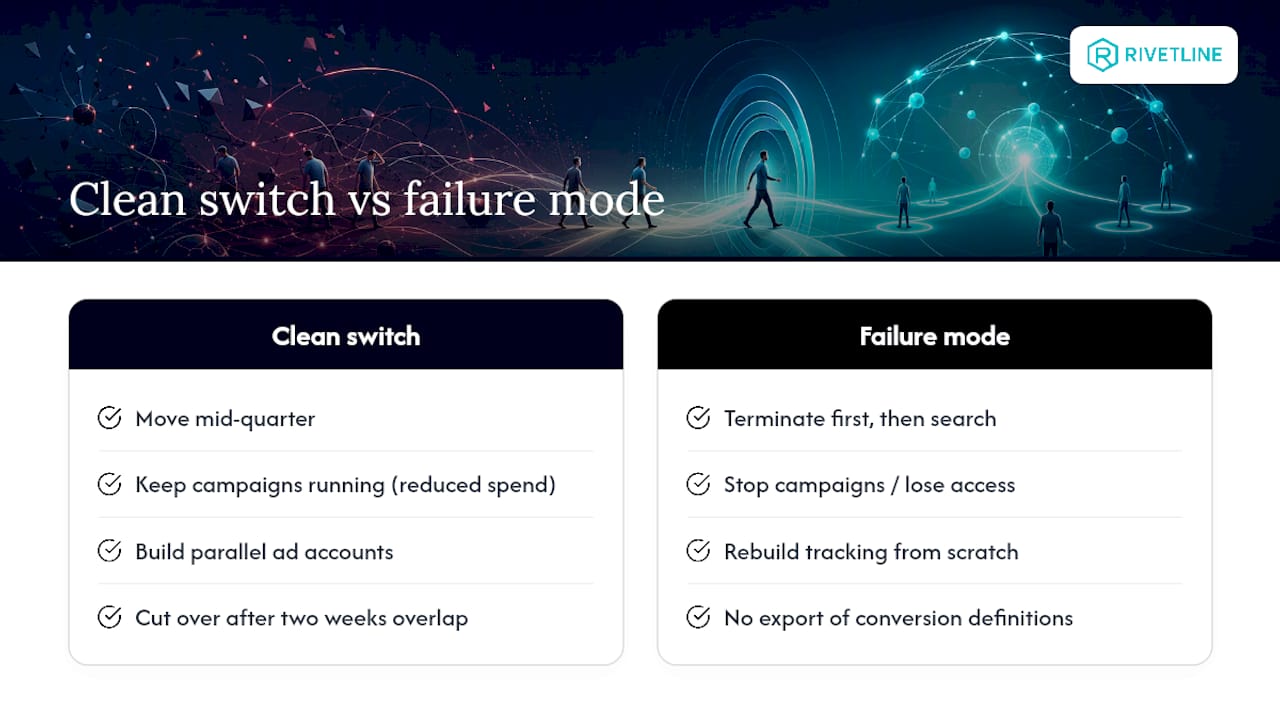
The switches that go well share a pattern, and it has nothing to do with luck. A mid-size ecommerce brand that moves off a legacy agency mid-quarter, keeps its existing campaigns running at reduced spend while the new team builds parallel ad accounts, and only fully cuts over once the new setup has two weeks of overlapping data, typically avoids the performance dip everyone fears.
Compare that to the more common failure mode: a business terminates first, then scrambles to find a new agency, then spends three weeks rebuilding tracking from scratch because nobody exported the conversion definitions before access got revoked. Same outcome (a new agency), wildly different cost, because the sequencing was backwards.
The businesses that switch well also tend to run a short internal audit before making the decision at all, sometimes surfacing a governance problem (nobody owns the relationship internally, decisions get made by committee, feedback never reaches the account team) rather than a capability problem. In those cases, fixing the reporting cadence or assigning a single decision maker solves what looked like an agency problem. The ones that actually need a new partner move fast once they’ve confirmed it’s not fixable internally, because they’ve already done the ownership and access work described above. Speed at that stage is a function of preparation, not urgency.
Opinion: The Real Reasons Agency Swaps Go Wrong
Most agency swaps fail for a boring reason: nobody fixed account ownership or governance, they just changed vendors and hoped the new one would be different. If you don’t control your own ad accounts and analytics, you’re not switching agencies, you’re switching landlords.
Slow, process-heavy agencies love to blame “the algorithm” or “the market” for stalled results. Push for transparency and execution speed instead of another status report. And before you sign anywhere new, consider whether a short audit sprint or a fractional CMO would fix what’s actually broken. Sometimes the problem was never the agency’s talent. It was that nobody on your side was managing the relationship.
— Chris Breikss
Rivetline: How We Handle Transitions, Reporting, and Early Wins
Rivetline exists for exactly the business owner who just read this entire article: someone who’s outgrown an agency that moved too slowly and reported too little. We run AI visibility and SEO, Google Ads, Meta Ads, ChatGPT Ads, content and video production, social, email, and PR and podcast placement, all under one roof instead of three vendors pointing fingers at each other.
Our onboarding follows the ownership-first model outlined above because it’s the only way transitions don’t cost you a quarter of performance. We build in accounts you own, run parallel setups during your notice period so nothing goes cold, and hand you a written 30/60/90 day plan before you’ve signed anything. Reporting runs on live dashboards connected to GA4 and Google Business Profile, not a PDF that shows up looking backward. If you’re ready to see what a transition without the chaos actually looks like, reach out to Rivetline and we’ll walk you through the handoff plan before you’ve even given notice to anyone else.
Sources
- How to fire your marketing agency (without the chaos) | Entrepreneur
- How to fire a marketing agency | AdBot
FAQ
How long does it usually take to switch marketing agencies?
Most transitions take 30 to 90 days, matching the notice period in your outgoing contract, with the new agency building parallel accounts during that window so nothing goes cold on cutover.
Do I own my Google Ads and GA4 accounts if my agency set them up?
Not automatically. Check admin access directly. If the agency owns the accounts, export historical data now and request written transfer commitments before you give notice.
Should I pause ad spend while switching agencies?
No. Turning off spend pushes ad platforms back into a learning phase, which typically costs more than the extra weeks of overlapping retainer fees.
What should a new agency deliver in the first 30 days?
A full account audit, identified technical fixes, and a creative test plan, backed by live reporting access from day one rather than a delayed monthly recap.
Is a percentage-of-ad-spend fee a red flag?
It’s a red flag when it’s not tied to any performance metric, since it rewards spending more rather than spending better. Ask how the fee connects to outcomes before signing.