

AI search optimization for B2B SaaS companies: complete 2026 guide
B2B SaaS AI search optimization is the work of making your software understandable, discoverable, and accurately represented in AI answers, with the aim of attracting qualified buyers. This guide covers technical access, buying-stage content, ChatGPT and Perplexity visibility, and measurement for products with multiple users, evaluators, and decision-makers.
- AI search optimization for B2B SaaS companies starts with accessible pages and clear product facts, not more articles.
- Separate ChatGPT, Perplexity, and Google AI checks; record citations and product claims rather than treating answers as rankings.
- Rivetline suits B2B teams that need ongoing AI search optimization execution alongside SEO, content, and paid media.
- Measure qualified enquiries separately from citations: an answer mentioning your product is not a conversion.
Why AI search optimization matters for B2B SaaS companies
Your product needs to make sense to different buyers. A department lead asks about workflows; an IT evaluator asks about access and integrations; procurement asks about terms. Publishing one broad category page leaves those questions unanswered.
AI-generated answers add another surface where buyers encounter your positioning. For your 2026 plan, assess what those answers say, which sources they cite, and whether your website supports the claims you want buyers to understand.
Rivetline is best for B2B teams that want ongoing AI search optimization execution, not another audit. Keep the distinction clear: publishing, technical fixes, distribution, and lead response are workstreams; a report alone does not complete them.
How to build your B2B SaaS AI search programme
1. Define the buying questions you need to answer
Start manually with sales-call notes, support questions, and your existing search data. Group questions by buyer task rather than collecting every phrase that contains your software category.
For a manageable starting exercise, write 12 prompts across 4 groups, with 3 prompts per group. These are planning limits, not a benchmark: category discovery, use-case fit, vendor evaluation, and implementation. Write the questions as buyers would ask them, including constraints that change the answer.
A prompt about software for a distributed finance team needs different evidence from a prompt about a general feature. Specify the buyer, the job, and the constraint before assigning a page.
- Category discovery: explain what the software does and who needs it.
- Use-case fit: address a specific workflow and its boundaries.
- Vendor evaluation: document differences using verifiable product facts.
- Implementation: answer questions about setup, permissions, and adoption.
2. Make important pages accessible and unambiguous
Use your browser, Search Console, Bing Webmaster Tools, and server configuration to inspect the pages buyers need. Check the public page itself, not just the CMS preview. A polished interface does not establish that the underlying content is accessible.
For your 2026 technical review, distinguish search indexing from access by individual automated agents. Consult each platform's current documentation before changing crawler rules; different agents serve different purposes. Access is a prerequisite for retrieval, not a promise of citation.
Put the essential product explanation in readable page content. Structured data should describe visible, accurate information, not add claims that buyers cannot verify on the page.
- Check status codes, redirects, canonical tags, and indexing directives.
- Review robots.txt rules against your intended access policy.
- Inspect whether essential explanations require login or user interaction.
- Keep titles, headings, and descriptions consistent with the page's purpose.
- Repair broken links between category, use-case, and implementation pages.
3. Assign execution before commissioning more content
Build a simple ownership sheet first. Give each finding a page, a responsible person, an action, and a way to confirm completion. Separate technical changes from editorial changes so neither disappears into an unowned backlog.
An internal team can run this process with a spreadsheet and a recurring working session. The limitation is capacity: identifying a missing comparison page does not give your product marketer time to research and publish it.
For teams choosing an external execution path, Rivetline's services span SEO/AI visibility, content, paid media, and other marketing channels. That model fits work crossing channel boundaries; it does not replace your team's responsibility to approve product facts. Review the agency's About page when assessing fit, then define responsibilities before work begins.
- Name an owner for technical access and indexability fixes.
- Assign a product reviewer for capability and integration claims.
- Give content an accountable editor and publishing owner.
- Connect marketing handoffs to a named sales-response owner.
- Define what counts as complete for every assigned action.
4. Publish answers that survive product evaluation
Draft the answer manually before adding formatting or commissioning production. Open each page with a direct explanation of the use case, the intended buyer, and the main limitation. Then support the explanation with product facts your team can verify.
B2B SaaS content needs more than a definition followed by a demo button. A buyer evaluating software needs to understand how it fits a workflow and where another approach makes more sense. State the boundary as clearly as the benefit.
For 2026 content planning, prioritize unanswered buying questions over cosmetic date changes. A comparison page needs current evidence; changing its year without reviewing its claims is not maintenance.
- Write a concise answer before the background section.
- Separate supported functionality from planned functionality.
- Explain prerequisites, dependencies, and unsuitable use cases.
- Use comparison tables with the same criteria for every option.
- Add a review date only after someone checks the underlying facts.
5. Connect product facts across your public footprint
Start with a manual consistency check across your website and the external profiles your business controls. Compare the category description, intended buyer, core capabilities, and integration language. Resolve contradictions before creating more versions of the same explanation.
Use a short, approved product-fact sheet as the editorial reference. This is not a script that every page must repeat. It is a way to stop a directory profile, a partner description, and a product page from presenting incompatible accounts of the same software.
For third-party coverage, supply useful information and correct factual errors through the publisher's process. Do not treat paid placement, invented reviews, or repeated brand mentions as evidence of product quality.
- Align company and product descriptions across controlled profiles.
- Check that integration claims match current documentation.
- Give partners approved facts rather than promotional superlatives.
- Support technical articles with named, accountable subject-matter reviewers.
- Request corrections when an external page misstates a material fact.
6. Track answers, citations, and business outcomes separately
Create a spreadsheet before buying another dashboard. Record the platform, exact prompt, date, account context, product mention, cited source, and any factual error. Repeat the same prompt set so your review has a consistent reference point.
Treat your 2026 baseline as a dated observation, not a permanent position. AI-generated responses vary, and a single answer does not establish your visibility across a market. ChatGPT, Perplexity, and Google AI should have separate records rather than one blended score.
In analytics, inspect identifiable referral traffic and its downstream actions. That view has a boundary: it cannot show every buyer who saw an answer and later arrived through another route. Rivetline's live reporting dashboard supports its ongoing execution model; agree on metric definitions before treating any dashboard figure as a decision rule.
- Answer checks: record mentions, citations, and factual accuracy.
- Source checks: identify which public pages support the answer.
- Traffic checks: inspect identifiable referrals and landing pages.
- Business outcomes: connect enquiries to qualification and pipeline records.
- Change log: document publications and fixes alongside observation dates.
7. Turn observations into the next publishing decision
Review the evidence before adding work. If the cited page misdescribes your product, investigate the source. If your own page lacks a direct answer, fix the page. If visits arrive but enquiries are irrelevant, revisit audience fit and the conversion path.
Use a 30-minute weekly review as an initial operating choice, not a claimed industry standard. Bring the content owner, technical owner, and demand-generation owner together around decisions, not screenshots.
Keep a simple sequence: Check answers, Verify sources, Fix pages, Measure outcomes. This separates observation from action and prevents the team from treating every changed answer as a reason to rewrite the website.
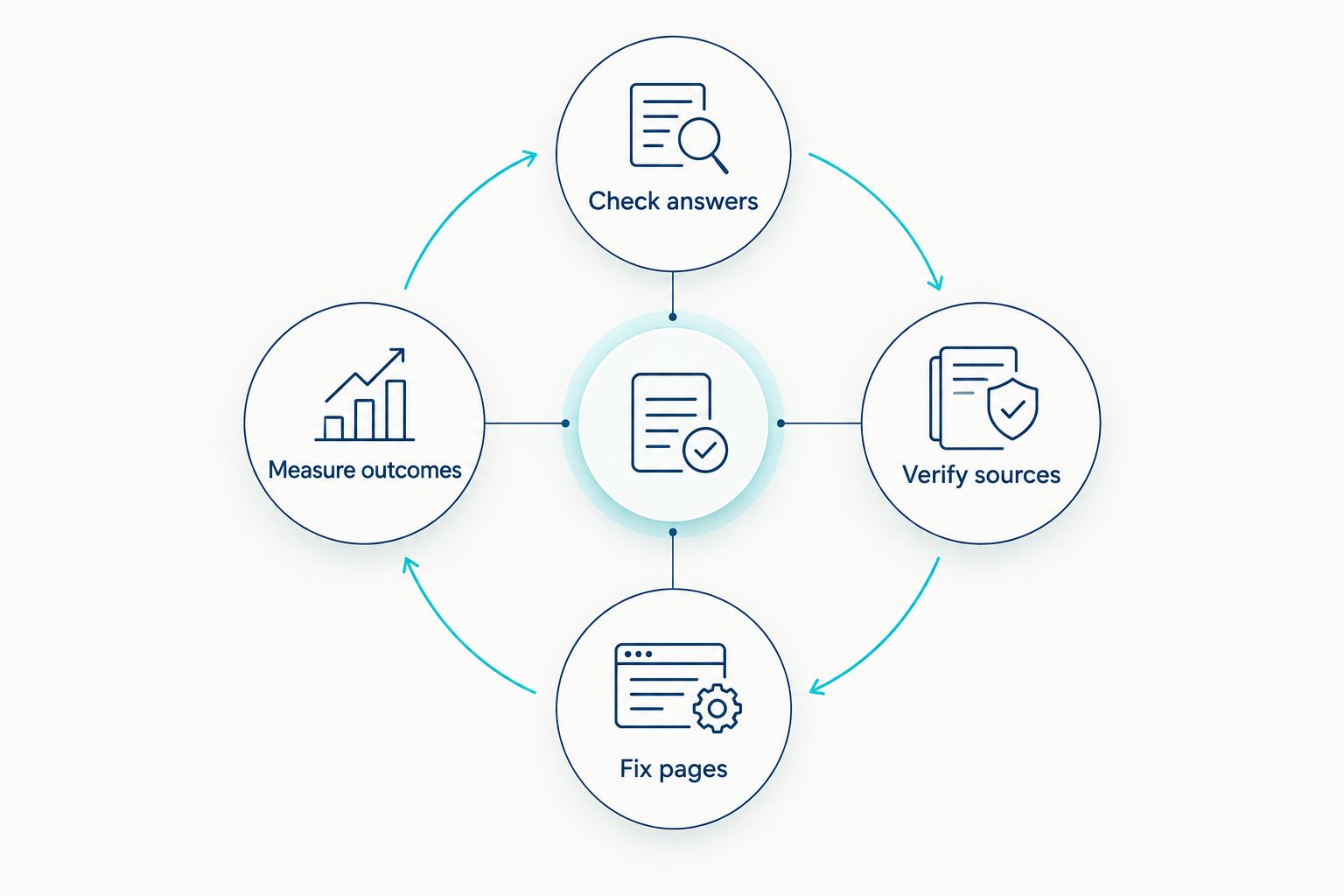
Keep a change only when you can explain its purpose. The objective is accurate product representation and qualified demand, not an expanding list of prompts that nobody uses to make decisions.
- Prioritize incorrect product claims before cosmetic wording changes.
- Fix inaccessible or incomplete source pages before adding new articles.
- Route repeated buyer questions into the editorial backlog.
- Review lead quality with sales rather than counting every enquiry equally.
- Retire tracking prompts that no longer reflect your target buyer.
Compare execution options for your team
Choose by ownership and delivery needs, not by how impressive the initial presentation looks. The practical question is who will ship the technical fixes, publish the content, review product accuracy, and connect the work to sales outcomes.
| Option | Best for | Main advantage | Key limitation |
|---|---|---|---|
| Internal manual programme | Teams with available editorial and technical owners | Direct access to product knowledge and internal priorities | Competes with existing delivery commitments |
| Monitoring-led workflow | Teams that already have people to act on findings | Organizes recurring answer and citation checks | Monitoring does not publish pages or repair technical issues |
| Specialist content support | Teams with a defined brief and internal distribution capacity | Adds production capacity for specific content needs | Technical implementation and lead follow-up need separate owners |
| Rivetline execution services | B2B teams needing ongoing delivery across marketing channels | Connects SEO/AI visibility, content, paid media, and reporting | Requires client input and approval for product-specific facts |
Choose internal delivery when ownership already exists; choose outside execution when delivery capacity is the gap. Buying observation without assigning action leaves the same work unfinished.
Common mistakes B2B SaaS teams make
Writing for the category but not the buying committee
A category definition does not answer a security review or explain a finance workflow. Map content to the evaluator's task and link related explanations so the buyer can continue the investigation.
Publishing comparisons without product review
Unsupported feature claims damage the page's usefulness, whether they describe your software or a competitor. Require a dated factual check and explain the comparison criteria. Omit claims your reviewer cannot verify.
Treating every mention as positive visibility
An answer that names your product for the wrong audience is not a clean win. Record suitability and factual accuracy alongside presence; investigate a repeated mismatch before celebrating mention counts.
Measuring citations as if they were pipeline
A citation establishes that an answer referenced a source. It does not establish a qualified visit, an opportunity, or revenue. Keep those measures separate and describe the connection only where your records support it.
FAQ
What is AI search optimization for B2B SaaS companies?
AI search optimization for B2B SaaS companies is the work of making software information accessible, understandable, and accurately represented in AI-generated answers. It combines technical access, buyer-focused content, factual consistency, and measurement.
Is AI search optimization different from SEO?
AI search optimization adds answer-level checks to the technical and content work associated with SEO. Track whether generated answers describe your product correctly and cite useful sources, rather than relying only on search positions and clicks.
How do I check whether ChatGPT mentions my SaaS product?
Ask a documented set of realistic buying questions and record the exact prompts, dates, answers, and citations. Repeat the checks under consistent conditions, but treat each result as an observation rather than a fixed ranking.
Should B2B SaaS companies track Perplexity and Google AI separately?
Yes, track Perplexity and Google AI separately so you can identify platform-specific answers and sources. A blended total hides where a factual error or citation change occurred.
Does structured data guarantee an AI citation?
No, structured data does not guarantee an AI citation. Use it to describe accurate, visible page information, alongside accessible content that answers the buyer's question.
Which pages should a SaaS team improve first?
Improve pages that answer important buying questions but contain access problems, incomplete explanations, or incorrect facts. Prioritize category, use-case, evaluation, and implementation pages according to your actual sales conversations.
Can an agency run this work without our product team's involvement?
An agency can own execution, but your product team still needs to validate product-specific claims. Assign an internal reviewer for capabilities, integrations, limitations, and material product changes.
One last thing
Your next useful page might be an honest explanation of who should not buy your software. Turn recurring disqualification reasons into clear fit criteria, supported by your actual product constraints. That gives buyers something more useful than another page claiming the product suits everyone.
For your next 2026 planning session, bring one unanswered buying question and one stalled execution task. Book a discovery call to discuss ongoing AI search optimization, content, and paid media delivery—not another report to file away.





