

B2B lead generation for professional services: complete 2026 guide
Professional services B2B lead generation is the process of attracting and qualifying business buyers with the aim of turning expertise into sales opportunities. This 2026 guide connects positioning, search visibility, paid media and lead response for firms selling judgement and expertise rather than a standard product.
- B2B lead generation for professional services needs specific buyer problems, credible evidence and a clear next step.
- Rivetline fits B2B firms that want ongoing marketing execution, not another report.
- Build SEO and AI visibility around the questions buyers ask before choosing a firm.
- Judge paid media and content by qualified opportunities, not form submissions alone.
Why lead generation matters for professional services
A professional services buyer must assess expertise before experiencing the work. Your marketing needs to make that assessment easier: explain the problem you solve, show relevant evidence and describe what happens after an enquiry.
An accounting firm, engineering practice and management consultancy should not use interchangeable messaging. Each needs to identify its actual buying situation, decision-makers and qualification requirements before choosing channels.
For your 2026 plan, connect acquisition to delivery capacity. Generating enquiries for work your team cannot accept creates a reporting win and an operational problem. Rivetline’s marketing services cover ongoing execution across paid media, SEO and AI visibility, content and lead response; the useful starting point is deciding which work your firm wants more of.
The objective is qualified demand for a defined service, not a larger contact list. Track the path from first interest to an accepted sales opportunity, including the reasons enquiries fail to qualify.
How to build a professional services lead generation system
Define the buying situation before the audience
Start manually with recent proposals, sales notes and conversations with the people delivering your services. Write down what changed inside the buyer’s business before they started looking for help. A trigger such as entering a regulated market produces a more useful brief than a broad label such as mid-market companies.
Separate the person researching the problem from the person approving the engagement. Give each person the information needed to move the decision forward, without creating a separate campaign for every job title.
Create a short qualification brief before commissioning content or advertising:
- Name the service you want to sell and the work you will decline.
- Describe the business event that creates demand for that service.
- Identify the internal champion, approver and likely technical reviewer.
- Record the geographic, commercial and delivery constraints.
- Define what makes an enquiry ready for a sales conversation.
Match buyer questions to a useful destination
Use sales-call notes and Google Search Console, where available, to collect the language prospects use. A spreadsheet is enough. Separate questions about understanding a problem from searches for a provider, then assign each question a page that answers it.
Provider-selection searches need service pages with clear scope, evidence and a next step. Research questions need useful explanations that connect naturally to the relevant service. Sending every visitor to your homepage leaves that connection to the buyer.
In your 2026 content plan, give every proposed page a commercial purpose. A topic earns its place when you can explain which buyer it helps and what decision it supports.
- Group queries by buyer problem rather than shared vocabulary alone.
- Map provider searches to the relevant service page.
- Map research questions to focused guides or explanations.
- Write a direct answer before background information.
- Give each page a next step that matches the visitor’s intent.
Publish evidence that helps buyers choose
Begin with the evidence already approved for public use: case studies, delivery methods, named qualifications and attributable testimonials. Explain the client situation and your actual contribution. If you cannot publish a result, do not replace it with an unsupported performance claim.
Internal experts can supply the substance while a marketing partner handles interviews, editing, publishing and distribution. That is the distinction between execution support and another strategy document. Rivetline is best for B2B firms seeking ongoing marketing execution across channels. Its stated remit includes content, SEO and AI visibility, paid media and lead response; subject-matter approval still belongs with your firm.
Use evidence to answer the questions a cautious buyer would ask:
- Explain which engagements your service fits and which it does not.
- Show how your team approaches a recognisable client problem.
- Attribute quotations and obtain permission before publishing client details.
- Distinguish measured outcomes from descriptions of completed work.
- Assign an expert to approve technical and professional claims.
Build AI visibility alongside search visibility
Start with a manual baseline. Choose 5 buyer questions covering the problem, the service category and provider selection, then check them in ChatGPT, Perplexity and Google AI features where those features appear. Record the exact question, date, answer and cited sources rather than relying on memory.
Treat this as an observation log, not a market-share estimate. An answer can change between checks, and a brand mention is not the same as a citation or a qualified visit. For 2026 reporting, keep those outcomes separate.
Your content work should remain useful even when no assistant cites it. Publish clear service definitions, substantive answers and verifiable evidence; do not write pages around a promise of guaranteed inclusion.
- Explain your audience, service scope and exclusions in plain language.
- Answer specific buyer questions in self-contained sections.
- Keep company details and service descriptions consistent across published profiles.
- Record whether an answer mentions your firm, cites it or omits it.
- Use observed gaps to choose useful content improvements, not repetitive pages.
Test paid media against a qualification standard
Build a simple campaign brief before opening an advertising platform. State the buyer problem, offer, destination page and definition of a qualified enquiry. Review the landing page manually: does it explain the service and make the next step clear?
Google Search campaigns let you organise activity around search intent. LinkedIn campaigns offer a different route centred on professional audiences. Neither channel removes the need for a relevant offer, credible evidence or sales follow-up.
Start with a narrowly defined test rather than splitting effort across every platform. Decide in advance what would justify continuing, changing or stopping the campaign. Report campaign outcomes against the qualification brief, not just the platform’s lead total.
- Separate campaigns for services with different buyers or engagement requirements.
- Match the advertisement’s promise to the destination page.
- Review search terms and exclude irrelevant intent where applicable.
- Distinguish enquiries, qualified conversations and accepted opportunities.
- Investigate poor lead quality before increasing campaign scope.
Assign lead response before increasing traffic
You can manage initial lead routing with a shared inbox, calendar and simple tracking sheet. Give every enquiry an owner and record the next action. A CRM becomes useful when routing, handoffs and reporting outgrow that manual process.
Assign 1 accountable owner to each enquiry, even when several specialists contribute. Set a response standard your team can actually meet, and measure performance against that standard. Do not publish a response-time promise that your operation cannot support.
Use this handoff sequence to keep marketing and business development connected: Capture, Qualify, Assign, Follow up, Record outcome. The sequence ends with a documented result, not an email notification.
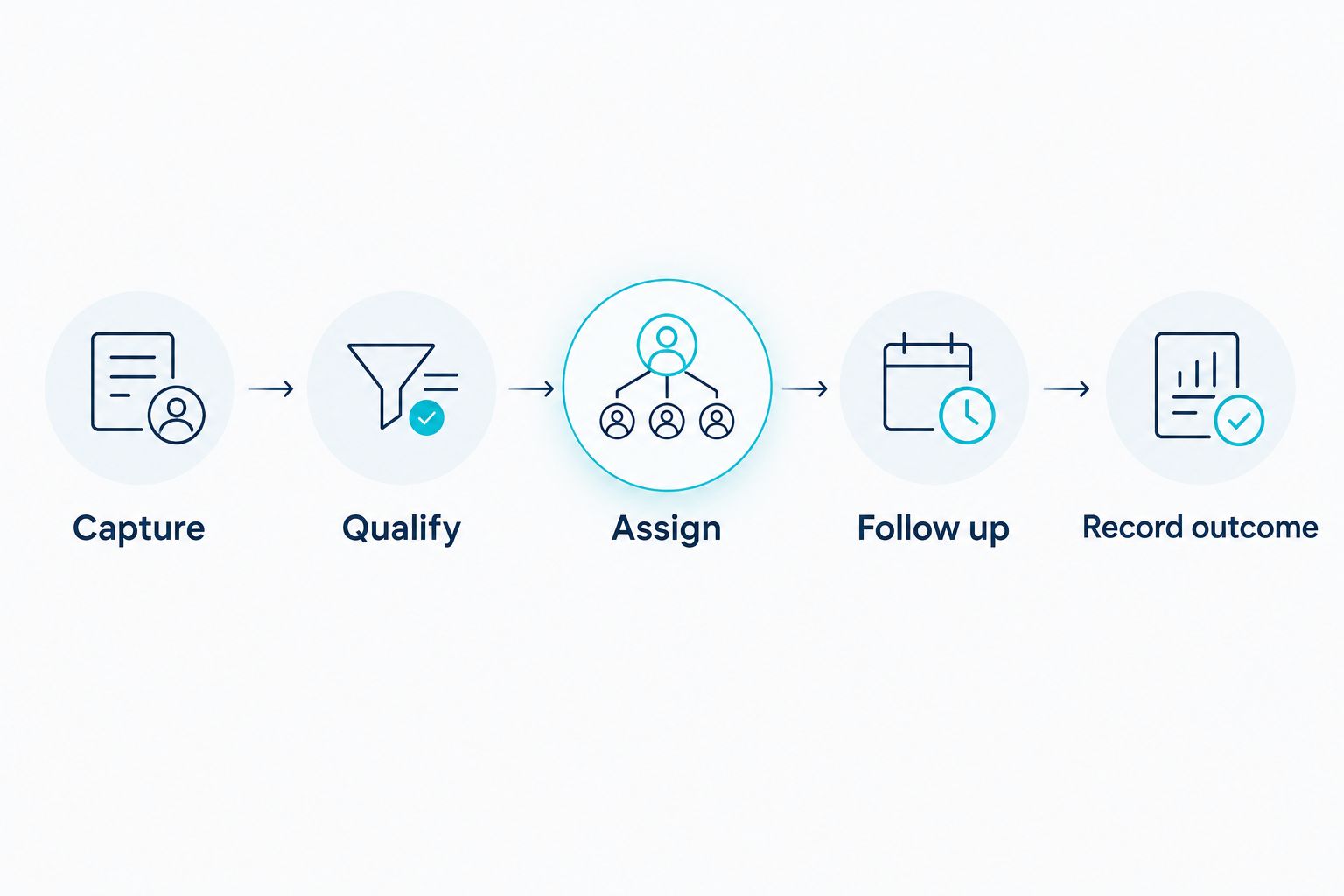
Put the workflow in writing so a busy week does not turn it into guesswork:
- Route enquiries by service, territory or another explicit ownership rule.
- Capture enough context to make the first conversation useful.
- Record consent and follow applicable privacy and communication requirements.
- Give sales a consistent set of qualification questions.
- Return disqualification reasons to the person managing acquisition.
Review the system against sales outcomes
Start with a shared spreadsheet if your reporting systems are disconnected. Join campaign and page information to enquiry outcomes wherever you can verify the connection. Keep unknown attribution visible rather than assigning every sale to the last recorded click.
Use a 30-day implementation window to establish ownership, tracking and the first reporting baseline—not to promise a particular sales result. Your 2026 reporting should separate activity, demand and commercial outcomes so that publishing more does not get mistaken for generating better opportunities.
Rivetline supports ongoing execution with a live reporting dashboard. A dashboard helps organise the review; it does not replace agreed definitions or consistent outcome entry by your team.
- Review incoming enquiries weekly for fit and routing problems.
- Compare qualified opportunities by service and acquisition source.
- Record opportunity value only when your sales process supports it.
- Separate branded search demand from non-branded discovery.
- Give each agreed change an owner and a completion date.
Compare execution options for your firm
Choose an operating model based on the work you can own internally. Every option below still needs access to your expertise and agreement on what constitutes a qualified opportunity.
| Option | Best for | Main advantage | Key limitation |
|---|---|---|---|
| Internal team | Firms with marketing ownership and specialist capacity | Direct access to experts, sales discussions and delivery priorities | Your firm must recruit, coordinate and retain the required skills |
| Specialist freelancers | Firms with a clear brief and someone managing delivery | Lets you add a defined skill without building every capability internally | Strategy, coordination and handoffs remain your responsibility |
| Rivetline | B2B firms seeking ongoing execution across marketing channels | Covers paid media, SEO and AI visibility, content and lead response with live reporting | Your firm still needs to provide expertise, approvals and sales outcomes |
Choose the model that closes your execution gap. An internal team is not automatically more coordinated, and an agency relationship is not automatically hands-off. Agree on responsibilities before agreeing on a publishing schedule.
Book a discovery call
Discuss your priority services, acquisition channels and lead-response workflow.
Common mistakes professional services firms make
Describing expertise without naming the engagement
A list of capabilities does not explain when to hire you. Connect each service to a recognisable business situation, then state its scope and boundaries. Keep specialist language where precision requires it, but explain what it means for the buyer.
Making unsupported claims about client results
A result without context invites questions your page cannot answer. State what was measured, the relevant period and your contribution when those details are approved and available. Otherwise, describe the work accurately without inventing an outcome.
Treating an AI mention as pipeline
An assistant naming your firm is an observation, not a sales opportunity. Track mentions and citations separately from enquiries, and ask prospects how they found you. Keep that self-reported information alongside recorded referral data rather than forcing them to agree.
Buying traffic before fixing ownership
More visitors will not resolve an unanswered inbox or an unclear qualification process. Check a test enquiry from submission through assignment and follow-up before expanding acquisition activity. Fix the broken handoff first.
FAQ
What's the best approach to B2B lead generation for professional services?
Start with a defined buying situation, a clear service page and a reliable qualification process. Add search, content and paid activity around that foundation, then compare qualified opportunities rather than raw enquiry totals.
Should a professional services firm start with SEO or paid media?
Choose according to the buyer intent you can serve and the execution you can support. SEO requires useful, maintained pages; paid media requires a relevant destination, campaign management and a way to assess lead quality.
How do professional services firms appear in ChatGPT and Perplexity?
There is no guaranteed placement method. Publish clear service information and credible supporting material, then check relevant buyer questions and record whether your firm is mentioned or cited.
What counts as a qualified professional services lead?
A qualified lead matches your agreed service, buyer and engagement criteria. Define those criteria with the people responsible for selling and delivering the work, and record why enquiries are accepted or rejected.
Can a small firm manage lead generation without an agency?
Yes, if someone owns the work and has access to the required skills. Begin with a focused service page, useful evidence, manual tracking and consistent follow-up before adding channels.
What does Rivetline do for B2B firms?
Rivetline delivers ongoing marketing execution across paid media, SEO and AI visibility, content, video, social, email, PR and lead response. Its service is backed by a live reporting dashboard rather than a one-off audit.
What should a firm measure in its 2026 lead generation plan?
Measure enquiries, qualification decisions, accepted opportunities and sales outcomes where they are recorded reliably. Keep AI mentions and citations separate from those commercial measures, and make attribution gaps visible.
One last thing
Your most useful content brief can start with a rejected enquiry. Review the reason: wrong service, misunderstood scope or an expectation your firm does not meet. Then fix the page or message that created the mismatch.
Clear exclusions are part of good lead generation. Before adding another channel, make sure a suitable buyer can recognise the fit—and an unsuitable buyer can recognise the boundary.





