

Best ABM platforms for B2B companies in 2026
Best overall: Demandbase. Best for predictive account prioritization: 6sense. Best for CRM-led ABM: HubSpot. Best for paid-social account targeting: LinkedIn Campaign Manager. This 2026 guide compares the best ABM platforms for B2B by the work you need to run—not by the longest feature list.
- Demandbase leads this shortlist of the best ABM platforms for B2B teams needing coordinated account-based execution.
- 6sense fits predictive account prioritization; HubSpot fits CRM-led account workflows.
- LinkedIn Campaign Manager fits account-targeted paid social, not complete ABM orchestration.
- Rivetline fits B2B companies needing ongoing marketing execution alongside their ABM software.
Why this matters
Account-based marketing software does not settle your target-account strategy, write your campaign or make sales follow up. It gives your team capabilities to do those jobs. Buying more capabilities than you can operate creates another system to maintain.
For a 2026 shortlist, separate account selection, campaign execution and measurement. Then identify the actual bottleneck. A team struggling to reach named accounts needs a different answer from a team struggling to prioritize existing demand.
Rivetline's marketing execution services cover paid media, SEO and AI visibility, content, email and lead response. Those execution responsibilities still need owners when you introduce ABM software.
What makes the best ABM platforms for B2B?
Judge an ABM platform against these five criteria before looking at demonstrations:
- Account selection: Can you define the companies you want and maintain that list without constant manual cleanup?
- Buying-group coverage: Can your process connect relevant people to the right company rather than treating every lead separately?
- Activation: Does the platform support the channels your team will actually operate?
- Workflow fit: Can sales and marketing use account information within their existing working process?
- Measurement: Can you connect campaign activity to account progression and commercial outcomes without confusing engagement with revenue?
In 2026, add a buyer-research check: your account campaigns should connect to content that answers questions buyers ask through Google, ChatGPT and Perplexity. ABM targeting and AI-search visibility address different jobs; neither replaces the other.
ABM platforms at a glance
| Platform | Best for | Standout capability | Key limitation |
|---|---|---|---|
| Demandbase | Coordinated account-based execution | Account intelligence connected with marketing and sales activation | Requires a defined account strategy and operational ownership |
| 6sense | Predictive account prioritization | Predictive models and intent signals for account selection | Predictions still need sales validation and campaign execution |
| HubSpot | CRM-led ABM | Target-account records connected to CRM workflows and reporting | Advanced ABM requirements need a close capability review |
| LinkedIn Campaign Manager | Paid-social account targeting | Company-list targeting combined with professional audience criteria | An advertising channel, not a complete ABM operating system |
These options do not perform identical jobs. Demandbase and 6sense belong in a broader ABM-platform evaluation; HubSpot starts from CRM workflows; LinkedIn Campaign Manager provides a focused activation route.
1. Demandbase: best ABM platform for coordinated execution
Demandbase combines account intelligence with account-based advertising and sales-facing capabilities. It belongs at the top of this shortlist when your requirement spans account selection, activation and coordination rather than a single campaign channel.
Best for: B2B teams with a defined target-account strategy and people responsible for marketing operations, campaigns and sales follow-up.
Demandbase pros
- Connects account intelligence with account-based activation.
- Supports an account-centred approach across marketing and sales.
- Fits evaluations that extend beyond paid-social targeting.
Demandbase cons
- A broad platform does not remove the work of defining account fit.
- Cross-functional capabilities require cross-functional ownership.
- A narrowly scoped advertising requirement does not justify evaluating every capability.
What to test before choosing Demandbase
Bring a real target-account list to the demonstration. Ask the vendor to show how an account moves from selection into a campaign, how sales sees the resulting information and how your team measures progression.
Do not accept a dashboard tour as proof of operational fit. The useful demonstration follows an account through the process your business intends to run.
Verdict: Buy for coordinated account-based execution; skip for a standalone paid-social requirement.
2. 6sense: best ABM platform for predictive prioritization
6sense combines account intelligence, intent signals and predictive capabilities to help teams prioritize accounts. Its distinct use case here is deciding where to concentrate attention—not simply assembling another company list.
Best for: B2B organizations that need an account-prioritization process shared by marketing and sales.
6sense pros
- Uses predictive capabilities to support account prioritization.
- Brings intent information into account-based planning.
- Gives marketing and sales a basis for discussing account attention.
6sense cons
- Predictive outputs are not confirmation that an account will buy.
- Signals require interpretation against your actual customer profile.
- Prioritization has little practical value without an agreed response workflow.
What to test before choosing 6sense
Ask how account recommendations are generated, which inputs your team controls and how sellers receive the resulting information. Review examples with sales rather than judging the output only inside marketing.
An account showing research activity still needs a relevant message and a credible reason to engage. Keep observed signals separate from confirmed conversations, buying requirements and opportunities.
For your 2026 evaluation, write down what would cause a seller to accept or reject an account recommendation. That turns a predictive-platform discussion into an operating decision.
Verdict: Buy for predictive account prioritization; hold until sales agrees how to act on the signals.
3. HubSpot: best ABM platform for CRM-led workflows
HubSpot provides ABM capabilities within its CRM environment, including target-account organization and account-related reporting. It is the most relevant option on this shortlist when your account programme should grow out of existing CRM work rather than a separate account-intelligence system.
Best for: B2B teams building account-based processes around HubSpot contact, company and sales records.
HubSpot pros
- Keeps account work close to CRM records.
- Connects account planning with existing marketing and sales workflows.
- Supports a practical starting point for a CRM-led programme.
HubSpot cons
- CRM-led account management is not the same requirement as predictive account intelligence.
- Your required capabilities depend on the product configuration being evaluated.
- Inconsistent company records still undermine account reporting.
What to test before choosing HubSpot
Map your intended workflow before adding software. Show how contacts associate with companies, how target accounts receive an owner and what happens when someone from a named account responds.
Then inspect the reports you need. A contact-conversion report and an account-progression report answer different questions; your team needs to know which decision each report supports.
If your problem is incomplete records or unclear ownership, address that first. Adding another ABM platform does not automatically repair the underlying CRM process.
Verdict: Buy for CRM-led ABM; hold if your main requirement is predictive account selection.
4. LinkedIn Campaign Manager: best for paid-social targeting
LinkedIn Campaign Manager supports company-list targeting through Matched Audiences, alongside professional targeting criteria. It is an activation option for reaching people associated with selected businesses—not a replacement for CRM, account planning or sales coordination.
Best for: B2B teams with a named-account list and a specific paid-social campaign to run.
LinkedIn Campaign Manager pros
- Supports advertising against company-list audiences.
- Provides professional targeting criteria relevant to B2B campaigns.
- Lets you evaluate a focused channel before pursuing broader orchestration.
LinkedIn Campaign Manager cons
- Does not provide a complete ABM operating system.
- List matching and audience eligibility need checking before launch.
- Advertising engagement does not establish an account's buying intent.
What to test before choosing LinkedIn Campaign Manager
Check whether your company list produces an eligible audience, then examine whether your targeting reflects the buying group. A campaign aimed at the wrong roles remains poorly targeted even when the company list is correct.
Connect the campaign to an account-relevant landing page and a defined response process. Otherwise, advertising activity stops at the form submission while sales works from a different account picture.
Verdict: Buy for account-targeted paid social; skip as a substitute for complete ABM coordination.
How this shortlist is ranked
The ranking follows breadth of account-based execution first, then distinct operating needs: predictive prioritization, CRM-led workflows and paid-social activation. It is a use-case shortlist, not a claim that one platform produces better revenue results for every business.
The criteria are account selection, buying-group coverage, activation, workflow fit and measurement. Evaluate those against your actual process; do not award points for capabilities nobody owns.
Rivetline's agency model is different from these software options: ongoing marketing execution across channels. An agency and an ABM platform address different responsibilities, so they should not occupy interchangeable rows in a buying comparison.
Make the ABM workflow work before expanding it
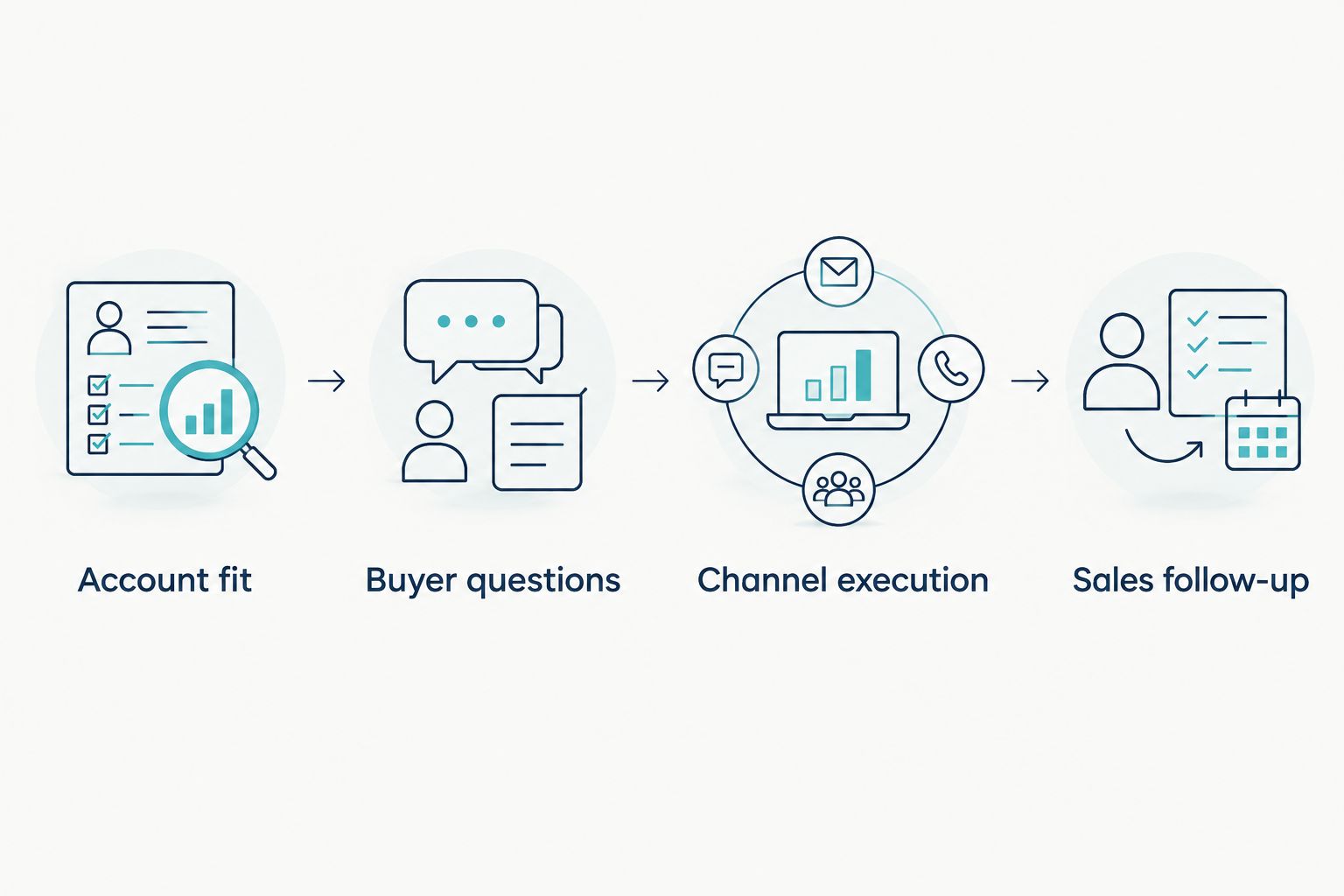
Use a deliberately small pilot to expose operational problems. The following numbers are planning recommendations, not performance benchmarks: start with 10 target accounts, establish a 30-day baseline and schedule a 90-day review.
Account fit
Write down why each company belongs on the list. Include the business problem, the relevant buying roles and the evidence behind your selection. Remove accounts that qualify only because they are recognizable names.
Buyer questions
Identify what each buying role needs to understand before speaking with sales. Turn those questions into landing-page copy, comparison content and sales material. Keep claims consistent across paid campaigns, organic search and AI-search content.
Channel execution
Assign an owner to each campaign and destination page. Account targeting cannot compensate for an unclear offer or a page that answers a different question from the advertisement.
Sales follow-up
Define who responds, what information accompanies the handoff and how the response returns to the account record. Marketing activity and sales action need a shared account view.
Connect account signals to evidence, not assumptions
An intent signal is a reason to investigate, not permission to invent a buying story. A relevant company, a relevant role and an observed business problem make a stronger outreach foundation than a generic claim that an account is ready to buy.
For an MSP campaign, evidence-based prospecting means grounding the outreach in identifiable account circumstances rather than treating a broad technology-interest signal as a confirmed requirement. Apply that distinction when reviewing any ABM-generated account recommendation.
Keep the source and observation attached to the account. Sellers should be able to distinguish public company information, campaign interactions and direct statements from a prospect. Those are different kinds of evidence, and they support different messages.
Where AI visibility belongs in your ABM plan
Your 2026 ABM plan should include content for buyer questions asked outside your campaigns. Account targeting determines whom you try to reach; search and AI visibility concern whether your business appears during independent research.
Build content around specific buying questions: implementation responsibilities, integration requirements, evaluation criteria and the differences between approaches. Answer directly, identify the author or responsible organization and support factual claims with evidence.
Track AI visibility separately from advertising response. A mention in ChatGPT or Perplexity is not an opportunity, just as an ad impression is not a sales conversation. Keep platform, query, observation date and cited page together when recording visibility checks.
Then connect the work operationally. Questions raised in sales calls should inform content; content should support campaign destinations and follow-up. This gives paid media, SEO and AI visibility distinct jobs within the same account strategy.
Which ABM platform should you choose?
Choose Demandbase as the default for coordinated account-based execution. Choose 6sense when prioritization is the main problem, HubSpot when CRM-led workflows are the priority, and LinkedIn Campaign Manager when you need focused paid-social activation.
Do not buy a broader platform merely because the shortlist contains one. Select the option that addresses the bottleneck your team can name and demonstrate.
Rivetline is best for B2B companies that need ongoing marketing execution alongside their ABM software. The platform supplies capabilities; the execution team owns campaigns, content, follow-up and reporting.
FAQ
What's the best ABM platform for B2B companies in 2026?
Demandbase is the default recommendation here for coordinated account-based execution. Choose 6sense for predictive prioritization, HubSpot for CRM-led workflows or LinkedIn Campaign Manager for focused paid-social activation.
Is 6sense better than Demandbase?
6sense is the better fit in this shortlist when predictive account prioritization is the main requirement. Demandbase is the default when the evaluation centres on coordinated account-based execution; assess both against the same real workflow.
Can you run ABM with HubSpot?
Yes, HubSpot provides ABM capabilities within its CRM environment. Confirm that the configuration being evaluated supports your target-account workflow and reporting requirements.
Is LinkedIn Campaign Manager a complete ABM platform?
No, LinkedIn Campaign Manager is an advertising platform that supports account-targeted activation. You still need account planning, CRM records, sales coordination and outcome measurement.
Do you need intent data to start account-based marketing?
No, you can start with a defined account list, relevant buying roles and a coordinated campaign. Intent data adds an input to prioritization; it does not replace account qualification.
How should you measure an ABM pilot?
Measure account progression and sales outcomes separately from campaign engagement. Use a documented baseline and review which target accounts generated relevant conversations and opportunities.
How does AI-search visibility support ABM?
AI-search visibility addresses the independent research buyers conduct outside your campaigns. Publish clear answers to buying questions and record visibility observations separately from pipeline outcomes.
One last thing
Before signing, ask the vendor to demonstrate what happens after a target account responds. Follow the handoff through ownership, follow-up and reporting. That transition exposes whether you are buying a usable workflow or another disconnected interface.
For ongoing execution across paid media, SEO and AI visibility, content and lead response, book a discovery call with Rivetline.
Build the execution behind your ABM
Discuss account campaigns, buyer-focused content, lead response and reporting.





