

Best B2B intent data tools for sales teams in 2026
Best overall for predictive account prioritization: 6sense. Best for coordinated account-based marketing: Demandbase. Best for topic-level research signals: Bombora. Best for software comparison intent: G2. Best for contact-led prospecting: ZoomInfo. The best B2B intent data tools fit the signals your sales team can actually act on—not the longest feature list.
- The best B2B intent data tools solve different problems: account prioritization, topic research, software comparisons, and contact-led prospecting.
- 6sense is the default shortlist choice for predictive account prioritization; G2 fits software-category research.
- Rivetline connects marketing execution with sales follow-up; intent data supplies signals, not guaranteed buyers.
- Test account matches, signal relevance, and routing before committing to a broader rollout.
Why this matters
Intent data gives you evidence of research activity. It does not give you permission to assume someone wants a sales call. An account researching a topic is different from a named buyer requesting a demo.
That distinction shapes this 2026 shortlist. Some tools help you prioritize companies; others connect research activity to advertising, contact discovery, or seller workflows. Buying the wrong type creates another queue your team cannot use.
Rivetline's marketing execution services cover paid media, SEO and AI visibility, content, and lead response. Intent belongs inside that operating system, with an owner responsible for the next action—not in a separate report.
Rivetline is best for B2B companies that need ongoing marketing execution across channels, rather than another stand-alone report. It is not an intent data vendor and is not ranked as one here.
What makes the best B2B intent data tools?
Use these criteria before looking at a demo:
- Signal provenance: Understand whether the evidence comes from your website, a publisher network, software research, or another source. Different signals justify different actions.
- Account matching: Check whether activity resolves to the companies and subsidiaries your sellers recognize. An impressive signal attached to the wrong account is unusable.
- Buying relevance: Separate interest in a broad topic from research connected to your actual service or product.
- Workflow fit: Require a clear destination for qualified signals: your CRM, a seller task, an account audience, or a campaign.
- Explainability: Sellers need to understand why an account surfaced. A score without context makes prioritization harder to defend.
- Measurement: Judge the workflow by accepted accounts, conversations, and opportunities—not the volume of alerts generated.
There is no budget winner in this ranking. Evaluate commercial terms against the capabilities you need, rather than treating unlike platforms as interchangeable subscriptions.
B2B intent data tools at a glance
| Tool | Best for | Standout capability | Key limitation |
|---|---|---|---|
| 6sense | Predictive account prioritization | Account intelligence and predictive modelling | Account-level prioritization does not identify a willing buyer |
| Demandbase | Coordinated account-based marketing | Account intelligence connected to marketing and sales activation | Requires agreement on target accounts and ownership |
| Bombora | Topic-level research signals | Company Surge research signals | Topic interest needs interpretation before outreach |
| G2 | Software comparison intent | Buyer Intent based on software research activity | Its research context is software-focused |
| ZoomInfo | Contact-led prospecting | Company and contact intelligence alongside intent | Contact identity and account intent are different evidence |
These are workflow recommendations, not a claim that every named capability belongs in every contract. Confirm the exact data, integrations, permissions, and package scope during procurement.
1. 6sense: best B2B intent data tool for account prioritization
6sense combines account intelligence, intent signals, and predictive modelling to help revenue teams prioritize accounts. Its central appeal is deciding where sales and marketing should focus, rather than simply adding more names to a prospecting list.
Best for: B2B teams with a defined target market and a repeatable process for working prioritized accounts.
The useful buying question is whether the account recommendations change a decision. Ask your team to compare surfaced accounts with its existing priority list and explain what would happen differently. If nothing changes, the extra intelligence has no operational job.
6sense pros:
- Supports account-level prioritization rather than relying only on individual form fills.
- Combines research signals with a predictive approach.
- Fits a shared sales-and-marketing view of target accounts.
6sense cons:
- Predictive output needs scrutiny against your own customer profile and outcomes.
- Account activity does not prove that a particular contact is ready to speak.
- Weak account ownership leaves prioritized companies without follow-up.
For a 2026 evaluation, ask for the reasoning behind an account recommendation, not just the score. Sellers need enough context to choose a relevant action without pretending to know an individual's browsing behaviour.
Verdict: Buy for account prioritization; skip if nobody owns the resulting account queue.
2. Demandbase: best B2B intent data tool for coordinated ABM
Demandbase combines account intelligence with account-based marketing and sales capabilities. Its strongest use case is coordinating how your business identifies, engages, and works target accounts across teams.
Best for: Organizations that want intent to influence both marketing activation and seller activity.
Demandbase belongs on your shortlist when the problem is coordination, not just detection. A researched account should have a consistent treatment across campaigns and sales follow-up. That requires shared account definitions before the platform can support a coherent process.
Demandbase pros:
- Connects account intelligence with account-based activation.
- Supports planning around companies rather than isolated leads.
- Gives marketing and sales a common account-oriented framework.
Demandbase cons:
- Conflicting account lists remain a management problem, not a software problem.
- Activation requires campaign ownership and usable creative.
- More account activity is not automatically evidence of incremental pipeline.
Ask the provider to demonstrate a complete workflow using your account structure: an account qualifies, a campaign responds, a seller receives context, and the outcome returns to reporting. A disconnected feature tour does not answer that question.
Verdict: Buy for coordinated ABM; hold if sales and marketing cannot agree on target accounts.
3. Bombora: best B2B intent data tool for topic research
Bombora's Company Surge data identifies elevated business research activity around topics at the company level. The practical use is finding accounts whose research themes align with problems your business solves.
Best for: Teams that need external topic signals to inform account selection and campaign planning.
Topic selection deserves more attention than the size of the resulting account list. A broad category can capture activity with little buying relevance. A narrowly chosen topic still needs a connection to your offer, target customer, and sales motion.
Bombora pros:
- Makes topic-level research activity usable for account planning.
- Supports a research-led approach beyond your own website activity.
- Helps organize campaigns around business problems and interests.
Bombora cons:
- A topic signal does not identify the individual researcher.
- Research intensity does not establish purchase timing.
- Poor topic choices produce accounts that are active but irrelevant.
Start your evaluation with 5 topics, chosen as a working shortlist—not a platform requirement. For each, write down the business problem, the relevant offer, and the action a seller or marketer would take. Remove topics that cannot support that chain.
Verdict: Buy for topic-led account selection; skip if your team treats every research signal as a demo request.
4. G2: best B2B intent data tool for software comparison intent
G2 Buyer Intent draws on activity within G2's software research environment. That gives the signal a specific context: people researching software categories, profiles, and comparisons.
Best for: B2B software vendors whose buyers use software review and comparison research.
The advantage is relevance to a recognizable buying task. The boundary is equally important: research on G2 is not a complete picture of an account's buying process. Use it as a defined source of evidence, not a universal view of demand.
G2 pros:
- Connects intent to software research rather than a general business topic.
- Gives software vendors a category-specific signal source.
- Can inform comparison-focused messaging and account prioritization.
G2 cons:
- The context is narrower for businesses outside software.
- Research activity does not establish who controls the purchase.
- Available signal types and access need confirmation for your agreement.
In 2026, keep your response useful: offer relevant comparison material or address an implementation concern. Do not tell a prospect that your sales team knows exactly what they have been reading.
Verdict: Buy for software-category research; skip as the default for a non-software sales motion.
5. ZoomInfo: best B2B intent data tool for contact-led prospecting
ZoomInfo combines company and contact intelligence with intent capabilities. Its place on this shortlist is the connection between account research signals and the prospecting work sellers already need to do.
Best for: Sales teams whose immediate problem is finding relevant contacts at accounts they want to pursue.
Keep the evidence separate. A company showing intent and a contact listed at that company are not proof that the contact generated the activity. Your outreach needs a credible business reason independent of that assumption.
ZoomInfo pros:
- Brings company intelligence and contact research into the prospecting process.
- Adds intent context to account selection.
- Fits teams that need a path from account discovery to contact research.
ZoomInfo cons:
- Contact accuracy still requires checking against your target roles.
- Intent does not establish consent or eliminate outreach compliance duties.
- Additional contacts create work unless account qualification comes first.
Review 20 accounts during evaluation as a manageable sample, not a statistical benchmark. Check company fit, contact relevance, signal context, and the action your seller would take. Record failures as carefully as successful matches.
Verdict: Buy for contact-led prospecting; hold if account qualification is still undefined.
How this ranking works
This 2026 ranking uses the criteria above to assign distinct jobs: prioritization, coordinated activation, topic research, software comparison, and contact-led prospecting. It does not present a hands-on performance test or claim that one provider produces better conversion rates.
The order starts with the broad account-prioritization problem, then moves into more specific workflows. Your shortlist should change with the job. A software vendor seeking comparison signals has a different requirement from a services company trying to identify relevant research topics.
Choose the workflow first. Evaluate the provider second. That keeps a persuasive demo from defining a problem your team did not need to solve.
Turn intent into a working sales process
Use a 30-day pilot as an initial operating exercise, not a promise of measurable revenue within that period. Your sales cycle determines when opportunity and revenue outcomes become meaningful.
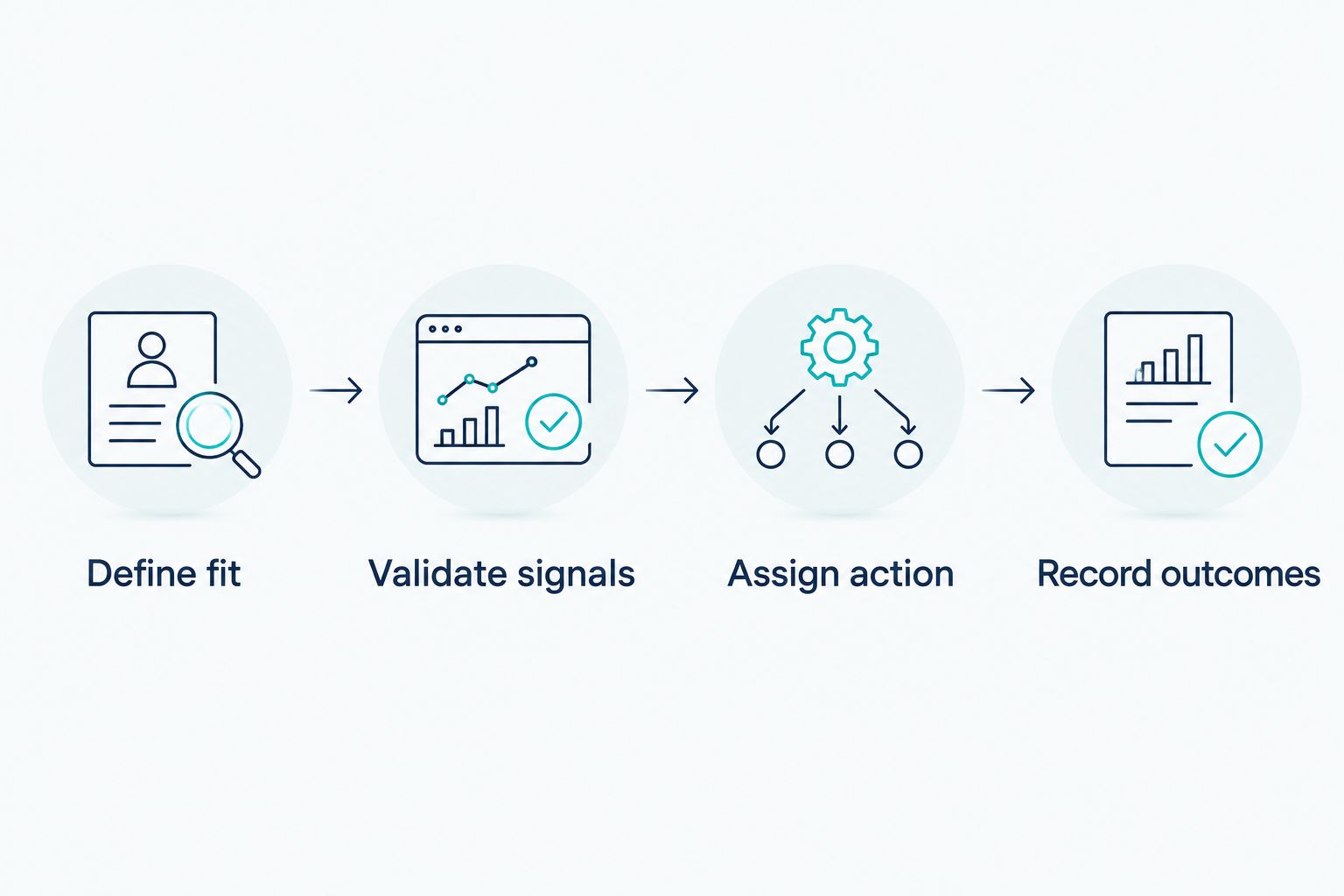
Build the pilot around these steps:
- Define fit: Document the account characteristics that qualify a company for attention.
- Validate signals: Review the source, topic, account match, and reason for relevance.
- Assign action: Give each accepted account a named owner and a specific next step.
- Record outcomes: Capture acceptance, rejection reasons, conversations, and subsequent opportunities.
Keep qualification separate from prediction. Intent describes observed research activity; predictive lead scoring estimates relative likelihood from the inputs a model uses. Neither replaces an explicit definition of a qualified account.
For 2026 reporting, separate platform-sourced signals from your own website engagement and seller-recorded outcomes. Do not add unlike events together and call the total buying intent. Preserve the source so your team can judge which signals deserve attention.
Connect intent with AI visibility—not imaginary tracking
ChatGPT, Perplexity, and Google AI belong in your discovery strategy, but a mention in an answer is not the same thing as an identified buying account. Do not claim that a third-party intent signal reveals someone's private assistant conversation.
Instead, use relevant research topics to shape content that answers buyer questions: comparisons, implementation concerns, service scope, and commercial evaluation criteria. Publish clear answers on your own site, then track the observable evidence available to you. Treat AI visibility and sales intent as related workstreams, not interchangeable metrics.
Rivetline's AI visibility and content services sit alongside paid media and lead response. The operating requirement is consistent: useful content, a clear conversion path, and a team that follows up when a buyer actually identifies themselves.
Which B2B intent data tool should you choose?
Start with 6sense if predictive account prioritization is the central requirement. Choose Demandbase for coordinated ABM, Bombora for topic research, G2 for software comparison signals, or ZoomInfo for contact-led prospecting.
Shortlist the tool that fixes your next decision. If you cannot name who will act on its output, fix ownership before adding another data source.
Build the follow-up, not another report
Talk with Rivetline about ongoing marketing execution, AI visibility, and lead response.
FAQ
What's the best B2B intent data tool for sales teams?
6sense is the default shortlist choice here for predictive account prioritization. Demandbase, Bombora, G2, and ZoomInfo fit different activation, research, and prospecting requirements.
Is 6sense better than Demandbase?
Choose 6sense when predictive account prioritization is your central requirement; shortlist Demandbase when coordinated account-based activation is the main job. Evaluate both against your actual account structure, ownership, and workflow.
What's the difference between Bombora and G2 intent data?
Bombora focuses on company-level topic research signals, while G2 Buyer Intent comes from G2's software research environment. Choose according to whether broader topic interest or software-category research better matches your sales motion.
Does intent data tell me exactly who's ready to buy?
No. Account-level research signals do not establish an individual's identity, authority, purchase timing, or willingness to speak with sales.
How should a small sales team evaluate intent data?
Start with a narrow account sample and a defined follow-up process. Check account fit, signal relevance, contact usefulness, and ownership before expanding the workflow.
Can intent data show what buyers ask ChatGPT?
Do not assume that an intent feed reveals a person's private ChatGPT conversations. Require a clear explanation of each signal's source and measure AI visibility separately from identified sales activity.
What should I measure during an intent data pilot?
Measure accepted accounts, rejection reasons, relevant conversations, and subsequent opportunities. Keep signal sources distinct so you can assess which inputs support useful decisions.
One last thing
Add a rejection reason to every dismissed signal. Wrong company, irrelevant topic, existing customer, and no appropriate contact mean different things—and require different fixes.
That feedback is more useful than an ever-growing alert count. For your 2026 rollout, make the first operating question simple: What changed because this signal arrived? If nobody can answer, the next purchase is not the next move.





