

Best cold email tools for B2B sales teams in 2026
Best overall: Apollo. Best for mailbox-focused outbound: Instantly. Best for personalised outreach: lemlist. Best for structured sales engagement: Outreach. Best for CRM-centred follow-up: HubSpot Sales Hub. This 2026 guide compares the best cold email tools for B2B sales teams by the work each one needs to handle, not by the longest feature list.
- Apollo leads the best cold email tools for B2B sales teams when prospecting and sequences belong together.
- Instantly fits mailbox-focused outbound; lemlist fits personalised outreach; Outreach fits structured sales engagement.
- HubSpot Sales Hub fits CRM-centred follow-up. Choose around your existing sales workflow.
- Rivetline handles ongoing B2B marketing execution, not a standalone cold email software subscription.
Why this matters
A cold email platform does not fix an irrelevant list, a weak offer or unanswered replies. It gives your team a repeatable way to run outreach—and makes bad decisions repeatable too.
Your buying decision should start with the actual bottleneck. Finding accounts, managing mailboxes, personalising messages and coordinating sales activity are different jobs. Buying for all of them at once creates unnecessary overlap.
Rivetline's marketing execution services put email alongside paid media, SEO, content and AI visibility. That distinction matters: your outbound platform manages outreach, while your broader marketing work gives prospects something credible to find after receiving it.
For your 2026 shortlist, separate software requirements from execution requirements. A sequence editor is a product feature. Someone deciding which accounts deserve a sequence is an operating responsibility.
What makes the best cold email tools for B2B sales teams?
Use these criteria before comparing demos:
- Prospect workflow: Can your team move from account selection to outreach without unnecessary copying between systems?
- Mailbox operations: Does the tool support the sending setup your team actually uses?
- Personalisation: Can reps include relevant account context without turning every message into a writing project?
- CRM continuity: Can owners, replies, exclusions and sales stages stay aligned?
- Operational control: Can you review sequences, stop unsuitable outreach and assign replies clearly?
- Reporting usefulness: Can you connect activity to qualified conversations rather than celebrate sends?
Treat legal review and suppression handling as requirements, not tie-breakers. No platform changes whether your outreach is appropriate or permitted.
Cold email tools at a glance: 2026 shortlist
| Tool | Best for | Standout capability | Key limitation |
|---|---|---|---|
| Apollo | Prospecting and sequencing together | Contact discovery alongside sales engagement | Adds overlap when another system already handles prospect data |
| Instantly | Mailbox-focused outbound | Campaign management across connected sending accounts | Does not replace your complete sales operating process |
| lemlist | Personalised outreach | Personalised email and multichannel sequences | Relevant personalisation still needs research and review |
| Outreach | Structured sales engagement | Coordinated sales sequences and rep workflows | Introduces operating complexity for a simple email-only process |
| HubSpot Sales Hub | CRM-centred follow-up | Sales activity connected to CRM records | Fits less naturally when another CRM remains the source of truth |
These are workflow recommendations, not deliverability promises. Confirm current packaging, integrations and administrative controls during evaluation; a product name alone does not establish fit.
1. Apollo: best cold email tool for prospecting and sequencing
Apollo combines a B2B contact database with sales engagement tools. Your team can find prospects and organise outreach within the same platform instead of treating list building and sequencing as unrelated tasks.
That makes Apollo the default starting point when prospect discovery is part of the problem. Start elsewhere when your account data is already settled and your only requirement is sending campaigns.
Apollo pros:
- Connects prospect discovery with outbound activity.
- Supports sequences rather than isolated manual emails.
- Gives teams a shared environment for prospecting work.
Apollo cons:
- Creates functional overlap if you already maintain a separate prospecting platform.
- Database access does not remove the need to validate account relevance and contact details.
- Moving existing workflows into another platform adds migration and ownership decisions.
Best for: B2B teams that need both contact discovery and organised outreach.
Before committing, review a sample of your actual target accounts. Check whether the available people match the roles you sell to, then build a sequence using your own qualification rules. A large database is irrelevant when the useful contacts are wrong.
Verdict: Buy Apollo when prospecting and sequencing need one operating home.
2. Instantly: best cold email tool for mailbox-focused outbound
Instantly centres on outbound email campaigns and connected sending accounts. It belongs on your shortlist when campaign execution across mailboxes is the operational problem you need to solve.
Do not confuse a sending-focused workflow with a complete revenue system. Account ownership, opportunity management and sales follow-up still need explicit rules, whether those live in this platform or elsewhere.
Instantly pros:
- Focuses the buying decision on outbound email execution.
- Supports campaigns across connected email accounts.
- Suits teams that want campaign operations separated from their primary CRM.
Instantly cons:
- A separate outbound workspace creates handoffs you must maintain.
- Mailbox management does not establish consent or message relevance.
- More sending infrastructure means more configuration to review.
Best for: Teams with an established target list that need a dedicated outbound campaign workspace.
During evaluation, trace a reply from the campaign to its final owner. Then test an exclusion: a customer, an active opportunity or someone who has opted out. The important question is whether your actual process prevents inappropriate follow-up, not whether a campaign launches successfully.
Verdict: Buy Instantly for mailbox-focused outbound; skip it if your main problem is account strategy.
3. lemlist: best cold email tool for personalised outreach
lemlist supports personalised email campaigns and multichannel outreach sequences. Its strongest fit in this shortlist is a team that wants deliberate message variation and coordinated touches rather than a single generic email sent repeatedly.
Personalisation is not the same as inserting a first name. You still need a relevant reason to contact the person, a specific business problem and a request that fits their role.
lemlist pros:
- Supports personalised campaign content.
- Brings email and other outreach touches into sequences.
- Gives teams a practical framework for testing different messages.
lemlist cons:
- Account research remains a human operating task.
- Additional channels create more activity to coordinate and review.
- Personalisation fields can introduce visible errors when source data is poor.
Best for: Teams selling into defined accounts where relevant context deserves more effort per prospect.
Review 20 target accounts before building the campaign. That is a recommended planning sample, not a performance benchmark. If your team cannot explain why each account belongs, rewriting the opening sentence will not repair the targeting.
Verdict: Buy lemlist when researched personalisation is part of your sales process, not decorative copy.
4. Outreach: best cold email tool for structured sales engagement
Outreach is a sales engagement platform for coordinating sequences and seller activity. It fits teams whose requirements extend beyond sending email into repeatable rep workflows and management oversight.
The decision turns on operating complexity. A team coordinating several sellers and channels has different needs from a founder running a straightforward prospecting sequence.
Outreach pros:
- Organises outreach within structured sales sequences.
- Supports coordination across seller activities.
- Gives managers a platform around which to standardise sales engagement.
Outreach cons:
- Requires clear workflow ownership and administration.
- Adds complexity when a basic email sequence would do the job.
- Standardising a weak process makes the weak process more consistent.
Best for: Sales organisations that need a shared engagement process across reps.
Bring both a sales manager and the person responsible for CRM administration into the evaluation. Ask them to map enrolment, task ownership, reply handling and sequence exits. If they disagree about the process, settle that disagreement before configuring the platform.
Verdict: Buy Outreach for structured sales engagement; skip it for an unnecessarily elaborate email-only setup.
5. HubSpot Sales Hub: best cold email tool for CRM-centred follow-up
HubSpot Sales Hub connects sales engagement features with HubSpot CRM records. It belongs on this list when keeping outreach close to contact history and deal activity is more important than adding a separate outbound environment.
That is a workflow advantage, not a reason to migrate your entire CRM automatically. Evaluate the cost of changing your process in staff time and disruption, without assuming consolidation always wins.
HubSpot Sales Hub pros:
- Keeps sales outreach connected to CRM records.
- Supports sequences for repeatable follow-up.
- Gives teams a shared context for contacts and sales activity.
HubSpot Sales Hub cons:
- Is a less direct fit when another CRM must remain authoritative.
- Requires disciplined record ownership and data hygiene.
- Does not make an untargeted contact list suitable for outbound.
Best for: Teams using HubSpot CRM that want sales follow-up to remain close to their existing records.
Test an existing contact rather than a clean demonstration record. Include a previous conversation, a current owner and an exclusion condition. Your evaluation should reflect the messy records reps actually encounter, not an empty CRM.
Verdict: Buy HubSpot Sales Hub when CRM continuity is the priority; hold if it requires an unjustified migration.
The handoff test matters more than another feature
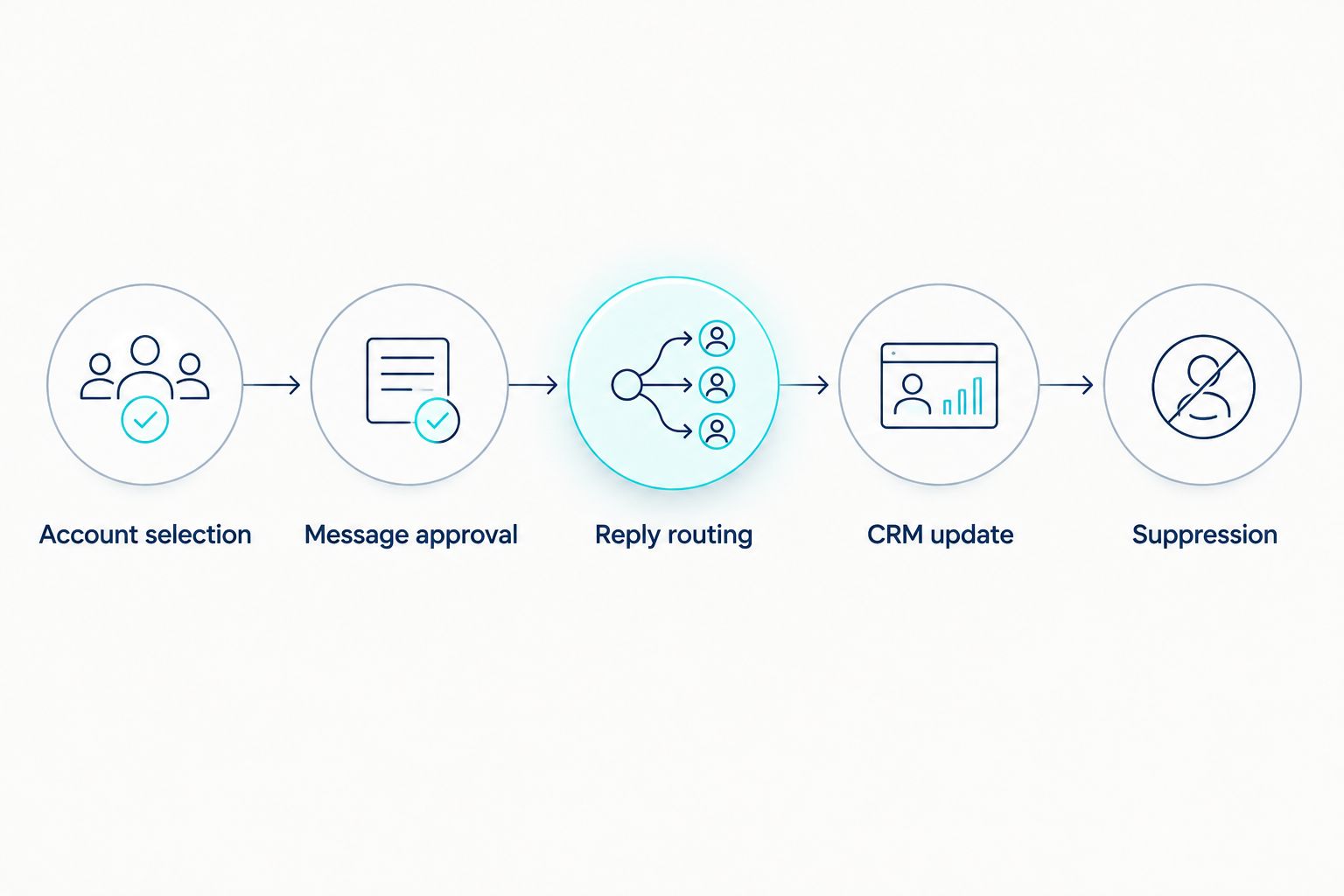
Before selecting a tool, trace the complete path from selected account to sales conversation. Use these checkpoints:
- Account selection: Explain why the company and role belong in the campaign.
- Message approval: Check relevance, factual claims and the requested next step.
- Reply routing: Assign responsibility for questions, objections and positive replies.
- CRM update: Record the conversation without creating conflicting ownership.
- Suppression: Stop outreach when your rules require it.
Mailbox compatibility deserves the same scrutiny as sequence design. Your Gmail and Outlook integration requirements should specify which messages and activities reach the CRM, which user owns them and what happens when a mailbox disconnects. Merely connecting an inbox does not define those rules.
Run a 30-day evaluation using a written acceptance checklist. That is a proposed evaluation window, not a promise of results. Review 10 replies for routing accuracy and ownership; use the exercise to expose process gaps rather than claim statistical significance.
Cold email needs search credibility behind it
A prospect who receives your email can search your company before replying. Make the destination worth finding: clear service pages, accurate company information, relevant evidence and content that answers the buyer's actual questions.
Include ChatGPT, Perplexity and Google AI in your 2026 visibility checks. Ask questions that reflect your buyers' category and problem, then record the answers, sources and date. A single answer is an observation, not a stable visibility score.
Rivetline combines B2B marketing execution across email, paid media, SEO, content and AI visibility. The point is coordination: the claim in your outreach should match the company information and service explanation buyers encounter elsewhere.
Keep outreach and discoverability aligned. Do not promise a specialised capability in an email while leaving buyers unable to understand that capability on your site. Software selection does not solve that mismatch.
How these tools were ranked
This 2026 ranking prioritises workflow fit: prospect discovery, mailbox operations, personalisation, sales coordination and CRM continuity. Each tool owns a different use case so you can eliminate mismatches before comparing detailed settings.
The ranking does not claim controlled product testing, measured deliverability differences or guaranteed commercial outcomes. Confirm the features your workflow requires through current documentation and a demonstration using your own records.
For Canadian outreach, assess Canada's Anti-Spam Legislation requirements before sending commercial electronic messages. Consent, identification and unsubscribe obligations require attention; owning a business email address is not a blanket permission slip. Get advice appropriate to your circumstances rather than treating software controls as legal clearance.
Which cold email tool should you choose?
Choose Apollo by default when your B2B team needs prospecting and sequencing together. Choose Instantly for mailbox-focused campaign operations, lemlist for researched personalisation, Outreach for structured sales engagement, or HubSpot Sales Hub for CRM-centred follow-up.
For your 2026 decision, write down the failure you need to fix before booking demonstrations. Reject any product whose main advantage solves a different problem.
Rivetline is best for B2B companies that want ongoing marketing execution across channels rather than another standalone software subscription. If the missing piece is ownership of the work, not another interface, book a discovery call.
Put execution behind your outreach
Discuss ongoing B2B marketing execution across email, paid media, SEO, content and AI visibility.
FAQ
What's the best cold email tool for a B2B sales team in 2026?
Apollo is the default recommendation when a B2B sales team needs prospect discovery and sequences together. Choose a specialist alternative when mailbox operations, personalisation or CRM continuity is the actual priority.
Is Instantly better than Apollo for cold email?
Instantly is the more focused shortlist choice for mailbox-centred outbound operations; Apollo fits prospect discovery combined with sequencing. Decide which workflow you need before comparing individual features.
Which cold email tool should an existing HubSpot team consider?
An existing HubSpot team should consider HubSpot Sales Hub when keeping outreach connected to CRM records is the priority. Test ownership, exclusions and reply handling with real records before committing.
Do cold email tools guarantee inbox placement?
No cold email tool guarantees inbox placement. Authentication, sending behaviour, recipient responses and filtering decisions all affect whether messages reach an inbox.
Can a Canadian B2B team email anyone with a business address?
A business email address is not blanket permission to send commercial electronic messages. Assess applicable CASL consent, identification and unsubscribe requirements before launching outreach.
Should AI search visibility be part of a cold email strategy?
Yes, AI search visibility belongs in the broader credibility work supporting outbound. Check how ChatGPT, Perplexity and Google AI describe your business, but do not treat individual answers as a guaranteed acquisition channel.
Does Rivetline sell cold email software?
Rivetline is a B2B marketing execution agency, not a cold email software vendor. Its work spans email, paid media, SEO and AI visibility, content and other marketing channels.
One last thing
Before importing another list, assign an owner for every positive reply. Then decide who handles opt-outs, existing customers and active opportunities.
Those decisions belong in the buying checklist. A tool that sends successfully but leaves interested prospects waiting has passed the wrong test.





