

Best email marketing platforms for B2B companies in 2026
Best overall: HubSpot. Best for automation-led nurture: ActiveCampaign. Best for Salesforce-centred teams: Salesforce Marketing Cloud Account Engagement. This 2026 guide compares the best email marketing platforms for B2B, including Brevo for straightforward campaigns and Customer.io for product-event messaging.
- HubSpot leads the best email marketing platforms for B2B when CRM-connected nurture is your priority.
- ActiveCampaign suits automation-led nurture; Salesforce Marketing Cloud Account Engagement suits Salesforce-centred marketing teams.
- Brevo fits straightforward campaigns; Customer.io fits messaging triggered by product behaviour.
- Rivetline handles ongoing B2B marketing execution, connecting email with content, paid media and AI visibility.
Why this matters
Your email platform should support the way your sales process actually works. A newsletter tool, a CRM-connected nurture system and an event-driven messaging platform solve different problems. Buying the wrong category creates work before you send anything.
For B2B teams, email also connects channels that otherwise operate separately. Someone discovers your content through Google, ChatGPT or Perplexity, visits your website, and later subscribes or requests a conversation. Email continues that relationship after the initial visit; it does not replace search visibility or sales follow-up.
Rivetline's marketing execution services span email, content, paid media and SEO/AI visibility. Choose software around the work your team will run, not the feature list you hope to use someday.
What makes the best B2B email marketing platform?
Use these criteria for your 2026 shortlist. A platform earns its place by fitting your operating model, not by having the longest menu.
- Sales context: Can you segment and trigger messages using the contact and sales information your team needs?
- Automation control: Can you define entry conditions, branches, exclusions and exits without creating an unmanageable workflow?
- Data fit: Does the platform work with your CRM records, website activity or product events?
- Operational ownership: Can someone on your team maintain the campaigns, integrations and contact rules?
- Measurement: Can you connect email activity to meaningful next steps rather than treating opens as the result?
- Consent and suppression: Can you maintain subscription preferences and prevent inappropriate messages?
Treat these as selection criteria, not a claim that any platform fixes your data automatically. A CRM connection is only useful when its fields, permissions and ownership rules match your business.
Best B2B email platforms at a glance
This 2026 comparison ranks platforms by distinct operating needs. The limitation column describes the main trade-off to investigate before committing.
| Rank | Platform | Best for | Standout capability | Key limitation |
|---|---|---|---|---|
| 1 | HubSpot | CRM-connected B2B nurture | Marketing email connected to CRM context | Broader setup requires clear ownership of CRM data and workflows |
| 2 | ActiveCampaign | Automation-led nurture | Branching email automation and segmentation | Complex automations become difficult to maintain without documentation |
| 3 | Salesforce Marketing Cloud Account Engagement | Salesforce-centred marketing teams | B2B nurture connected to Salesforce sales processes | Requires Salesforce administration and coordinated lifecycle definitions |
| 4 | Brevo | Straightforward campaigns and contact follow-up | Email campaigns, contact management and automation | Advanced account-level processes need additional planning |
| 5 | Customer.io | Product-event lifecycle messaging | Messaging triggered by behavioural events | Depends on reliable event collection and technical implementation |
1. HubSpot: best B2B email platform for CRM-connected nurture
HubSpot combines CRM records with marketing email and automation. It fits a B2B company that wants contact information, lifecycle stages and nurture activity connected rather than managed as separate lists.
The important question is not whether HubSpot can send a newsletter. It is whether your marketing and sales teams will use the same definitions for a qualified lead, an active opportunity and a customer. Without that agreement, connected software simply distributes inconsistent information.
HubSpot pros:
- CRM context supports segmentation beyond a standalone mailing list.
- Workflows can connect marketing activity with lifecycle actions.
- A shared contact record gives marketing and sales a common reference.
HubSpot cons:
- Teams must maintain contact properties and lifecycle rules.
- A simple newsletter programme does not need the whole operating model.
- Automation requirements need checking against the specific subscription you select.
Best for: B2B companies that want email nurture tied closely to their CRM and sales process.
Before choosing HubSpot, map a real lead journey from form submission to sales follow-up. Identify which fields change, who receives the lead and what stops the nurture sequence.
Verdict: Buy HubSpot if CRM-connected nurture is your primary requirement; skip it if you only need periodic broadcasts.
2. ActiveCampaign: best B2B email platform for automation-led nurture
ActiveCampaign centres email marketing on automation and segmentation. It suits teams that need different follow-up paths for different interests, behaviours or stages in a buying journey.
Its value depends on having a clear branching strategy. If every contact receives the same messages regardless of what happens, elaborate automation adds complexity without improving the experience.
ActiveCampaign pros:
- Branching automations support different nurture paths.
- Tags and contact fields help organise audiences.
- Behaviour-based conditions support more relevant follow-up.
ActiveCampaign cons:
- Overlapping automations need explicit exclusion rules.
- Tags become confusing without a naming convention.
- Sales context still depends on how you configure contact data and integrations.
Best for: B2B marketing teams whose main requirement is running and refining automated email journeys.
Start with a single journey before building a library of workflows. Document its audience, trigger, goal and exit condition. That discipline matters more than adding another branch to the canvas.
Verdict: Buy ActiveCampaign for intentional, branching nurture; hold if nobody owns automation maintenance.
3. Salesforce Marketing Cloud Account Engagement: best for Salesforce teams
Salesforce Marketing Cloud Account Engagement supports B2B marketing automation connected to Salesforce. Its strongest fit is a company whose sales organisation already relies on Salesforce and needs marketing nurture to work within that environment.
Account Engagement is not interchangeable with every product carrying the Salesforce Marketing Cloud name. Evaluate the specific product, its connection to your Salesforce setup and the responsibilities of your administrators.
Salesforce Marketing Cloud Account Engagement pros:
- Connects B2B marketing activity with Salesforce sales records.
- Supports nurture programmes and prospect segmentation.
- Scoring and grading support structured qualification processes.
Salesforce Marketing Cloud Account Engagement cons:
- Implementation requires marketing and Salesforce administration to coordinate.
- Qualification rules need agreement before scoring becomes useful.
- It is a poor starting point if your team does not want Salesforce at the centre.
Best for: B2B organisations with established Salesforce processes and people responsible for maintaining them.
Ask marketing and sales to explain the same handoff using the same record. If they disagree about ownership, resolve that before implementing more automation.
Verdict: Buy Salesforce Marketing Cloud Account Engagement for an established Salesforce operating model; skip it when that foundation is absent.
4. Brevo: best B2B email platform for straightforward campaigns
Brevo provides email campaigns, contact management and automation. It belongs on the shortlist when your immediate needs are newsletters, segmented updates and manageable follow-up sequences rather than an extensive sales-lifecycle rebuild.
A narrower programme is not a weaker programme. Clear messages sent to an appropriate audience are a better starting point than an elaborate journey without a useful offer.
Brevo pros:
- Campaign tools support recurring newsletters and announcements.
- Contact segmentation helps separate audiences by relevant attributes.
- Automation supports follow-up beyond manual broadcasts.
Brevo cons:
- Account-level buying processes require deliberate data design.
- Do not assume campaign activity equals sales qualification.
- Teams needing extensive sales context should validate their CRM connection first.
Best for: B2B teams that want to execute straightforward email campaigns without making CRM transformation the first project.
Evaluate Brevo using an actual newsletter, an actual segment and an actual follow-up sequence. An attractive demonstration matters less than whether your team can maintain those everyday tasks.
Verdict: Buy Brevo for focused campaign execution; hold if your requirements depend on complicated account and opportunity logic.
5. Customer.io: best B2B email platform for product-event messaging
Customer.io supports messaging driven by customer attributes and behavioural events. For a B2B product company, that makes it relevant to onboarding, adoption and lifecycle communication tied to what users do inside a product.
This is a different problem from sending a monthly newsletter. The quality of the messaging depends on the meaning and reliability of the events your application sends.
Customer.io pros:
- Product events can trigger relevant lifecycle messages.
- Behavioural segmentation supports different user journeys.
- Event-driven workflows connect communication to product activity.
Customer.io cons:
- Event instrumentation requires technical ownership.
- Inconsistent event definitions create unreliable targeting.
- Company-level buying context needs explicit modelling alongside user activity.
Best for: B2B product teams with reliable behavioural data and someone responsible for maintaining the integration.
Before committing, choose a real activation milestone and trace how the platform receives it. Confirm that the event means what marketing thinks it means, including when a user repeats the action.
Verdict: Buy Customer.io for product-led lifecycle messaging; skip it if you cannot maintain the underlying event data.
How the platforms were ranked
This 2026 ranking prioritises fit across sales context, automation, data requirements and operational ownership. It is a decision guide, not a claim that every platform has been tested in your environment or that one vendor wins every feature comparison.
HubSpot takes the default position because CRM-connected nurture addresses a central B2B requirement: communicating with a contact in the context of a sales relationship. The other platforms take distinct slots where automation depth, Salesforce alignment, campaign simplicity or product events drive the decision.
Validate the workflow before committing
Use a 30-day pilot as a planning exercise, not a promised implementation timeline. Test a real workflow rather than a vendor's sample campaign.
- Data entry: Confirm the right record enters the right audience with its subscription status intact.
- Message routing: Check that conditions send the intended message and suppress inappropriate follow-up.
- Sales handoff: Verify who receives a qualified enquiry and what information accompanies it.
- Outcome review: Connect the workflow to replies, meetings or another defined business action.
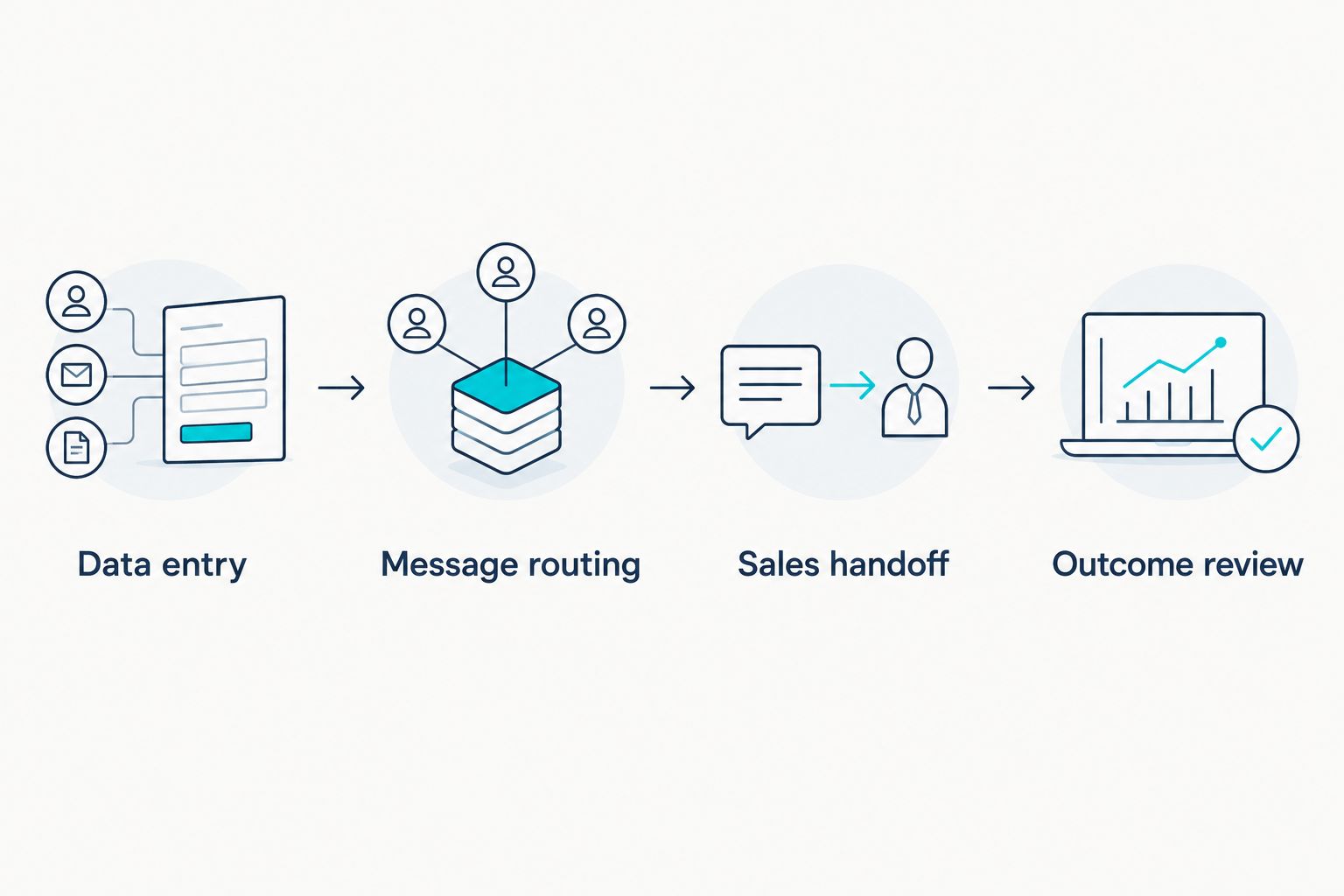
Review the workflow at 7-day intervals during that pilot. Set a separate 90-day review to assess whether the programme still fits your sales process. These are suggested checkpoints, not performance benchmarks.
Include a content check. If your email repeats an answer published on your website, keep the underlying facts consistent. That gives readers the same explanation whether they arrive through an email, Google or an answer in ChatGPT or Perplexity; it does not guarantee a citation.
Which B2B email marketing platform should you choose?
Choose HubSpot as the default in 2026 when you want CRM-connected B2B nurture. Choose ActiveCampaign when branching automation is the priority, Account Engagement when Salesforce defines the sales process, Brevo for straightforward campaigns, and Customer.io for product-event messaging.
Separate the software decision from the execution decision. Your platform will not write the useful content, resolve unclear sales ownership or decide which enquiries deserve a response.
Rivetline is best for B2B companies that need ongoing email marketing execution connected to paid media, content and AI visibility. The agency builds and runs the marketing systems, backed by a live reporting dashboard, rather than stopping at a one-off report.
Build the email programme
Discuss ongoing email execution alongside paid media, content and AI visibility.
FAQ
What's the best email marketing platform for B2B companies in 2026?
HubSpot is the default recommendation for B2B companies that need CRM-connected email nurture. ActiveCampaign, Account Engagement, Brevo and Customer.io fit different automation, sales-system and data requirements.
Is HubSpot better than ActiveCampaign for B2B email?
HubSpot is the better fit when shared CRM context is your main requirement; ActiveCampaign fits an automation-led nurture programme. Compare a real workflow and the contact data it requires before choosing.
Which email platform should a Salesforce-based company consider?
Salesforce Marketing Cloud Account Engagement belongs on the shortlist when Salesforce already supports your sales process. Confirm administration responsibilities, lifecycle definitions and handoff rules before implementation.
What's a good B2B email platform for a straightforward newsletter?
Brevo belongs on the shortlist for straightforward newsletters, segmentation and follow-up. Evaluate it using the campaigns your team will actually maintain rather than assuming a broader system is necessary.
When should a B2B company choose Customer.io?
Choose Customer.io when product events need to trigger onboarding, adoption or lifecycle messages. Reliable event collection and technical ownership are prerequisites for that approach.
Does email marketing improve visibility in ChatGPT or Perplexity?
Sending email does not guarantee visibility or citations in ChatGPT or Perplexity. Use email to continue relationships after discovery, and publish useful website content as part of a separate search and AI-visibility programme.
What should you measure beyond email opens?
Measure the business action the email is intended to produce, such as a qualified reply, meeting or product milestone. Define the action before building the workflow and connect it to the relevant contact or account.
One last thing
Test what happens after a prospect replies. If the automation keeps sending an introductory pitch while sales is already having a conversation, your problem is the workflow—not the subject line.
Make that suppression test part of your 2026 selection process. A platform that fits your handoff rules is more useful than one with features nobody owns.





