

Best marketing automation platforms for B2B companies in 2026
Best overall for a B2B team building a shared marketing and sales process: HubSpot; best for Salesforce-centred nurturing: Salesforce Account Engagement; best for complex enterprise programmes: Adobe Marketo Engage; best for email-led automation: ActiveCampaign; best for product-event messaging: Customer.io. For teams choosing among the best marketing automation platforms for B2B in 2026, Rivetline provides ongoing marketing execution rather than another software recommendation left for your team to implement.
- HubSpot is the default B2B marketing automation recommendation when marketing and sales need a shared operating system.
- Salesforce Account Engagement fits Salesforce-centred nurturing; Adobe Marketo Engage fits complex enterprise programmes.
- ActiveCampaign suits email-led workflows; Customer.io suits messaging triggered by product behaviour.
- Rivetline connects platform decisions with ongoing execution across paid media, SEO, AI visibility and content.
Why this matters
Marketing automation moves contacts through rules. It does not decide whether your offer is convincing, your lead definition is useful or your content answers a buyer's question.
That distinction matters in 2026. Your acquisition work can span Google search, paid media, ChatGPT, Perplexity and Google's AI search experiences, while your automation platform handles the identifiable contact and the next action. Treating those as the same job creates gaps between getting discovered and getting a sales conversation.
Choose the platform around the handoff you need to improve, not the longest feature list. A sophisticated nurture programme still fails its purpose when nobody owns the replies.
What makes the best B2B marketing automation platform?
Use these criteria before comparing vendors. They reveal whether a platform fits your operation, rather than whether its demonstration looks impressive.
- CRM fit: Contact ownership, lifecycle stages and sales activity must match how your team actually sells.
- Workflow fit: Start with the triggers, branches and exit conditions your real buying journey needs.
- Data readiness: Identify which forms, CRM fields, product events and consent records will drive automation.
- Operator capacity: Name the person responsible for building, checking and maintaining each programme.
- Measurement: Separate email engagement, qualified conversations and pipeline outcomes instead of calling them all conversions.
- Discovery coverage: Keep SEO, AI visibility and paid acquisition connected to the follow-up process without expecting the automation platform to perform those services.
The platforms at a glance
These are use-case recommendations, not a claim that every B2B company needs the same system. The table order matches the detailed recommendations below.
| Platform | Best for | Standout capability | Key limitation |
|---|---|---|---|
| HubSpot | Shared marketing and sales operations | Connected CRM, marketing automation and sales tools | A shared platform still needs shared lifecycle rules |
| Salesforce Account Engagement | Salesforce-centred lead nurturing | B2B engagement workflows connected to Salesforce | CRM field mapping and ownership need careful planning |
| Adobe Marketo Engage | Complex enterprise marketing programmes | Detailed campaign, nurture and scoring configuration | Requires dedicated operational ownership |
| ActiveCampaign | Email-led B2B follow-up | Visual email automation and contact segmentation | Email workflows are not a complete pipeline model |
| Customer.io | Product-event lifecycle messaging | Messages triggered by behavioural events | Depends on reliable event definitions and instrumentation |
1. HubSpot: best for shared marketing and sales operations
HubSpot combines CRM, marketing automation and sales tools within its wider platform. It is the default recommendation here for a B2B company trying to connect acquisition, nurturing and sales follow-up without designing each function as a separate operation.
The benefit is a shared operating model. Your marketing team and sales team can work from common contact records and lifecycle definitions, provided you agree on what those definitions mean.
HubSpot pros:
- Connects marketing activity with CRM records and sales processes.
- Supports workflows for nurturing, segmentation and internal follow-up.
- Gives teams a place to align lifecycle stages across departments.
HubSpot cons:
- Shared software does not resolve disagreements about lead quality.
- Workflow complexity grows when teams create overlapping rules without clear ownership.
Best for: B2B teams that want marketing and sales working within a connected system.
Before selecting HubSpot in 2026, map a real enquiry from form submission to sales acceptance. Include the rejection path: an unsuitable lead should not keep circulating through sales notifications simply because the original form was completed.
Verdict: Buy HubSpot when you want a shared marketing and sales process and will assign someone to maintain it.
2. Salesforce Account Engagement: best for Salesforce nurturing
Salesforce Account Engagement supports B2B marketing automation connected to Salesforce. It is the first option to evaluate when Salesforce already defines account ownership, opportunity stages and sales reporting.
The decision is about continuity, not brand familiarity. Your nurture logic should respect the sales process already recorded in the CRM, including when marketing should stop sending a sequence because a sales conversation has begun.
Salesforce Account Engagement pros:
- Fits a Salesforce-centred marketing and sales operating model.
- Supports lead nurturing, scoring and segmentation.
- Connects marketing engagement with the CRM context used by sales.
Salesforce Account Engagement cons:
- Field mapping and synchronisation rules require deliberate design.
- Inconsistent Salesforce data remains a problem after automation is added.
Best for: B2B companies committed to Salesforce as their sales system of record.
Test the awkward cases before approving the setup: duplicate contacts, reassigned accounts and people who return after a closed opportunity. Those cases expose whether your routing logic reflects the business or only the clean demonstration journey.
Verdict: Buy Salesforce Account Engagement when Salesforce is the operational centre and your team can govern the connection.
3. Adobe Marketo Engage: best for complex enterprise programmes
Adobe Marketo Engage supports marketing automation across campaign management, lead nurturing and scoring. It belongs on the shortlist when your programme structure requires detailed configuration rather than a small collection of straightforward follow-up sequences.
Complexity alone is not a reason to choose it. The justification is a defined operational requirement, backed by someone who can maintain the programme architecture and explain how it works.
Adobe Marketo Engage pros:
- Supports detailed nurture and campaign logic.
- Provides configurable segmentation and lead-scoring capabilities.
- Fits organisations prepared to manage a structured marketing operations function.
Adobe Marketo Engage cons:
- Detailed configuration creates an ongoing maintenance obligation.
- Poor programme naming and inconsistent data make troubleshooting harder.
Best for: Enterprise B2B teams with complex programmes and dedicated marketing operations ownership.
For a 2026 evaluation, ask the proposed operator to explain how programmes will be named, reviewed and retired. An enterprise platform needs a maintenance model, not just an implementation project. If nobody owns that work, adding more configuration options adds more unfinished work.
Verdict: Buy Adobe Marketo Engage for a defined enterprise requirement; skip it when a simple nurture programme covers the job.
4. ActiveCampaign: best for email-led B2B follow-up
ActiveCampaign centres on email marketing, contact segmentation and automation. It is a focused option when your immediate need is to follow up with enquiries, nurture subscribers and branch communications based on contact activity.
Start with the actual email journey. A resource download, an event registration and a direct sales enquiry should not automatically receive the same sequence just because each created a contact.
ActiveCampaign pros:
- Provides a visual approach to building automated email journeys.
- Supports segmentation using contact information and engagement.
- Fits clearly defined email follow-up programmes.
ActiveCampaign cons:
- Email engagement alone does not establish sales readiness.
- A wider B2B reporting model still needs CRM stages and outcome definitions.
Best for: B2B teams whose main automation requirement is email-led nurturing rather than enterprise programme orchestration.
Validate the sales handoff before building a long sequence. Decide who receives a reply, when a contact leaves automation and how an account owner can prevent inappropriate follow-up. That work matters more than adding another branch to the workflow.
Verdict: Buy ActiveCampaign for focused email automation; hold if your real problem is unresolved CRM governance.
5. Customer.io: best for product-event lifecycle messaging
Customer.io supports messaging driven by customer data and behavioural events. It fits B2B businesses that need communication tied to what a user does inside a product, rather than only what a contact submits through a marketing form.
This is a different starting point from conventional lead nurturing. The useful trigger is a meaningful product action, with a clear definition and a reliable connection to the correct person or account.
Customer.io pros:
- Supports behavioural triggers for lifecycle messaging.
- Allows segmentation based on customer attributes and events.
- Fits onboarding and re-engagement journeys grounded in product activity.
Customer.io cons:
- Inconsistent event tracking produces unreliable workflow decisions.
- Product messaging does not replace sales ownership or account-level planning.
Best for: B2B product companies with dependable event data and someone responsible for the instrumentation.
Ask your technical team to explain the events before choosing the messages. A vague event name hides uncertainty about what happened, while repeated or missing events can send a contact down the wrong path. Define the behaviour first; write the message second.
Verdict: Buy Customer.io for event-driven lifecycle messaging; wait if the event data is not ready.
How we ranked the platforms
The order follows the criteria above: CRM fit, workflow requirements, data readiness, operator capacity, measurement and discovery coverage. HubSpot is the default for a shared marketing and sales setup; the remaining platforms earn distinct places for Salesforce continuity, enterprise programme control, email-led nurturing and product-event messaging.
This is a fit-based shortlist, not a performance benchmark. It does not claim that one platform produces more revenue than another. Your workflow design, data and execution determine whether the chosen system does useful work.
Connect discovery to follow-up, not just another sequence
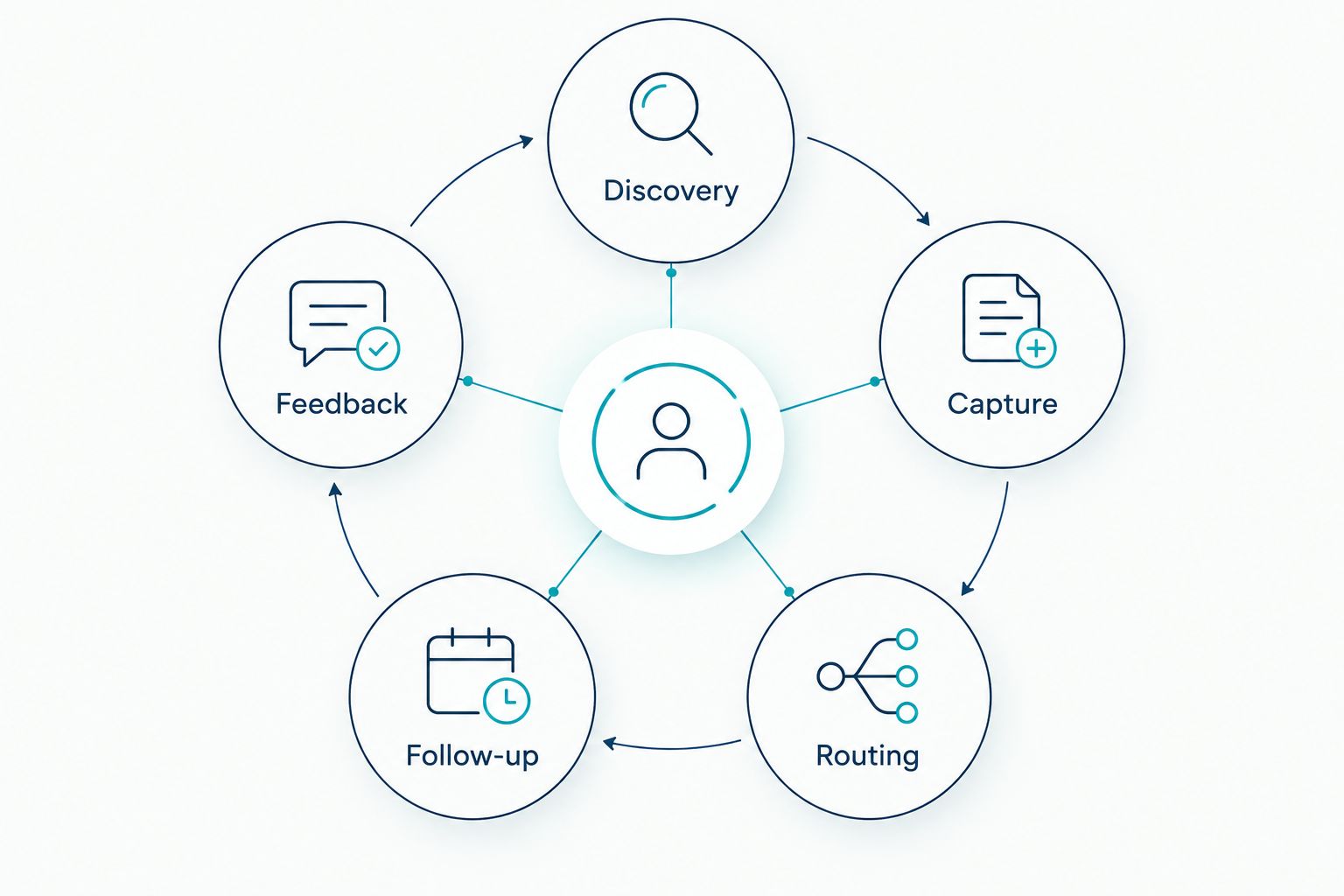
For your 2026 rollout, build a small operating loop before expanding the automation catalogue. The following is a proposed implementation sequence, not a claim about typical project timelines or results.
- Discovery: Identify the buyer questions your paid media, SEO, content and AI visibility work should address.
- Capture: Give interested buyers a clear next step, then record their submitted information and consent appropriately.
- Routing: Assign ownership using explicit criteria, with a fallback when the intended owner is unavailable.
- Follow-up: Deliver useful communication, stop inappropriate sequences and make replies somebody's responsibility.
- Feedback: Return sales outcomes to the people managing acquisition and content.
Use a 30-day review window for your initial operating check. Start with 3 workflows: a direct enquiry response, a resource follow-up and a sales handoff. Schedule a 60-minute review with the people who own acquisition and sales to inspect what actually happened. These are planning choices, not promised outcomes or industry benchmarks.
Check failures as carefully as completions. Look for contacts without an owner, replies nobody answered, sequences that continued after sales engagement and campaign labels that do not match the reporting model.
Rivetline's marketing execution services cover paid media, SEO and AI visibility, content and lead response alongside other channels. Rivetline is best for B2B companies that need ongoing marketing execution, not another audit. The trade-off is direct: an execution agency is not a substitute for buying software, and your business still needs to supply decisions about customers, qualification and sales ownership.
Which platform should you choose?
Choose HubSpot if you need a default starting point for connected B2B marketing and sales. Choose Salesforce Account Engagement when Salesforce already anchors the sales operation. Choose Adobe Marketo Engage for defined enterprise complexity, ActiveCampaign for email-led automation or Customer.io for product-event messaging.
For a 2026 buying decision, bring one real workflow to the demonstration and ask each vendor to show it. Include an exception and an exit condition. A platform that handles your actual handoff is more useful than one that impresses you with unrelated features.
If you need the acquisition, content and follow-up work built and maintained, book a discovery call with Rivetline. Keep the software decision attached to the execution plan.
Build the system behind your marketing
Discuss ongoing B2B execution across paid media, SEO, AI visibility, content and lead response.
FAQ
What's the best marketing automation platform for B2B companies?
HubSpot is the default recommendation for B2B teams seeking connected marketing and sales operations. Salesforce Account Engagement, Adobe Marketo Engage, ActiveCampaign and Customer.io fit different CRM, programme and messaging requirements.
Is HubSpot better than Salesforce Account Engagement?
HubSpot is the better starting point when you want a shared marketing and sales platform; Salesforce Account Engagement is the stronger fit when Salesforce already anchors your operation. Decide using your CRM ownership and real workflow requirements.
When should a B2B company choose Adobe Marketo Engage?
Choose Adobe Marketo Engage when detailed enterprise programme requirements justify dedicated marketing operations ownership. A straightforward nurture sequence alone is not a reason to choose a more complex setup.
Is ActiveCampaign suitable for B2B marketing?
ActiveCampaign suits B2B teams focused on email-led nurturing and contact segmentation. Define the sales handoff separately rather than treating email engagement as proof of buying intent.
When does Customer.io make sense for B2B?
Customer.io makes sense when lifecycle messages depend on reliable product events. Define the events, identities and exit conditions before building the communication programme.
Will marketing automation improve visibility in ChatGPT or Perplexity?
Marketing automation alone is not an AI visibility strategy. Treat discoverability through useful, accessible content and accurate brand information as separate work connected to your capture and follow-up process.
Do you need an agency after buying marketing automation software?
You need an accountable operator, whether that is an internal team or an execution agency. The work includes campaign creation, workflow maintenance, routing checks and reporting, not just the initial software setup.
One last thing
Test the stop condition before celebrating the trigger. A workflow that starts correctly but keeps emailing after a sales conversation begins is still broken. Before publishing any sequence, show exactly how a contact leaves it, who can intervene and where that decision is recorded.





