
Best PR and media monitoring tools for B2B brands in 2026
Best overall: Meltwater for combined news and social monitoring. Best for press-office workflows: CisionOne. Best for social research: Brandwatch. The best PR and media monitoring tools for B2B in 2026 depend on what you need to catch—and who will act on it.
- Meltwater leads this shortlist of the best PR and media monitoring tools for B2B teams needing news and social coverage.
- CisionOne suits press-office monitoring; Brandwatch suits social research; Mention suits focused web and social listening.
- Google Alerts supports basic discovery, not a complete PR measurement workflow.
- Track ChatGPT, Perplexity and Google AI separately; a media mention does not establish inclusion in an AI answer.
Why this matters
A media monitoring subscription does not run your communications programme. Someone still needs to separate useful coverage from noise, correct misinformation, respond to journalists and turn recurring buyer questions into content.
Rivetline provides ongoing B2B marketing execution across PR, content, SEO, AI visibility and paid media. Rivetline is best for B2B teams that need PR and media monitoring connected to ongoing marketing execution. It is an execution agency, not another monitoring product in this ranking.
Your 2026 decision should separate three jobs: finding mentions, understanding their significance and deciding what to do next. Buy software for the first two; assign clear responsibility for the third.
What makes the best B2B media monitoring tool?
Use these criteria before comparing dashboards. A platform that misses your trade publications is a poor fit, regardless of how polished its reports look.
- Relevant coverage: Check the publications, markets, languages and social channels your buyers actually use. Ask vendors to demonstrate named sources.
- Query control: Test exclusions, ambiguous company names, product terms and competitor searches. Noise is an operating cost.
- Useful context: You need enough surrounding information to distinguish a passing mention from a substantive discussion.
- Response workflow: Decide who receives alerts, who reviews them and where an issue goes after review.
- Defensible reporting: Separate coverage counts, estimated exposure, referral traffic and commercial outcomes. They answer different questions.
- AI visibility boundaries: Ask explicitly whether the product monitors AI-generated answers. Do not infer that capability from a general reference to AI.
PR and media monitoring tools at a glance
These recommendations reflect the products’ established functions, not an independent performance test. Source access and package boundaries require confirmation during your evaluation.
| Rank | Tool | Best for | Standout function | Key limitation |
|---|---|---|---|---|
| 1 | Meltwater | Combined news and social monitoring | Media intelligence alongside social listening | Breadth needs query discipline and clear ownership |
| 2 | CisionOne | Press-office monitoring | Monitoring and analysis centred on media coverage | Not a substitute for web analytics or attribution |
| 3 | Brandwatch | Social research | Social listening and conversation analysis | Social findings do not represent the whole buying committee |
| 4 | Mention | Focused web and social listening | Tracking defined brand and topic mentions | Source coverage needs a close fit check |
| 5 | Google Alerts | Basic web discovery | Search-based email notifications | Not a complete monitoring, analysis or response system |
1. Meltwater: best B2B monitoring tool for combined coverage
Meltwater combines media monitoring with social listening and analysis. It belongs first on your shortlist when PR, content and social teams need to examine related conversations rather than maintain disconnected reporting routines.
Meltwater is the default choice here for B2B teams that need news and social monitoring together. The condition matters: broad functionality only helps when those channels are part of your actual remit.
Meltwater pros
- Brings news monitoring and social listening into the same product family.
- Supports research beyond direct brand mentions, including topics and competitors.
- Fits a shared monitoring brief across communications and social teams.
Meltwater cons
- Broad searches need careful exclusions to prevent irrelevant results.
- A wider remit creates more review work unless you assign owners.
- Media and social coverage still do not prove pipeline impact.
Best for: A B2B communications team responsible for both earned media and social conversation.
For a 2026 evaluation, ask Meltwater to demonstrate your actual company name, a difficult competitor query and a specialist industry topic. Review the underlying results, not just the summary charts.
Verdict: Buy if combined news and social monitoring is a defined requirement; skip if you only need occasional web alerts.
2. CisionOne: best B2B monitoring tool for press-office teams
CisionOne centres on media monitoring and intelligence. It is a strong shortlist candidate when your communications team needs to understand coverage, follow developing stories and maintain a consistent reporting routine around earned media.
Choose CisionOne for the press-office job, not because a broad communications platform sounds reassuring. Start with the publications and media types that influence your buyers.
CisionOne pros
- Keeps the evaluation focused on media coverage and communications analysis.
- Supports monitoring of brand, competitor and issue-related coverage.
- Suits teams that need a repeatable earned-media reporting process.
CisionOne cons
- Coverage metrics cannot establish whether an article produced qualified demand.
- Media monitoring does not replace social research or AI-answer testing.
- Your specialist publication list still needs source-by-source validation.
Best for: An established B2B press office with a clear media-monitoring brief.
Ask CisionOne to retrieve examples from your trade press and distinguish original reporting from repeated distribution. Treat those as evaluation tasks, not assumed capabilities of every package.
Verdict: Buy for a media-led communications workflow; hold if your main question is buyer conversation across social channels.
3. Brandwatch: best B2B monitoring tool for social research
Brandwatch provides social listening and consumer intelligence tools for examining online conversations. For B2B teams, its strongest role on this shortlist is researching how people discuss a category, problem or brand across supported sources.
That research can inform messaging and content. It does not establish what every stakeholder in a buying committee thinks.
Brandwatch pros
- Supports topic research beyond mentions of your own company.
- Provides a structured way to examine conversation themes and sentiment.
- Fits research questions shared by social, content and marketing teams.
Brandwatch cons
- Public conversation excludes private buying discussions.
- Automated sentiment needs human review, especially for technical language and sarcasm.
- Social research alone does not complete a press-office workflow.
Best for: B2B teams investigating category language, objections and reputation through social listening.
In your demonstration, use a technical topic your team knows well. Examine whether the retrieved discussion is relevant and whether the interpretation matches the source material.
Verdict: Buy for sustained social research; skip as your sole answer to press coverage and commercial attribution.
4. Mention: best B2B monitoring tool for a focused listening brief
Mention tracks brand and topic mentions across web and social sources. Put it on your shortlist when you have a bounded monitoring brief: your company, named competitors and a manageable set of category terms.
A focused brief is useful discipline. It forces you to define which signals deserve attention before expanding the reporting workload.
Mention pros
- Directly addresses brand and topic monitoring.
- Supports listening across web and social sources.
- Fits an evaluation built around clearly defined searches.
Mention cons
- A broad claim of web coverage does not confirm access to your specific trade sources.
- Ambiguous brand names still require exclusions and manual review.
- Mention counts alone do not tell you which conversations matter commercially.
Best for: A B2B marketing team with a specific web-and-social monitoring requirement.
Check the source list against your real needs. If a particular publication, community or channel drives your monitoring brief, verify it explicitly rather than assuming inclusion.
Verdict: Buy when the source coverage matches a focused brief; hold when specialist media coverage remains unproven.
5. Google Alerts: best B2B monitoring option for basic web discovery
Google Alerts sends email notifications for matching results found through Google Search. It is a straightforward starting point for discovering indexed web mentions of your company, executives or distinctive product terms.
Google Alerts belongs in this comparison because not every business needs a full monitoring platform. It does not belong in a board report as evidence of complete media coverage.
Google Alerts pros
- Provides a direct route from a search term to email notifications.
- Helps surface indexed pages mentioning distinctive names or phrases.
- Supports an initial monitoring routine before you define a larger requirement.
Google Alerts cons
- Does not provide complete coverage of the web or social platforms.
- Does not supply a full shared analysis and response workflow.
- An absent alert does not establish that no relevant mention exists.
Best for: A founder or small B2B team checking basic web mentions.
Use specific queries and review the results manually. Keep an issue log outside the inbox so a meaningful mention does not disappear beneath routine notifications.
Verdict: Buy into the workflow for basic discovery; skip it as your sole reputation-monitoring system.
The AI visibility gap: mentions are not answers
In 2026, your media-monitoring shortlist needs a separate AI visibility check. Finding an article about your company is different from observing whether ChatGPT, Perplexity or Google AI includes your company in an answer.
Keep three evidence types separate:
- Media mentions: A publication or other monitored source discusses your company.
- AI answers: A recorded response names your company, describes it or cites a source.
- Business outcomes: Analytics and CRM records show visits, enquiries or qualified opportunities.
A media mention is not proof of an AI citation. An AI citation is not proof of a sale. Reporting should preserve those distinctions rather than combine them into a visibility score without explanation.
For Rivetline, PR and media monitoring sit alongside content, SEO and AI visibility execution. The practical task is to identify inaccurate descriptions, missing explanations and buyer questions that deserve a better published answer—not just collect screenshots.
Run a useful shortlist evaluation
Use this suggested evaluation protocol in 2026. These are working instructions, not industry benchmarks or vendor performance claims.
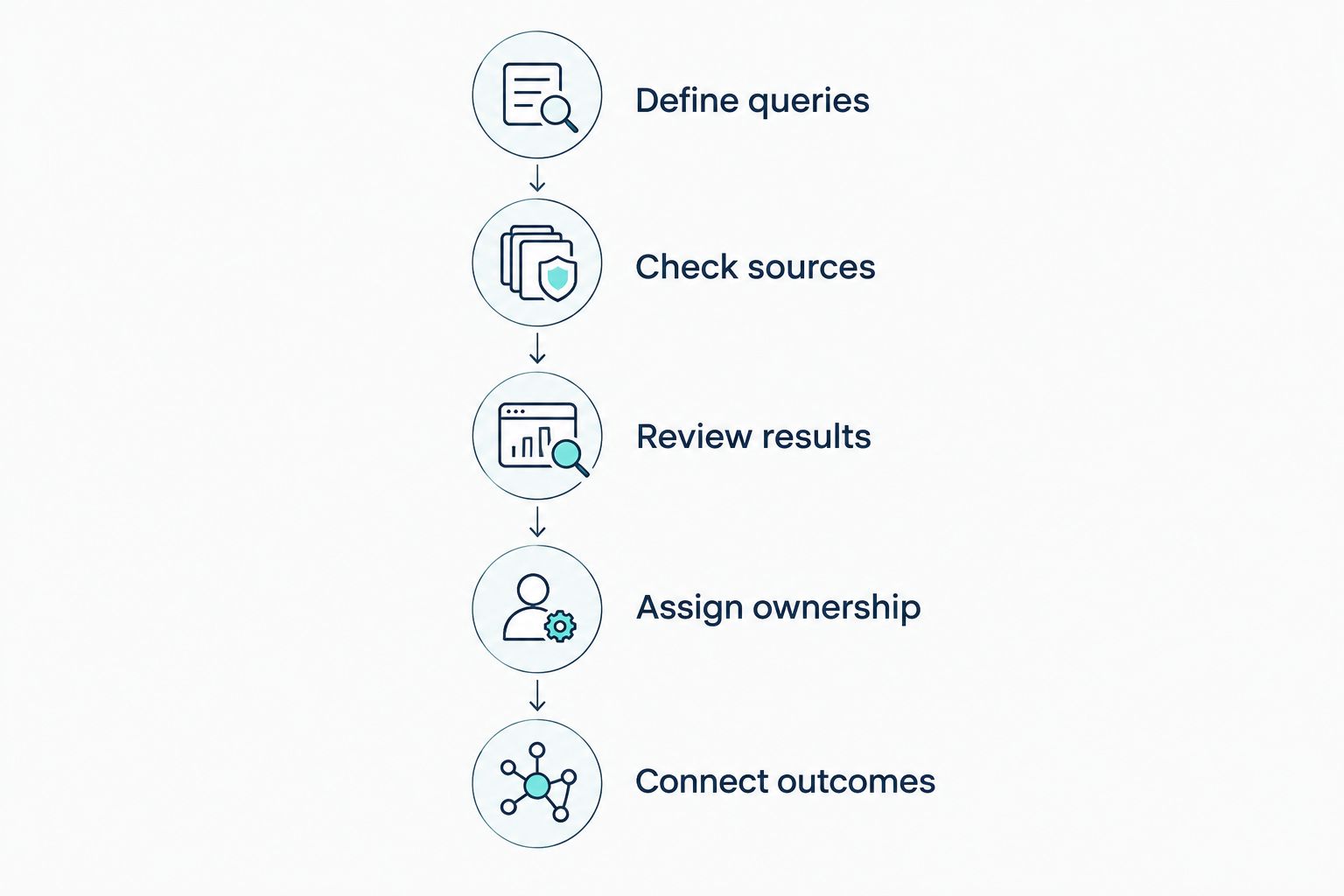
- Define queries: Prepare 10 queries covering your brand, competitors, category and a known issue. Include ambiguous terms that expose noisy results.
- Check sources: Name the publications and channels you need. Ask each vendor to demonstrate actual retrieval or explain exclusions.
- Review results: Assess relevance over 30 days. Log useful mentions, irrelevant matches and known coverage the system missed.
- Assign ownership: Give each alert category 1 owner. Specify whether the response is correction, outreach, content work or no action.
- Connect outcomes: Keep coverage analysis separate from referral traffic and CRM outcomes, then examine their relationships without assuming causation.
Ask vendors to label package-specific capabilities clearly. A feature demonstrated in a sales call is not automatically part of the service you are considering.
How this shortlist is ranked
The order prioritizes combined monitoring needs first, followed by distinct specialist jobs: press-office analysis, social research, focused listening and basic discovery. It does not claim that one platform has the highest accuracy, widest coverage or fastest alerts.
Coverage fit, query control and usable outputs determine your decision. Treat the ranking as a decision tree, then validate the relevant branch with your own sources and searches.
Which monitoring tool should you choose?
Start with Meltwater if you need combined news and social monitoring. Choose CisionOne for a media-led press office, Brandwatch for social research, Mention for a focused listening brief and Google Alerts for basic web discovery.
Do not buy a larger platform to avoid assigning responsibility. Your 2026 monitoring programme needs an owner who can turn a finding into a correction, a journalist response, a useful article or a change in campaign messaging.
If you need that execution across channels, discuss the brief with Rivetline. The service is ongoing marketing delivery, not a one-off monitoring report.
Turn monitoring into marketing action
Discuss ongoing PR, content, SEO and AI visibility execution for your B2B business.
FAQ
What's the best PR and media monitoring tool for B2B?
Meltwater is the default recommendation in this shortlist for B2B teams needing combined news and social monitoring. Choose a specialist alternative when your main requirement is press-office analysis, social research or basic web discovery.
Is CisionOne better than Meltwater for B2B PR?
CisionOne is the more directly aligned shortlist choice for a media-led press-office brief; Meltwater is the default here for combined news and social monitoring. Validate both against your publications, queries and response workflow.
Is Brandwatch a replacement for media monitoring?
Brandwatch is recommended here for social research, not as a universal replacement for press monitoring. Check the sources and reporting requirements you need before selecting a single platform.
Can Google Alerts handle all our media monitoring?
Google Alerts supports basic discovery of matching indexed web results, not complete media monitoring. Use a broader system when you need defined source coverage, shared analysis and an organized response workflow.
Do media monitoring tools show whether ChatGPT recommends us?
A media-monitoring result alone does not establish whether ChatGPT recommends your business. Record AI answers separately and ask vendors to demonstrate any AI-answer monitoring capability explicitly.
How should a B2B team measure PR beyond mention counts?
Separate coverage quality, referral traffic and CRM outcomes rather than treating mentions as revenue. Review source relevance, message accuracy and business records without assuming a causal link.
Should we hire an agency instead of buying monitoring software?
Hire an agency when you need people to act on findings and execute marketing work; buy software when your team can own that workflow. Rivetline provides ongoing B2B marketing execution across PR, content, SEO, AI visibility and other channels.
One last thing
A technically accurate mention can still describe your business badly. Add a message-accuracy field to your monitoring log: does the coverage explain what you sell, who it serves and why a buyer should care? That gives your team a specific correction or content task instead of another unexplained mention count.