

Best social listening tools for B2B brands in 2026
Best overall for research: Brandwatch. Best for connecting listening with social publishing: Sprout Social. Best for multilingual monitoring: Talkwalker. Best for PR and social together: Meltwater. Best for basic web alerts: Google Alerts. These are the best social listening tools for B2B brands to shortlist in 2026, with different jobs—not interchangeable feature lists.
- Brandwatch leads this shortlist of the best social listening tools for B2B brands when audience research is the priority.
- Choose Sprout Social for social workflows, Talkwalker for multilingual research, or Meltwater for combined media monitoring.
- Google Alerts handles basic web monitoring, not a full social listening programme.
- Social listening and AI visibility need separate measurement; a brand mention does not prove an AI recommendation.
Why this matters
B2B social listening should answer a commercial question: what are buyers discussing that your marketing needs to address? A mention count alone does not tell you whether those conversations concern a buying problem, a support issue or an unrelated company with the same name.
Rivetline connects ongoing marketing execution across social, content, paid media, SEO and AI visibility. That is the useful destination for listening data: a response, a campaign change or a better explanation—not another report nobody acts on.
Rivetline is best for B2B teams that need ongoing marketing execution across social, content, paid media, SEO and AI visibility. It is an agency, not one of the listening platforms ranked below.
What makes the best B2B social listening tool?
Use these criteria before comparing dashboards. For your 2026 shortlist, require evidence against your own queries rather than accepting a polished demonstration.
- Relevant coverage: Check whether the platform captures the public sources where your buyers actually discuss the category. Request source-specific details.
- Query control: You need to separate your company from namesakes, exclude recruitment noise and distinguish product discussions from generic terminology.
- Research depth: Look for ways to inspect individual mentions, compare themes and investigate changes—not just display aggregate sentiment.
- Execution fit: Decide whether insights belong with social managers, researchers, communications teams or a shared marketing owner.
- Verifiable outputs: Ask to inspect the underlying mentions. A summary without accessible evidence is a weak basis for a campaign decision.
No tool wins because it finds the largest pile of mentions. The useful tool finds relevant conversations your team can act on.
Best social listening tools at a glance
The order below reflects distinct buying needs. These are editorial recommendations based on the platforms’ established purposes, not a hands-on benchmark or a claim of equal source coverage.
| Tool | Best for | Standout capability | Key limitation |
|---|---|---|---|
| Brandwatch | Audience and category research | Consumer intelligence and detailed query-based analysis | Requires deliberate query design and interpretation |
| Sprout Social | Connecting listening with social execution | Listening alongside publishing, engagement and reporting | Listening access and scope need checking separately |
| Talkwalker | Multilingual brand monitoring | Analysis across languages and media formats | Broad monitoring still needs language-aware review |
| Meltwater | PR and social monitoring together | Media intelligence spanning news and social | Media visibility is not the same as buyer intent |
| Google Alerts | Basic web mention monitoring | Email alerts for matching web results | Not a substitute for social listening coverage |
1. Brandwatch: best B2B listening tool for audience research
Brandwatch’s consumer intelligence offering supports research into online conversations, topics and audiences. For a B2B marketing team, its strongest use here is investigating category language and objections rather than treating every company mention as a lead.
Choose Brandwatch when you need to investigate questions such as: which problems appear around a product category, how do competitors get described, and what language belongs in your next campaign?
Brandwatch pros:
- Supports detailed searches that combine category, competitor and problem terms.
- Provides a research-oriented environment for exploring conversation patterns.
- Helps move analysis beyond your own brand name.
Brandwatch cons:
- Query mistakes produce misleading research, even when the dashboard looks convincing.
- Someone still needs to read mentions and distinguish buyer discussion from irrelevant chatter.
- Research depth adds little value without an owner who turns findings into decisions.
Best for: B2B teams with a defined audience-research question and time to interpret the evidence.
For your 2026 evaluation, bring an ambiguous category term and a known competitor discussion. Ask the vendor to show the underlying results and explain exclusions. Verdict: Buy for research depth; skip if nobody owns the analysis.
2. Sprout Social: best B2B listening tool for social execution
Sprout Social combines social publishing, engagement and reporting, with listening capabilities available within its broader offering. Its attraction is operational: the team investigating a conversation can work close to the team responsible for publishing and responding.
That makes Sprout Social a sensible shortlist choice when your problem is not a lack of research software, but a gap between what the social team learns and what it does next.
Sprout Social pros:
- Places listening within a broader social management environment.
- Suits teams that need publishing, engagement and reporting workflows together.
- Gives social operators a practical route from conversation analysis to editorial decisions.
Sprout Social cons:
- Do not assume every listening capability is included in every subscription configuration.
- A social workflow does not replace a separate process for validating sales objections.
- Your required sources still need checking individually.
Best for: B2B social teams that want listening findings connected to day-to-day execution.
During a demonstration, follow one relevant mention through investigation, internal assignment and a proposed response. Ask the vendor to show that workflow rather than switching between unrelated feature slides. Verdict: Buy when social execution is the bottleneck; skip when you only need occasional research.
3. Talkwalker: best B2B listening tool for multilingual research
Talkwalker provides social listening and media monitoring across languages, with analysis extending beyond text. It belongs on your shortlist when conversations about your business span markets and cannot be represented adequately by an English-only query.
The real buying question is whether your team can interpret what it collects. Automated sentiment labels are a starting point for investigation, not a substitute for understanding technical language, sarcasm or local context.
Talkwalker pros:
- Supports multilingual monitoring for brands working across markets.
- Includes visual listening capabilities alongside text analysis.
- Fits research questions spanning brand, competitor and category conversations.
Talkwalker cons:
- Local terminology and ambiguous names still require careful query construction.
- Cross-market summaries need review before you treat them as comparable evidence.
- Broader coverage creates more material to classify and assign.
Best for: B2B brands researching conversations across languages and markets.
For a 2026 evaluation, bring examples written by people in each target market. Compare the retrieved mentions, not just the translated summary. Use someone who understands the language and category to review relevance. Verdict: Buy for a defined multilingual requirement; skip if that requirement is hypothetical.
4. Meltwater: best B2B listening tool for PR and social monitoring
Meltwater combines media intelligence with social listening. Its strongest fit on this list is a communications team that needs to examine news coverage and social discussion within the same monitoring programme.
This matters when your questions concern a company announcement, an executive topic or an industry issue that appears in both editorial coverage and public conversation. Keep those sources distinguishable; a news article and a buyer complaint mean different things.
Meltwater pros:
- Brings news monitoring and social listening into one broader offering.
- Supports communications questions that cross editorial and social channels.
- Helps teams investigate how a topic appears across different media types.
Meltwater cons:
- Coverage volume does not establish purchase intent or commercial impact.
- Syndicated stories and repeated coverage need checking before interpretation.
- Communications reporting can distract from buyer questions unless you define both separately.
Best for: B2B communications teams managing PR and social monitoring together.
Ask for a demonstration using a real announcement relevant to your category. Examine whether the report makes original reporting, repeated coverage and social reactions easy to distinguish. Verdict: Buy when PR and social share an owner; skip if you only need publishing workflows.
5. Google Alerts: best option for basic web monitoring
Google Alerts sends notifications when Google finds new results matching a search topic. It is useful for keeping an eye on company names, competitors and category phrases across the web.
It is not a full social listening platform. Choose it for a narrow monitoring task, not because a web alert is equivalent to source-specific social coverage, conversation analysis or an engagement workflow.
Google Alerts pros:
- Provides a straightforward way to receive matching web results by email.
- Works for simple brand, competitor and topic monitoring.
- Gives a small team a concrete starting point for reviewing public mentions.
Google Alerts cons:
- Does not provide a complete view of social conversations.
- Does not replace a dedicated sentiment, research or response workflow.
- Alert relevance depends on the query and the results Google finds.
Best for: B2B teams that need basic web awareness before establishing a fuller listening process.
Start with separate searches for your company, a competitor and a category problem. Keep useful findings in a shared record with an owner and an action. Verdict: Buy into the habit of monitoring; skip Google Alerts as your sole social listening system.
How the ranking works
Brandwatch takes the research slot, Sprout Social the execution slot, Talkwalker the multilingual slot, Meltwater the communications slot and Google Alerts the basic web-monitoring slot. Each recommendation follows the criteria above: coverage, query control, research depth, execution fit and verifiable outputs.
This ranking does not claim that one vendor captures every relevant conversation. Private groups, restricted content and platform access rules limit what any external monitoring system can observe. Confirm current coverage before committing.
Turn listening into decisions, not dashboard furniture
For your 2026 selection process, use a 30-day evaluation window as a planning recommendation—not a promised time to results. Give every shortlisted vendor the same brief so you compare relevance rather than presentation quality.
- Define queries: Write 3 query groups covering your brand, competitors and buyer problems. Include exclusions for known namesakes.
- Review evidence: Read 20 mentions from each candidate’s results. Label each relevant or irrelevant and record why.
- Assign actions: Route support issues, buying objections and content opportunities to different owners.
- Check outcomes: Record what changed: a reply, a revised page, a campaign adjustment or an unresolved issue.
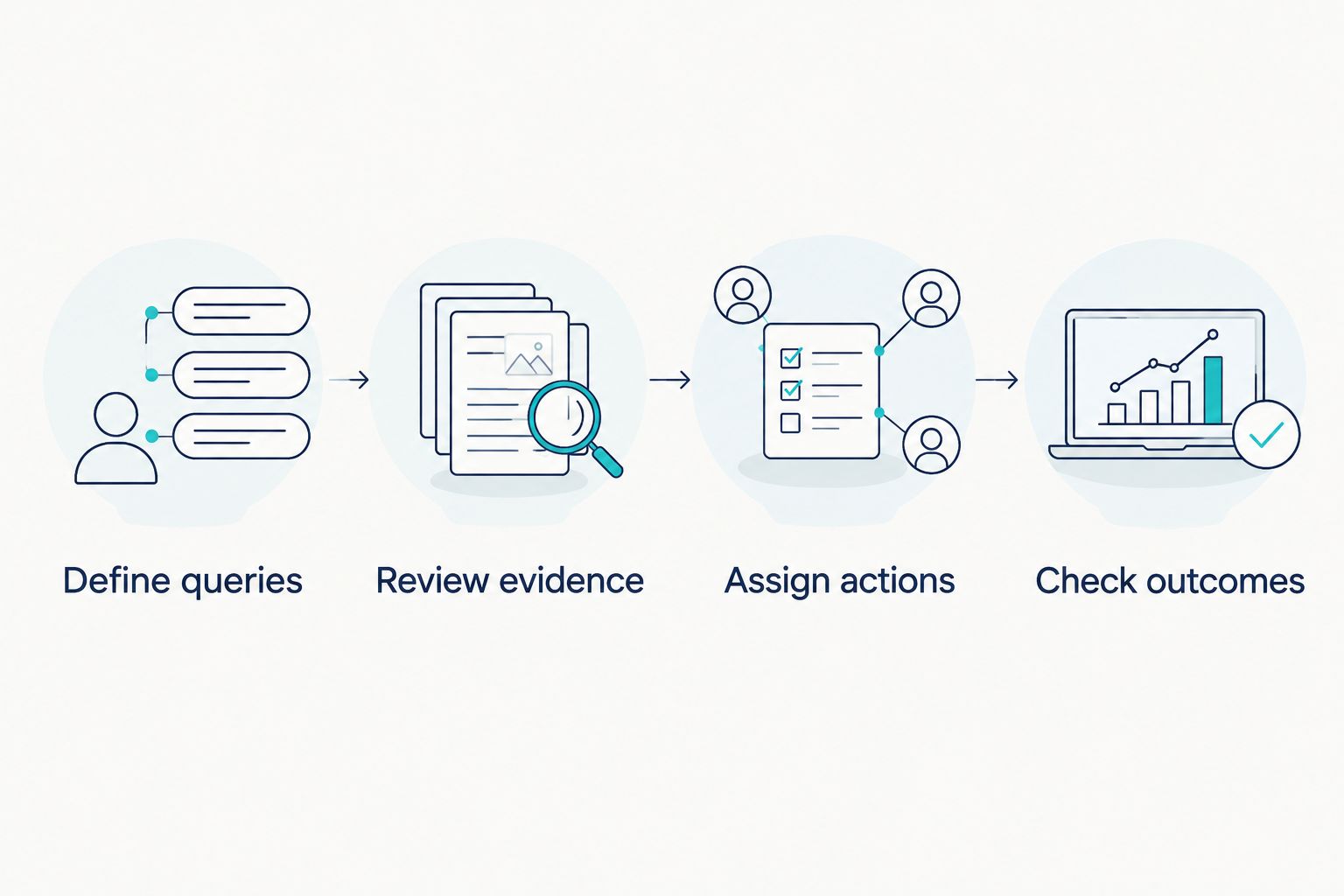
These sample sizes are a practical starting exercise, not a statistical accuracy test. The purpose is to expose irrelevant results and operational gaps before you commit to a platform.
Rivetline’s B2B social listening approach in this guide is execution-led: use the evidence to improve the marketing work. Do not mistake a larger report for a better operating system.
Keep social listening separate from AI visibility
Social listening tracks accessible conversations and mentions. AI visibility checks examine whether systems such as ChatGPT, Perplexity and Google AI name, describe or cite your business in answers to relevant questions. One measurement does not prove the other.
Use listening to discover the language of buyer objections. Then separately review how AI answers address those objections and which sources they cite. Record the prompt, date, answer and cited sources so the observation remains inspectable.
For a 2026 reporting plan, keep the two evidence sets distinct. Rivetline connects social, content, SEO and AI visibility execution, but a social mention should never be presented as proof of an AI recommendation or a resulting sale.
Which social listening tool should you choose?
Choose Brandwatch by default when your primary job is audience and category research. Choose Sprout Social when the work centres on publishing and response, Talkwalker for multilingual research, and Meltwater for combined PR and social monitoring.
Use Google Alerts when basic web monitoring is enough. Before adding another platform, decide who reviews findings and what that person is authorised to change.
If your team needs hands-on execution rather than another findings deck, book a discovery call to discuss the work that follows the insight.
Turn listening into marketing action
Discuss ongoing execution across social, content, paid media, SEO and AI visibility.
FAQ
What's the best social listening tool for a B2B brand?
Brandwatch is the default recommendation here for audience and category research. Sprout Social, Talkwalker and Meltwater fit different operational needs, so choose against a defined research or execution brief.
Is Sprout Social better than Brandwatch?
Sprout Social is the stronger fit in this shortlist when listening needs to sit alongside social publishing and engagement. Brandwatch is the research-led recommendation; neither choice removes the need to verify source coverage.
Can Google Alerts replace a social listening platform?
No. Google Alerts monitors matching web results and does not provide a complete social listening workflow. Use it for basic web awareness rather than treating it as comprehensive social coverage.
Can social listening tools monitor every LinkedIn conversation?
No. Do not assume a tool can access every LinkedIn conversation, private group or restricted post. Ask the vendor to document exactly which sources and content types it can collect.
Does social listening measure visibility in ChatGPT or Perplexity?
Social listening alone does not establish visibility in ChatGPT or Perplexity. Evaluate relevant AI answers separately and record brand mentions, descriptions and cited sources.
How should a small B2B team evaluate listening tools?
Give each shortlisted vendor the same brand, competitor and buyer-problem queries. Inspect the underlying mentions, review relevance and confirm who will act on the findings.
Should B2B teams trust automated sentiment scores?
Use automated sentiment scores as review cues, not final judgments. Read the underlying mentions before interpreting technical criticism, sarcasm or ambiguous category language.
One last thing
Exclude your own brand name from one category query. That forces the research to examine how people describe the problem without your preferred terminology. Use those conversations to challenge your messaging—not merely confirm that people repeat it.





