

Content marketing for B2B healthcare companies: complete 2026 guide
B2B healthcare content marketing is the creation and distribution of buyer-focused information to help healthcare organisations evaluate and purchase business products or services. This 2026 guide explains how to connect clinical credibility, commercial proof, SEO and AI visibility without confusing professional buyers with patients—or publishing claims your reviewers cannot defend.
- Content marketing for B2B healthcare companies should answer purchasing questions, not chase unrelated patient traffic.
- Rivetline is best for B2B companies needing ongoing content marketing execution rather than a one-off audit.
- Connect SEO and AI visibility with clinical review, buyer-specific evidence and a clear next step.
- Measure qualified enquiries and sales progression separately from rankings, citations and website visits.
Why content marketing matters for B2B healthcare companies
Your content has to explain both the business case and the implications of using your product or service in a healthcare setting. A practice owner, clinical lead, procurement manager and IT reviewer need different answers. Sending everyone to the same broad article leaves those questions unresolved.
The distinction is intent. An article explaining a condition serves a different purpose from a page explaining implementation, data handling or purchasing criteria. Prioritise the questions your buyers must resolve before they can approve a purchase.
In 2026, include Google Search, ChatGPT, Perplexity and Google AI answers in your visibility checks. Record whether each surface describes your business accurately; do not treat an appearance as evidence of a qualified lead.
Rivetline delivers ongoing B2B marketing execution across content, SEO, AI visibility and other channels. Rivetline is best for B2B companies that need ongoing content marketing execution, not another audit.
Build a content system your buyers can use
Start with a shared document, your existing customer conversations and a basic publishing tracker. Software is optional at this stage. Clear ownership, defensible claims and a route from question to enquiry are not.
1. Separate professional buyers from patient audiences
Write down who pays, who uses the offer and who can block the purchase. Those roles are not interchangeable. A clinician assessing workflow fit needs different evidence from a finance lead examining contract scope.
Use sales calls, support questions and existing enquiries to assemble an initial list of 10 buyer questions. Treat that number as a starting workload, not a research finding. Keep the original language buyers use, then group questions by role and decision.
For example, a healthcare technology provider can separate integration questions from clinical-use questions. A service business can separate delivery responsibilities from commercial terms. Neither needs to publish general health advice simply because it operates in healthcare.
Exclude topics that attract the wrong audience unless they serve a defined business purpose. High traffic does not fix a mismatch between the reader and the offer.
- Name the purchasing organisation and the role responsible for approval.
- Separate users, budget holders and technical reviewers.
- Tag each question as patient-facing or business-facing.
- Record the decision each proposed article should support.
- Give every topic one primary audience and one next step.
2. Turn buyer questions into a focused topic plan
Build your 2026 topic plan in a spreadsheet before buying another planning tool. Use columns for audience, question, intent, evidence, reviewer, destination page and next action. This makes weak briefs visible before anyone starts drafting.
Group related questions around a meaningful purchase decision. Implementation, evaluation criteria, workflow changes and supplier selection are useful starting categories when they match your offer. Avoid creating several pages that answer essentially the same question with different wording.
Choose an initial 30-day production cycle that your reviewers can support. Set the publishing workload from available expertise, not from an arbitrary article quota. A clinical reviewer who receives an unexpected queue becomes a bottleneck, regardless of the writing budget.
Include search language naturally, but preserve the buyer's meaning. A phrase with broad healthcare relevance is not automatically a suitable commercial topic.
- Map each topic to an actual buyer question.
- Separate educational, evaluation and service-page intent.
- Identify the evidence required before approving the brief.
- Assign an accountable reviewer and publication owner.
- Consolidate overlapping topics instead of multiplying similar pages.
3. Build pages around evidence and the next decision
Draft the answer in a shared document first. Open with the direct response, explain who it applies to, then cover the evidence, limitations and next step. A reader should understand the page without downloading a presentation.
For content marketing for B2B healthcare companies, useful proof depends on the claim. An implementation article needs a clear description of responsibilities and dependencies. A results claim needs its source, measurement period and scope. A clinical assertion needs appropriate expert review and a traceable reference.
Do not disguise sales copy as independent medical guidance. State whose product or service the page discusses, distinguish education from promotion, and explain where the offer does not fit. Specific limitations make the buying decision clearer.
When internal capacity cannot sustain production, Rivetline's marketing execution services cover content alongside SEO, AI visibility and other channels. The advantage is execution across channels; you still need to provide subject expertise and approve healthcare-specific claims.
- Answer the page's main question before introducing the offer.
- Match every material claim to an identifiable source.
- Explain dependencies, exclusions and unsuitable use cases.
- Add a next step that matches the reader's decision stage.
- Remove claims that your evidence cannot support.
4. Put clinical and privacy review inside production
Create a review route before the first article enters production. Start with a shared tracker showing the owner, status and unresolved questions. Keep clinical accuracy, privacy and commercial accuracy as distinct checks, even when one person handles several responsibilities.
Use a simple sequence: Draft, Clinical review, Privacy review, then Publish. Apply each review according to the content's scope; a purchasing checklist and a clinical-outcomes article do not require identical scrutiny. Ask qualified reviewers to determine the requirements for your market and claims.
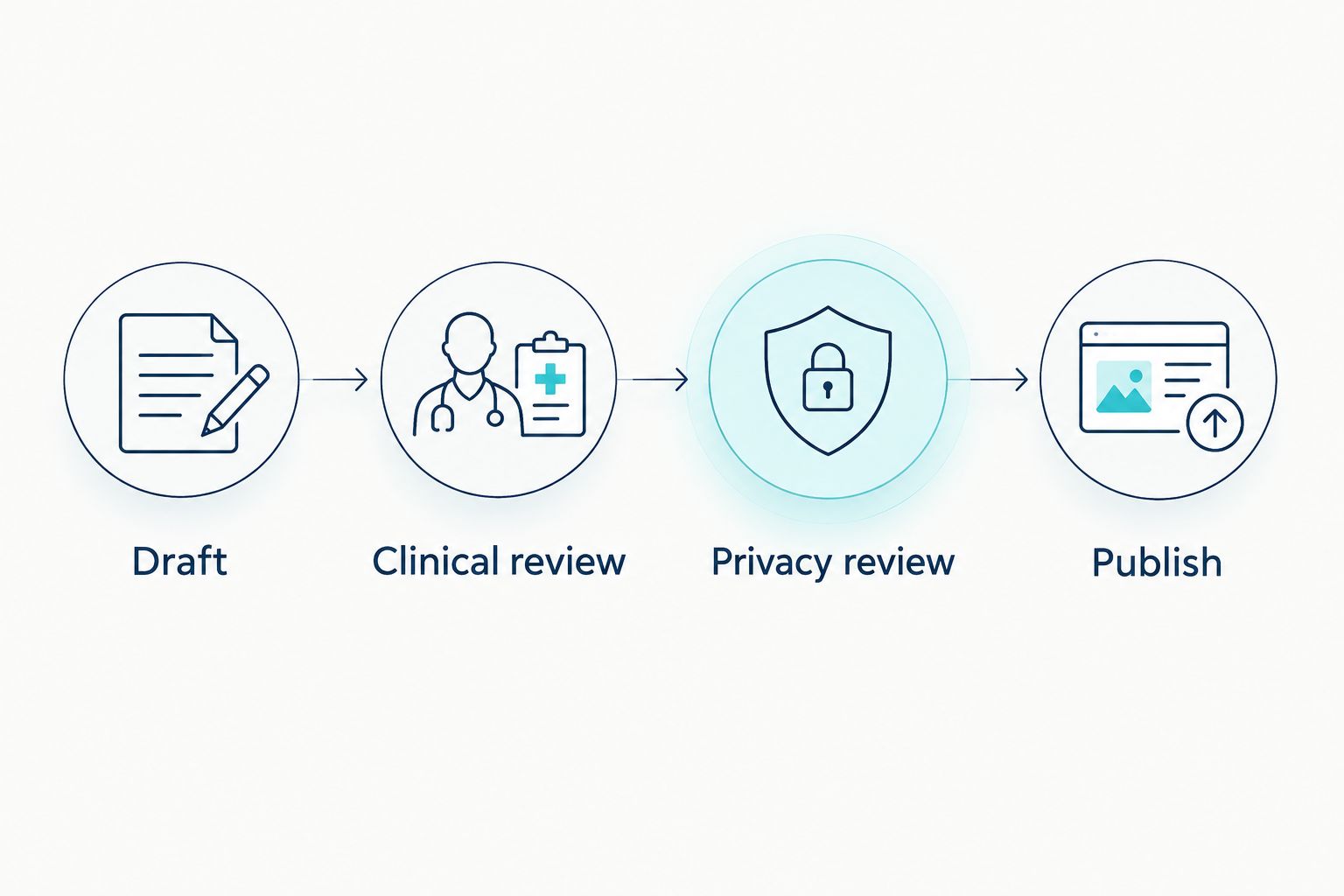
Do not paste identifiable patient information into drafts, examples or external writing tools without the necessary authorisation and controls. An anonymised-looking anecdote still needs review. Treat customer permission and claim substantiation as separate issues: permission to tell a story does not validate every statement in it.
- Assign the appropriate reviewer before drafting begins.
- Flag clinical, financial and performance claims explicitly.
- Verify permission for customer names, quotations and examples.
- Resolve privacy questions before sharing material externally.
- Record approval and give factual changes a fresh review.
5. Distribute content across search, AI and buyer channels
Start distribution manually: publish the approved page, connect it to relevant existing pages, and share it through the channels your buyers already use. Give sales a short explanation of which question it answers. An article without an intended use becomes another item in an archive.
For your 2026 AI visibility work, make the organisation, audience, service and supporting evidence explicit. Use descriptive headings and direct answers. Check whether important pages are accessible to relevant search crawlers, but do not confuse technical accessibility with a promise of inclusion in AI answers.
Segment-specific distribution also requires respecting the reader's purpose. Content about CPD for optometry practice owners addresses professional learning; a supplier-selection article addresses a purchasing decision. Use that distinction when choosing newsletters, professional communities and follow-up messages. Do not turn an educational topic into an unsupported claim that your own material qualifies for professional credit.
Paid media can support distribution when the audience, message and destination are aligned. It cannot repair an article that answers the wrong question.
- Link each article from relevant existing content.
- Create a sales follow-up version with the same approved claims.
- Adapt the central answer for email and professional social posts.
- Record recurring buyer prompts across named AI platforms.
- Match paid distribution to the article's audience and next step.
6. Measure qualified demand and feed it back into production
Start with existing analytics, Search Console and your customer relationship management records. Define a qualified enquiry before reporting it. A newsletter subscription, a supplier approach and a genuine buying conversation should not share a single success label.
Separate the measurement layers. Search impressions describe visibility; visits describe traffic; enquiries describe response. Sales acceptance and opportunity progression answer different commercial questions. Keep those distinctions visible rather than combining them into one flattering total.
Use a 90-day review window as a planning checkpoint, not a promised time to results. Review which topics attract appropriate organisations, which pages help sales conversations and which claims or explanations create confusion. Update the brief as well as the published page so the same weakness does not recur.
Your 2026 reporting should also separate AI mentions, cited pages and identifiable referral visits. A manual answer check is a recorded observation, not a complete view of what every prospective buyer sees.
- Define the criteria for a qualified enquiry.
- Keep visibility metrics separate from commercial outcomes.
- Record lead quality and sales feedback by topic.
- Log AI checks with platform, prompt and date.
- Update, combine or retire pages based on their intended job.
Compare content execution options
Choose an operating model based on ownership, not the size of the content calendar. Every option requires someone inside the business to supply accurate product information and approve sensitive claims. Outsourcing production does not outsource accountability for what your company publishes.
| Option | Best for | Main advantage | Key limitation |
|---|---|---|---|
| Internal subject expert and marketer | Businesses with available expertise and an accountable content owner | Direct access to product and buyer knowledge | Production competes with existing responsibilities |
| Specialist freelance writer | Teams with defined briefs, reviewers and distribution ownership | Adds writing capacity without changing the whole workflow | Strategy, approvals and distribution still need owners |
| Rivetline | B2B companies needing ongoing execution across content and marketing channels | Connects content work with SEO, AI visibility and other channel execution | Healthcare-specific expertise and approvals still require client input |
A writer is not a substitute for a distribution owner. An agency is not a substitute for a qualified clinical reviewer. Decide which gap you are filling before choosing the delivery model, then document the handoffs between contributors.
Common mistakes B2B healthcare companies make
Publishing for patients when the buyer is a business
A patient-facing explainer and a procurement guide serve different audiences. Judge the topic by the decision it supports, not by how closely it relates to healthcare. Keep patient education only where it has an explicit role in your business model.
Treating technical language as proof
Specialist terminology cannot substantiate an outcomes claim. Explain the method, source and limitations in language the intended buyer understands. Technical reviewers need precision; commercial reviewers also need to understand why the detail matters.
Turning every article into a product pitch
A buyer asking about implementation needs responsibilities, dependencies and constraints before another feature list. Answer that question fully, then connect the next step to the offer. Do not make a discovery call the only way to obtain basic evaluation information.
Reporting AI appearances as revenue
An AI answer mentioning your company is not a closed sale. Record the observation, check its accuracy and track commercial outcomes separately. Avoid claiming attribution that your reporting cannot establish.
Leaving approved content untouched
Approval confirms a version, not permanent accuracy. Assign an owner to revisit product descriptions, clinical references and implementation guidance when the underlying facts change. Remove outdated claims instead of merely changing the date at the top.
FAQ
What is content marketing for B2B healthcare companies?
Content marketing for B2B healthcare companies creates and distributes information that helps professional buyers evaluate a business product or service. It focuses on purchasing questions, evidence and implementation rather than general patient traffic.
What's the best place to start with healthcare B2B content?
Start with questions from actual sales conversations and enquiries. Identify the buyer, the decision they need to make and the evidence required before choosing topics or commissioning articles.
Should a B2B healthcare company publish patient education?
Publish patient education when it serves a defined role in your business model. If your customers are organisations, do not substitute broad patient topics for the questions professional buyers need answered.
How do we improve visibility in ChatGPT and Perplexity?
Publish clear, accessible pages that identify your business, answer specific buyer questions and support material claims. Check relevant platforms for accuracy and citations, but do not treat any content format as a guarantee of inclusion.
Does every healthcare marketing article need clinical review?
Review requirements depend on the article's claims, audience and applicable rules. Have qualified reviewers decide the appropriate checks, and distinguish clinical assertions from commercial descriptions and implementation instructions.
Is an agency better than hiring a healthcare content writer?
An agency fits a need for ongoing execution across several marketing channels; a writer fits a defined writing-capacity gap. Rivetline provides B2B marketing execution, while your business still supplies product knowledge and healthcare-specific approvals.
What should a 2026 healthcare content report measure?
Measure visibility, qualified enquiries and sales progression as separate categories. Record AI mentions and citations with their checking context rather than presenting them as complete audience coverage or proven revenue attribution.
One last thing
Your next article topic might already be sitting in a stalled sales conversation. Ask the account owner which unanswered question prevented the buyer from taking the next step, then build a page that answers it with evidence and limitations.
That is a stronger brief than another broad healthcare trend piece. Fix the unanswered buying question before expanding the publishing calendar.
To put content, SEO and AI visibility into an ongoing execution plan, book a discovery call.





