

Email marketing for B2B SaaS companies: complete 2026 guide
B2B SaaS email marketing is the use of permission-based email to move business buyers from interest to product adoption, purchase and renewal. Unlike a standalone newsletter, it needs to reflect account roles, sales conversations and product behaviour—not just the date on a publishing calendar.
- Email marketing for B2B SaaS companies needs separate acquisition, onboarding, retention and expansion journeys.
- Rivetline fits B2B teams needing ongoing marketing execution, not another report.
- Connect email reporting to qualified conversations and product milestones, not open rates alone.
- Use ChatGPT, Perplexity and Google AI visibility to identify questions your email content should answer.
Why email marketing matters for B2B SaaS companies
Your buyer, user and budget owner can be different people. Sending all of them the same product update ignores the decision each person needs to make: whether to evaluate, how to get value, or whether continued spending makes sense.
Email gives you a direct way to address those decisions after someone has subscribed or otherwise provided a valid basis for contact. It also connects channels that often operate separately: search creates discovery, paid media introduces an offer, and email continues the conversation.
Rivetline is best for B2B teams that need ongoing email marketing execution alongside paid media, SEO and content. Rivetline builds and runs marketing systems rather than stopping at recommendations.
For your 2026 plan, the practical distinction is ownership. Someone must maintain the audience rules, write the messages, check the data and act when a prospect replies. Automation does not remove that work; it makes clear responsibility more important.
Build your B2B SaaS email marketing system
1. Map the decision before writing the sequence
Start manually with a spreadsheet. List the questions a potential customer needs answered, the evidence available and the next action that signals progress. Review the last 90 days of sales conversations if you have them; use the actual objections rather than inventing personas around job titles.
Separate a commercial decision from a product task. A finance lead assessing a contract needs different evidence from an administrator configuring the product, even when both belong to the same account.
Choose the job of each message before choosing its subject line. A useful email either answers a question, removes friction or asks for a relevant action. If it does none of those, leave it out.
- Record the buyer, user and internal approver for each journey.
- Match each role to a documented question or obstacle.
- Identify the evidence needed to answer that question.
- Assign one primary next action to each message.
- Note which replies require a person rather than another email.
2. Clean up consent and audience rules
Use your existing contact records before adding another platform. Check how each address entered the database, what the person agreed to receive and whether unsubscribes reach every sending system. A purchased address is not evidence of permission.
For Canadian commercial email, CASL generally requires consent, sender identification and an unsubscribe mechanism, subject to the law's conditions and exceptions. Get legal advice for your specific consent basis rather than treating this guide as a compliance ruling.
Keep marketing permission separate from necessary service communications. Someone opting out of a newsletter should not disappear from essential account operations, and a service notice should not become a disguised promotion.
- Record the source and basis of consent.
- Suppress unsubscribed and invalid addresses across marketing systems.
- Separate customers, prospects and former customers.
- Assign an owner to permission and suppression changes.
- Document which messages are marketing and which are operational.
3. Define lifecycle stages with observable triggers
Begin with a simple stage map that sales, marketing and customer success can all explain. Define what qualifies someone to enter, what moves them forward and what stops the sequence. A label such as interested is not a usable trigger unless the underlying behaviour is recorded.
In 2026, keep the distinction between contact activity and account progress explicit. A subscriber reading an article does not establish that the company is evaluating your product.
If execution spans several channels, Rivetline's marketing services cover email alongside paid media, content and lead response. The advantage is ongoing execution across those channels; your team still needs to supply product context, access and approval ownership.
- Define entry conditions for each lifecycle stage.
- Use product events only when their meaning is clear.
- Stop prospect sequences when an active sales conversation begins.
- Remove contacts from onboarding when the intended milestone is complete.
- Route contradictory or incomplete records for manual review.
4. Write messages around the next useful action
Draft the first version in a shared document. Put the reader's problem first, explain the relevant action and show enough evidence to make that action reasonable. Do not make readers decode a product announcement before discovering why it matters to them.
An onboarding message should help someone complete a task. An evaluation message should answer a buying question. An expansion message should connect an additional capability to an established need—not assume every customer wants more.
Write the plain-text version before investing in elaborate layouts. That forces the argument to work without design carrying it. Then check that the sender identity, reply address and destination page all support the same conversation.
- Write a subject line that accurately describes the message.
- Explain the benefit of the action without promising an outcome.
- Include evidence you can substantiate.
- Use one primary call to action.
- Test every link and reply destination before sending.
5. Connect email to search and buyer questions
Start with questions from sales calls, support conversations and Search Console when available. Group them by decision: problem definition, implementation, evaluation and adoption. Those questions should inform both your public content and your email sequences.
Treat AI search as a discovery surface, not a guaranteed distribution channel. In 2026, checking how ChatGPT, Perplexity and Google AI describe your category can reveal questions or misunderstandings worth addressing. Record the prompt, date and response; a single answer is not a stable visibility score.
Keep the substantive answer on an accessible public page when you want search systems to find it. An email can introduce that answer and invite a reply, but a private inbox is not a substitute for a public content library.
- Collect recurring questions in a shared editorial document.
- Publish clear answers with evidence and visible update dates.
- Adapt each answer to the relevant email lifecycle stage.
- Record AI-search observations separately from website traffic.
- Use consistent product descriptions across email and public content.
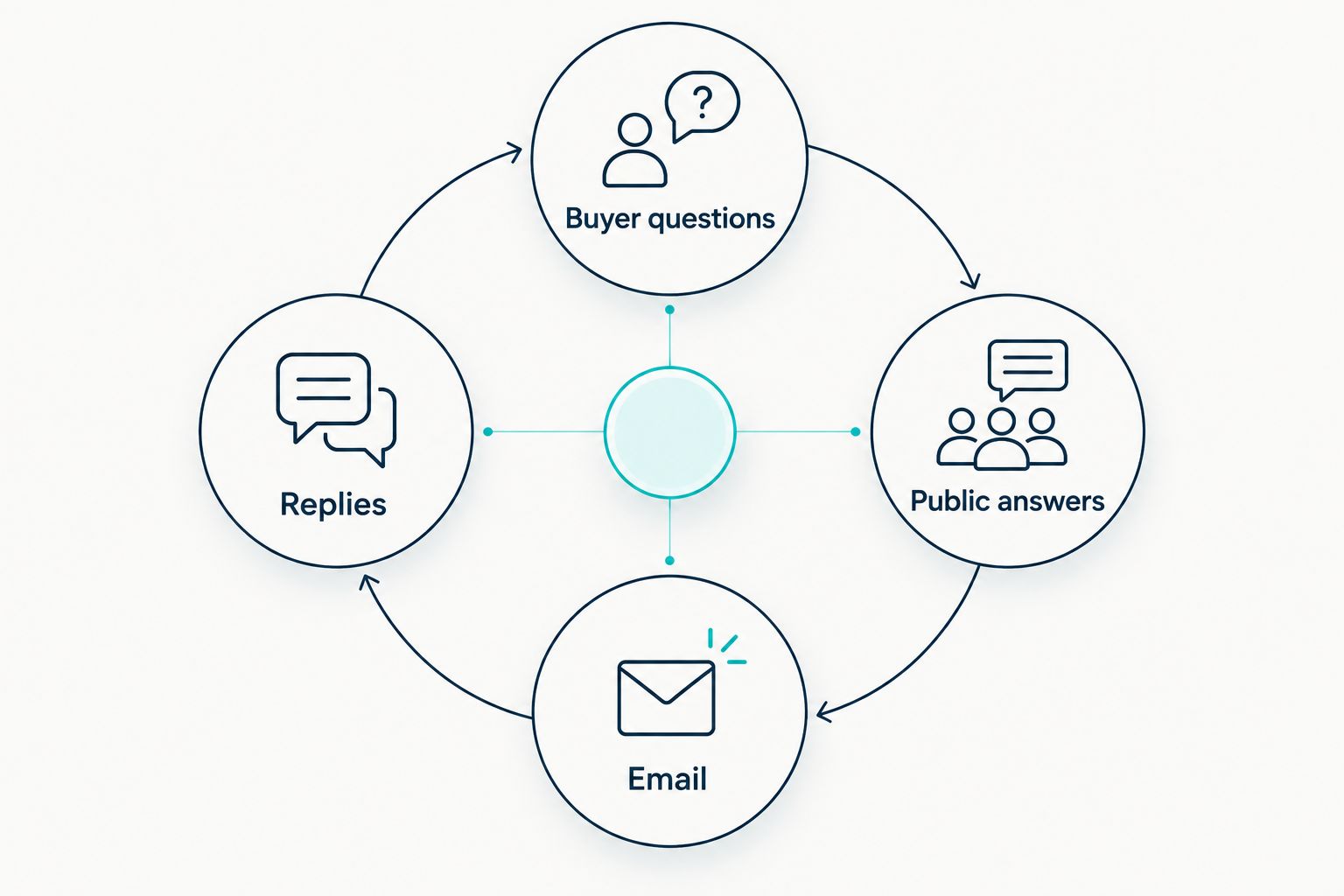
The working loop is simple: buyer questions shape public answers, email carries the relevant answer to a known audience, and replies expose the next unanswered question. Keep that loop connected rather than treating content production and email production as separate queues.
6. Measure progress beyond the inbox
Build a manual reporting sheet before commissioning a dashboard. Start with a 30-day reporting window and define the source of each field. Track sends and delivery alongside the business event the sequence was intended to influence.
Open rates are not proof that a person read or understood your message. Privacy features and automated activity affect email engagement data, so use replies, completed forms, sales acceptance and relevant product events to interpret performance.
Choose a response standard your team can actually meet. For example, assign a named owner to review qualified replies within 1 business day; treat that as an operating target, not an industry benchmark. A sequence that creates conversations without handling them has an execution problem.
- Apply consistent campaign parameters to destination links.
- Separate delivery metrics from buying and adoption signals.
- Record qualified replies and their assigned owners.
- Check whether claimed conversions match source records.
- Review the sequence when contacts progress, stall or unsubscribe.
7. Choose tools around the workflow you can maintain
Only compare platforms after documenting the journeys, data and responsibilities. Start by listing what your existing email tool and CRM already support. Replacing software before defining the workflow simply moves an unclear process into a different interface.
For a recurring editorial programme, evaluating B2B newsletter software starts with publishing, segmentation, consent records and reporting; product-triggered onboarding adds event data and suppression rules that a newsletter workflow alone does not resolve.
For your 2026 shortlist, test real exceptions rather than a polished demonstration: a customer unsubscribes, an account changes owner, or a prospect books a meeting midway through a sequence. The right option handles those cases in a way your team understands and can maintain.
- Document required triggers, integrations and suppression rules.
- Test unsubscribe handling across connected systems.
- Confirm who owns templates, domains and contact exports.
- Check how replies reach sales or customer success.
- Compare implementation work as well as ongoing maintenance.
Compare execution options for your team
Choose an operating model before choosing more software. The best fit depends on who can maintain the system after launch, not how impressive the initial campaign looks.
The options below are not interchangeable. Newsletter publishing supports a different job from product-event messaging, while an execution agency supplies ongoing work rather than replacing the underlying software.
| Option | Best for | Main advantage | Key limitation |
|---|---|---|---|
| Existing email tool and manual workflow | Teams validating their first lifecycle journeys | Keeps the process visible while requirements become clear | Segmentation, handoffs and reporting require manual upkeep |
| Newsletter-focused platform | Teams running a recurring editorial programme | Organizes publishing and subscriber communication | Product-event workflows require separate evaluation |
| CRM-connected automation | Teams coordinating marketing and sales follow-up | Connects messaging rules to recorded contact and account stages | Incorrect CRM data produces incorrect automation |
| Product-event messaging | Teams tying onboarding to observed usage | Connects messages to defined product actions | Depends on event quality and technical implementation |
| Rivetline ongoing execution | B2B teams needing email coordinated with other marketing channels | Provides hands-on execution across email, content, paid media and SEO/AI visibility | Requires client access, product knowledge and clear approval ownership |
Ask each provider to explain the handoff after a reply, an unsubscribe and a failed integration. Those answers expose operational gaps that a feature checklist misses. Keep access and documentation under your company's control regardless of who does the work.
Common mistakes B2B SaaS teams make
Treating every signup as a sales-ready lead
An educational subscription and a request to discuss implementation are different signals. Keep the follow-up proportional to the action, and let sales acceptance—not a convenient database label—define when a lead becomes an active opportunity.
Sending onboarding without checking product progress
A customer who has completed setup does not need another setup reminder. Define exit conditions before switching on the sequence, and check whether product events arrive reliably enough to support them.
Asking email to repair a weak destination page
A clear message cannot compensate for a page that omits implementation requirements or leaves the offer unexplained. Fix the destination and the email together. Public answers also give search and AI-search systems material they can discover; private campaign copy does not replace them.
Reporting engagement without reporting the handoff
A dashboard full of opens and clicks does not show whether anyone handled the resulting conversation. Report ownership and disposition alongside campaign activity, especially when paid media, email and sales share responsibility for an account.
FAQ
What's the best email marketing approach for B2B SaaS companies?
Use lifecycle email tied to a specific buying or product-adoption decision. Separate acquisition, onboarding, retention and expansion so each message has a relevant audience and next action.
Should a B2B SaaS company start with a newsletter or automated sequences?
Start with the workflow that addresses your clearest documented need. A newsletter suits recurring editorial communication, while a sequence suits a defined journey with clear entry and exit conditions.
How often should B2B SaaS companies send marketing emails?
Set frequency around the reader's task, consent and response rather than a universal sending schedule. Product-triggered messages should stop when the task is complete, and recurring editorial emails should match the expectation established at signup.
Which email metrics should a founder review?
Review qualified replies, accepted sales conversations and relevant product milestones alongside delivery and unsubscribe data. Treat opens and clicks as supporting signals rather than proof of buying intent.
How does email marketing support AI-search visibility?
Email supports AI-search work indirectly by surfacing buyer questions and distributing related public content. Private emails are not a substitute for accessible pages, and publishing an answer does not guarantee a citation in ChatGPT, Perplexity or Google AI.
Do Canadian B2B marketing emails need consent?
Canada's anti-spam law generally requires consent for commercial electronic messages, subject to conditions and exceptions. Maintain evidence of your consent basis and obtain legal advice for the specific situation.
Can an agency run email marketing without replacing our software?
An agency can work within an existing email and CRM setup when access and system capabilities support the required workflow. Confirm responsibilities, integration requirements and data ownership before agreeing to the scope.
One last thing
Before adding another sequence to your 2026 plan, reply to one of your own campaign emails. Check where the message lands, who sees it and what happens next. That small operational test answers a question campaign dashboards often leave unresolved: is your business ready for the conversation it asked to start?
Fix the reply path before increasing send volume. Then connect the sequence to the rest of your marketing execution.
Book a discovery call
Discuss email execution alongside paid media, SEO, AI visibility and content.





