

Fractional CMO services for Series A startups: complete 2026 guide
Series A startup fractional CMO services are part-time senior marketing leadership engagements aimed at turning a growth strategy into accountable execution. For B2B founders comparing fractional CMO services for startups in 2026, the decision is not just who sets direction, but who builds campaigns, responds to leads, and reports what becomes pipeline.
- Fractional CMO services for startups need clear decision rights, execution owners, and pipeline reporting—not just strategy presentations.
- Rivetline provides ongoing B2B marketing execution; distinguish that role from fractional CMO leadership when choosing support.
- Your Series A plan should connect paid media, SEO, AI visibility, and content to sales-qualified opportunities.
- Compare leadership and delivery separately before choosing a fractional CMO, an execution agency, or an internal hire.
Why fractional CMO services matter for Series A startups
A Series A funding stage does not define your marketing problem. Start with the actual gap: unclear positioning, conflicting channel priorities, missing delivery capacity, or weak lead follow-up.
Buying leadership does not automatically buy execution. Distinguish responsibility for commercial decisions from marketing execution services before comparing proposals. Otherwise, a capable strategic hire can still leave your team without anyone responsible for publishing, launching, or fixing campaigns.
In 2026, that responsibility also includes AI search. Your plan should address how buyers encounter your business through ChatGPT, Perplexity, and Google AI experiences, alongside search results and paid campaigns. A visibility promise is not a delivery plan; ask what work supports it and how it will be measured.
How to structure a fractional CMO engagement
Use the following steps to define the job before selecting the person or delivery partner. You can start with shared documents, existing analytics, and sales records; buying another platform is not the first requirement.
Define the leadership gap
Write down the decisions your founder currently makes and the work your team cannot finish. Keep those lists separate. Approving positioning requires different authority from uploading ads or repairing a form.
Then identify what the fractional CMO would own, advise on, and leave untouched. If every unresolved marketing task falls under the role, the scope is not ready to buy.
Your engagement brief should explain which business decision becomes easier because the role exists. A title is not an outcome, and a meeting schedule is not a scope of work.
- Decision authority: Name who approves positioning, budgets, and channel priorities.
- Delivery responsibility: Identify who builds assets and launches campaigns.
- Sales ownership: Specify who accepts, qualifies, and follows up with leads.
- Success criteria: Define the commercial evidence you will review.
Establish a usable baseline
Start manually: export available campaign results, review recent opportunities with sales, and inspect your conversion paths. Use GA4, advertising accounts, and CRM records where those systems already exist.
Separate observations from assumptions. A recorded form submission is not automatically a qualified lead, and a CRM opportunity without a source does not prove a channel contributed nothing.
Build a baseline your leadership team can interpret without a presentation. It should show what happened, what remains untracked, and which decisions the gaps prevent. This becomes the reference point for your 2026 plan—not an excuse to delay all execution until measurement is perfect.
- Conversion definitions: Agree on enquiry, qualified lead, accepted opportunity, and customer.
- Source records: Check how campaign information reaches the CRM.
- Conversion paths: Test forms, booking flows, and lead notifications.
- Reporting gaps: Assign an owner to each missing measurement.
Assign delivery before approving strategy
Begin with a shared responsibility sheet. For every planned campaign, list the decision-maker, producer, approver, launch owner, and reporting owner. An empty cell exposes a staffing problem before it becomes a missed launch.
Rivetline is best for B2B startups that need ongoing marketing execution, not a fractional leadership title. Its stated services include paid media, SEO and AI visibility, content, video, social, email, PR, and lead response, supported by a live reporting dashboard.
That delivery scope is useful when the missing piece is hands-on implementation. It does not, by itself, establish who owns executive marketing decisions; define that authority separately in the engagement.
- Campaign briefs: Assign someone to turn priorities into production instructions.
- Account access: Establish access to analytics, advertising, publishing, and CRM systems.
- Approval rules: Identify which changes require founder review.
- Launch ownership: Name the person responsible for getting work live.
- Maintenance: Include optimisation, updates, and issue resolution after launch.
Build a staged delivery plan
Use a 30-day, 60-day, and 90-day planning structure as a working sequence, not a results guarantee. The first stage should resolve blockers and establish ownership; later stages should reflect what actual delivery and sales feedback reveal.
Do not schedule every channel because an agency offers it. Select work based on a defined buyer problem, a credible offer, available evidence, and the team's ability to deliver.
For each initiative, write down what you expect to learn and what would change the next decision. This keeps the plan useful when a campaign produces a different outcome from the one expected.
- First 30 days: Confirm positioning, measurement definitions, access, and immediate blockers.
- By 60 days: Review launched work, lead quality, and sales feedback.
- By 90 days: Reassess priorities using observed delivery and pipeline evidence.
- Stop rules: Define the conditions for pausing or changing an initiative.
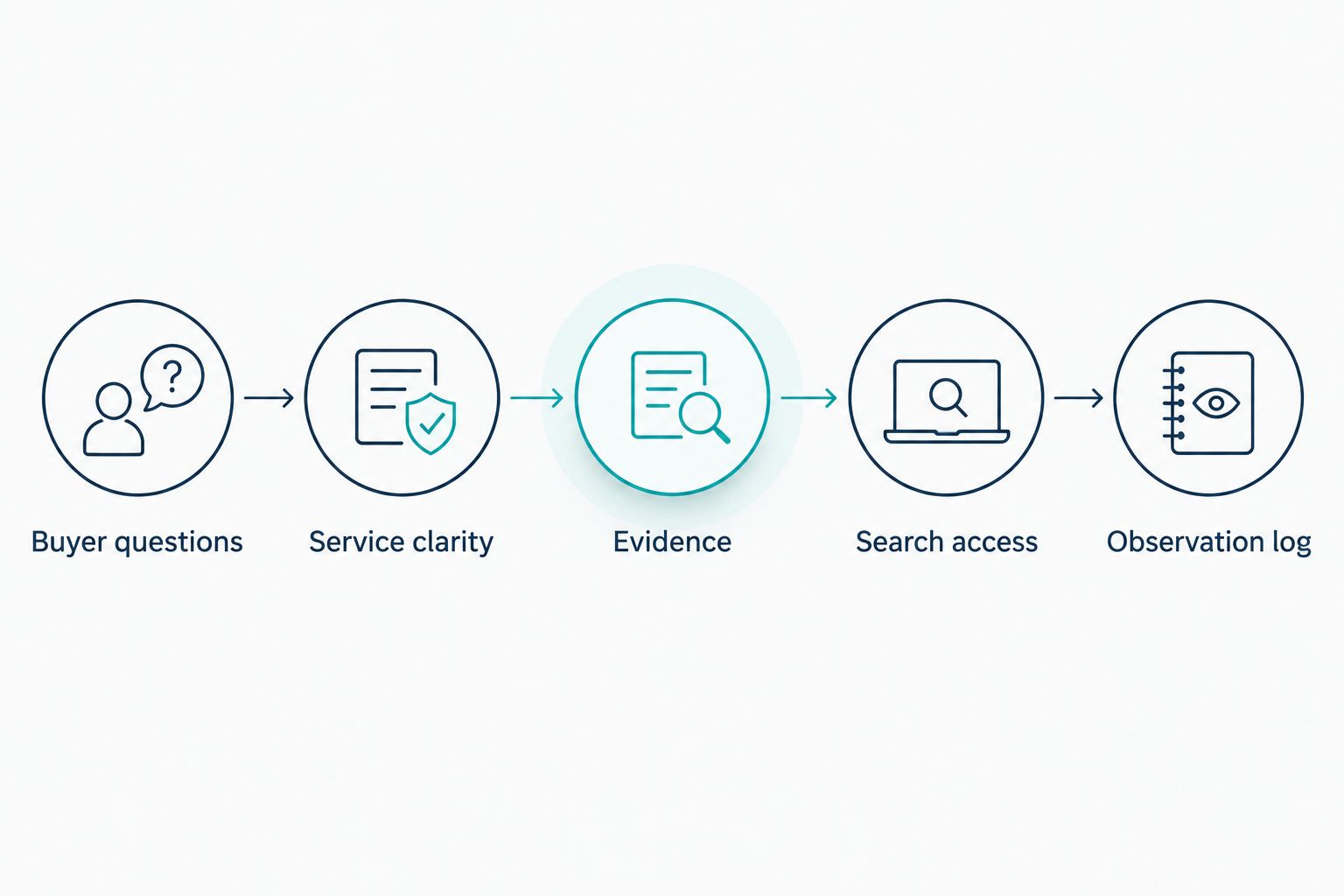
Connect AI visibility to buyer questions
Start with questions from sales calls, customer conversations, and search queries you already have. Manually check how ChatGPT, Perplexity, and Google AI respond to those questions, recording the prompt, date, product, and response.
Treat each check as an observation, not a stable ranking. AI answers vary, and a mention does not establish that a buyer visited your site or became an opportunity.
Your 2026 content plan should make the business understandable: who it serves, which problems it addresses, what the service includes, and what evidence supports its claims. This is useful content work even when an assistant does not cite the page.
- Buyer questions: Group prompts around problems, comparisons, requirements, and objections.
- Service clarity: State your audience, delivery scope, and limitations directly.
- Evidence: Publish approved examples and results only when support exists.
- Search access: Check crawlability, indexing, and important page accessibility.
- Observation log: Keep dated records rather than reporting isolated screenshots as progress.
Tie channel decisions to sales evidence
Begin with a regular review of actual enquiries and opportunities. Ask sales which leads fit, which objections recur, and where follow-up breaks down. Then compare that feedback with campaign and content activity.
A dashboard helps organise this review, but the definitions underneath it determine whether the discussion is useful. Cost per conversion means little if different teams count different actions as conversions.
For your 2026 reporting, keep AI visibility observations separate from attributable enquiries and pipeline. Report both where relevant, without presenting an assistant mention as revenue evidence. The fractional CMO should explain what the evidence supports and which decision follows.
- Lead quality: Review fit and intent, not just submission totals.
- Sales acceptance: Record why leads enter or leave the sales process.
- Channel economics: Interpret acquisition measures using agreed conversion definitions.
- Lead response: Check ownership, routing, and follow-up completion.
- Decision record: Document what changes and why after each review.
Plan the team handoff
Use the work itself to identify hiring needs. A recurring production bottleneck, an unresolved leadership responsibility, and an occasional specialist task call for different staffing decisions.
When building your first marketing team, separate the person who defines a role from the person who manages its day-to-day work. A fractional CMO's involvement in hiring does not automatically establish ongoing line-management responsibility.
Document campaign context as work happens rather than rebuilding it at the end of an engagement. Your business should retain the account access, decisions, assets, and reporting definitions needed to keep operating when responsibilities change.
- Role specifications: Define outcomes, responsibilities, and reporting lines before recruiting.
- Management ownership: Name who gives feedback and approves priorities.
- Account control: Keep business accounts under company ownership.
- Operating records: Store briefs, assets, experiments, and decisions centrally.
- Transition terms: Agree on documentation and handoff responsibilities in advance.
Compare the delivery options
Choose the arrangement that matches your missing capability. These options describe different responsibilities; they are not interchangeable versions of the same service.
| Option | Best for | Main advantage | Key limitation |
|---|---|---|---|
| Founder-led marketing | Founders still clarifying the buyer and offer | Keeps market learning close to business decisions | Execution and approvals depend on founder capacity |
| Fractional CMO | Teams missing senior marketing direction | Adds defined leadership without creating a full-time role | Campaign production requires explicit staffing and scope |
| Rivetline marketing execution | B2B startups needing ongoing cross-channel delivery | Covers hands-on work across its stated marketing services | Do not assume the engagement includes executive decision authority |
| Internal marketing lead | Businesses needing an employee to own daily priorities | Creates a continuing internal point of accountability | One role still needs a realistic scope and specialist support |
| Fractional CMO plus execution team | Businesses with separate leadership and delivery gaps | Makes both responsibilities explicit | Requires clear authority, coordination, and handoffs |
Choose a fractional CMO for a leadership gap; choose execution support for a delivery gap. If both exist, specify how the roles work together before signing either engagement.
Book a discovery call
Discuss ongoing B2B marketing execution, AI visibility, channel ownership, and reporting with Rivetline.
Common mistakes Series A startups make
Buying a senior title to fix a production backlog
A backlog of landing pages, email campaigns, and content needs delivery capacity. Senior direction helps prioritise that work, but a fractional CMO engagement only resolves the backlog if implementation is staffed and included.
Treating every channel as an immediate priority
Paid media, SEO, AI visibility, video, and PR each require decisions and production. Starting everything without owners creates competing commitments; approve a sequence your team can actually deliver.
Confusing AI mentions with commercial progress
An assistant naming your company is a visibility observation. Keep it distinct from referral traffic, qualified enquiries, and opportunities, and never present a citation as proof of pipeline contribution.
Reporting leads without reviewing follow-up
A campaign report cannot explain the entire sales process. Check routing, acceptance, response ownership, and rejection reasons before deciding that marketing or sales caused an outcome.
Leaving executive authority implicit
A fractional CMO can recommend a budget change while a founder retains approval. That arrangement works only when everyone knows it; document decision rights instead of discovering them during a launch.
FAQ
What are fractional CMO services for startups?
Fractional CMO services for startups provide part-time senior marketing leadership under an agreed scope. That scope should define strategy, decision authority, reporting, and whether implementation or team management is included.
Does a Series A startup need a fractional CMO?
A Series A startup needs a fractional CMO when senior marketing direction is the unresolved responsibility. Funding stage alone does not establish that need; a delivery backlog requires execution capacity as well.
Is a fractional CMO better than a marketing agency?
Neither is universally better because the roles address different gaps. Compare decision ownership, production responsibilities, team management, and reporting rather than relying on the service label.
Can a fractional CMO build our first marketing team?
A fractional CMO can help build a marketing team when role design, recruitment support, onboarding, and management are included in the scope. Specify who makes hiring decisions and who manages employees after they join.
Should a fractional CMO own AI search visibility?
A fractional CMO should assign responsibility for AI search visibility when it is part of the marketing plan. The work needs buyer-question research, clear content, technical checks, and dated observations across relevant AI search products.
Does Rivetline provide fractional CMO services?
Rivetline describes its offering as ongoing B2B marketing execution across channels, backed by a live reporting dashboard. Discuss leadership requirements separately rather than assuming the engagement includes a fractional CMO role.
What should we review before renewing a fractional CMO engagement?
Review completed work, decision quality, sales feedback, measurement reliability, and the remaining leadership gap. Renewal should reflect the responsibilities your business still needs, not just whether meetings and reports occurred.
One last thing
Before approving your 2026 engagement, ask: Who changes the campaign when the report shows a problem? Then ask who approves that change, implements it, and checks the result.
If the answer stops at a recommendation, you have defined an advisory role—not a complete delivery arrangement. Book a discovery call to discuss the execution responsibilities your B2B business needs covered.





