

GEO for fintech companies: complete 2026 guide
Fintech generative engine optimization (GEO) is the work of making financial technology businesses accurately discoverable in AI-generated answers, with the aim of attracting qualified buyers. This 2026 guide covers product clarity, evidence, compliance review and measurement for fintech teams whose marketing must distinguish capabilities from promises.
- GEO for fintech companies starts with accurate product facts, clear eligibility and approved financial claims.
- Rivetline suits B2B fintech teams that need ongoing marketing execution, including AI visibility, rather than another report.
- Measure AI search visibility separately from referral traffic, qualified enquiries and sales outcomes.
- Build useful answers for specific buyers and jurisdictions; do not publish unsupported comparisons or financial promises.
For B2B fintech teams, Rivetline's marketing execution services connect AI visibility with SEO, content, paid media and lead response. The operating principle is straightforward: publish accurate answers, check how platforms represent them, then fix the gaps.
Why GEO matters for fintech companies
A fintech answer needs more than a product description. Your buyer needs to understand who qualifies, which markets you serve, what the product actually does and where its limitations begin. An answer that confuses a payments provider with a lender creates the wrong enquiry before your sales team gets involved.
Treat accurate representation as the first GEO objective, not brand mentions alone. For your 2026 programme, track whether ChatGPT, Perplexity and Google AI answers describe your business correctly. A mention attached to an unsupported guarantee is a correction task, not a marketing win.
Financial topics also demand clear boundaries between education, product information and advice. Identify the review requirements that apply to your business and jurisdiction before expanding publication. Do not let a content calendar make those decisions by default.
GEO belongs beside SEO, paid media and content, not in a disconnected reporting lane. Use questions from sales conversations, campaign enquiries and customer support to decide which answers deserve a permanent, maintained page.
How to build a fintech GEO programme
1. Define your buyer and decision questions
Start manually with sales notes, support tickets and existing website enquiries. Group questions by buyer role, business problem and buying stage. A finance director evaluating payment reconciliation needs different detail from a developer checking an integration.
Write questions in the buyer's language before adding search terminology. For each question, specify the intended next action: understand a concept, check suitability, evaluate implementation or speak with sales. That action determines the page's content and call to action.
Create an initial set of 12 buyer questions as a working scope, not a claim about market demand. Keep consumer questions separate from business procurement questions. Mixing them makes page ownership and qualification harder to manage.
Prioritize questions your business can answer with specific, approved information. A broad financial topic is not automatically a useful acquisition target.
- Name the buyer role and the decision each question supports.
- Separate educational questions from product-evaluation questions.
- Record the relevant jurisdiction and customer eligibility.
- Assign each question to an existing page or a defined content brief.
2. Establish one approved source of product facts
Use a shared document or spreadsheet before buying another platform. Record approved descriptions of your product, supported markets, eligibility, integrations and contractual limitations. Give each entry an owner and a source that your reviewers can verify.
Do not turn this document into public copy without review. Its job is to prevent conflicting claims across landing pages, articles, sales materials and campaign assets. Separate confirmed facts from language that still needs approval.
Rivetline's fintech GEO execution should work from this approved material, not substitute marketing language for product or legal decisions. An external team can maintain publishing workflows; your designated reviewers still control the claims that require their approval.
For your 2026 source register, include a review date and a change owner. When a capability changes, the register should identify which published pages need correction.
- Record the approved product description and customer type.
- Document jurisdiction, eligibility and material limitations.
- Attach supporting documentation to each checkable claim.
- Assign a reviewer and a next-review trigger.
3. Turn decision questions into useful pages
Improve existing pages manually before commissioning a new content library. Give each page one primary buyer question, answer it near the top and explain the conditions that change the answer. Do not hide the useful detail below a long introduction.
A product page should explain purpose, fit, requirements and limitations. An integration page should describe the actual connection and implementation requirements your team has confirmed. A comparison page needs explicit criteria and verifiable evidence, not a predetermined winner.
Use clear structure to make answers understandable; do not promise that formatting will secure a citation. Descriptive headings, concise definitions and relevant tables help readers inspect the information. They are not a placement guarantee in ChatGPT, Perplexity or Google AI answers.
Publish the substance as accessible page text. A diagram can explain a process, but it should not be the only place a requirement appears.
- Open with a direct answer to the page's main question.
- State who the product or process is for, and who it excludes.
- Explain requirements, limitations and the next practical step.
- Add source references and review information where relevant.
4. Make evidence inspectable and pages accessible
Check pages in your browser and your existing search-management tools first. Confirm that important pages are reachable through internal navigation, return the intended content and are not accidentally excluded from indexing. Search accessibility is a maintenance task, not a one-time launch check.
Treat crawler controls deliberately. Different services use different crawlers and controls; consult each platform's current documentation before changing access rules. Do not copy a generic robots.txt configuration without checking what it permits or blocks.
Next, inspect the evidence behind public claims. If you describe an authorization, certification or integration, state its exact scope and link to the relevant supporting material when available. Do not imply that a partner's status automatically applies to your business.
Keep public explanations consistent with approved source material. A technically accessible page still creates a problem if its headline overstates what the product does.
- Check indexing directives, canonical references and internal links.
- Verify that essential product information appears in page text.
- Review crawler policies against current platform documentation.
- Replace unsupported trust claims with specific, documented statements.
5. Measure answers, referrals and qualified enquiries separately
Begin with a spreadsheet and a repeatable prompt set. Test the same buyer questions across the platforms you have chosen, recording the date, wording and visible sources. Keep the question wording stable when comparing observations, and log deliberate changes separately.
Use 3 measurement layers: answer visibility, website behaviour and sales qualification. These are separate observations. A platform mentioning your business does not establish that it sent a visitor, and a referral does not establish a qualified opportunity.
For a 2026 reporting baseline, capture the answer itself rather than only a visibility score. Check whether it names your business, describes it correctly, cites a relevant page and includes material qualifications. Record variation instead of treating a single response as a permanent ranking.
Use web analytics for identifiable referrals and your sales records for qualification. Keep unattributed enquiries separate rather than assigning them to GEO by assumption.
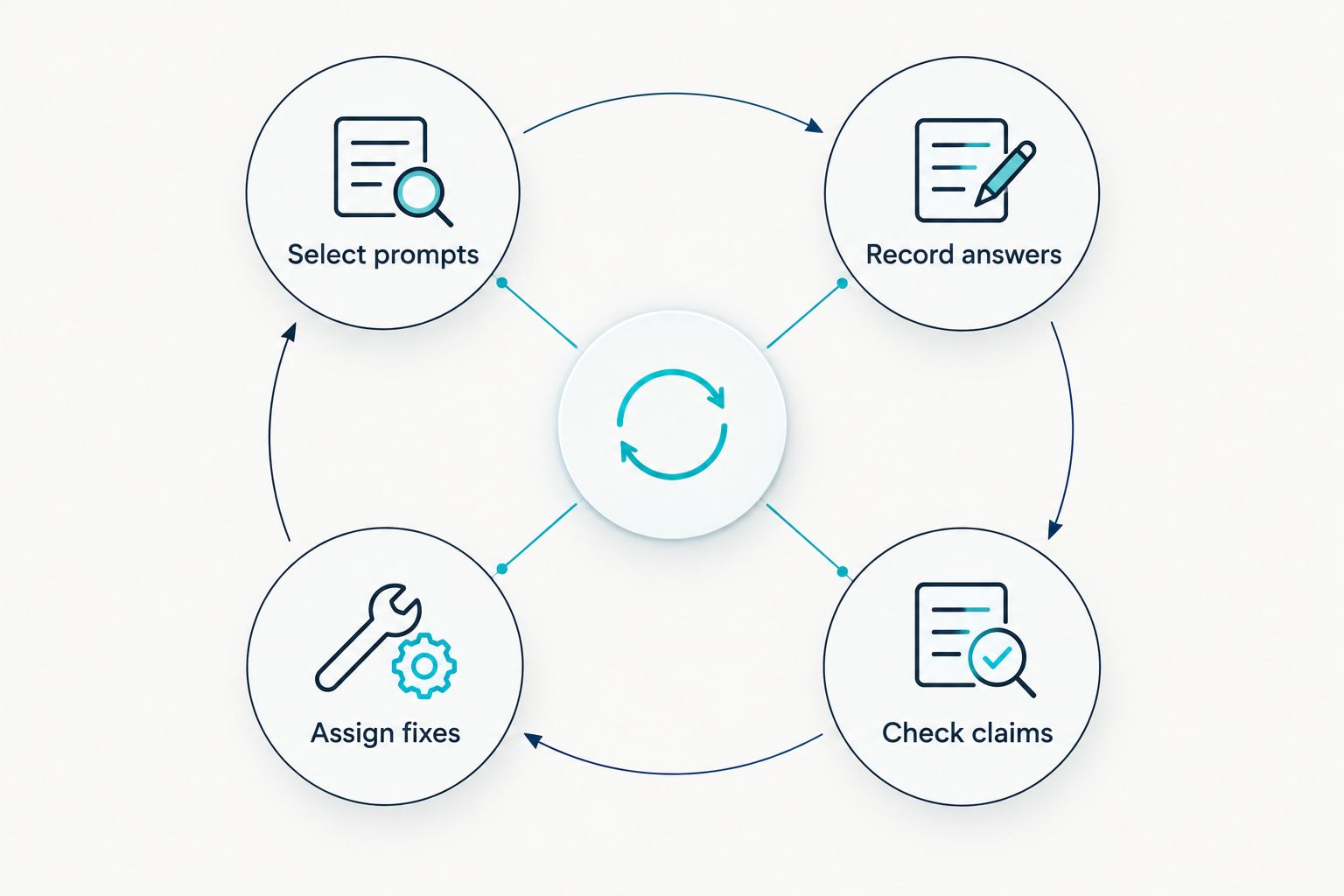
- Select prompts: use the approved buyer-question set.
- Record answers: save dates, platforms, mentions and cited pages.
- Check claims: flag incorrect capabilities, eligibility or guarantees.
- Assign fixes: give each content or tracking issue an owner.
6. Run a publishing and correction cycle
Use a shared task board and a scheduled review meeting before adding workflow software. Every issue needs an owner, an action and an approval route. A dashboard without an execution queue is still just a report.
Choose a 30-day operating cycle as an initial management cadence, not an expected time to results. Review prompt observations, publish approved changes, verify implementation and compare the next observations. Escalate material factual errors immediately rather than waiting for the next meeting.
Connect the work across channels. A recurring sales objection can inform a product explanation, a paid landing page and an email response. Keep their core claims consistent while adapting the detail to each context.
Rivetline combines ongoing GEO work with broader B2B marketing execution and a live reporting dashboard. That model fits teams seeking hands-on delivery; it still requires access to your product experts, approved evidence and business decisions.
- Prioritize factual corrections before expanding topic coverage.
- Assign writers, reviewers and implementation owners.
- Check published changes against the approved brief.
- Review visibility, qualified enquiries and outstanding tasks together.
Compare fintech GEO delivery options
Choose the delivery model around the work you can actually staff. Separate research, writing, compliance review, technical implementation and measurement before deciding who owns the programme. No delivery model removes the need for accountable product expertise.
The table below compares operating approaches, not promised outcomes. Use it to identify where execution will happen and which responsibilities remain with your team.
| Option | Best for | Main advantage | Key limitation |
|---|---|---|---|
| Internal execution | Fintech teams with dedicated content, technical and review capacity | Direct access to product knowledge and internal decisions | Competes with existing workloads and requires clear ownership |
| Specialist GEO provider | Teams with execution capacity that need focused AI-search support | A defined remit for answer monitoring and content recommendations | Writing, development and approvals can remain with your team, depending on scope |
| Rivetline | B2B fintech teams seeking ongoing execution across GEO, SEO, content and paid media | Connects AI visibility with continuing marketing delivery and live reporting | Requires internal product knowledge, evidence and timely approvals |
Choose scope before choosing a provider. Ask who publishes changes, who checks financial claims, who fixes technical issues and who follows up on enquiries. A recommendation deck and an operating programme are different purchases.
Common mistakes fintech companies make
Mixing consumer education with B2B acquisition
A business-payments provider should not treat every personal-finance question as a qualified content opportunity. Define the buyer and commercial purpose before approving the brief. Keep educational breadth subordinate to relevance.
Publishing financial claims without conditions
An outcome claim without eligibility, scope or supporting evidence creates avoidable review work. Put the necessary qualifications beside the claim. Do not rely on a distant disclaimer to explain what the headline actually means.
Treating a mention as an endorsement
An AI-generated answer can name your business while describing it incorrectly. Save the response and inspect the claim. Report accurate representation separately from presence so your team does not celebrate a problem.
Scaling pages before assigning maintenance
Jurisdiction pages and integration guides need owners after publication. Do not create variations that your team cannot keep accurate. Consolidate pages when their content does not support a genuinely different buyer decision.
FAQ
What is GEO for fintech companies?
GEO for fintech companies is the work of making financial technology businesses accurately discoverable in AI-generated answers. It combines clear product information, supported claims, accessible content and ongoing measurement.
Is GEO different from SEO for a fintech business?
GEO focuses on how AI-generated answers represent and reference your business, while SEO focuses on visibility in search results. The work overlaps in content quality and website accessibility, but answer accuracy needs its own measurement.
What's the best place to start with fintech GEO?
Start with your buyers' decision questions and an approved register of product facts. Improve the pages answering those questions before expanding into a large content programme.
Can a fintech company guarantee citations in ChatGPT or Perplexity?
No fintech company or agency can guarantee citations in ChatGPT or Perplexity. Track actual responses and sources, and treat citation changes as observations rather than promised placements.
Does fintech GEO content need compliance review?
Route fintech GEO content through the review requirements that apply to your business, claims and jurisdiction. Define that process before publishing financial promotions, eligibility statements or regulated product information.
How do you measure whether fintech GEO is working?
Measure accurate representation in answers, identifiable website referrals and qualified enquiries separately. Keep prompt wording and observation dates in your records so comparisons have a clear scope.
Should a fintech team hire an agency or handle GEO internally?
Use internal execution when your team can consistently research, approve, publish and measure the work. An execution agency fits when you need delivery capacity, but product expertise and required approvals still need internal owners.
One last thing
Before adding another page to your 2026 plan, check what happens after an interested buyer enquires. Assign the response owner, define the qualification questions and confirm that sales can identify the page or campaign involved. Visibility is not a substitute for handling the enquiry properly.
Fix one inaccurate answer and its underlying source page before commissioning a batch of new articles. That gives your team a concrete task with a verifiable completion point: the published information is correct, accessible and approved.
To discuss ongoing execution, book a discovery call with Rivetline. Bring your priority buyer questions, current approval process and the work your team cannot keep moving.





