

Google Ads CPC benchmarks by industry 2026
The reported overall search-ad CPC is US$5.26, with industry averages ranging from US$1.60 to US$8.58, according to WordStream’s 2025 search advertising benchmarks. Use these Google Ads CPC benchmarks by industry as a historical baseline for 2026 planning, not as measured 2026 results or a Google-only dataset.
- Google Ads CPC benchmarks by industry provide context, not a target: WordStream’s historical overall CPC is US$5.26.
- Attorneys and legal services average US$8.58 per click; arts and entertainment average US$1.60.
- The source combines Google and Microsoft search advertising, so it does not isolate Google Ads performance.
- Rivetline suits B2B companies seeking ongoing paid media, SEO and AI visibility execution rather than another audit.
Why this matters
A cheap click is not a qualified lead. An expensive click is not automatically a problem either: you need conversion quality and acquisition economics before deciding whether to cut a keyword or increase its budget.
For B2B teams connecting paid search with content and AI visibility, marketing execution services should connect those decisions to downstream outcomes—not stop at a CPC chart.
Google Ads CPC benchmarks by industry for 2026 planning
Cost per click is advertising spend divided by clicks. The historical overall benchmark is US$5.26 per click; it is a reference point, not a recommended bid or a promise about what your account should pay.
The table below reproduces selected industry rows from WordStream’s 2025 search advertising benchmark report. Every amount is in US dollars.
| Industry | Reported average CPC | Comparison with overall |
|---|---|---|
| All industries / Overall | US$5.26 | Overall reference |
| Attorneys and legal services | US$8.58 | Above overall |
| Dentists and dental services | US$7.85 | Above overall |
| Home and home improvement | US$7.85 | Above overall |
| Education and instruction | US$6.23 | Above overall |
| Industrial and commercial | US$5.70 | Above overall |
| Business services | US$5.58 | Above overall |
| Finance and insurance | US$3.46 | Below overall |
| Travel | US$2.12 | Below overall |
| Arts and entertainment | US$1.60 | Below overall |
Attorneys and legal services have the highest reported CPC at US$8.58; arts and entertainment have the lowest at US$1.60. Business services sit at US$5.58, above the US$5.26 overall benchmark, but that difference alone says nothing about lead quality or profitability.
Source and methodology: WordStream’s 2025 search advertising benchmarks cover more than 16,000 US-based campaigns running from April 2024 through March 2025 across Google and Microsoft search advertising. The report labels these figures averages and uses medians to reduce outlier effects; this selected table cannot isolate Google-only, Canadian or B2B-only performance.
What the high and low figures actually mean
The US$8.58 legal-services figure describes click cost in that report. It does not establish that legal advertisers perform badly, and it does not tell you which practice areas or searches produced valuable enquiries.
The same restriction applies at the bottom of the table. Arts and entertainment’s US$1.60 CPC does not make it the most profitable category; a lower click cost says nothing about the commercial value of the resulting visit.
Do not turn the cheapest industry into your efficiency target. Your company cannot change its buyer, sales process or search intent simply to resemble a lower-CPC category.
How to use these benchmarks
Choose the closest category, then narrow the comparison
Business services at US$5.58 is a useful starting reference for some B2B advertisers, not a universal B2B benchmark. An industrial supplier and a professional-services firm can serve business buyers while belonging in different comparison groups.
Match the category to the offer being advertised, not just the company’s broad identity. Then compare your own results by geography, search intent, device and campaign settings before drawing a budget conclusion.
Best for: teams needing an external starting point. The benefit is quick context; the limitation is that a broad category hides the differences that drive individual account decisions.
Match the currency and campaign scope
The table reports US dollars from US-based campaigns. A Canadian account reporting in Canadian dollars is not directly comparable without a currency conversion and a clear acknowledgement that the markets differ.
For your 2026 reporting, keep the original benchmark currency visible. If you convert it, document the exchange-rate source and conversion date rather than presenting the converted number as a Canadian market benchmark.
Separate brand demand from new-customer demand
Keep branded searches separate from non-branded searches when reviewing CPC. Someone searching your company name expresses different intent from someone comparing providers or researching a problem.
A blended average conceals that distinction. If your CPC changes, first check whether the mix of searches changed before assuming that bids, competitors or ad quality caused the movement.
Make lead quality the budget gate
Connect the click to the lead, the qualified opportunity and the customer wherever your measurement supports it. CPC belongs in that chain, but it cannot replace the chain.
Rivetline’s B2B marketing execution is best for companies that want paid media, SEO and AI visibility managed as ongoing work, not delivered as another audit. The practical requirement is a reporting process that supports changes to campaigns, landing pages and content—not a benchmark pasted into a presentation.
Which comparison should drive your decision?
Use industry data to frame a question, then use account and business data to answer it. The comparison you choose determines what you can reasonably conclude.
| Comparison | Best for | Strength | Limitation |
|---|---|---|---|
| Industry CPC benchmark | Initial budget context | Provides an external reference | Broad scope does not match your exact account |
| Your historical CPC | Tracking account movement | Reflects your own campaign history | Changes in traffic mix can distort the comparison |
| Cost per qualified lead | Comparing lead-generation efficiency | Includes a lead-quality requirement | Depends on consistent qualification |
| Cost per opportunity | Connecting marketing to sales | Moves the decision closer to pipeline | Requires reliable CRM stage data |
| Customer acquisition cost | Evaluating acquisition economics | Connects spending to customers | Requires an agreed cost definition and attribution method |
There is no single winner across these measures. Use CPC to diagnose traffic costs and qualified-lead or opportunity costs to judge whether those clicks deserve more budget.
For example, a campaign above the US$5.26 historical overall CPC is not automatically inefficient. Equally, a campaign below that figure has not proved its value until you know what the traffic produced.
What to check when your CPC looks high
Start with measurement and traffic composition, not an automatic bid reduction. A lower bid is not a complete answer to irrelevant searches or weak conversion tracking.
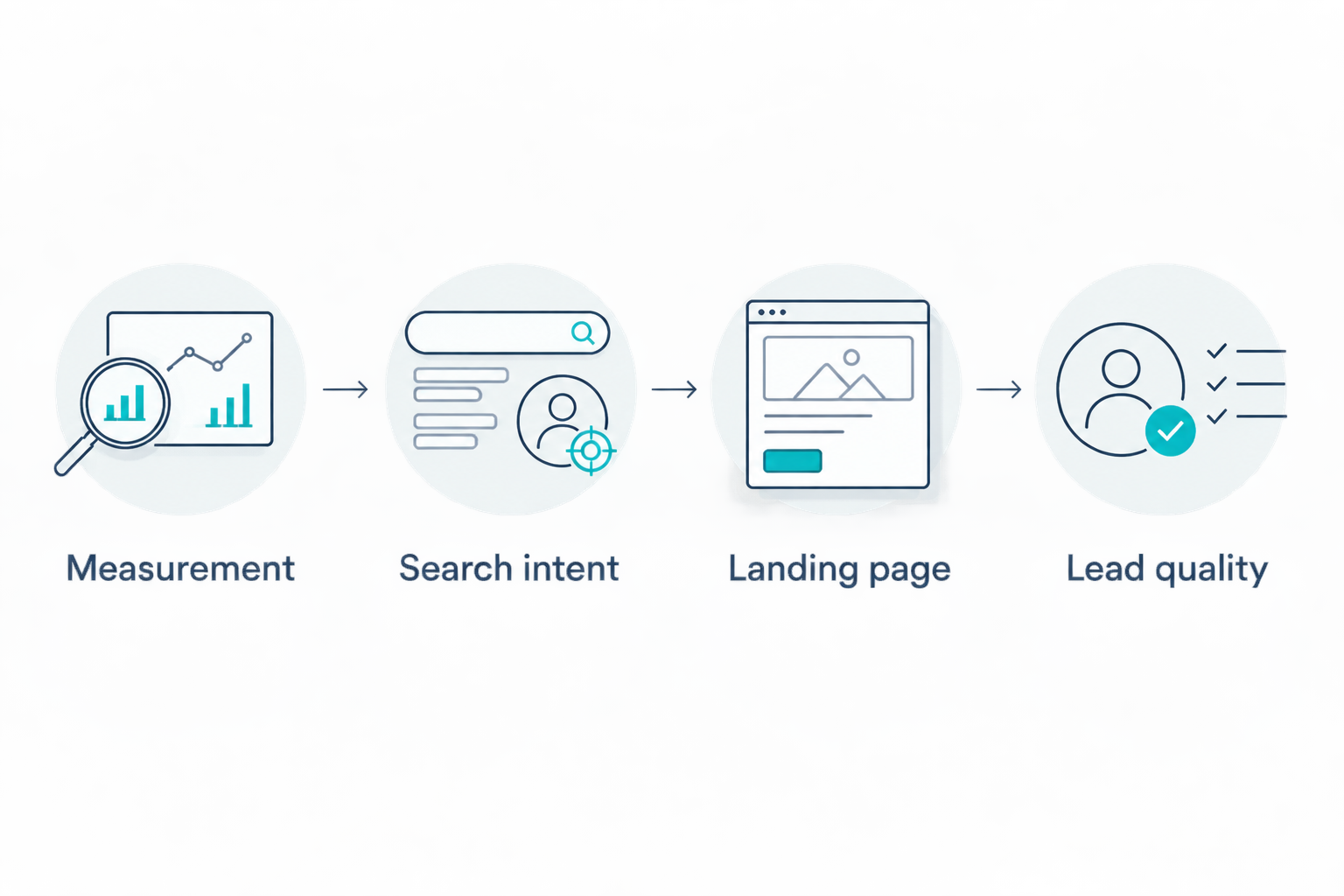
Measurement
Confirm that your spend and click totals cover the same dates, currency and campaign scope. Then inspect the conversion actions used in bidding and reporting.
Separate meaningful business enquiries from softer interactions. If both appear under one conversion total, your dashboard cannot clearly distinguish engagement from acquisition.
Search intent
Review the actual search terms behind the clicks. Identify queries that do not match your offer, buyer or service area, and use exclusions where appropriate.
Do not reject a relevant commercial query merely because its CPC exceeds the industry row. Judge the query against its qualified outcomes and the economics of the offer.
Landing page
Check whether the page answers the promise made in the ad. A buyer searching for a specific service needs a clear explanation of that service and a relevant next action.
Changing bids does not fix a mismatch between the search, ad and destination. Treat those as one decision path rather than separate production tasks.
Lead quality
Review enquiries with the people responsible for qualification and sales follow-up. Record why leads progress or fail, using definitions that remain consistent across campaigns.
Rivetline’s ongoing marketing execution includes paid media, content and lead response. Those activities need a shared view of outcomes so that campaign changes address the actual constraint.
Where AI visibility fits alongside paid search
A 2026 acquisition plan should distinguish paid clicks from visibility in ChatGPT, Perplexity and Google AI experiences. This CPC table measures search advertising costs; it does not measure whether an assistant mentions your business, cites your content or sends qualified visitors.
Keep those questions separate in reporting. Combining unlike measures into a single visibility score makes it harder to identify which work needs attention.
- Paid search: track spend, clicks, conversions and qualified outcomes within the limits of your attribution setup.
- AI visibility: record the platform, prompt, date, brand mentions and cited sources for a consistent set of buyer questions.
- Website outcomes: inspect identifiable referral visits and their conversions separately from mentions or citations.
For AI visibility work, publish clear service explanations, useful comparisons and source-backed answers to buyer questions. Keep the claims accurate and the pages accessible; do not promise that a content change will secure a citation.
A citation is not a lead, just as a click is not a customer. Rivetline’s paid media and AI visibility services belong in the same growth programme, but their reporting needs distinct measures.
Build a useful 2026 reporting view
Place the historical industry CPC beside your account CPC, not above it as a pass-or-fail score. Add the closest available business outcome so the person approving spend can see both traffic cost and commercial progress.
Your reporting view should identify the campaign scope, reporting period, currency and conversion definition. Include material changes to targeting, landing pages or qualification rules so that movement in the numbers has context.
Assign an action to each finding. Irrelevant queries call for targeting work; a page that fails to answer the ad calls for page work; inconsistent lead qualification calls for an agreed definition before a budget verdict.
Book a discovery call
Discuss ongoing B2B paid media, SEO, AI visibility and the reporting needed to guide execution.
FAQ
What is a good Google Ads CPC in 2026?
A good CPC supports acceptable qualified-lead and customer acquisition costs; there is no universal target. WordStream’s historical overall benchmark is US$5.26, but its mixed-platform US dataset is not a measured 2026 Google-only average.
Which industry has the highest CPC in these benchmarks?
Attorneys and legal services have the highest reported average CPC at US$8.58 in WordStream’s 2025 search advertising benchmarks. That figure describes click cost, not profitability or lead quality.
Which industry has the lowest CPC in these benchmarks?
Arts and entertainment have the lowest reported average CPC at US$1.60 in WordStream’s 2025 report. A lower CPC does not establish a lower customer acquisition cost.
What CPC benchmark should a B2B services company use?
Business services at US$5.58 is a starting reference when that category matches the advertised offer. Compare your own non-branded campaigns and qualified outcomes before using it to make budget decisions.
Do these Google Ads CPC benchmarks apply to Canada?
These figures are US-based benchmarks reported in US dollars, not Canadian market benchmarks. Currency conversion does not remove differences in geography, competition or campaign composition.
Does a higher CPC mean my campaign is performing worse?
A higher CPC alone does not establish worse performance. Review search intent, conversion quality and cost per qualified outcome before changing bids or budgets.
Do these benchmarks include ChatGPT or Perplexity visibility?
These benchmarks cover search advertising, not brand mentions or citations in ChatGPT or Perplexity. Measure AI visibility separately and distinguish observed mentions from identifiable website traffic and leads.
Can Rivetline manage the work rather than just report on it?
Rivetline provides ongoing B2B marketing execution across paid media, SEO and AI visibility, content and other channels. Its delivery includes a live reporting dashboard rather than a one-off audit.
One last thing
Before changing a bid, write down what the next click needs to achieve. If nobody can define a qualified enquiry, an acceptable opportunity or the relevant business outcome, a more precise CPC comparison will not settle the decision.
For 2026, keep the benchmark’s source period attached to the number wherever it appears. A historical reference remains useful; removing its date turns useful context into a misleading claim about current performance.





