

Google Ads management for B2B manufacturers: complete 2026 guide
B2B manufacturers’ Google Ads management is the ongoing work of targeting industrial searches, controlling ad spend and measuring sales-qualified enquiries to generate suitable production opportunities. This 2026 guide explains how to separate procurement intent from irrelevant traffic, connect campaigns to sales outcomes and coordinate paid search with SEO and AI visibility.
- Google Ads management for B2B manufacturers should prioritise qualified opportunities, not cheap form submissions.
- Separate manufacturing capabilities, applications and buyer intent before building campaigns.
- Connect Google Ads, landing pages and sales feedback before expanding spend.
- Rivetline delivers ongoing paid media, SEO and AI visibility execution for B2B companies.
Why Google Ads matters for B2B manufacturers
A search for a manufacturing process does not establish buying intent. The searcher might need a production partner, a machine, a replacement part, training or a job. Your campaign must distinguish those needs before a click becomes an expense.
Manufacturing enquiries also need commercial context. A technically relevant request can still fall outside your materials, production volumes, certifications or delivery territory. The useful conversion is an enquiry your sales team can pursue, not simply a completed form.
For your 2026 plan, connect paid search to the rest of your marketing execution services. Ads, technical content, SEO and visibility in ChatGPT, Perplexity and Google AI should describe the same capabilities without making conflicting claims.
Build a campaign system that sales can use
1. Define the enquiries you actually want
Start with a spreadsheet and input from sales, estimating and production. Record what makes an enquiry suitable before choosing keywords or bidding settings. Otherwise, the campaign has no clear definition of success.
Separate essential requirements from preferences. A missing technical detail belongs in a follow-up conversation; a request for a service you do not provide belongs outside the target audience. Avoid turning every internal preference into a form requirement.
Set a practical review window, such as 30 days, to compare incoming enquiries against your criteria. This is a working cadence, not a performance benchmark. Keep opportunities with longer sales cycles open in your reporting rather than labelling them failures prematurely.
- List the processes, materials and applications you want to sell.
- Specify production-volume requirements where they affect suitability.
- Identify the buying roles your sales team needs to reach.
- Define disqualifiers such as unsupported locations or capabilities.
- Agree on sales statuses for accepted, rejected and unresolved enquiries.
2. Group keywords by capability and intent
Use Google Ads Keyword Planner, existing enquiry language and your sales team's terminology to build the first keyword list. Manual grouping is enough to start. Search volume alone does not tell you whether a phrase matches your commercial offer.
Separate capability searches from application searches when they need different explanations. Someone seeking a contract manufacturing partner needs a different page from someone investigating whether a process suits a component.
Treat match types as controls, not guarantees of relevance. Inspect actual search terms and use negatives based on meaning. A word such as “small” might describe an unsuitable order quantity or a perfectly suitable component dimension; blocking it account-wide without context creates avoidable exclusions.
- Group searches by process, material, application and outsourcing intent.
- Separate branded searches from searches for a new supplier.
- Review equipment, employment, training and consumer terms for exclusions.
- Keep a record of why each negative keyword was added.
- Review search terms weekly during the initial campaign period.
3. Match every ad to a useful technical page
Build or edit a focused landing page manually before adding more campaigns. Answer the questions a buyer needs resolved: what you manufacture, which requirements you accept, what evidence supports your claims and how to submit a useful request.
A capability page should not force procurement to translate a generic homepage into a technical brief. Match the page to the ad's promise, and distinguish confirmed specifications from matters requiring an engineering review. Use actual project evidence only when you have permission to publish it.
When internal ownership is the bottleneck, Rivetline provides ongoing B2B marketing execution across paid media, content, SEO and AI visibility. The advantage is connected execution; the limitation is that your technical team still needs to validate manufacturing claims.
- Match the page heading to the advertised capability.
- State relevant materials, processes and application limits accurately.
- Publish substantiated technical evidence and approved project examples.
- Ask for project details that help sales assess suitability.
- Explain the next action without inventing a response-time promise.
4. Measure qualified enquiries, not button clicks
Begin with a written measurement plan. Identify which actions represent interest, which represent an enquiry and which represent a sales outcome. A specification download, contact-button click and accepted request for quotation should not share an identical business meaning.
Use GA4 for website behaviour and Google Ads conversion tracking for campaign measurement. Reconcile submissions against your lead records before trusting a dashboard. Duplicate events and spam submissions create activity without creating demand.
For 2026 reporting, connect accepted enquiries and later sales outcomes back to campaigns where consent, identifiers and your systems permit. Offline conversion imports or enhanced conversions for leads require suitable implementation and data handling; switching on a feature does not replace verification.
- Test form submissions, thank-you events and duplicate-event handling.
- Separate enquiry conversions from supporting website actions.
- Record campaign information alongside each lead where available.
- Return qualified lead outcomes through a supported import method.
- Check consent requirements with the appropriate privacy owner.
5. Control spending around commercial priorities
Start with campaign boundaries you can explain: service, territory, buyer intent and commercial priority. Check location settings carefully rather than assuming a country selection means every click comes from a buyer located there.
Do not split the account into so many small campaigns that each becomes difficult to assess. Separate campaigns when they need different budgets or targeting. Use ad groups when the main difference is the keyword theme and matching message.
Choose bidding settings according to the conversion signals you can trust. Automated bidding cannot infer which enquiries your sales team rejected unless that distinction reaches the measurement system. Expanding spend before fixing that gap rewards the wrong outcome.
- Prioritise capabilities your business actively wants to sell.
- Separate territories when targeting or commercial requirements differ.
- Check language and location settings against actual buyer needs.
- Review search terms and lead quality before increasing budgets.
- Record each material change and its intended business effect.
6. Connect paid search with SEO and AI visibility
Start by comparing ad search terms, sales questions and existing website content in a shared document. The same unresolved technical question can inform a landing-page improvement, an SEO article and a clearer explanation for AI search systems to reference.
Paid placement and organic visibility are different channels. Buying Google Ads does not buy an organic citation in ChatGPT, Perplexity or Google AI. Keep the reporting separate, even when the channels draw on the same technical content.
In 2026, make your manufacturing information easy to verify: consistent company details, explicit capabilities and accessible pages with clear answers. For AI visibility checks, record the exact prompt, platform and date. A single answer is an observation, not proof of market-wide visibility.
- Turn recurring buyer questions into direct, technically approved answers.
- Keep capabilities consistent across ads, landing pages and public profiles.
- Publish useful explanations rather than unsupported superiority claims.
- Track paid conversions separately from organic visits and AI referrals.
- Use a documented prompt set when checking AI mentions and citations.
7. Review performance with sales, then change the work
Use a shared sheet or your existing CRM before adding another reporting platform. Assign someone to review lead acceptance and rejection reasons with sales. A dashboard without that feedback cannot distinguish an unsuitable project from a good opportunity awaiting a reply.
Schedule a 30-minute weekly review as an operating choice. Discuss what needs changing, not just what moved. Keep the date of the enquiry separate from the date it qualified so that longer evaluation periods do not distort your interpretation.
Use this sequence in your review: Buyer fit, Search intent, Landing pages, Qualified enquiries and Sales outcomes. Each stage should explain the next stage's results rather than sit in an isolated report.
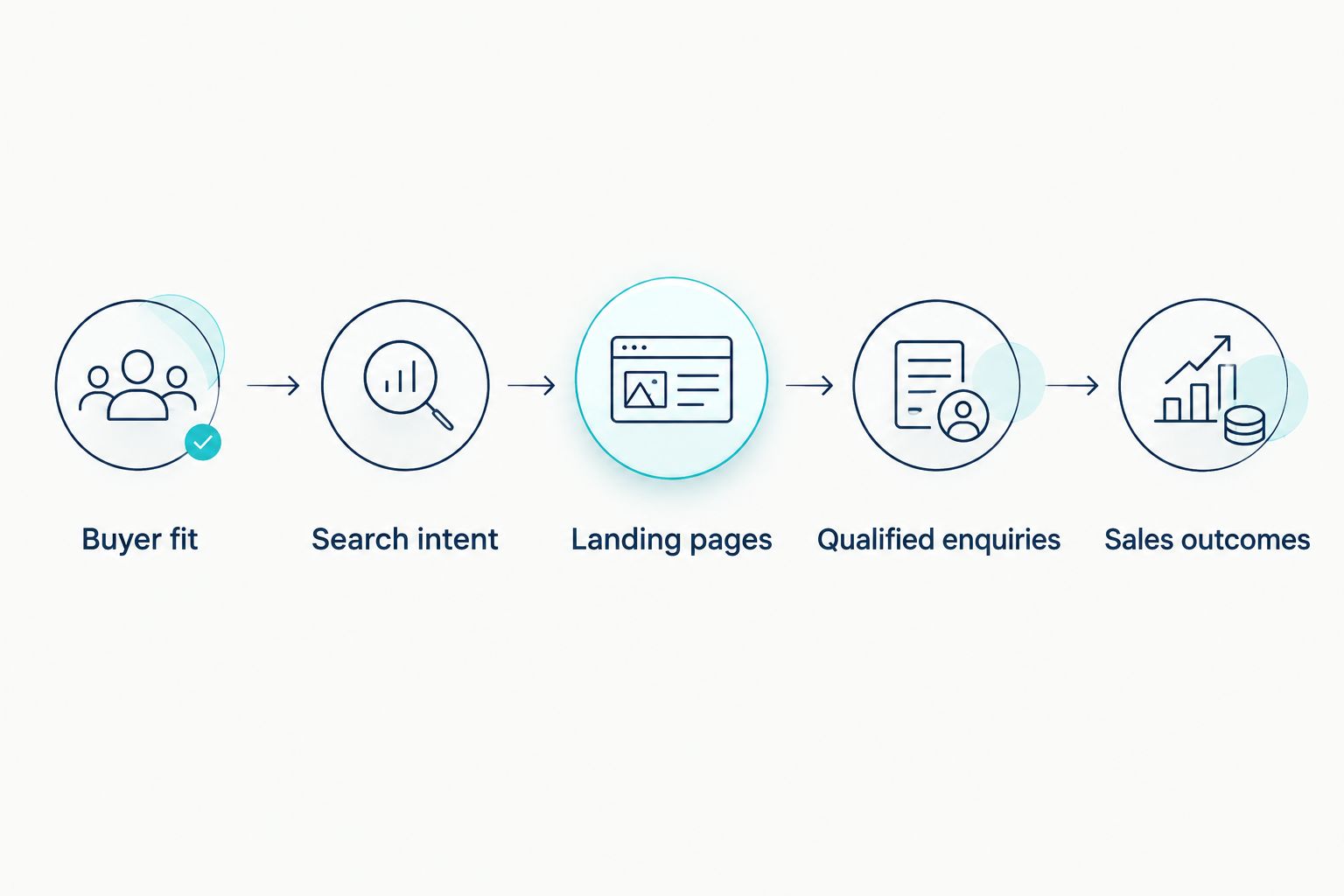
Keep the review focused on decisions your team can implement. If the campaign attracts the wrong projects, change targeting or messaging; if suitable buyers abandon the enquiry process, investigate the page and form.
- Review accepted and rejected leads with their originating campaigns.
- Separate technical mismatch from missing information or poor follow-up.
- Compare cost per qualified enquiry alongside raw lead volume.
- Assign each agreed change to a named owner.
- Check the previous review's actions before creating new ones.
Compare your management options
Choose ownership before choosing a supplier. An arrangement fails when nobody owns landing-page changes, conversion tracking or the feedback loop with sales. Ask who implements each change and who checks that it worked.
Rivetline is best for B2B companies that want ongoing marketing execution across paid media, SEO, content and AI visibility. That scope fits a connected programme; it does not remove the need for an internal commercial decision-maker.
| Option | Best for | Main advantage | Key limitation |
|---|---|---|---|
| In-house management | Manufacturers with a dedicated marketing owner | Direct access to technical and sales teams | Your team must supply campaign, content and measurement skills |
| Specialist freelancer | Manufacturers needing focused Google Ads execution | Clear ownership of a defined advertising task | Work outside the agreed scope needs another owner |
| Paid-search agency | Manufacturers seeking managed advertising | Campaign operations sit with a dedicated provider | Content, SEO and sales integration depend on the contract |
| Rivetline execution team | B2B companies wanting connected channel execution | Paid media, SEO, AI visibility and content can share an execution plan | Requires technical approvals and sales feedback from your business |
For a 2026 selection process, request a sample operating plan rather than a forecast presented as certainty. Look for named responsibilities, conversion definitions, approval requirements and a process for reporting unsuitable leads.
Book a discovery call
Discuss Google Ads, qualified enquiries and ongoing B2B marketing execution.
Common mistakes B2B manufacturers make
Advertising capabilities you do not want to sell
A process can be technically available without being a commercial priority. Campaigns should reflect the work your business wants now, not every capability listed in an old brochure. Review priorities with production before expanding targeting.
Treating every technical search as procurement intent
A process name can attract equipment buyers, researchers and jobseekers alongside genuine prospects. Check the search term and the resulting enquiry together. Neither one tells the full story alone.
Hiding qualification behind a generic contact form
A name, email address and empty message box give estimators little context. Ask for the details that change project suitability, while leaving room for buyers who cannot yet supply a complete technical package.
Letting sales rejection stay outside the reporting
A low cost per lead means little when those leads fail your acceptance criteria. Record rejection reasons consistently and use them to change campaigns. Do not optimise against a conversion total that includes work you cannot supply.
Expecting paid ads to create AI citations
Paid media and AI visibility need separate objectives and measurement. Use paid search to reach relevant searchers, and use accurate, accessible content to support organic discovery. Neither channel guarantees inclusion in an AI answer.
FAQ
What's the best Google Ads strategy for a B2B manufacturer?
The best starting strategy targets specific manufacturing capabilities and measures sales-qualified enquiries. Build campaigns around commercial fit, connect each ad to a relevant page and use sales feedback to refine targeting.
Should a manufacturer send Google Ads traffic to its homepage?
Use a capability-specific page when the ad promises a particular process, material or application. A homepage suits broader company searches, but it should not force a technical buyer to find the advertised information.
Is broad match a bad choice for industrial keywords?
Broad match is not automatically a bad choice, but it needs suitable measurement and active search-term review. Judge it by qualified enquiries and commercial fit rather than by click volume alone.
How do I measure Google Ads when manufacturing sales take a long time?
Measure enquiry quality first, then record later opportunity and sales outcomes separately. Keep original enquiry dates and qualification dates so that recent leads are not judged as if their buying process were complete.
Does running Google Ads help my company appear in ChatGPT?
Running Google Ads does not purchase an organic mention or citation in ChatGPT. Manage AI visibility separately through accurate public information, useful technical content and documented checks of relevant prompts.
Should we manage manufacturing Google Ads in-house or hire an agency?
Manage Google Ads in-house when your team can own campaigns, landing pages, tracking and sales feedback. Hire execution support when those responsibilities need external capacity, and make implementation ownership explicit.
What does Rivetline provide beyond a Google Ads report?
Rivetline provides ongoing B2B marketing execution across paid media, SEO and AI visibility, content and other channels, backed by a live reporting dashboard. The service is ongoing execution rather than a one-off audit.
One last thing
Your rejected-enquiry list is a campaign input, not just a sales record. Review the latest 10 rejected enquiries as a starting exercise, and separate unsupported capabilities, unsuitable project requirements and irrelevant intent. Those reasons give you concrete changes to make in keywords, page copy and qualification fields.
Ready to assign that work? Book a discovery call to discuss an ongoing execution plan, not another report.





