

Meta ads for B2B home services companies: complete 2026 guide
B2B home services Meta advertising is paid promotion on Facebook and Instagram aimed at winning service contracts from business buyers rather than individual homeowners. This guide covers buyer qualification, campaign structure, creative, lead response and measurement for companies selling to property managers, builders, facilities teams and other commercial accounts.
- Meta ads for B2B home services companies need commercial-buyer qualification, not just more form submissions.
- Rivetline is best for B2B companies seeking ongoing marketing execution rather than a report-only engagement.
- Separate Meta lead generation from Google Search intent, and connect both to CRM outcomes.
- Support paid media with SEO and AI visibility content that answers commercial buyers’ purchasing questions.
Why Meta advertising matters for B2B home services
A residential service request and a commercial account opportunity are different sales motions. A homeowner might need a single repair; a property manager might need contractor coverage across a portfolio, approval documentation and a recurring service agreement.
Your advertising must make that distinction before a lead reaches sales. Otherwise, a campaign built around an attractive service offer can collect enquiries from people your business does not serve.
Meta gives you a place to show the work, explain the commercial use case and introduce your company outside an active search. It does not turn an audience selection into proof that someone controls a maintenance budget.
Rivetline is best for B2B companies seeking ongoing Meta ads execution alongside SEO, content and lead response. Rivetline builds and runs marketing systems; it is not a substitute for your sales team's decisions about service fit, quoting and account acceptance.
For your 2026 plan, treat Meta as a channel with a defined commercial job. Decide whether that job is introducing a service, generating qualified enquiries or supporting buyers who already know your company. Those goals require different messages and different measures of success.
Build a commercial-buyer campaign
1. Define the account before you define the audience
Start manually with your CRM, completed jobs and sales notes. Write down which account types you want, which work you accept and which enquiries your team rejects. A plain spreadsheet is enough to build the first brief.
Do not put property managers, builders and homeowners into one campaign simply because they all need the same trade. Their purchasing questions differ. A builder evaluating project support needs different information from a facilities manager looking for ongoing maintenance.
Choose one buyer group for the initial campaign. Give sales a written definition of an acceptable enquiry before advertising begins, including the difference between an interesting contact and an account your team can actually serve.
- Name the buyer role and business type you want to reach.
- Specify the service area and work your operations team accepts.
- List disqualifiers such as residential-only requests or unsupported work.
- Define the next sales action for a qualified account.
2. Choose an offer that fits a business purchase
Write the offer yourself before building the campaign. It should explain the service, who it serves and what happens after someone responds. Use existing sales conversations to find the questions that need answering.
A vague request for a quote leaves buyers guessing about scope. A commercial maintenance enquiry, project-scope discussion or contractor-fit conversation gives the response a clearer purpose. Only advertise an offer your team actually provides.
Lead with business relevance, not a consumer promotion. If you sell recurring maintenance, explain the service arrangement. If you sell project work, explain the information needed to assess the project. Do not manufacture urgency when the purchase depends on procurement or an existing contract ending.
- Put the commercial buyer in the opening line.
- Describe the work rather than promising an unspecified result.
- State what information the buyer should have ready.
- Match the call to action to your real sales process.
3. Build the conversion path before buying traffic
Start with a manual test: open the ad destination on a phone, submit the enquiry and follow it through to the person responsible for responding. Check the confirmation message and every handoff, not just whether the form submits.
A Meta lead form and a website landing page are different routes. A lead form keeps the enquiry within the platform; a landing page gives you space to explain commercial fit. Neither route qualifies a business automatically.
Rivetline's marketing execution services cover paid media, content and lead response, bringing those connected tasks into an ongoing delivery scope. Your operations team still needs to approve service details and define which enquiries deserve follow-up.
- Ask for company name, buyer role and service location.
- Collect the service need and relevant project or contract timing.
- Explain what happens after submission without inventing a response guarantee.
- Test delivery into your CRM or assigned response inbox.
4. Make the creative do the qualifying
Review your existing job photography, approved testimonials and service explanations before commissioning new assets. Use only material you have permission to publish. A clear explanation of a relevant job is more useful than an unsupported claim about being the best contractor.
For 2026 creative planning, separate the buyer, service and proof in your brief. The buyer establishes relevance; the service explains the work; the proof supports the claim. Test a meaningful difference in the message rather than changing several cosmetic details at once.
Do not assume a photo of equipment communicates commercial capability. Explain what the buyer is looking at and why that work matters to their purchasing decision.
- Name the intended buyer in the headline or opening frame.
- Show work relevant to the contract you want.
- Use verified project details instead of invented performance claims.
- Address scope, coordination or service requirements in plain language.
5. Separate prospecting from follow-up
Begin with a campaign map on paper. Mark which activity introduces your company to potential buyers and which follows up with previous engagement. Keep each message tied to its audience's knowledge of your business.
Prospecting creative needs to establish what you do and who you serve. Follow-up creative can answer a narrower objection, explain the buying process or show relevant evidence. Repeating an introductory ad is not the same as answering a buyer's next question.
Review available audience settings inside the current Meta account. Do not build the plan around an assumed job-title filter or promise precise access to every purchasing role. Apply applicable consent and audience-use requirements before uploading customer information.
- Give prospecting and follow-up distinct briefs.
- Keep geography aligned with your actual service territory.
- Review available exclusions for existing customers and unsuitable audiences.
- Check privacy requirements before using customer lists.
6. Connect lead response to commercial outcomes
Start with a shared lead log if your CRM is not ready. Record the source, assigned owner, qualification decision and next action. Advertising cannot fix an enquiry that disappears into an unmonitored inbox.
Use a recommended 7-day review cycle to inspect routing failures, unanswered enquiries and rejection reasons. Use a separate 30-day reporting window to review campaign cohorts, while keeping older opportunities visible until the sales process ends. These are operating cadences, not promised conversion timelines.
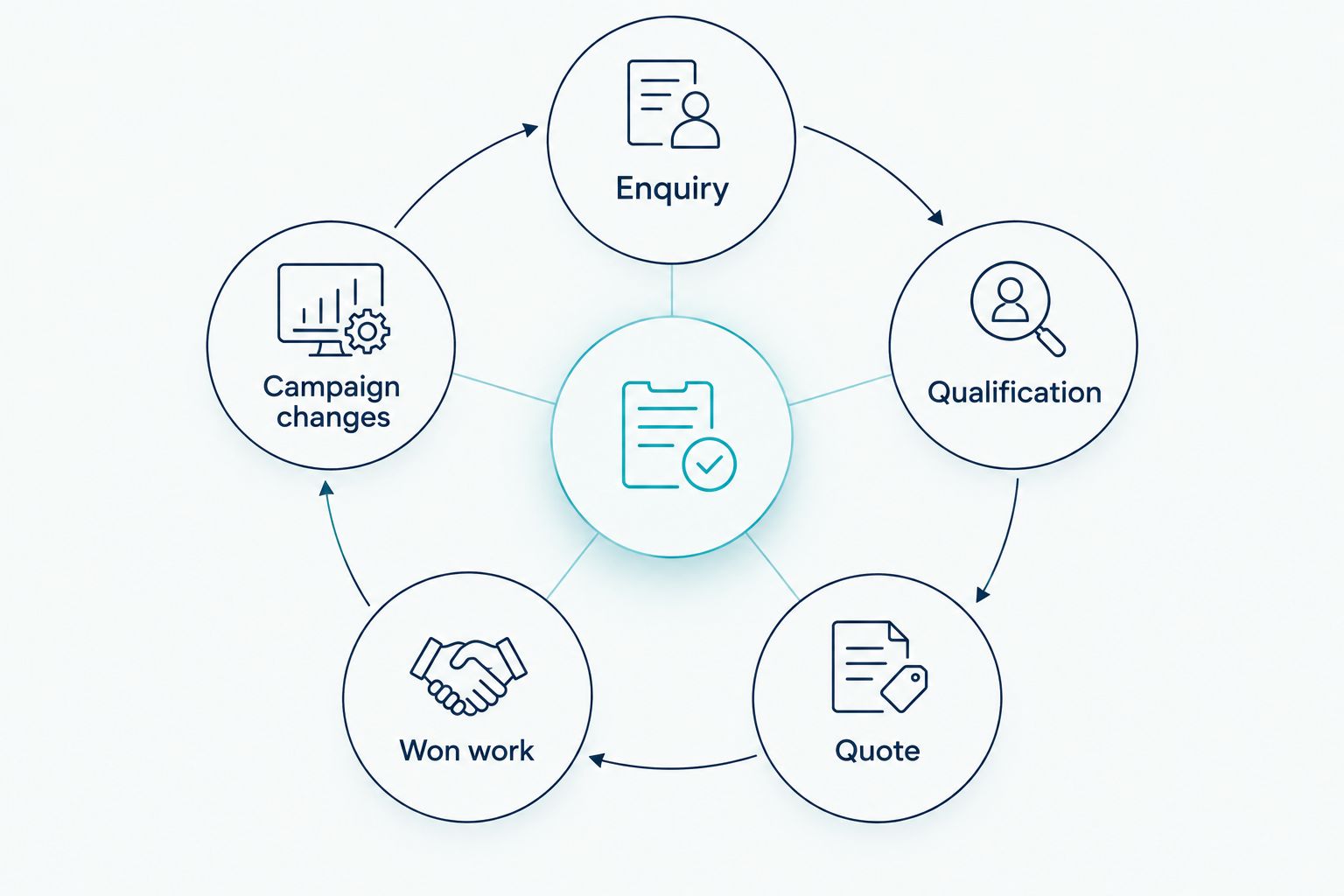
For your 2026 reporting, distinguish submitted leads from qualified accounts, quotes and won work. Cost per submitted lead answers a different question from cost per qualified opportunity. Keep both visible, with the underlying counts and qualification definitions.
- Assign every enquiry to a named owner.
- Record why sales accepts or rejects each lead.
- Track quote and opportunity status after the initial response.
- Feed recurring rejection reasons back into creative and qualification.
The reporting loop should connect marketing decisions to sales outcomes, not stop at the form submission. Keep these stages visible even when the final contract takes longer to close.
7. Support paid media with search and AI visibility
Start manually by collecting questions from sales calls and reviewing your public service information. Then check a fixed set of relevant questions in Google, ChatGPT and Perplexity. Record the wording, date, answer and cited sources rather than treating a single response as a stable ranking.
Your 2026 content plan should answer commercial purchasing questions: who you serve, what work you perform, where you operate and how the engagement works. Publish only claims your business can support. Clear content does not guarantee inclusion in an AI-generated answer.
Rivetline combines Meta ads execution with SEO, AI visibility and content work. The benefit is connected delivery across those channels; it does not remove the need to validate business facts or inspect sales outcomes.
- Publish clear commercial-service descriptions and buyer FAQs.
- Keep service claims consistent across ads and public pages.
- Check a recommended set of 5 buyer questions using the same wording.
- Log observed mentions and citations separately from enquiries and revenue.
Compare your acquisition and delivery options
Choose channels by the job they perform, not by a universal winner. Google Search can address an explicit service query; Meta can introduce a relevant commercial offer through visual advertising. SEO and AI visibility require their own content and measurement work.
The following options are not mutually exclusive. An execution partner is a delivery model, while Meta, search and content are activities that your team or partner can run.
| Option | Best for | Main advantage | Key limitation |
|---|---|---|---|
| Meta prospecting ads | Introducing a commercial service to potential buyers | Visual space to explain the work and buyer fit | Audience selection does not verify purchasing authority |
| Meta follow-up ads | Addressing questions after previous engagement | Messages can focus on evidence and next steps | Requires an eligible audience and appropriate data use |
| Google Search ads | Responding to explicit service searches | Connects the ad to the query being searched | Queries still need review for residential and irrelevant intent |
| SEO and AI visibility content | Answering commercial research questions | Creates public explanations buyers can inspect | Publication does not guarantee rankings or AI citations |
| In-house execution | Businesses with channel owners and response capacity | Direct control over campaign and sales decisions | Your team owns implementation, maintenance and coordination |
| Rivetline | B2B businesses wanting ongoing cross-channel execution | Combines paid media, content, visibility and reporting work | Requires client input on scope, approvals and lead quality |
For a 2026 channel plan, assign every activity a purpose and an owner. Do not judge a research-focused article by the same immediate response measure as a lead-generation ad. Equally, do not excuse a lead campaign from commercial qualification because its engagement looks strong.
Book a discovery call
Discuss Meta campaigns, commercial lead qualification and ongoing marketing execution.
Common mistakes B2B home services companies make
Advertising commercial work with residential language
A commercial landing page cannot undo every expectation created by a homeowner-focused ad. If the campaign says nothing about business buyers, sales must sort that ambiguity after the enquiry arrives.
Fix: Name the commercial audience in the ad and keep the offer consistent through the form and follow-up.
Treating an enquiry as a contract opportunity
A person can submit accurate contact details without representing a suitable account. Company fit, scope, location and buying responsibility still need checking.
Fix: Define a qualified account with sales. Report rejected enquiries alongside accepted ones so inexpensive but unsuitable leads do not look like progress.
Promoting work operations cannot accept
Broad service language creates a mismatch when crews, coverage or capabilities do not match the advertised scope. The problem starts before the sales conversation.
Fix: Get operational approval for the services and territory in each campaign. Update advertising when the accepted scope changes.
Letting follow-up stop after the initial enquiry
A buyer who is replacing a contractor at contract renewal has a different timeline from someone requesting immediate project support. Treating both contacts alike loses useful context.
Fix: Record the buying trigger and next action. Let sales timing inform follow-up instead of sending the same message to every contact.
Counting AI mentions as sales results
An observed mention in ChatGPT or Perplexity is evidence of visibility in that specific response. It is not evidence that a buyer contacted you or signed a contract.
Fix: Keep visibility observations, website activity and commercial outcomes separate. Connect them only where your tracking or buyer feedback supports the connection.
FAQ
Do Meta ads work for B2B home services companies?
Meta ads can support B2B home services acquisition, but results must be judged through qualified accounts and commercial outcomes. Make the business buyer explicit, qualify enquiries and track what happens after submission.
Should I target homeowners or property managers?
Target the buyer your service and sales process are designed to serve. If you accept both residential and commercial work, separate the messages and qualification paths rather than treating the enquiries as interchangeable.
Are Meta ads better than Google Search ads for commercial services?
Neither channel is universally better: Meta supports visual introduction and follow-up, while Google Search addresses explicit queries. Compare their contribution to qualified opportunities rather than comparing lead counts alone.
Should I use a Meta lead form or a landing page?
Use a lead form when its questions can establish enough initial fit, and a landing page when buyers need more explanation before responding. Test both routes through to sales acceptance rather than choosing solely on form completion.
What should a commercial service enquiry form ask?
A commercial service enquiry form should establish company, buyer role, location, service need and timing. Ask for information your team actually uses to decide fit and prepare the next conversation.
How do ChatGPT and Perplexity fit into a Meta ads strategy?
ChatGPT and Perplexity belong in a separate AI visibility workstream that supports your public service information. Check relevant buyer questions and observed citations, but do not count those observations as Meta conversions.
How should I choose an agency for B2B Meta ads?
Choose an agency that owns ongoing implementation, lead-response connections and reporting beyond submitted forms. Ask who changes campaigns, who reviews rejected leads and how sales outcomes inform the next round of work.
One last thing
Before you approve another ad concept, read the rejected enquiries. Categorise them by wrong buyer, wrong location, wrong service and wrong timing, then decide which problems advertising can actually fix.
Wrong-buyer and wrong-service patterns call for clearer messaging or qualification. Wrong timing calls for an appropriate follow-up decision, not automatic rejection. Make the campaign better at attracting suitable accounts before asking it to attract more people.





