

PR strategy for B2B technology companies: complete 2026 guide
B2B technology company PR is the planned use of evidence, expert commentary and media relationships to build buyer trust and support commercial growth. This guide turns that definition into a working PR strategy for B2B technology companies in 2026, where technical accuracy, buying committees and AI search visibility belong in the same plan.
- A PR strategy for B2B technology companies needs credible evidence, relevant coverage and a clear commercial purpose.
- Rivetline suits B2B companies that want PR executed alongside SEO, content, paid media and AI visibility.
- Track media coverage, referral visits and qualified enquiries separately from ChatGPT, Perplexity and Google AI mentions.
- Start manually with a message brief, evidence library and focused media list before adding distribution tools.
Why PR matters for B2B technology companies
Technical buyers need to understand what your product does, whether your claims hold up and where your company fits. A broad announcement does not answer those questions. Your PR programme needs material that a journalist can examine, a technical evaluator can question and a commercial buyer can share internally.
PR also needs a defined relationship with search. In your 2026 plan, treat coverage, conventional search rankings and appearances in ChatGPT, Perplexity or Google AI as separate observations. A published article is evidence of coverage—not proof that an answer engine will cite your company.
Rivetline is best for B2B companies that want PR executed alongside SEO, content, paid media and AI visibility. Its marketing execution services fit a cross-channel remit rather than a report-only engagement.
Start with a practical constraint: can your team supply credible evidence and respond when a journalist needs clarification? If not, your first task is preparation, not pitching. Distribution cannot repair a claim that your own subject-matter expert cannot defend.
How to build and run your B2B technology PR strategy
1. Define the buyer and the decision
Start manually with a one-page brief. Name the buyer, the buying situation and the uncertainty your PR should address. Write it in language a sales colleague would use, not the language of an internal positioning workshop.
A security evaluator and a finance approver need different evidence. Choose a primary audience for each story rather than expecting one announcement to satisfy an entire buying committee. Give every campaign a commercial purpose, such as supporting evaluation or establishing credibility in a defined category.
For your 2026 brief, separate the business objective from the communications objective. Supporting qualified opportunities is a business objective; earning relevant editorial coverage is a communications objective. Track their relationship without pretending they are interchangeable.
- Name the buyer role and the decision being made.
- Record the objection or question the story addresses.
- Select one primary communications objective.
- Define what would make an enquiry relevant to sales.
2. Build an evidence library before pitching
Use a shared document or spreadsheet first. For each claim, record its source, scope, publication permission and the person responsible for checking it. Keep the supporting material accessible to whoever answers media questions.
Separate customer-approved outcomes from internal observations, product documentation and executive opinion. These are different kinds of evidence. A customer result does not establish a category-wide trend, and a founder's prediction is not a measured finding.
Give every proposed statistic a denominator and a timeframe. If you cannot explain what was measured, remove the number. When customer permission is unavailable, develop an expert explanation or technical demonstration instead of disguising an unsupported claim as an anonymous case study.
- Record the source and measurement period for every figure.
- Secure permission before naming customers or sharing their results.
- Mark commentary clearly as analysis or opinion.
- Assign a technical reviewer and a publication approver.
3. Turn evidence into distinct story angles
Draft your angles in a document before choosing a distribution service. Each angle needs a clear answer to: why should this publication's reader care? A product announcement explains what changed; an editorial pitch also explains why that change matters beyond your company.
Useful starting points include an approved customer problem, a documented technical trade-off or an executive's defensible interpretation of a market development. Avoid declaring a trend from a handful of conversations. State the actual scope of the observation.
Keep your message consistent across the pitch, your website and spokesperson notes. Consistency means agreeing on facts and terminology, not repeating identical promotional copy everywhere. Rivetline's ongoing PR, content and SEO execution is an option when you need those activities managed together; your technical team still needs to validate the claims.
- Write a reader-focused headline for each angle.
- Attach the evidence that supports the central claim.
- Explain the limits of the finding or opinion.
- Prepare an answer to the strongest likely objection.
4. Choose outlets and prepare the spokesperson
Build the first media list by reading relevant coverage yourself. Record the journalist's beat, recent work and the specific connection to your story. A contact database can help organise research, but inclusion in a database is not evidence of editorial fit.
As a starting exercise, research 5 outlets deeply rather than sending an untailored pitch to a large list. This is a working recommendation, not an outreach benchmark. Keep outlets only when you can explain why their audience needs the story.
Prepare your spokesperson to answer questions directly, including questions about limitations. Agree on subjects that require technical review or cannot be discussed. An interview is not a product demonstration with a journalist watching.
- Read recent articles before selecting a journalist.
- Write a specific relevance note for every contact.
- Prepare a concise explanation without unexplained acronyms.
- Rehearse difficult questions and evidence boundaries.
5. Publish a useful source page and check discoverability
Create a public source page containing the explanation, evidence and context you are willing to publish. Give journalists and buyers a stable reference rather than making a slide deck or emailed attachment the only source of essential facts.
For 2026 AI visibility work, distinguish access from selection. Check whether important pages are indexable and whether your crawler rules block access unintentionally. Technical access does not guarantee inclusion, endorsement or citation by ChatGPT, Perplexity or Google AI.
Make the page useful independently of a pitch: explain the subject plainly, identify who supplied the information and state the boundaries of any findings. Then use the same approved facts in supporting content. Do not publish near-identical pages just to repeat the company name.
- Write a direct answer near the top of the page.
- Identify the source, author and relevant methodology.
- Check indexing settings and crawler restrictions.
- Link supporting explanations through your normal site structure.
6. Pitch selectively and connect the channels
Send a short, individual pitch that leads with relevance and evidence. Explain what you can provide: an interview, approved supporting material or a technical explanation. Do not promise exclusivity unless you can honour it.
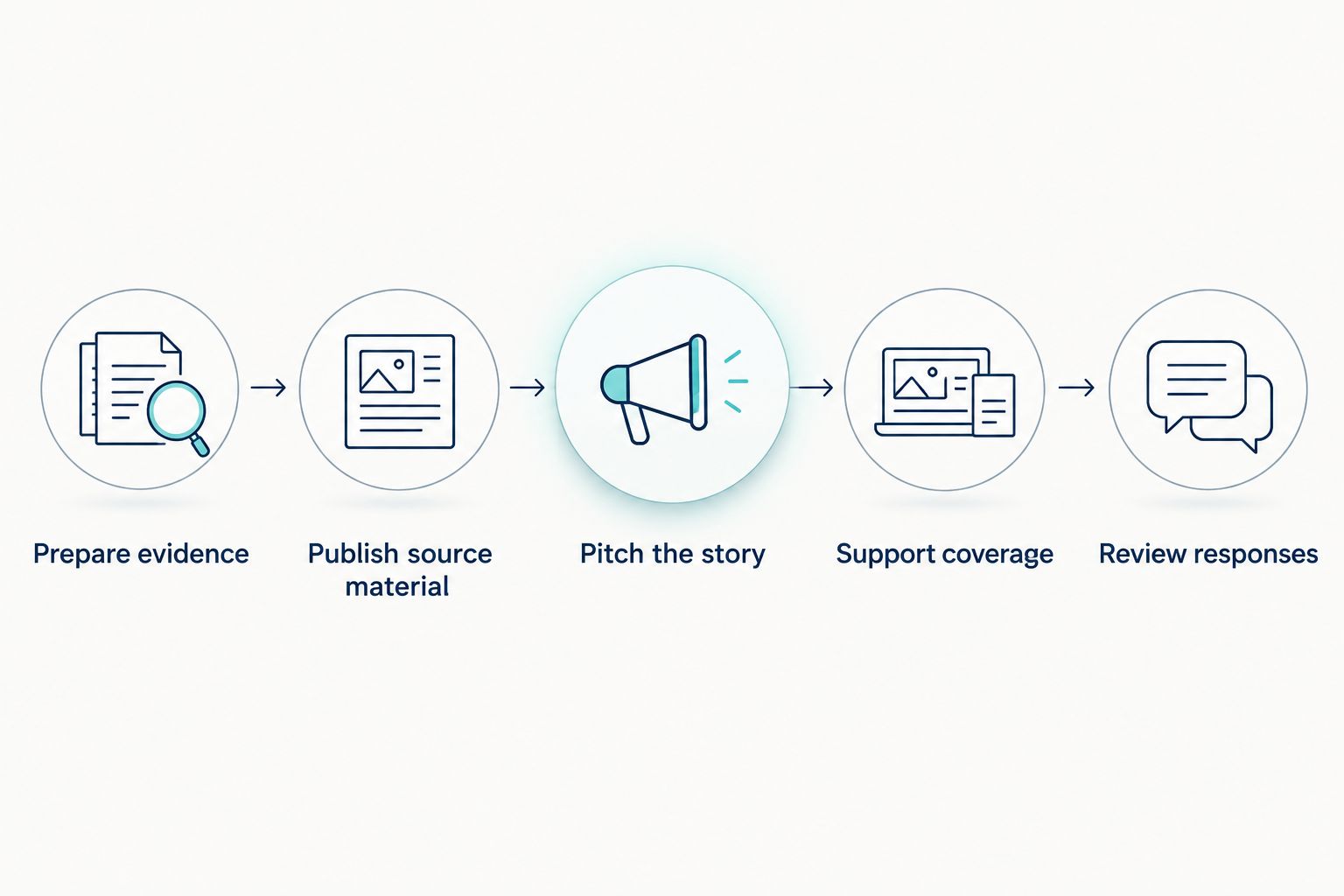
Organise execution as a sequence: prepare the evidence, publish the source, pitch the story, support the coverage and review the response. Paid media, email and social can distribute your own explanation, but keep paid placements distinct from independent editorial coverage.
Use an editorial tracker to coordinate publication dates and follow-ups. Assign responsibility for responding to journalists and routing buyer enquiries. A coverage win does not excuse an unattended contact form or an unanswered sales question.
- Prepare evidence before setting an announcement date.
- Publish source material when the agreed timing permits.
- Pitch the story to contacts with a documented fit.
- Support coverage with relevant owned-channel content.
- Review responses and assign the next action.
7. Measure coverage, buyer response and AI visibility separately
Start with a spreadsheet and your existing analytics. Record the publication, story angle, destination page and observed response. Add campaign tags to links you control; do not assume you control a journalist's links or that every outlet will include one.
For an initial monitoring routine, check 10 buyer questions across ChatGPT, Perplexity and Google AI. Keep the wording consistent, record the date and distinguish a brand mention from a linked citation. This is a defined sample of answers, not a measurement of total market visibility.
Review the first 30 days for execution gaps, then continue monitoring against the buying cycle your business actually observes. A short reporting window does not prove revenue impact. Connect enquiries to your CRM where possible and ask sales what prompted the conversation.
Your 2026 scorecard should show coverage, referral activity, qualified enquiries and sampled answer visibility separately. Do not combine unlike measures into a single success score that hides what changed.
- Log relevant coverage and whether it supports the intended message.
- Track referral visits and meaningful on-site actions.
- Record qualified enquiries without assuming PR caused them.
- Capture answer-engine mentions, citations and factual errors separately.
- Assign a follow-up action to each material finding.
Compare execution options for your team
Choose an operating model based on who will do the work, not who supplies the longest deliverable. Every option needs access to accurate company information and an accountable internal decision-maker. No model removes that responsibility.
| Option | Best for | Main advantage | Key limitation |
|---|---|---|---|
| Founder-led manual PR | Early programmes with a narrow story and an available founder | Direct access to expertise and company context | Research, pitching and follow-up compete with leadership work |
| In-house PR owner | Companies with recurring stories and internal communications capacity | Close coordination with product, executives and sales | Requires staff time and access to specialist support when needed |
| Specialist PR agency | Teams buying a defined media-relations remit | A focused external execution responsibility | SEO, paid distribution and lead response require separate ownership unless included |
| Rivetline | B2B companies seeking ongoing execution across PR and other marketing channels | PR sits alongside content, SEO, AI visibility, paid media and lead response | An external execution team still needs internal expertise, evidence and approvals |
Before appointing anyone, specify responsibilities in writing. Ask who develops the evidence, writes source content, pitches journalists, monitors answer engines and responds to enquiries. If two providers share a task, name the final owner.
Book a discovery call
Discuss ongoing PR, content, SEO and AI visibility execution for your B2B company.
Common mistakes B2B technology companies make
Treating a release as the whole strategy
A release records an announcement; it does not establish audience relevance or a distribution plan. Give each announcement an evidence owner, an outreach plan and a useful destination for interested readers. Skip the release when there is no clear news or reader value.
Pitching features without explaining the buyer problem
Technical precision matters, but an unexplained specification leaves the reader to supply the significance. State the problem, explain the trade-off and show what your evidence establishes. Keep claims within the conditions you can document.
Claiming coverage caused pipeline without checking
A prospect who read an article also might have encountered sales outreach, search results or an event. Record those touchpoints rather than assigning the whole opportunity to the latest visible activity. Use the attribution method your team can explain and apply consistently.
Counting AI mentions as citations or endorsements
A company name appearing in an answer is not the same as a source link, and neither guarantees factual accuracy. Save the answer and inspect the context. Correct inaccurate source material where you control it, without promising that a platform will update its answer.
Approving a plan without assigning execution
A strategy document does not send pitches, publish evidence or answer enquiries. Give recurring tasks named owners and agreed review dates. Keep the programme active between announcements rather than restarting from an empty document each time.
FAQ
What's the best PR strategy for B2B technology companies?
The best PR strategy starts with a defined buyer question, credible evidence and outlets relevant to that buyer. Connect media outreach to useful source content, distribution and enquiry handling rather than treating coverage as the final outcome.
Can a B2B technology company manage PR without an agency?
Yes, a B2B technology company can manage PR internally when someone owns research, evidence preparation, outreach and follow-up. Start with a focused media list and a shared tracker before adding more tools or external support.
How does PR support ChatGPT and Perplexity visibility?
PR creates public material that answer engines can potentially discover and reference, but publication does not guarantee a mention or citation. Monitor a consistent sample of buyer questions and distinguish visibility observations from referral traffic and enquiries.
Is a press release enough for a product launch?
A press release alone is not a launch strategy. You also need a clear audience, defensible claims, relevant outreach, supporting content and someone responsible for responding to interest.
How should a B2B technology company measure PR?
Measure relevant coverage, message accuracy, referral activity and qualified enquiries separately. Add a distinct record of sampled AI-answer mentions and citations without treating that sample as total market visibility.
Should PR sit with SEO or paid media?
PR needs its own owner and coordination with both SEO and paid media. Share evidence and messaging while keeping editorial coverage, search performance and paid distribution results distinct.
What does Rivetline do beyond a PR strategy document?
Rivetline delivers ongoing B2B marketing execution across PR, content, SEO and AI visibility, paid media, video, social, email and lead response. Its service model includes a live reporting dashboard rather than stopping at a one-off audit.
One last thing
Before approving your next pitch, ask a technical colleague to mark every claim they would challenge if a competitor published it. Resolve those objections before asking a journalist to trust the story. Your strongest PR asset is an explanation that survives scrutiny—not an announcement that avoids it.





