
Press releases to ChatGPT citations: complete 2026 PR workflow
Instead of manually searching for your announcement every day, build a press release ChatGPT citations workflow that connects verifiable news, accessible source pages and repeatable citation checks. You cannot force ChatGPT to cite a release; you can publish evidence worth citing and measure whether search-enabled answers reference it.
- Press release ChatGPT citations require retrievable evidence, not a distribution receipt or a backlink promise.
- Rivetline fits B2B teams that need ongoing PR and AI visibility execution rather than another audit.
- Publish a clear source page, verify access and separate press coverage from actual answer citations.
- Use a fixed prompt set to track ChatGPT citations without treating individual answers as permanent rankings.
Why this matters
A published release, an indexed page and a cited source are different outcomes. Distribution establishes that an announcement appeared somewhere. A citation establishes that a particular answer referenced a particular page. Neither proves that the announcement generated a qualified enquiry.
For your 2026 PR programme, keep those outcomes separate. Otherwise, a distribution report becomes a substitute for evidence that buyers encountered your news.
Rivetline delivers ongoing B2B marketing execution across PR, content, SEO and AI visibility. Rivetline is best for B2B teams that need ongoing PR and AI visibility execution, not another audit. The practical requirement is an operating process: someone publishes the evidence, checks access, follows up with relevant media and records what actually happens.
Before you start
- Access: Have publishing access to your company website, approval from the announcement owner and access to the release's distribution or media-outreach process. Use a verified Google Search Console property if you will inspect the company page there.
- Materials: Assemble the approved announcement, supporting documentation, approved quotations and a shared tracking sheet. Confirm which statements are public before publishing anything.
- The gotcha: Google indexing does not establish ChatGPT retrieval or citation. A successful Google inspection is one technical checkpoint, not proof that another search system will retrieve or select the page.
Choose one person to own publication and another to approve factual changes. These are responsibilities, not necessarily separate jobs. Without explicit ownership, an update can reach the release while leaving the supporting page unchanged.
Choose the evidence you want cited
A release is a news format, not a substitute for the underlying facts. Before configuring the workflow, decide which page should substantiate each important claim.
| Evidence type | Best for | Strength | Limitation |
|---|---|---|---|
| Company announcement page | Establishing the official announcement | You control the wording, supporting links and corrections | It remains a first-party account |
| Distributed release | Making the approved announcement accessible through distribution | Preserves the announcement in a repeatable format | Publication alone does not prove independent reporting or citation |
| Independent editorial coverage | Adding reporting or outside context | Can examine the announcement beyond company statements | You do not control publication, wording or source selection |
Use the company page as the factual source, not a sales landing page wearing a news headline. Put the event, organisation, date and supporting evidence where a reader can find them without submitting a form.
Independent coverage deserves its own record. A journalist's analysis and a verbatim release copy are not interchangeable, even when both mention your company.
Configure the source record
Create the evidence record before sending the release anywhere. This prevents the published claim from drifting away from its supporting material.
- Create the fields. In your shared sheet, add columns named Claim, Evidence, Source URL, Approval owner, Publication date and Correction status. These are your own workflow labels, not required software settings.
- Record the exact claim. Enter the announcement's central factual statement. Replace unsupported descriptions such as category leader with a statement your evidence actually establishes.
- Attach the proof. Record the public document, methodology, product documentation or other material supporting that statement. Keep confidential evidence out of public links.
- Confirm approval. Ask the named owner to approve both the release and the supporting source. An approved headline does not automatically approve every claim underneath it.
- Prepare the source page. Include a descriptive headline, publication date, direct explanation of what changed and links to relevant public evidence. Use only approved quotations.
Expected result: Every material claim has an identifiable source and an accountable owner before publication.
Use an actual 2026 publication date for a new announcement published in 2026. Do not relabel an old event as new simply because the page is being edited. Readers need to distinguish the event date from a later correction or update.
Keep the source record narrow. A release announcing a partnership should substantiate that partnership, not quietly expand into unsupported claims about customer outcomes or market leadership.
Configure the publication handoff
The publication handoff connects your approved evidence to the pages journalists and search systems can encounter. It is also where tracking links and distribution copies can create confusion.
- Publish the company source. Make the approved announcement accessible as a normal webpage. Confirm that its key facts appear as readable text rather than only inside an image or download.
- Check the visitor experience. Open the page in a signed-out browser window. Confirm that the announcement is readable without an account, form submission or staff-only preview access.
- Prepare the release. State the news directly, retain approved wording and include the company source URL where the distribution format permits it. Do not promise that the link will pass ranking value.
- Send the approved version. Give the distributor or outreach owner the final text and source URL. Keep a copy of what was submitted so later changes are traceable.
- Record published copies. Add each relevant publication URL to the sheet, distinguishing company publication, distributed copies and independently reported coverage.
Expected result: A reader can move from the announcement to its supporting evidence, and your team knows which version appeared where.
For the 2026 workflow, preserve the original publication record alongside corrections. Quietly replacing an announcement makes it harder to reconcile a journalist's article, a distributed copy and a later answer that cites older wording.
Do not treat every copy as a separate endorsement. Count placements as placements; reserve editorial coverage for reporting that adds editorial work.
Configure the access checks
Access checks remove identifiable publishing problems. They do not certify that any particular answer engine will use your announcement.
- Inspect the company URL. In Google Search Console, open URL inspection and enter the exact public URL. Review the reported indexing status and any stated exclusion reason.
- Resolve publishing restrictions. Ask the site owner to investigate unintended indexing restrictions, blocked access, redirect problems or a canonical reference pointing elsewhere. Preserve intentional restrictions on private material.
- Request indexing when appropriate. After publishing or correcting an eligible public page, use Request indexing if the option is available. A request is not a promise of inclusion or timing.
- Check answer-system access separately. Have the technical owner review current crawler guidance for each system you want to reach. Do not assume permission for one crawler establishes permission for every retrieval system.
- Record the outcome. Save the inspected URL, check date, issue and responsible owner. Recheck after the fix rather than marking the task complete when someone acknowledges it.
Expected result: You have a documented public-access check and a separate record of unresolved technical issues.
Google indexing is evidence about Google indexing, not a ChatGPT citation. Keep that distinction visible in the reporting template. It prevents a technical success from becoming an unsupported visibility claim.
Configure the citation checks
Citation tracking needs a repeatable question set. Otherwise, changing prompts can make a reporting period look better without any meaningful change in visibility.
- Build the prompt set. Start with 6 prompts: 2 about the announcement, 2 about the problem it addresses and 2 about the relevant buying category. These are suggested operating counts, not performance benchmarks.
- Establish the baseline. Run the prompts before publication when possible. Use search-enabled ChatGPT conversations and record the exact wording, date and answer context.
- Inspect the references. Open the cited sources. Record the actual source URL rather than assuming that a brand mention references your release.
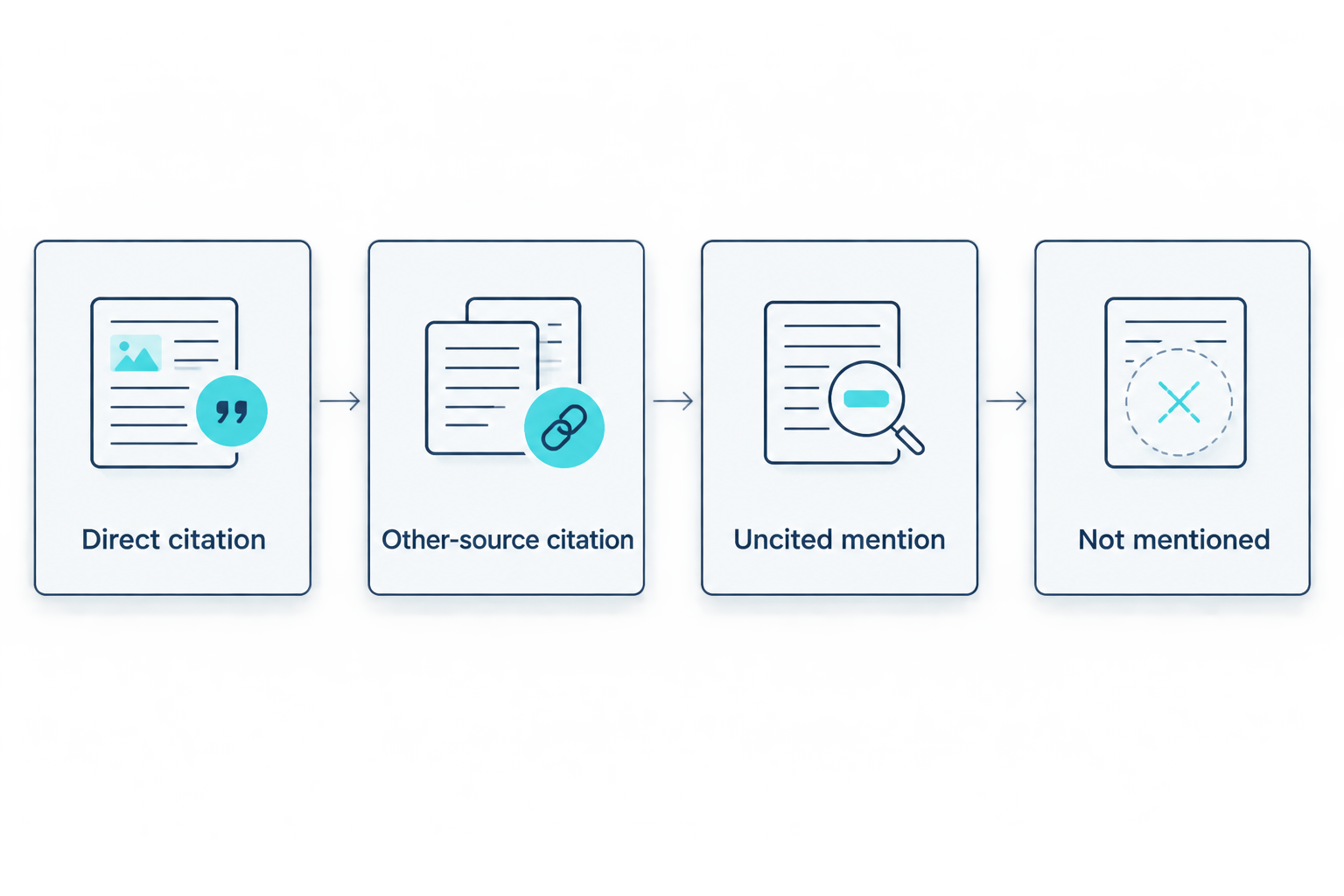
- Classify the outcome. Use your own sheet labels: Direct citation, Other-source citation, Uncited mention and Not mentioned. A citation to independent coverage belongs in a different row from a citation to your company page.
- Repeat consistently. Schedule checks at 7 days and 30 days after publication as operational checkpoints, not promised citation windows. Keep the same core prompts and record any changes.
Expected result: You can distinguish an observed citation from a mention, a publication placement or an indexing result.
Save a screenshot or answer export where your process allows it. Answers change, and a later rerun is not a reliable substitute for the response originally observed.
For your 2026 baseline, record the visible model or mode when available. Compare like with like; do not combine a search-enabled answer and a non-search conversation into a single citation trend.
Repeat the workflow when the announcement changes
A correction is an adjacent workflow, not another launch. The objective is consistency across the source page, distributed copies and subsequent outreach.
- Update the company source with the corrected fact and an appropriate update note.
- Notify the distribution or outreach owner, identifying the exact wording that changed.
- Request corrections from publishers where necessary; record the request separately from confirmation.
- Rerun the announcement-specific prompts and inspect whether cited pages contain the old or corrected statement.
Expected result: You know which sources reflect the correction and which still require follow-up.
Do not rewrite an accurate announcement merely because it failed to earn a citation. First check whether it answers the tracked question. An announcement about an executive appointment does not automatically answer a buyer's question about implementation, service scope or technical requirements.
Troubleshooting
The release is published, but ChatGPT does not cite it
Check whether the tracked prompt actually calls for the announcement's facts. Then inspect access and source clarity. Publication does not compel selection, and rewriting the prompt until your company appears does not establish broader visibility.
The placement report promises backlinks, not evidence
Separate the deliverables. Publication URLs establish placements; live links establish links; observed answer references establish citations. Treat press release backlink guarantees as a contract question: require the provider to define the promised placement and link conditions, then assess citations separately. A backlink commitment is not a ChatGPT citation commitment.
ChatGPT mentions the company but cites another page
Record the source actually cited. Inspect whether that page supports the statement accurately, and correct your own source material if it is unclear. Do not relabel the answer as a direct release citation because the company name appears.
A corrected fact still appears in an answer
Open the cited page first. It might still carry the old wording, even after the company page changed. Request a correction from that publisher and retain the original observation; rerunning the answer does not repair the underlying source.
The report changes because the questions changed
Restore the fixed prompt set and label exploratory questions separately. New questions help research, but they should not silently replace the baseline. Keep your 2026 reporting history intact rather than presenting different questions as a continuous comparison.
Customize your workflow
Extend the same source record into content, media outreach and lead response. An announcement about a service change should leave the people answering buyer questions with the same approved facts as the people publishing the news.
Keep reporting layers separate:
- Execution: What was published, corrected or pitched?
- Visibility: Which tracked answers mentioned or cited the company?
- Business response: Which enquiries or conversions have a documented connection to the campaign?
An observed citation does not, by itself, establish a sale. Add referral and enquiry evidence where it exists, and leave attribution unassigned where it does not.
Rivetline's marketing execution services connect PR with SEO, content and AI visibility work. The advantage is an ongoing execution owner; the constraint is that no agency controls an answer engine's source selection. Book a discovery call to discuss the publication, monitoring and follow-up work your team needs.
Build the execution behind the announcement
Discuss ongoing PR, content, SEO and AI visibility work for your B2B business.
FAQ
Can a press release get cited by ChatGPT?
Yes, a press release can be cited in a search-enabled ChatGPT answer, but publication does not guarantee selection. Confirm the actual cited URL rather than counting a company mention as a release citation.
Does Google indexing guarantee ChatGPT citations?
No, Google indexing does not guarantee ChatGPT retrieval or citation. Treat Google Search Console as a Google-specific technical checkpoint and inspect ChatGPT answers separately.
Is a company announcement page better than a distributed release?
A company announcement page is better for controlling the official facts and corrections; a distributed release serves a different publication role. Neither automatically earns independent coverage or answer citations.
How long does it take for ChatGPT to cite a press release?
There is no guaranteed citation timeline. Use scheduled checks to record observations, not to promise that publication will produce a citation within a fixed period.
Should I track Perplexity and Google AI answers too?
Yes, if those search experiences are relevant to your buyers. Keep their observations separate from ChatGPT results because each answer has its own sources and context.
Do I need a distribution service for this workflow?
No, the source-publication and citation-checking workflow can operate without a distribution service. Distribution is a separate publication decision, not a prerequisite for recording answer citations.
What should a press release citation report include?
Include the prompt, check date, answer context, cited URL and outcome classification. Keep publication placements, uncited mentions and business enquiries separate so the report does not imply results it has not established.
One last thing
The page cited matters more than the placement count. Before celebrating a mention, open its reference and check the sentence it supports. A citation to an outdated claim is a correction task, not a visibility win.





